Number Theory — Concept, Formulas & Examples
Sign in to track masteryFree Maths notes on Number Theory for CAT-MBA — learn the concept, then practise.
Classification
INTRODUCTION
Numbers is an extremely important topic for any MBA entrance exam. Apart from direct questions from this topic you will also find questions from other topics which require application of concepts from numbers.
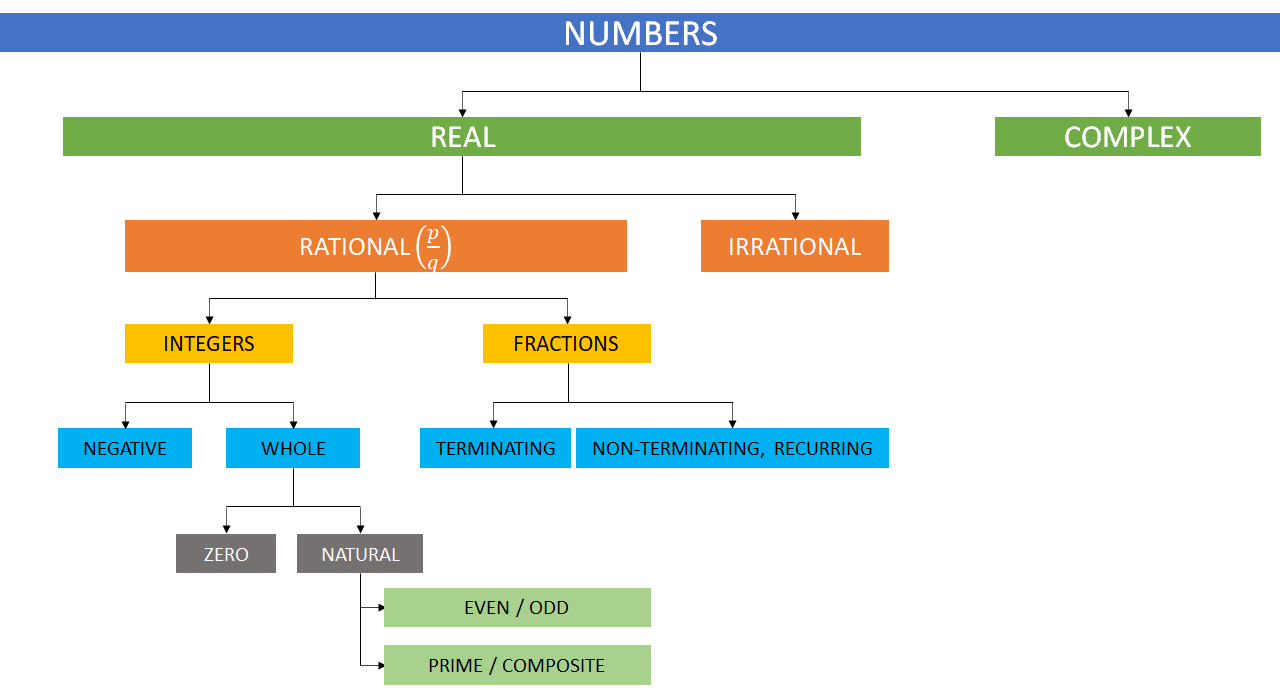 âââââââ
REAL & COMPLEX
As far as CAT and other MBA entrance exams is concerned, we will limit our discussion to only real numbers.
Real numbers are simply the combination of rational and irrational numbers, in the number system. In general, all the arithmetic operations can be performed on these numbers and they can be represented in the number line, also.
RATIONAL (Z) & IRRATIONAL
A rational number is a number that is in the form of p/q, where p and q are integers, and q is not equal to 0. Example: 1/3, 2/4, 1/5 etc.
A number which cannot be written in the form of p/q satisfying above criteria, is an irrational number. Example: Ï, â2, log2 etc.
FRACTIONS
A numerical quantity that is not a whole number. Example: 3/2, 0.5, 2/3 etc.
PROPER / IMPROPER
- A fraction whose decimal value is between -1 and 1 is called a proper fraction
- A fraction whose decimal value is less than -1 or greater than 1 is called an improper fraction
Note: For a decimal to be a rational number, it should be:
- Either a terminating decimal. Example: 2.125, 0.5587 etc., or
- A non-terminating but recurring decimal. Example: or
CONVERTING DECIMAL TO FRACTION
If x = , then
x =
INTEGERS
An integer is a number with no decimal or fractional part, from the set of negative and positive numbers, including zero. Examples of integers are: -5, 0, 1, 5,
NEGATIVE INTEGERS
Negative Integers are simply any integer with a value less than zero.
WHOLE NUMBERS (W)
- The whole numbers are the numbers without fractions and it is a collection of positive integers and zero.
- They are also called non-negative integers.
NATURAL NUMBERS (N)
- Counting numbers from 1 to infinity i.e., 1, 2, 3, and so on are called Natural Numbers.
- They are also called positive integers
- Prime numbers have exactly 2 factors. Example, 2, 3, 5, 7, 9 etc.
- 2 is the only even prime number.
- Any prime number greater than 3 can be written as (6k + 1) or (6k - 1)
- Composite numbers have more than 2 factors. Example: 4, 6, 10, 15 etc.
- 1 is neither prime nor composite
- Any number which is completely divisible by 2 is called an even number.
- 0 is an even number.
Divisibility Rules
Divisibility Rule for 2 n
For N to be completely divisible by a, remainder when N is divided by a should be 0.
Divisibility Rule for 2 n
For a number to be divisible by 2n, the number formed by its last 'n' digits should be divisible by 2n.
Divisibility Rule for 2
For a number to be divisible by 2, it's last digit should be divisible by 2.
Divisibility Rule for 4
For a number to be divisible by 4, the number formed by its last 2 digits should be divisible by 4.
Divisibility Rule for 8
For a number to be divisible by 8, the number formed by its last 3 digits should be divisible by 8.
Divisibility Rule for 3 or 9
For a number to be divisible by 3 or 9, sum of it's digits should be divisible by 3 or 9 respectively.
Divisibility Rule for 5 n
For a number to be divisible by 5n, the number formed by its last 'n' digits should be divisible by 5n.
Divisibility Rule for 5
For a number to be divisible by 5, its last digit should be divisible by 5.
Divisibility Rule for 25
For a number to be divisible by 25, the number formed by its last 2 digits should be divisible by 25.
Divisibility Rule for 125
For a number to be divisible by 125, the number formed by its last 3 digits should be divisible by 125.
Divisibility Rule for 7
For a number to be divisible by 7, then the difference between twice the unit's digit of the given number and the remaining part of the given number should be a multiple of 7 or it should be equal to 0.
Divisibility Rule for 11
To find if a number is divisible by 11 or not, we need to calculate sum of alternated digits starting with unit;s digit (u) and sum of alternate digits starting with ten's digit (t)
If (u - t) is divisible by 11 (ignoring its sign), then the given number is also divisible by 11.
Divisibility Rule for any composite number
To find if a given number 'N' is divisible by 'p' or not, write 'p' as a product of two co-prime numbers, i.e., p = a × b
If 'N' is divisible by both 'a' and 'b', then 'N' is also divisible by 'p'.
- If N is divisible by both 'a' and 'b', then it will also be divisible by LCM(a, b)
- If N is divisible by numbers 'a', 'b', 'c', and so on, then it will also be divisible by LCM(a, b, c, ...)
Divisibility Rule for 6
For a number to be divisible by 6 (= 2 × 3), the number should be divisible by both 2 and 3.
Divisibility Rule for 12
For a number to be divisible by 12 (= 3 × 4), the number should be divisible by both 3 and 4.
Divisibility Rule for 36
For a number to be divisible by 36 (= 4 × 9), the number should be divisible by both 4 and 9.
Divisibility Rule for 10 n ± 1
Divisibility Rule for 10 n + 1
This divisiblity Rule is similar to that of 11 (101 + 1). For 11 we took sum of alternate digits taking only one digit at a time since n = 1.
If n = 2, we will take sum of alternate pair digits taking 2 digits at a time.
Example: Find if 5741648 is divisible by 101 or not.
Solution:
Here we need to find divisiblity with 101 (102 + 1). Hence we make pair of 2-digit starting from right side.
5 74 16 48
Now, we add the alternate pair of digits
x = 48 + 74 = 122
y = 16 + 5 = 21
Now, x - y = 122 - 21 = 101.
Since, x - y is divisible by 101, the original number 5741648 is also divisible by 101.
This concept can be extended to any value of n.
Divisibility Rule for 10 n - 1
This divisiblity Rule is similar to that of 9 (101 - 1). For 9 we took sum of one digit at a time since n = 1.
If n = 2, we will take sum of digits taking 2 digits at a time.
Example: Find if 5741648 is divisible by 99 or not.
Solution:
Here we need to find divisiblity with 99 (102 - 1). Hence we make pair of 2-digit starting from right side.
5 74 16 48
Now, we add these pair of digits
5 + 74 + 16 + 48 = 143
Since, 143 is not divisible by 99, the original number 5741648 is also not divisible by 99.
This concept can be extended to any value of n.
Algebraic Formulae
(a + b + ...) 2
- (a)2 = a2
- (a + b)2 = a2 + b2 + 2ab
- (a + b + c)2 = a2 + b2 + c2 + 2ab + 2bc + 2ca
- (a + b + c + d)2 = a2 + b2 + c2 + d2 + 2ab + 2ac + 2ad + 2bc + 2bd + 2 cd
(a + b) n
- (a + b)1 = a1 + b1
- (a + b)2 = a2 + 2ab + b2
- (a + b)3 = a3 + 3a2b + 3ab2 + b3
- (a + b)4 = a4 + 4a3b + 6a2b2 + 4ab3 + b4
- (a + b)5 = a5 + 5a4b + 10a3b2 + 10a2b3 + 5ab4 + b5
- (a + b)n = nC0anb0
+ nC1an-1b2 + nC2an-2b2 +
...
+ nCn-2a2bn-2 + nCn-3a1bn-1+ nCna0bnâââââââ
[This is called Binomial Theorem] - Number of terms in (a + b)n = (n + 1)
(a - b) n
- (a - b)1 = a1 - b1
- (a - b)2 = a2 - 2ab + b2
- (a - b)3 = a3 - 3a2b + 3ab2 - b3
- (a - b)4 = a4 - 4a3b + 6a2b2 - 4ab3 + b4
- (a - b)5 = a5 - 5a4b + 10a3b2 - 10a2b3 + 5ab4 - b5
a n - b n
- a1 - b1 = a - b
- a2 - b2 = (a - b)(a + b)
- a3 - b3 = (a - b)(a2 + ab + b2)
- a4 - b4 = (a - b)(a3 + a2b + ab2 + b3) = (a - b)(a + b)(a2 + b2)
- a5 - b5 = (a - b)(a4 + a3b + a2b2 + ab3 + b4)
- an - bn = (an-1 + an-2b + ... + abn-2 + bn-1)
- an - bn is always divisible by (a - b)
- an - bn is also divisible by (a + b) if n is even.
a n + b n
- a1 + b1 = a + b
- a2 + b2 = No Identity
- a3 + b3 = (a + b)(a2 - ab + b2)
- a4 + b4 = No Identity
- a5 + b5 = (a + b)(a4 - a3b + a2b2 - ab3 + b4)
- an + bn is divisible by (a + b) if n is odd.
a 3 + b 3 + c 3
a3 + b3 + c3 - 3abc = (a + b + c)(a2 + b2 + c2 - ab - bc - ca)
Unit's Digit
INTRODUCTION
- Units's digit of sum of two numbers same as unit's digit of sum of their respective unit's digits.
- Units's digit of product of two numbers same as unit's digit of product of their respective unit's digits.
Example: Units digit of 126 + 589 = Units digit of 6 + 9 = 5
Example: Units digit of 126 × 589 = Units digit of 6 × 9 = 4
CYCLICITY OF UNIT'S OF POWERS
Let us calculate the unit's digit of various powers of 2.
Unit's digit of 21 = 2
Unit's digit of 22 = 4
Unit's digit of 23 = 8
Unit's digit of 24 = 6
Unit's digit of 25 = 2
Unit's digit of 26 = 4
Unit's digit of 27 = 6
Unit's digit of 28 = 8
Unit's digit of 29 = 2
...
∴ We see that the unit's digit of powers of 2 repeates after every 4 powers. Hence, we can say that unit's digit of powers of 2 has a cyclicity of 4 terms.
Unit's digit of 24k = 6
Unit's digit of 24k+1 = 2
Unit's digit of 24k+2 = 4
Unit's digit of 24k+3 = 8
- 2 has a cyclicity of 4 terms.
- 3 has a cyclicity of 4 terms.
- 4 has a cyclicity of 2 terms.
- 5 has a cyclicity of 1 term.
- 6 has a cyclicity of 1 term.
- 7 has a cyclicity of 4 terms.
- 8 has a cyclicity of 4 terms.
- 9 has a cyclicity of 2 terms.
- 0 has a cyclicity of 1 term.
Unit's digit of powers of:
In general, we can say unit's digit of power of any number has a cyclicity of 4.
 âââââââ
- Unit's digit of
- 4odd number = 4
- 4even number = 6
- Unit's digit of
- 9odd number = 9
- 9even number = 1
- Unit's digit of a4k+n = Unit's digit of an
where a is any single digit number. - Units's digit (...abc)x = Units's digit of cx.
Example: Units digit of 12654 = Unit's digit of 654 = 6 - Unit's digit of (5 × odd number) = 5
- Unit's digit of (5 × even number) = 0
Example: Find unit's digit of (123)23
Solution:
Unit's digit of (123)23 = Unit's digit of 323
= Unit's digit of 34×5 + 3
= Unit's digit of 33
= 7
Example: Find unit's digit of (23454)769
Solution:
Unit's digit of (23454)769 = Unit's digit of 4769
We know Unit's digit of 4odd number = 4
∴ Unit's digit of (23454)769 = 4
Example: Find unit's digit of (582)945
Solution:
Unit's digit of (582)945 = Unit's digit of 2945
= Unit's digit of 24×236 + 1
= Unit's digit of 21
= 2
Example: Find unit's digit of
Solution:
Unit's digit of = Unit's digit of
Now, 6125 when divided by 4 leaves a remainder of 1 [Concept of Remainders]
∴ Unit's digit of = Unit's digit of 74k + 1
= Unit's digit of 71
= 7
Successive Division
INTRODUCTION
When we divide N successively by 'a' and 'b', it means we first divide N by a, and then divide the quotient of this division by b.
- Dividend = Divisor × Quotient + Remainder
Example: Divide 100 successively by 2 and 5.
Solution:
We first divide 100 by 2. The quotient will be 50
Now, we divide 50 by 5 and the final answer will be 10.
Example: What are the remainder when 100 is successively divided by 3 and 5.
Solution:
We first divide 100 by 3. The quotient will be 33 while the remainder will be 1.
Now, we divide 33 by 5. The quotient will be 6 while the remainder will be 3.
∴ When 100 is successively divided by 3 and 5, the remainders are 1 and 3 respectively.
SMALLEST POSSIBLE NUMBER
Example: Find the smallest possible number which when successively divided by 3 and 4 leaves remainder of 1 and 3 respectively.
Solution:
In such examples we need to start from the last of the successive divisions.
When divided by 4 the remainder is 3. Since we need to find the smallest possible such number, we will assume the quotient for this division to be 0.
∴ The smallest possible number which when divided by 4 leaves remainder 3 is 3 itself.
Now, 3 must have been the quotient of previous division.
We need to find the number which when divided by 3 gives quotient as 3 and leaves remainder of 1.
∴ Original number = 3 × 3 + 1 = 10
The smallest number which when successively divided by 3 and 4 leaves remainder of 1 and 3 respectively is 10.
Example: Find the smallest possible number which when successively divided by 2 and 5 leaves remainder of 1 and 4 respectively.
Solution:
In such examples we need to start from the last of the successive divisions.
When divided by 5 the remainder is 4. Since we need to find the smallest possible such number, we will assume the quotient for this division to be 0.
∴ The smallest possible number which when divided by 5 leaves remainder 4 is 4 itself.
Now, 4 must have been the quotient of previous division.
We need to find the number which when divided by 2 gives quotient as 4 and leaves remainder of 1.
∴ Original number = 2 × 4 + 1 = 9
The smallest number which when successively divided by 2 and 5 leaves remainder of 1 and 4 respectively is 9.
Example: Find the smallest possible number which when successively divided by 2, 3 and 5 leaves remainder of 1, 2 and 3 respectively.
Solution:
In such examples we need to start from the last of the successive divisions.
When divided by 5 the remainder is 3. Since we need to find the smallest possible such number, we will assume the quotient for this division to be 0.
∴ The smallest possible number which when divided by 5 leaves remainder 3 is 3 itself.
Now, 3 must have been the quotient of previous division.
We need to find the number which when divided by 3 gives quotient as 3 and leaves remainder of 2.
∴ Number = 3 × 3 + 2 = 11
Now, 11 must have been the quotient of previous division.
We need to find the number which when divided by 2 gives quotient as 11 and leaves remainder of 1.
∴ Initial Number = 2 × 11 + 1 = 23
The smallest number which when successively divided by 2, 3 and 5 leaves remainder of 1, 2 and 3 respectively is 23.
GENERAL FORM
A number (N) when successively divided by a, b and c leaving remainders p, q and r respectively can be written as
N = (a × b × c) × k + n
where k is a whole number and n is the smallest such number.
Example: Find the highest three-digit number possible number which when successively divided by 2, 3 and 5 leaves remainder of 1, 2 and 3 respectively.
Solution:
In such example we need to first find the smallest possible such number.
The smallest number which when successively divided by 2, 3 and 5 leaves remainder of 1, 2 and 3 respectively is 23. (from previous example)
Now, N = 2 × 3 × 5 × k + 23
⇒ N = 30k + 23
Now, N = 30k + 23 < 1000
⇒ k < 977/30
∴ highest possible value of k = 32
∴ N = 30 × 32 + 23 = 983
Example: Find the smallest three-digit number possible number which when successively divided by 3 and 5 leaves remainder of 1 and 2 respectively.
Solution:
In such example we need to first find the smallest possible such number.
The smallest number which when successively divided by 3 and 5 leaves remainder of 1 and 2 respectively is 7.
Now, N = 3 × 5 × k + 7
⇒ N = 15k + 7
Now, N = 15k + 7 > 99
⇒ k > 92/15
∴ least possible value of k = 7
∴ N = 15 × 7 + 7 = 112
Factorial
INTRODUCTION
Factorial, in mathematics, is the product of all positive integers less than or equal to a given positive integer and is denoted by that integer and an exclamation point.
Thus, factorial four is written 4!, which means 1 Ã 2 Ã 3 Ã 4
Hence, n! = 1 Ã 2 Ã 3 Ã ... Ã (n-1) Ã n
- n! = n à (n - 1)! = n à (n - 1) à (n - 2)!
- 0! = 1
- 1! = 1
- 2! = 2
- 3! = 6
- 4! = 24
- 5! = 120
- 6! = 720
HIGHEST POWER OF P (PRIME) IN N!
If 'p' is a prime number, then highest power of 'p' in N! is sum of all quotients when N is successively divided by p.
Example: Find the highest power of 2 in 10!.
Solution:
To find the highest power of 2 in 10!, we successively divide 10 by 2 and then add all the quotients.
= 5
= 2
= 1
(We stop the division when quotient is less than the divisor)
∴ Highest power of 2 in 10! = 5 + 2 + 1 = 7
Note: Since, highest power of 2 in 10! is 7, it means 27 will be a factor of N!.
∴ N! can be written as 27 × X
where X is a factor of N! which is coprime to 2.
Example: Find the highest power of 5 in 100!.
Solution:
To find the highest power of 5 in 100!, we successively divide 100 by 5 and then add all the quotients.
= 20
= 4
∴ Highest power of 5 in 100! = 20 + 4 = 24
HIGHEST POWER OF A COMPOSITE NUMBER IN N!
To find highest power of a composite number in N!, we first prime factorise the given composite number and then find the highest powers of prime numbers.
Example: Find the highest power of 6 in 10!.
Solution:
To find the highest power of 6 in 10!, we prime factorise 6 as 2 × 3. Now we will find the highest power of 2 and 3 in 10!
Highest power of 2 in 10! is 7 (obtained in previous example).
To find the highest power of 3 in 10!, we successively divide 10 by 3 and then add all the quotients.
= 3
= 1
∴ Highest power of 3 in 10! = 3 + 1 = 4
∴ N! can be written as 27 × 34 × X (X is coprime to both 2 and 3)
⇒ N! = 23 × 64 × X
∴ Highest power of 6 in 10! is 4.
Example: Find the highest power of 4 in 50!.
Solution:
To find the highest power of 4 in 5!, we prime factorise 4 as 22. Now we will find the highest power of 2 in 50!
To find the highest power of 2 in 50!, we successively divide 50 by 2 and then add all the quotients.
∴ Highest power of 2 in 50! = 25 + 12 + 6 + 3 + 1 = 47
∴ 50! can be written as 247 × X
⇒ 50! = (22)23 × 2 × X
⇒ 50! = 423 × 2 × X
∴ Highest power of 4 in 50! is 23.
Example: Find the highest power of 12 in 50!.
Solution:
To find the highest power of 12 in 50!, we prime factorise 12 as 22 × 3. Now we will find the highest power of 2 and 3 in 50!
Highest power of 2 in 50! is 47 (obtained in previous example).
To find the highest power of 3 in 50!, we successively divide 50 by 3 and then add all the quotients.
∴ Highest power of 3 in 50! = 16 + 5 + 1 = 22
∴ 50! can be written as 247 × 322 × X
⇒ 50! = (22)22 × 23 × 322 × X
⇒ 50! = 422 × 322 × 23 × X
⇒ 50! = 1222 × 23 × X
∴ Highest power of 12 in 50! is 22.
Factors
INTRODUCTION
A Factor of a given number completely divides it. Example: Factors of 6 are 1, 2, 3 and 6.
i.e., 6 is completely divisible by 1 or 2 or 3 or 6.
- A given Natural number will always have finite factors.
PRIME FACTORISATION
Prime Factorisation is a way of writing the given number as a product of powers of prime numbers.
Prime Factorised for of 12 = 22 × 3
Prime Factorised for of 72 = 23 × 32
Example: Prime Factorise 180.
Solution:
Given, 180 = 4 × 45
⇒ 180 = 22 × 9 × 5
⇒ 180 = 22 × 32 × 5
∴ Prime Factorised form of 180 = 22 × 32 × 5
NUMBER OF FACTORS of N
If we need to find the number of factors of 72, we first prime factorise it as 23 × 32
Now, any factor (f) of 72 will contain powers of either 2 or 3.
The power of 2 in f can be either 0, 1, 2 or 3, i.e., one more than the higest power of 2 in the number
The power of 3 in f can be either 0, 1 or 2, i.e., one more than the higest power of 3 in the number
∴ Number of factors that can be formed = (3 + 1)(2 + 1) = 12
Generalising
If prime factorised form of a number N = ap × bq × cr
where a, b and c are prime numbers.
Then, Total number of factors of N = (p + 1)(q + 1)(r + 1)
Example: Find the number of factors of 180.
Solution:
180 can be factorised as 22 × 32 × 51
∴ Number of factors of 180 = (2 + 1)(2 + 1)(1 + 1) = 18
- Total number of factors of a perfect square will always be odd.
- Total number of factors of a non-perfect square will always be even.
Since p, q and r are even, (p + 1)(q + 1)(r + 1) will be odd.
Since at least one of p, q and r is odd, (p + 1)(q + 1)(r + 1) will be even.
WRITING N AS A PRODUCT OF TWO OF ITS FACTORS
Let us taken an example of 12. 12 can be factorised as 22 × 3.
Factors of 12 are 1, 2, 3, 4, 6 and 12.
Now, we need to find number of ways of writing 12 as a product of two of its factors.
Product of 1 and 12 will give us 12, product of 2 and 6 will given us 12 and product of 3 and 4 will give us 12.
∴ Number of ways of writing 12 as a product of two of its factors is 3.
In general product of two factors gives us the required number, hence number of ways of writing a given number as a product of two of its factors is half the number of its factors.
Generalising
If N = ap × bq × cr
Number of ways of writing N as a product of two of its factors = (p + 1)(q + 1)(r + 1)
Example: In how many ways can we write 180 as a product of two of its factors.
Solution:
180 can be factorised as 22 × 32 × 51
∴ Number of ways of writing 180 as a product of two of its factors = (2 + 1)(2 + 1)(1 + 1) = 9
WRITING A PERFECT SQUARE AS A PRODUCT OF TWO OF ITS FACTORS
Number of factors of a perfect square is always odd, hence dividing it by 2 will not give us the number of ways of writing it as a product of two of its factors. Let us understand perfect square with an example.
Let us take the example of 36. Factors of 36 are 1, 2, 3, 4, 6, 9, 12, 18 and 36 i.e., total 9 factors
Now,
36 = 1 × 36
36 = 2 × 18
36 = 3 × 12
36 = 4 × 9
Since 36 is a perfect square, one its factors is 6 (square root of 36).
36 = 6 × 6
∴ Number of ways of 36 as a product of two distinct factors = (9 - 1) = 4
∴ Number of ways of 36 as a product of any two factors = (9 - 1) + 1 (square of the square root) = 5
Generalising
If N (perfect square) = ap × bq × cr
Number of ways of writing N as a product of two distinct factors = [(p + 1)(q + 1)(r + 1) - 1]
Number of ways of writing N as a product of any two factors = [(p + 1)(q + 1)(r + 1) - 1] + 1
Example: In how many ways can we write 144 as a product of two of its factors.
Solution:
144 can be factorised as 24 × 32
∴ Number of ways of writing 144 as a product of two of its factors = [(4 + 1)(2 + 1) - 1] + 1 = 8
SUM OF FACTORS OF N
Let us take an example of 12. 12 can be factorised as 22 × 3.
Factors of 12 are
1 = 20 × 30
3 = 20 × 31
2 = 21 × 30
6 = 21 × 31
4 = 22 × 30
12 = 22 × 31
Sum of all factors of 12 = 20 × 30 + 20 × 31 + 21 × 30 + 21 × 31 + 22 × 30 + 22 × 31
= 20(30 + 31) + 21(30 + 31) + 22(30 + 31)
= (20 + 21 + 22)(30 + 31)
= (1 + 2 + 4)(1 + 3) = 28
Generalising
If prime factorised form of a number N = ap × bq × cr
Sum of all factors of N = (a0 + a1 + ... + ap) × (b0 + b1 + ... + bq) × (c0 + c1 + ... + cr)
Sum of all factors of N = × ×
NUMBER OF WAYS OF WRITING N AS A PRODUCT OF CO-PRIMES
Generalising
If prime factorised form of a number N = ap × bq × cr
Number of ways of writing N as a product of 2 co-prime numbers = 2m-1
where m is the number of distinct prime factors of N.
Example: 120 can be written as 3 × 40, 8 × 15, 24 × 5 and 120 × 1
We can write 120 as 23 × 3 × 5
Thus, 120 has 3 distinct prime factors i.e., 2, 3 and 5.
∴ Number of ways of writing 120 as a product of 2 co-prime numbers = 23-1 = 4.
NUMBER OF CO-PRIMES TO N LESS THAN N
Generalising
If prime factorised form of a number N = ap × bq × cr
Number of co-primes to N which are less than N = N
Example: Let us taken the example of 12. Numbers which are less than 12 and co-prime to 12 are 1, 5, 7 and 11 i.e., 4 co-primes
We can calculate this using the above relation.
i.e., Number of co-primes to 12 less than 12 = 12 = 4
SUM OF CO-PRIMES TO N LESS THAN N
Example: Let us taken the example of 12. Numbers which are less than 12 and co-prime to 12 are 1, 5, 7 and 11 i.e., 4 co-primes
Co-primes to 12 less than 12 are 1, 5, 7 and 11.
Sum of 1 and 11 gives 12, while sum of 5 and 7 gives 12.
Hence, sum of 2 co-primes gives us the number itself. Hence sum of all co-primes to a number less than the number = number × half the number of co-primes.
Generalising
If prime factorised form of a number N = ap × bq × cr
Sum of co-primes to N which are less than N =
LCM & HCF
INTRODUCTION
A Factor of a given number completely divides it. Example: Factors of 6 are 1, 2, 3 and 6.
i.e., 6 is completely divisible by 1 or 2 or 3 or 6.
A Multiple of a given number is such that the number completely divides the multiple. Example: Multiples of 6 are 6, 12, 18 and 24.
i.e., 6 completely divides 6 or 12 or 18 or 24.
- A given Natural number will always have finite factors.
- A given Natural number will always have infinite multiples.
- A given Natural number is always a factor as well as a multiple of itself.
If a number 'N' is divided by 'd' giving quotient 'q' and remainder 'r', then we can form an equation:
N = d × q + r
Here,
N = Dividend
d = divisor
q = quotient
r = remainder
LOWEST COMMON MULTIPLE (LCM)
The Lowest Common Multiple (LCM) of 2 or more numbers is the lowest number which is divisible by all the given numbers.
Example: Let us take two numbers 4 and 6.
Multiples of 4 are 4, 8, 12, 16, 20 and so on
Multiples of 6 are 6, 12, 18, 24 and so on
We can see that the lowest common multiple is 12, i.e., 12 is the lowest number which is completely divisible by both 4 and 6.
We can calculate LCM of any given numbers by prime factorising then and taking the highest power available of all distinct prime numbers.
Example: Find LCM of 10, 12 and 15.
Solution:
Let us prime factorise 10, 12 and 15.
10 = 2 × 5
12 = 22 × 5
15 = 3 × 5
The distinct prime factors for given numbers are 2, 3 and 5
Highest power of these prime numbers i.e., 2, 3 and 5 in the given numbers is 2, 1 and 1.
∴ LCM(10, 12 and 15) = 22 × 31 × 51 = 60
Example: Find LCM of 36, 48 and 64.
Solution:
Let us prime factorise 36, 48 and 64.
36 = 22 × 32
48 = 24 × 3
64 = 26
The distinct prime factors for given numbers are 2 and 3
Highest power of these prime numbers i.e., 2 and 3 in the given numbers is 6 and 2.
∴ LCM(36, 48 and 64) = 26 × 32 = 576
LCM APPLICATION TYPE 1
A number which when divided by a, b or c leaves the same remainder r = LCM(a, b, c) × k + r
Example: Find the smallest 2-digit number which when divided by 2, 3 or 5 leaves remainder of 1.
Solution:
Let smallest such number is N.
N when divided by 2 leaves remainder of 1.
∴ N = 2 × a + 1
⇒ N - 1 = 2 × a ...(1)
N when divided by 3 leaves remainder of 1.
∴ N = 3 × b + 1
⇒ N - 1 = 3 × b ...(2)
N when divided by 5 leaves remainder of 1.
∴ N = 5 × c + 1
⇒ N - 1 = 5 × c ...(3)
From (1), (2) and (3) we can say that N - 1 is a multiple of 2, 3 and 5.
∴ N - 1 will be a multiple of LCM(2, 3, 5)
⇒ N - 1 = LCM(2, 3, 5) × k
⇒N = LCM(2, 3, 5) × k + 1
⇒ N = 30k + 1
For N to be smallest 2-digit number we put k = 1, hence N = 31.
LCM APPLICATION TYPE 2
The greatest number which when divided by a, b or c leaves remainders p, q and r respectively such that (a - p) = (b - q) = (c - r) = d (say)
then, N = LCM(a, b, c) × k - d
Example: Find the smallest 2-digit number which when divided by 2, 3 or 5 leaves remainder of 1, 2 and 4 respectively.
Solution:
Let smallest such number is N.
Here, divisors are 2, 3 and 5 while remainders are 1, 2 and 4 respectively such that
2 - 1 = 3 - 2 = 5 - 4 = 1 (d)
N when divided by 2 leaves remainder of 1.
∴ N = 2 × a + 1
⇒ N - 1 = 2 × a
Adding 2 (divisor) both sides we get
N + 1 = 2(a + 1) ...(1)
N when divided by 3 leaves remainder of 2.
∴ N = 3 × b + 2
⇒ N - 2 = 3 × b
Adding 3 (divisor) both sides we get
N + 1 = 3(b + 1) ...(2)
N when divided by 5 leaves remainder of 4.
∴ N = 5 × c + 4
⇒ N - 4 = 5 × c
Adding 5 (divisor) both sides we get
N + 1 = 5(c + 1) ...(3)
From (1), (2) and (3) we can say that N + 1 is a multiple of 2, 3 and 5.
∴ N + 1 will be a multiple of LCM(2, 3, 5)
⇒ N + 1 = LCM(2, 3, 5) × k
⇒ N = LCM(2, 3, 5) × k - 1 (d)
⇒ N = 30k - 1
For N to be smallest 2-digit number we put k = 1, hence N = 29.
LCM APPLICATION TYPE 3
The greatest number which when divided by a or b leaves remainder p and q respectively such that (a - p) ≠ (b - q)
then, N = LCM(a, b) × k + n
where, n is the smallest such number which needs to found out by a little hit and trial method.
Example: Find the highest 2-digit number which when divided by 3 or 5 leaves remainder of 1 and 4 respectively.
Solution:
Let smallest such number is n.
Here, divisors are 2 and 5 while remainders are 1 and 4 respectively such that
3 - 1 ≠ 5 - 4
n when divided by 5 leaves remainder of 4.
∴ n = 5 × a + 4
⇒ n can be 4, 9, 14, 19, 24, 29, ... etc.
Now smallest value of n which when divided by 3 gives remainder 1 is 4.
Now we can generalise, any number which when divided by 3 or 5 and gives remainders as 1 or 4 respectively (N) = LCM(3, 5) × k + 4 = 15k + 4
For N to be highest 2-digit number (N) = 15k + 4 < 100
15k < 96
k < 6.4
Highest possible value of k = 6
Highest 2-digit value of N = 15 × 6 + 4 = 94
Example: Find the smallest 3-digit number which when divided by 12 or 15 leaves remainder of 2 and 8 respectively.
Solution:
Let smallest such number is n.
Here, divisors are 12 and 15 while remainders are 2 and 8 respectively such that
12 - 2 ≠ 15 - 8
n when divided by 15 leaves remainder of 8.
∴ n = 15 × a + 8
⇒ n can be 8, 23, 38, 53, 68, 83, ... etc.
Now smallest value of n which when divided by 12 gives remainder 2 is 38.
Now we can generalise, any number which when divided by 12 or 15 and gives remainders as 2 or 8 respectively (N) = LCM(12, 15) × k + 38 = 60k + 38
For N to be smallest 3-digit number (N) = 60k + 38 > 99
⇒ 60k > 61
⇒ k > 1.01
Least possible value of k = 2
Smallest 3-digit value of N = 60 × 2 + 38 = 158
HIGHEST COMMON HCF (HCF)
The Highest Common Factor (HCF) or Greatest Common Divison (GCD) of 2 or more numbers is the highest number which can divide all the given numbers.
Example: Let us take two numbers 4 and 6.
Factors of 4 are 1, 2 and 4
Factors of 6 are 1, 2, 3 and 6
We can see that the highest common factor is 2, i.e., 2 is the highest number which can completely divide both 4 and 6.
We can calculate HCF of any given numbers by prime factorising then and taking the smallest power available of only common distinct prime numbers.
Example: Find HCF of 12 and 18.
Solution:
Let us prime factorise 12 and 18.
12 = 22 × 3
18 = 2 × 32
The common distinct prime factors for given numbers are 2 and 3
Smallest power of these prime numbers i.e., 2 and 3 in the given numbers is 1 and 1.
∴ HCF(12 and 18) = 2 × 3 = 6
Example: Find HCF of 36, 48 and 60.
Solution:
Let us prime factorise 36, 48 and 64.
36 = 22 × 32
48 = 24 × 3
60 = 22 × 3 × 5
The common distinct prime factors for given numbers are 2 and 3
Highest power of these prime numbers i.e., 2 and 3 in the given numbers is 2 and 1.
∴ LCM(36, 48 and 60) = 22 × 3 = 12
HCF APPLICATION TYPE 1
The greatest number which divides X, Y and Z leaving remainders p, q and r = HCF[(X - p), (Y - q), (Z - r)]
Example: The greatest number which divides 53 and 68 leaving remainders 5 and 8
Solution:
Let the required number be p.
53 when divided by p leaves a remainder of 5
∴ 53 = p × a + 5
⇒ 53 - 5 = p × a
⇒ a = (53 - 5)/p ...(1)
68 when divided by p leaves a remainder of 8
∴ 68 = p × b + 8
⇒ 68 - 8 = p × b
b = (68 - 8)/p ...(2)
From (1) and (2)
Since, a and b are integers, p should completely divided (53 - 5) and (68 - 8) i.e., 48 and 60
Highest possible value of p = HCF(48 and 60) = 12.
Example: The greatest number which divides 327, 223 and 411 leaving remainders 15, 7 and 3
Solution:
Highest possible such number = HCF[(327 - 15), (223 - 7), (411 - 3)] = HCF[312, 216, 408].
312 = 23 × 3 × 13
216 = 23 × 33
408 = 23 × 3 × 17
∴HCF[312, 216, 408] = 23 × 3 = 24
HCF APPLICATION TYPE 2
The greatest number which divides X, Y and Z leaving the same remainder = HCF[(X - Y), (Y - Z), (Z - X)]
Example: The greatest number which divides 470, 545 and 410 leaving remainders 5 and 8
Solution:
Let the required number be p.
470 when divided by p leaves a remainder of say r
∴ 470 = p × a + r
⇒ 470 - r = p × a ...(1)
545 when divided by p leaves a remainder of say r
∴ 545 = p × b + r
⇒ 545 - r = p × b ...(2)
410 when divided by p leaves a remainder of say r
∴ 410 = p × c + r
⇒ 410 - r = p × c ...(3)
(1) - (3)
470 - 410 = p(a - c)
a - c = (470 - 410)/p ...(4)
(2) - (3)
545 - 410 = p(b - c)
b - c = (545 - 410)/p ...(5)
(2) - (1)
545 - 470 = p(b - a)
b - a = (545 - 470)/p ...(6)
From (4), (5) and (6)
Highest possible value of p = HCF[(470 - 410), (545 - 410), (545 - 470)] = 15
Example: The greatest number which divides 559, 415 and 343 leaving remainders 5 and 8
Solution:
Let the required number be p.
Highest possible value of p = HCF[(559 - 415), (415 - 343)] = 72
Note: Taking LCM of 2 pairs will give the same answer as taking LCM of all 3 pairs.
- For any number of numbers, LCM is always a multiple of HCF.
LCM & HCF OF TWO NUMBERS
Let the LCM of two number 'a' and 'b' be 'L' while their HCF be 'H'.
Now 'a' = as H × x and 'b' = H × y
Since H is the highest common factor between 'a' and 'b', hence x and y will have not common factor i.e., x and y will be co-prime numbers.
Also, LCM of numbers consist of all the factors possible, hence L = H × x × y
∴ L × H = a × b
i.e., Product of two numbers is equal to product of their LCM and HCF
Note: The above relation is true only for two numbers and should not be extended to more than 2 numbers.
Example: Let us take two numbers 24 and 60.
HCF (24, 60) = 12
LCM (24, 60) = 120
Now, 12 × 120 = 1440 while 24 × 60 = 1440
Example: How many pair of numbers exist such that their HCF is 12 and LCM is 72.
Solution:
Let the required numbers be a and b.
Since their HCF is 12, a = 12x and b = 12y where x and y are co-prime numbers.
Now, product of two numbers = product of their HCF and LCM
∴ a × b = LCM × HCF
⇒ 12x × 12y = 12 × 72
⇒ x × y = 6
Now, we need to write 6 as a product of two co-prime numbers.
⇒ 6 = 1 × 6 or 2 × 3
∴ x = 12 and y = 72 or x= 24 and y = 36
⇒ 2 pair of values are possible.
Last 2 Digits of a Number
INTRODUCTION
To calculate last two digits of a addition/product of 2 or more numbers, we need to only calculate the addition/product of numbers formed by last 2 digits.
Example: Last 2 digits of 123 + 346 + 987 is same as the last 2 digits of 23 + 46 + 87 which is equal to 56.
Example: Last 2 digits of 123 × 346 is same as the last 2 digits of 23 × 46 which is equal to 58.
LAST 2 DIGITS OF POWERS OF ODD NUMBERS ENDING WITH 1, 3, 7 OR 9
- Last 2 digits of (a1)xyz = Unit's digit of a×z 1
- Units digit of (a1)xyz = 1
- Tens digit of (a1)xyz = Unit's digit of a × z
The goal is to convert the given number in the form of (a1)power.
Example: Find the last 2 digits of (131)99
Solution:
Last 2 digits of (131)99 = Last 2 digits of (31)99
Unit's digit of (131)99 = 1
Ten's digit of (131)99 = Unit's digit of 3 × 9 = 7
Last 2 digits of (131)99 = 71
Example: Find the last 2 digits of (133)99
Solution:
Last 2 digits of (133)99 = Last 2 digits of (33)99
We need to convert the given number in the form of (a1)power
We know 4th power of 3 gives last digit as 1.
Last 2 digits of (33)99 = Last 2 digits of (33)96 × 333
= Last 2 digits of ((33)4)24 × 333 = Last 2 digits of ((89)2)24 × 332 × 33
= Last 2 digits of (21)24 × 89 × 33
= Last 2 digits of 81 × 89 × 33
= 97
Example: Find the last 2 digits of (257)133
Solution:
Last 2 digits of (257)133 = Last 2 digits of (57)133
We need to convert the given number in the form of (a1)power
We know 4th power of 7 gives last digit as 1.
Last 2 digits of (57)133 = Last 2 digits of (57)132 × 57
= Last 2 digits of ((57)4)33 × 57 = Last 2 digits of ((49)2)33 × 57
= Last 2 digits of (01)33 × 57
= Last 2 digits of 01 × 57
= 57
Unit's digit of (01)33 = 1
Ten's digit of (01)33 = Unit's digit of 0 × 3 = 0
Last 2 digits of (01)33 = 01
Example: Find the last 2 digits of (569)170
Solution:
Last 2 digits of (569)170 = Last 2 digits of (69)170
We need to convert the given number in the form of (a1)power
We know 2nd power of 9 gives last digit as 1.
Last 2 digits of (69)170 = Last 2 digits of ((69)2)85
= Last 2 digits of (61)85
= 01
Unit's digit of (61)85 = 1
Ten's digit of (61)85 = Unit's digit of 6 × 5 = 0
Last 2 digits of (61)85 = 01
LAST 2 DIGITS OF POWERS OF NUMBERS ENDING WITH 5
- Last 2 digits of power of a number ending with 5 and whose ten's digit is odd is
- 25, if the power is even.
- 75, if the power is odd.
- Last 2 digits of power of a number ending with 5 and whose ten's digit is even is
- always 25, for any power.
Example: Find the last 2 digits of (475)589
Solution:
Last 2 digits of (475)589 = Last 2 digits of (75)589
Last 2 digits of 751 = 75
Last 2 digits of 752 = 25
Last 2 digits of 753 = 75
Last 2 digits of 754 = 25
Last 2 digits of 755 = 75
Last 2 digits of 756 = 25
⇒ Last 2 digits of 75odd number = 75
⇒ Last 2 digits of 75even number = 25
∴ Since 589 is odd, Last 2 digits of 75589 = 75
Example: Find the last 2 digits of (345)250
Solution:
Last 2 digits of (345)250 = Last 2 digits of (45)250
Last 2 digits of 451 = 45
Last 2 digits of 452 = 25
Last 2 digits of 453 = 25
Last 2 digits of 454 = 25
⇒ Last 2 digits of 45power (> 1) = 25
∴ Last 2 digits of 45250 = 25
LAST 2 DIGITS OF POWERS OF EVEN NUMBERS ENDING WITH 2, 4, 6 OR 8
- Last 2 digits of 210 = 24
- Last 2 digits of 2odd number × 10 = 24
- Last 2 digits of 220 = 76
- Last 2 digits of 2even number × 10 = 76
- Last 2 digits of 220 × 2x is same as last 2 digits of 2x [x > 2]
- Last 2 digits of (a1)xyz = Unit's digit of a×z 1
- Units digit of (a1)xyz = 1
- Tens digit of (a1)xyz = Unit's digit of a × z
To calculate last two digits of power of an even number, we need to first write it in the form of 2a × (odd number)b
Example: Find the last 2 digits of (472)100
Solution:
Last 2 digits of (472)100 = Last 2 digits of (72)100
We need to convert the given number in the form of (2)a × (odd)b
∴ 72 can be written as 23 × 9
∴ 72100 can be written as 2300 × 9100
Last 2 digits of 2300 = Last 2 digits of 230 × 10 = 76
Last 2 digits of 9100 = Last 2 digits of 8150 = 01
⇒ Last 2 digits of 72100 = Last 2 digits of 76 × 01 = 76
Example: Find the last 2 digits of (54)210
Solution:
We need to convert the given number in the form of (2)a × (odd)b
∴ 54 can be written as 2 × 27
∴ 54210 can be written as 2210 × 27210
Last 2 digits of 2210 = Last 2 digits of 221 × 10 = 24
Last 2 digits of 27210 = Last 2 digits of (272)105
Last 2 digits of 27210 = Last 2 digits of (29)105
Last 2 digits of 27210 = Last 2 digits of (292)52 × 29
Last 2 digits of 27210 = Last 2 digits of (41)52 × 29
Last 2 digits of 27210 = Last 2 digits of 81 × 29
Last 2 digits of 27210 = 49
⇒ Last 2 digits of 54210 = Last 2 digits of 24 × 49 = 76
LAST 2 DIGITS OF POWERS OF ANY NUMBERS ENDING WITH 0
Last 2 digits of any power (> 1) of a number ending with 0 will be '00'.
Example: Last 2 digits of (120)276 = 00
Remainders
INTRODUCTION
Remainder means something which is âleft overâ or âremainingâ.
If you have 11 chocolates and you share it equally amongst your four friends. How many chocolates will remain not shared?
If you give two chocolates each to your friends, you would have shared 8 chocolates.
3 chocolates will remain with you, and this leftover of 3 chocolates is called the remainder.
Mathematically we can write the above expression as:
11 ÷ 4 = 2 remainder 3 or
11 = 4 × 2 + 3
Where 11 is the dividend, 4 is the divisor, 2 is the quotient, and 3 is the remainder.
On dividing 25 by 7. We get 3 equal parts of 7 each, that add up to 21
3 x 7 = 21
We are left with 4. This 4 is the remainder.
⇒ 25 = 7 × 3 + 4
REMAINDER THEOREM
- Remainder of sum of two numbers is same as the sum of their individual remainders.
- Remainder of product of two numbers is same as the product of their individual remainders.
= +
= ×
Note: In case sum / product of remainders is greater than or equal to the divisor, then we can get the final remainder by again dividing by the divisor.
Example: Find the remainder when 37 × 48 is divided by 5
Solution:
= × = 2 × 3 = 6
Since 6 ≥ 5, we can get the final remainder by finding the remainder of 6 with 5.
= = 1
Note: = = 1
CYCLICITY OF REMAINDERS
Example: Find the remainder when 2100 is divided by 5
Solution:
Let us check remainders of various powers of 2 when divided by 5.
= 2
= 4= 3
= 1
= 2
= 4
= 3
= 1
We see that remainders follow a cyclic pattern which repeats after every 4 powers of 2.
∴ = = 1
∴ = = 2
∴ = = 4
∴ = = 3
⇒ = = 1
Example: Find the remainder when 12100 is divided by 5
Solution:
= × × × ... × [100 times]
⇒ = 2 × 2 × 2 × ... × 2 [100 times] = 2100
Since 2100 is greater than the divisor 5, we again calculate the remainder of 2100 when divided by 5
∴ =
Now, this question becomes same as the previous example.
∴ = = 1
Example: Find the remainder when 18111 is divided by 7
Solution:
=
⇒ =
Now, let us figure out the cyclicity of remainder of powers of 4 when divided by 7.
= 4
= 2
= 1
Remainders will repeat after this. Remainders start repeating after remainder 1 is obtained.
∴ Cyclicity is of three terms.
⇒ = 1
⇒ = 4
⇒ = 2
Now, = = 1
∴ = = = 1
NEGATIVE REMAINDER
When N is divided by d, remainder will be any integer from 0 till (d - 1).
By definition, remainder cannot be negative. But in certain cases, you can assume that for your convenience. But a negative remainder in real sense means that you need to add the divisor in the negative remainder to find the real remainder.
Example: When 14 is divided by 5, remainder is 4, while the negative remainder is (4 - 5) = -1.
As discussed earlier, when N objects are divided in groups of d leaving remainder r, it means there are r objects extra. It also means that to make another complete group of d objects we need to (d - r) more objects i.e., we are short of (d - r) objects.
Example: Find the remainder when 2111 is divided by 9
Solution:
Let us figure out the cyclicity of powers of 2 when divided by 9.
⇒ = 2
⇒ = 4
⇒ = 8 or negative remainder is -1
∴ = = (-1)2 = 1
∴ The cyclicity of remainders is that of 6 terms.
⇒ = = = 8
FERMAT'S LITTLE THEOREM
Fermat's Little Theorem states that remainder of ap-1 when divided by p leaves a remainder of 1 if p is a prime number and a & p are co-prime numbers.
i.e., = 1
Example: Find the remainder when 8100 is divided by 13.
Solution:
Using FLT we know, i.e., = 1
Now we can need to find
=
= ×
= × ×
= 1 × -1 × -1
= 1
Note: Questions based on Fermat's Theorem have not been asked in CAT in recent few years.
EULER'S THEOREM
According to Eulerâs theorem, any number a raised to the power Φ(d) will leave a remainder of 1 when it is divided by d, provided d and a are co-primes.
= 1
Φ(d) = number of coprimes to d which are less than d.
Note: Questions based on Euler's thorem have not been asked in CAT in recent few years.
WILSON'S THEOREM
When (p - 1)! is divided by p, the remainder will be (p â 1), where p is a prime number.
= p - 1
Example: Remainder of 16! when divided by 17 is 16.
Based on Wilson's theorem we get another rule:
When (p - 2)! is divided by p, the remainder will be 1, where p is a prime number.
= 1
Proof:
= p - 1
⇒ × = (p - 1)
⇒ (p - 1) × = (p - 1)
∴ = 1
Note: Questions based on Wilson's thorem have not been asked in CAT in recent few years.
Practise Number Theory
Sign in to get adaptive practice tuned to your level, with your progress and mastery saved.
Sign in to practiseTrack your progress on Number Theory
Create a free account to save your answers, see your mastery grow, and get questions you miss back on a spaced-revision schedule.
Create your free account