CAT 1996 — QA Question 11
Basics of CirclesEasy
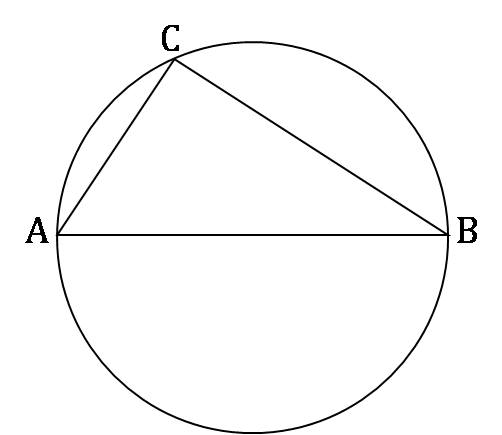
The figure shows a circle of diameter AB and radius 6.5 cm. If chord CA is 5 cm long, find the area of ΔABC.
Answer & solution
Correct answer: 30 sq.cm
- A
60 sq.cm
30 sq.cm
- C
40 sq.cm
- D
52 sq.cm
Solution
The radius of the circle is 6.5 cm. Therefore, its diameter = 13 cm and AB = 13 cm. Since the diameter of a circle
subtends 90° at the circumference, ∠ACB = 90°. So ΔACB is a right-angled triangle with AC = 5, AB = 13.
Therefore, CB should be equal to 12 cm (as 5-12-13 form a Pythagorean triplet).
Hence, the area of the triangle × AC × CB = × 5 × 12 = 30 sq.cm.