CAT 1996 — QA Question 3
Basics of QuadrilateralsEasy
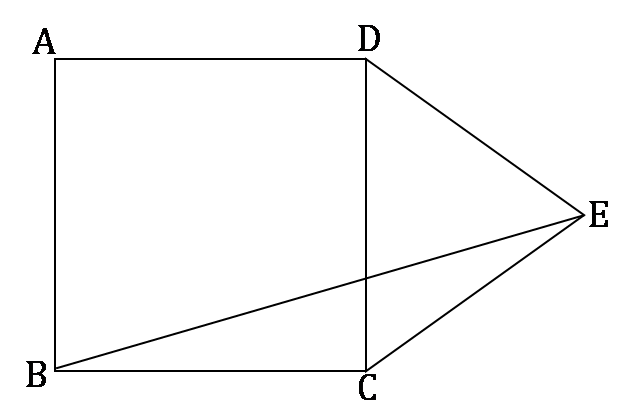
If ABCD is a square and BCE is an equilateral triangle, what is the measure of ∠DEC?
Answer & solution
Correct answer: 15°
15°
- B
30°
- C
20°
- D
45°
Solution
Since ΔBCE is an equilateral triangle, CE = BC = BE.
And since ABCD is a square, BC = CD. Hence, CD = CE.
So in ΔCDE, we have CD = CE. Hence, ∠EDC = ∠CED.
Now ∠BCE = 60° (since equilateral triangle) and ∠BCD = 90° (since square).
Hence, ∠DCE = ∠DCB + ∠BCE = (60 + 90) = 150°.
So in ΔDCE, ∠EDC + ∠CED = 30° (since three angles of a triangle add up to 180°). Hence, we have ∠DEC = ∠EDC = 15°.