CAT 1997 — QA Question 32
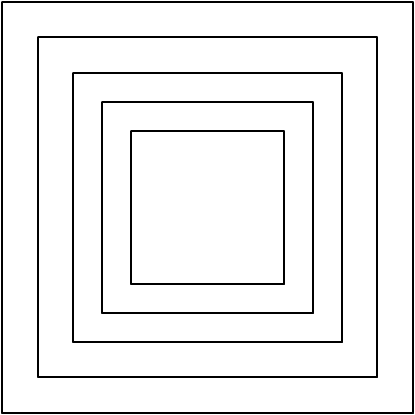
The adjoining figure shows a set of concentric squares. If the diagonal of the innermost square is 2 units, and if the distance between the corresponding corners of any two successive squares is 1 unit, find the difference between the areas of the eighth and the seventh squares, counting from the innermost square.
Answer & solution
Correct answer: 30 sq. units
- A
10√2 sq. units
30 sq. units
- C
35√2 sq. units
- D
None of these
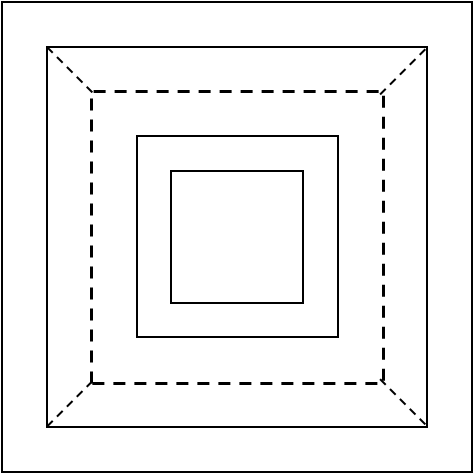
The diagonal of the innermost square is 2 units. The diagonal of every successive square would increase by 2 units (since corners are one unit apart). So the diagonal of the 7th square = 14 units and that of the 8th square = 16 units. Areas of the 7th square = (14)2 and that of 8th square = (16)2, and 128 respectively. Hence, the difference in their areas = (128 – 98) = 30 sq.units.
Related Basics of Quadrilaterals questions
- In a rectangle, the difference between the sum of the adjacent sides and the dia…
- In the given figure, EADF is a rectangle and ABC is a triangle whose vertices li…