CAT 1999 — QA Question 50
Directions: Answer the questions based on the following information.
Recently, Ghosh Babu spent his winter vacation on Kyakya Island. During the vacation, he visited the local casino where he came across a new card game. Two players, using a normal deck of 52 playing cards, play this game. One player is called the ‘dealer’ and the other is called the ‘player’. First, the player picks a card at random from the deck. This is called the base card. The amount in rupees equal to the face value of the base card is called the base amount. The face values of ace, king, queen and jack are ten. For other cards the face value is the number on the card. Once the ‘player’ picks a card from the deck, the ‘dealer’ pays him the base amount. Then the ‘dealer’ picks a card from the deck and this card is called the top card. If the top card is of the same suit as the base card, the ‘player’ pays twice the base amount to the ‘dealer’. If the top card is of the same colour as the base card (but not the same suit), then the ‘player’ pays the base amount to the ‘dealer’. If the top card happens to be of a different colour than the base card, the ‘dealer’ pays the base amount to the ‘player’.
Ghosh Babu played the game four times. First time he picked eight of clubs and the ‘dealer’ picked queen of clubs. Second time, he picked ten of hearts and the ‘dealer’ picked two of spades. Next time, Ghosh Babu picked six of diamonds and the ‘dealer’ picked ace of hearts. Lastly, he picked eight of spades and the ‘dealer’ picked jack of spades. Answer the following questions based on these four games.
Directions: Each question is followed by two statements I and II. Mark:
1. if the question can be answered by any one of the statements alone, but cannot be answered by using the other statement alone.
2. if the question can be answered by using either statement alone.
3. if the question can be answered by using both the statements together, but cannot be answered by using either statement alone.
4. if the question cannot be answered even by using both the statements together.
Mr X starts walking northwards along the boundary of a field from point A on the boundary, and after walking for 150 m reaches B, and then walks westwards, again along the boundary, for another 100 m when he reaches C. What is the maximum distance between any pair of points on the boundary of the field?
I. The field is rectangular in shape.
II. The field is a polygon, with C as one of its vertices and A as the mid-point of a side.
Answer & solution
- A
1
- B
2
3
- D
4
Statement I by itself does not solve the problem but it does tell us about the shape of the field. However, it fails to give information about the points A, B and C as to whether they be at the end of the field, etc. This data is given by the second statement, from which it is known that
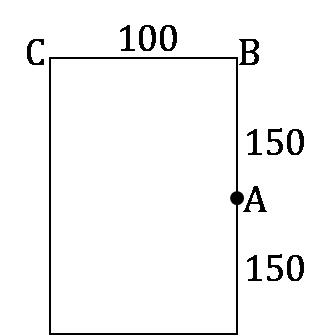
The polygon has the length = 150 × 2 = 300 m and the breadth = 100 m and also that it is a rectangle (from A). Thus, the maximum distance is the diagonal length of the rectangle.