CAT 1999QA Question 52

CirclesEasy
Passage / Data

Directions: Answer the questions based on the following information.
Recently, Ghosh Babu spent his winter vacation on Kyakya Island. During the vacation, he visited the local casino where he came across a new card game. Two players, using a normal deck of 52 playing cards, play this game. One player is called the ‘dealer’ and the other is called the ‘player’. First, the player picks a card at random from the deck. This is called the base card. The amount in rupees equal to the face value of the base card is called the base amount. The face values of ace, king, queen and jack are ten. For other cards the face value is the number on the card. Once the ‘player’ picks a card from the deck, the ‘dealer’ pays him the base amount. Then the ‘dealer’ picks a card from the deck and this card is called the top card. If the top card is of the same suit as the base card, the ‘player’ pays twice the base amount to the ‘dealer’. If the top card is of the same colour as the base card (but not the same suit), then the ‘player’ pays the base amount to the ‘dealer’. If the top card happens to be of a different colour than the base card, the ‘dealer’ pays the base amount to the ‘player’.
Ghosh Babu played the game four times. First time he picked eight of clubs and the ‘dealer’  picked queen of clubs. Second time, he picked ten of hearts and the ‘dealer’ picked two of spades. Next time, Ghosh Babu picked six of diamonds and the ‘dealer’ picked ace of hearts. Lastly, he picked eight of spades and the ‘dealer’ picked jack of spades. Answer the following questions based on these four games.

Directions: Each question is followed by two statements I and II. Mark:
1. if the question can be answered by any one of the statements alone, but cannot be answered by using the other statement alone.
2. if the question can be answered by using either statement alone.
3. if the question can be answered by using both the statements together, but cannot be answered by using either statement alone.
4. if the question cannot be answered even by using both the statements together.

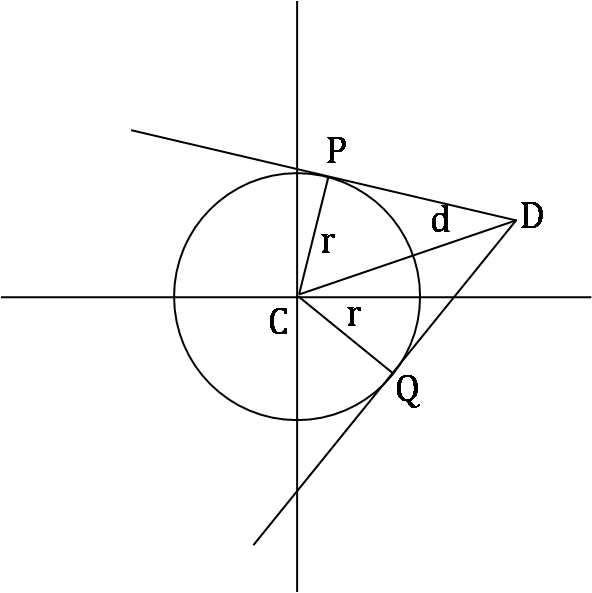
There is a circle with centre C at the origin and radius r cm. Two tangents are drawn from an external
point D at a distance d cm from the centre. What are the angles between each tangent and the X-axis.
I. The coordinates of D are given.
II. The X-axis bisects one of the tangents.

Answer & solution

  • A

    1

  • 2

  • C

    3

  • D

    4

Solution

r and d are given
From statement I, when co-ordinates of D are given,
only one pair of tangents can be drawn onto the given circle from D. So angle made by x-axis for each can be found out.
Hence, statement I alone is sufficient.
Consider statement II. Let the x-axis bisect the tangent QD, i.e. QA = AD.
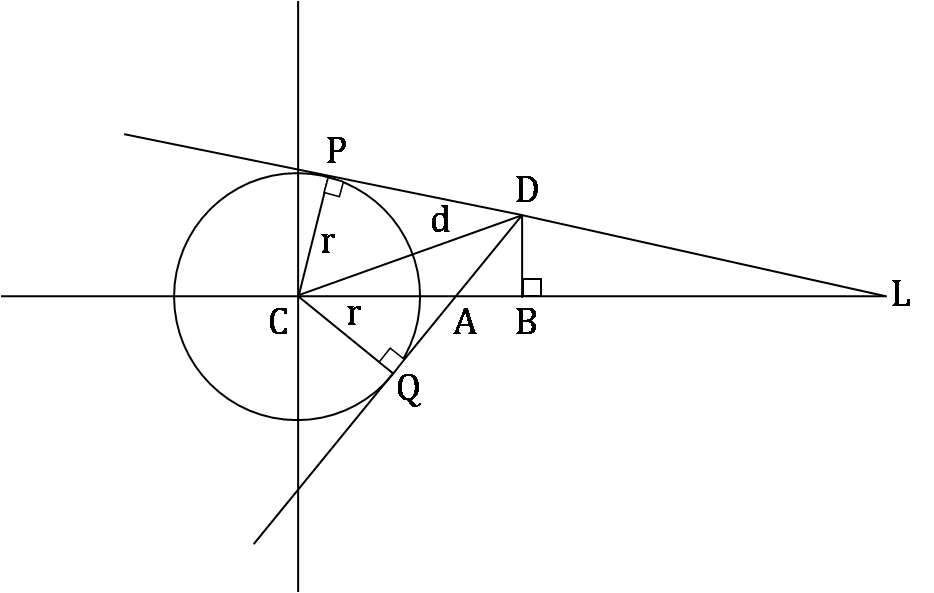
Here QA = 12QD = 12d2-r2. So using trigonometric ratios in right ΔCQA, we can determine ∠CAQ. Therefore, ∠DAB is equal to ∠CAQ CAQ (vertically opposite angles).
Consider the other tangent DP. Let it intersect x-axis at point L.
∠CDQ can be determined using trigonometric ratios (as two of the sides are given in right ΔCDQ). Also, ∠CDQ is equal to ∠CDP (since the two right ΔCQD and ΔCPD are congruent). Drop a perpendicular DB on x-axis. In right ΔDBL, we can find ∠BDL = 180o − (∠ADB + ∠CDQ + ∠CDP)

= 180° − 2∠CDQ − ∠ADB . Applying angle sum property of triangle, we can determine ∠DLB.
Hence, statement II alone is sufficient.

CAT 1999 QA Q52: Directions: Each question is followed by two statements I and II. Mark: 1. if the question can be answered by — Solution | TheCATExam