CAT 1999 — QA Question 54
Directions: Each question is followed by two statements I and II. Mark:
1. if the question can be answered by any one of the statements alone, but cannot be answered by using the other statement alone.
2. if the question can be answered by using either statement alone.
3. if the question can be answered by using both the statements together, but cannot be answered by using either statement alone.
4. if the question cannot be answered even by using both the statements together.
Three professors A, B and C are separately given three sets of numbers to add. They were expected to find the answers to 1 + 1, 1 + 1 + 2, and 1 + 1 respectively. Their respective answers were 3, 3 and 2. How many of the professors are mathematicians?
I. A mathematician can never add two numbers correctly, but can always add three numbers correctly.
II. When a mathematician makes a mistake in a sum, the error is +1 or –1.
Answer & solution
Correct answer: 4
- A
1
- B
2
- C
3
4
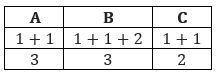
Statement I:
As C added up two numbers correctly, he is not a mathematician. However, from the given information, it is not necessary that any person who adds up two numbers incorrectly is a athematician.
Therefore, A or B may or may not be mathematicians. Hence, statement I alone is not sufficient.
Statement II:
If a mathematician makes a mistake in a sum, the error is +1 or -1. But it doesn't implies that if a
person makes an error of +1 or-1, he is a mathematician.
Hence, statement II alone is not sufficient.
Even on combining the two statements, we cannot conclude anything concrete.