CAT 2003 Slot 2 — DILR Question 45
Answer the following question based on the information given below.
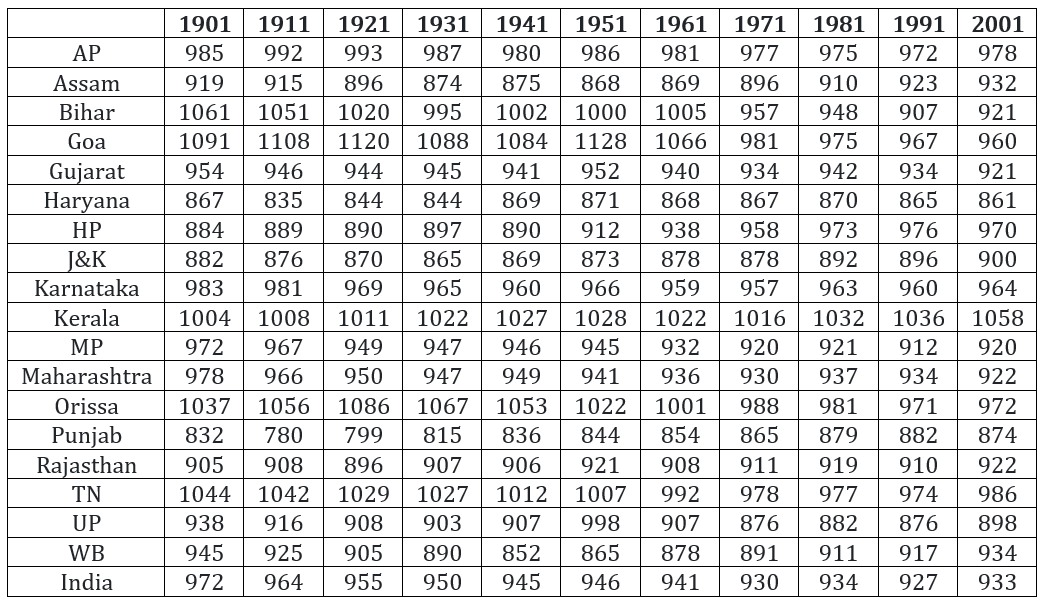
Sex Ratio (Number of females per 1,000 males) of Selected States in India : 1901-2001
 âââââââ
Each of the following statements pertains to the number of states with females outnumbering males in a given census year. Which of these statements is NOT correct?
Answer & solution
Correct answer: The number of consecutive censuses in which this number remained unchanged never exceeded 3
- A
This number never exceeded 5 in any census year.
- B
This number registered its sharpest decline in the year 1971
The number of consecutive censuses in which this number remained unchanged never exceeded 3
- D
Prior to the 1971 census, this number was never less than 4.
Option 1 is true because from 1901 to 2001 the number of states where females outnumber males are either five or less than that.
Option 2 is true because from 1961 to 1971 this number changes from 4 to 1.
Option 4 is true because there are at least four states that have more females than males for all the censuses prior to 1971.
For four years from 1971 to 2001 this number remains 1.
∴ Option 3 is false.
Hence, option (c).
Related Tables questions
- In the consolidated list, what would be the overall rank of the Philippines?…
- In the consolidated list, how many countries would rank below Spain and above Ta…
- In the consolidated list, which country ranks 37th?…
- In the consolidated list, how many countries in Asia will rank lower than every …
- Let us suppose that one bag of cement (50 kgs) consumes 100 kgs of limestones an…
- Steel manufacturing requires the use of iron ore, power and manpower. The cost o…