CAT 2005 — DILR Question 19
Answer the following question based on the information given below.
The year is 2089. Beijing, London, New York, and Paris are in contention to host the 2096 Olympics. The eventual winner is determined through several rounds of voting by members of the IOC with each member representing a different city. All the four cities in contention are also represented in IOC.
- In any round of voting, the city receiving the lowest number of votes in that round gets eliminated. The survivor after the last round of voting gets to host the event.
- A member is allowed to cast votes for at most two different cities in all rounds of voting combined. (Hence, a member becomes ineligible to cast a vote in a given round if both the cities (s)he voted for in earlier rounds are out of contention in that round of voting).
- A member is also ineligible to cast a vote in a round if the city (s)he represents is in contention in that round of voting.
- As long as the member is eligible, (s)he must vote and vote for only one candidate city in any round of voting.
The following incomplete table shows the information on cities that received the maximum and minimum votes in different rounds, the number of votes cast in their favour, and the total votes that were cast in those rounds.
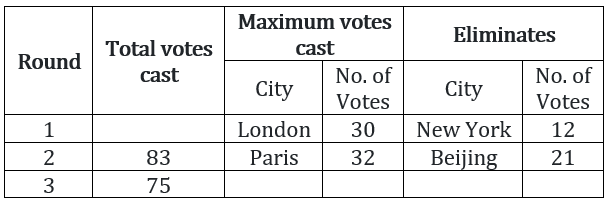
It is also known that:
- All those who voted for London and Paris in round 1, continued to vote for the same cities in subsequent rounds as long as these cities were in contention. 75% of those who voted for Beijing in round 1, voted for Beijing in round 2 as well.
- Those who voted for New York in round 1, voted either for Beijing or Paris in round 2.
- The difference in votes cast for the two contending cities in the last round was 1.
- 50% of those who voted for Beijing in round 1, voted for Paris in round 3.
What percentage of members from among those who voted for New York in round 1, voted for Beijing in round 2?
Answer & solution
Correct answer: 75
- A
33.33
- B
50
- C
66.67
75
Let there be x members in the IOC.
As a member cannot vote if his or her city is in contention, the number of voters in Round 1 (R1) = x – 4
The number of voters in Round 2 (R2) = x – 3 and
The number of voters in Round 3 (R3) = x – 2 – n
Where n is the number of voters who have voted for New York (NY) in R1 and Beijing (B) in R2.
Since x – 3 = 83, we get x – 4 = 82 and x – 2 – n = 75 or n = 9
21 members voted for B in R2. Out of these, 9 voted for NY in R1.
The remaining 12 who voted for B comprised 75% of those who voted for B in R1.
Thus 12/0.75 = 16 members voted for B in R1.
∴ Paris (P) got 82 – 16 – 30 – 12 = 24 votes in R1.
All those who voted for London (L) and P in R1 continued to vote for the same cities in subsequent rounds. Thus, 24 voters of P in R2 had voted for P in R1 too. Also from the given information, 3 voters who had voted for NY in R1 voted for Paris in R2.
Out of the remaining 5 that voted for P in R2, 4 had voted for Beijing in R1 and 1 vote came from the member who represented NY.
In R3, the difference in the votes cast for L and P was 1, i.e. L and P got 37 and 38 votes in some order.
The composition of 75 voters of R3 was as follows:
12 members who had voted for B in R1 and R2 were eligible for voting in R3.
30 and 24 members who voted for L and P in R1 continued to do so in R3.
4 voters of R3, voted for B in R1 and P in R2.
3 voters of R3, voted for NY in R1 and P in R2.
1 member represented NY and 1 represented B.
From given information, 50% of voters of B in R1 i.e. 8 voted for P in R3. So, 8 out of the 12 who voted for B in R1 and R2, voted for London in R3.
The information can be summarised as shown in the table:
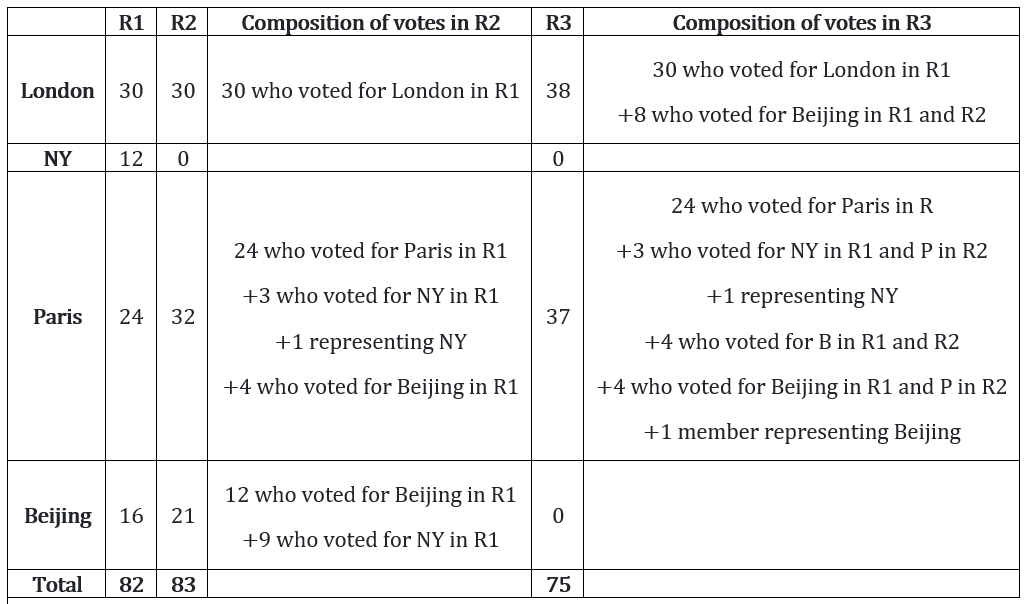
Required percentage = × 100 = 75%
Hence, option (d).
Related Mixed Practice questions
- According to the passage, internal conflicts are psychologically more interestin…
- Which, according to the author, would qualify as interesting psychology?…
- According to the passage, which of the following options about the application o…
- The problem solving process of a scientist is different from that of a detective…
- Each of the questions below consists of a set of labelled sentences. These sente…
- Each of the questions below consists of a set of labelled sentences. These sente…