CAT 2006 — DILR Question 17
Answer the following question based on the information given below.
A significant amount of traffic flows from point S to point T in the one-way street network shown below. Points A, B, C, and D are junctions in the network, and the arrows mark the direction of traffic flow. The fuel cost in rupees for travelling along a street is indicated by the number adjacent to the arrow representing the street.
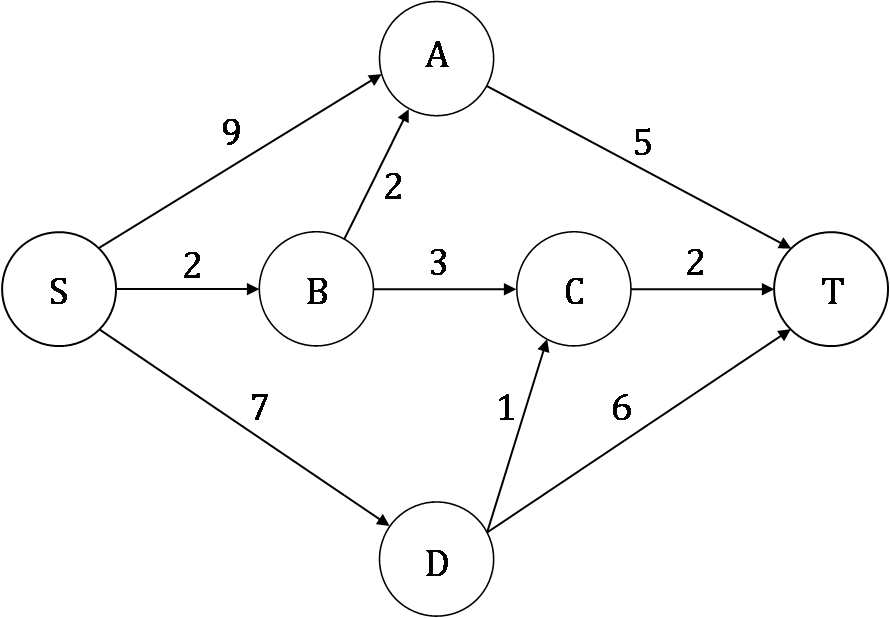
Motorists travelling from point S to point T would obviously take the route for which the total cost of travelling is the minimum. If two or more routes have the same least travel cost, then motorists are indifferent between them. Hence, the traffic gets evenly distributed among all the least cost routes.
The government can control the flow of traffic only by levying appropriate toll at each junction. For example, if a motorist takes the route S-A-T (using junction A alone), then the total cost of travel would be Rs. 14 (i.e. Rs. 9 + Rs. 5) plus the toll charged at junction A.
If the government wants to ensure that no traffic flows on the street from D to T, while equal amount of traffic flows through junctions A and C, then a feasible set of toll charged (in rupees) at junctions A, B, C, and D respectively to achieve this goal is:
Answer & solution
Correct answer: 0, 5, 2, 2
- A
1, 5, 3, 3
- B
1, 4, 4, 3
- C
1, 5, 4, 2
- D
0, 5, 2, 3
0, 5, 2, 2
Since the cost of travel including toll on routes S-A-T, S-B-C-T, S-B-A-T and S-D-C-T is the same,
∴ 14 + a = 7 + b + c = 9 + a + b = 10 + c + d
∴ b = 5, d = 2, c – a = 2
Only option 5 satisfies these criteria.
Hence, option (e).
Related Routes & Network questions
- If the government wants to ensure that all motorists travelling from S to T pay …
- If the government wants to ensure that all routes from S to T get the same amoun…
- If the government wants to ensure that the traffic at S gets evenly distributed …
- The government wants to devise a toll policy such that the total cost to the com…