CAT 2008 — QA Question 16
Basics of QuadrilateralsEasy
Consider a square ABCD with midpoints E, F, G, H of AB, BC, CD and DA respectively. Let L denote the line passing through F and H. Consider points P and Q, on L and inside ABCD, such that the angles APD and BQC both equal 120°. What is the ratio of the area of ABQCDP to the remaining area inside ABCD?
Answer & solution
Correct answer: 2 3 - 1
- A
- B
- C
- D
Solution
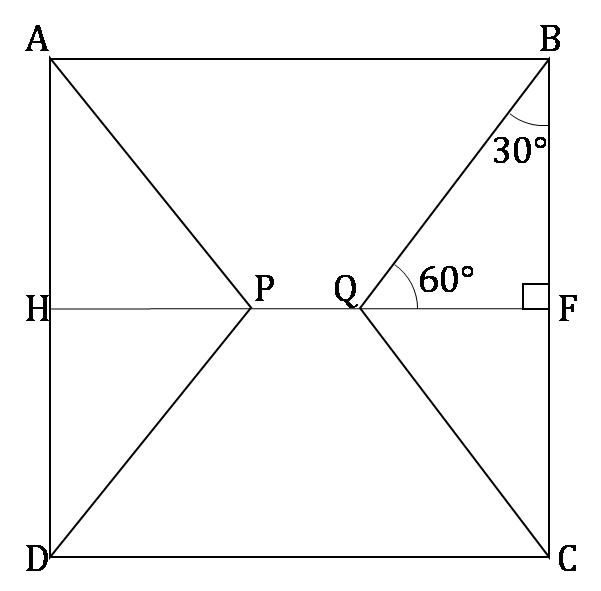
Let the length of the sides of the square be 2s.
Consider ∆BQF,
BF = s
In 30° - 60° - 90° triangle,
QF =
∴ Area of ∆BQF = × s ×
Area of ABQCDP = Area of square ABCD – 4 × Area of ∆BQF
∴ Required ratio = =
Hence, option (e).