CAT 2017 Slot 1 — DILR Question 18
Answer the following question based on the information given below.
There are 21 employees working in a division, out of whom 10 are special-skilled employees (SE) and the remaining are regular-skilled employees (RE). During the next five months, the division has to complete five projects every month. Out of the 25 projects, 5 projects are “challenging”’ while the remaining ones are “standard”. Each of the challenging projects has to be completed in different months. Every month, five teams – T1, T2, T3, T4 and T5, work on one project each. T1, T2, T3, T4 and T5 are allotted the challenging project in the first, second, third, fourth and fifth month, respectively. The team assigned the challenging project has one more employee than the rest.
In the first month, T1 has one more SE than T2, T2 has one more SE than T3, T3 has one more SE than T4, and T4 has one more SE than T5. Between two successive months, the composition of the teams changes as follows:
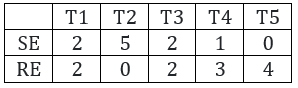
a. The team allotted the challenging project, gets two SE from the team which was allotted the challenging project in the previous month. In exchange, one RE is shifted from the former team to the latter team.
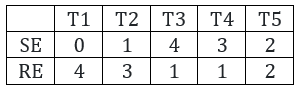
b. After the above exchange, if T1 has any SE and T5 has any RE, then one SE is shifted from T1 to T5, and one RE is shifted fromT5 to T1. Also, if T2 has any SE and T4 has any RE, then one SE is shifted from T2 to T4, and one RE is shifted from T4 to T2.
Each standard project has a total of 100 credit points, while each challenging project has 200 credit points. The credit points are equally shared between the employees included in that team.
The number of SE in T1 and T5 for the projects in the third month are, respectively:
Answer & solution
Correct answer: (0, 2)
(0, 2)
- B
(0, 3)
- C
(1, 2)
- D
(1, 3)
1. Let number of SE’s (special skilled employees) in T5 in the first month be ‘x’. Then number of SE’s in T4, T3, T2 and T1 will be x + 1, x + 2, x + 3 and x + 4 respectively. As per given data, number of SE’s is 10.
∴ x + x + 1 + x + 2 + x + 3 + x + 4 = 10
∴ x = 0
So number of SE’s in T1, T2, T3, T4 and T5 will be 4, 3, 2, 1 and 0 respectively. Now T1, T2, T3, T4 and T5 get the challenging projects in months.
1, 2, 3, 4 and 5 respectively.
Also as total number of employees in the team having the challenging projects in a particular month is 1 more than the other teams the standard projects in the first month, T1 will have a total of 5 employees in the 1st month and hence 1 RE (Regular Skilled Employee). Since the other teams have a total of 4 employees each in the 1st month, the number of RE’s in T2, T3, T4 and T5 will be 1, 2, 3 and 4 respectively in the first month. So in the 1st month break up of employees in each of the teams will be as follows
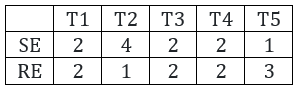
In the second month, the number of team members following condition (a) will be as follows
Following condition (b) number of employees in month 2 will be
For month 3 following condition (a)
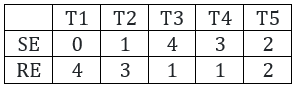
Following condition (b)
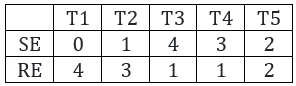
For month 4, following condition (a)
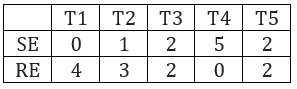
his is the final number of SE’s and RE’s in month4 as after following condition (a) as T1 has no SE and T4 has no RE, no further interchange can happen
For month 5, following condition (a)
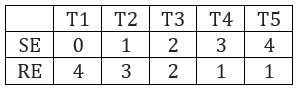
Following condition (b)
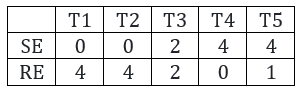
Using this information let us answer the questions.
The number of SE in T1 and T5 for month 3 is 0 and 2 respectively.
Hence, option (a).
Related Distribution questions
- Assume that only one client’s order can be processed at any given point of…
- Assume that only one client’s order can be processed at any given point of…
- Suppose the employees are allowed to process multiple order at a time, but the p…
- Suppose the employees are allowed to process multiple order at a time, but the p…
- The number of times in which the composition of team T2 and the number of times …
- Which of the following CANNOT be the total credit points earned by any employee …