CAT 2019 Slot 2 — DILR Question 11
Answer the following questions based on the information given below.

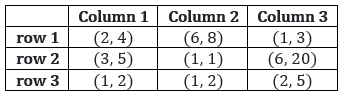
Three pouches (each represented by a filled circle) are kept in each of the nine slots in a 3 × 3 grid, as shown in the figure. Every pouch has a certain number of one-rupee coins. The minimum and maximum amounts of money (in rupees) among the three pouches in each of the nine slots are given in the table. For example, we know that among the three pouches kept in the second column of the first row, the minimum amount in a pouch is Rs. 6 and the maximum amount is Rs. 8.
There are nine pouches in any of the three columns, as well as in any of the three rows. It is known that the average amount of money (in rupees) kept in the nine pouches in any column or in any row is an integer. It is also known that the total amount of money kept in the three pouches in the first column of the third row is Rs. 4.
What is the number of slots for which the average amount (in rupees) of its three pouches is an integer?
Answer & solution
Correct answer: 2
Answer: 2
Consider C1R1: Maximum coins in a pouch = 4 and minimum coins = 2. The third bag could have 2, 3 or 4 coins. Therefore, sum = 8, 9 or 10
Consider C1R2: Maximum coins in a pouch = 5 and minimum coins = 3. The third bag could have 3, 4 or 5 coins. Therefore, sum = 11, 12 or 13
Consider C1 R3: Maximum coins in a pouch = 2 and minimum coins = 1. As the sum = 4, third pouch has 1 coin.
As the sum of coins in the nine pouches in the column are divisible by 9, the coins in C1R1 and C1R2 has to be 10 (i.e., 2, 4, 4) and 13 (i.e., 3, 5, 5) respectively.
Consider column 2:
C2R1: Maximum coins in a pouch = 8 and minimum coins = 6. The third bag could have 6, 7 or 8 coins. Therefore, sum = 20, 21 or 22
C2R2: All the three pouches have one coin each. Sum = 3
C2R3: Maximum coins in a pouch = 2 and minimum coins = 1. The third bag could have 1 or 2 coins. Therefore, sum = 1 or 4
In order to have number of coins in the cells of the column divisible by 9, sum of the coins in C2R1 = 20(i.e., 6, 6, 8) and in C2R3 = 4(i.e., 1,1,2)
Now consider R1
First two cells together have 30 coins. So the third cell has to have 6(i.e., 1, 2, 3) coins.
Consider R2: First two cells together have 16 coins. Coins in the third cell are in the range 6 + 6 + 20 = 32 to 6 + 20 + 20 = 46. Therefore the third cell has to have 38 (i.e., 6, 12, 20) coins.
Consider R3: First two cells together have 8 coins. So the third cell has to have 10 (i.e., 2, 3, 5) coins.
Thus, we have
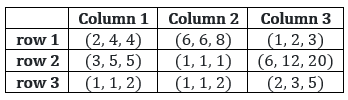
For average amount to be an integer, we need to consider slots having total number of coins in the pouches divisible by 3.
There are two such slot i.e., (row 1 column 3) and (row 2 column 2).
Answer: 2.
Related Mixed Practice questions
- By “digital colonialism”, critics of the CyArk–Google project …
- In Dr. Thompson’s view, CyArk owning the copyright of its digital scans of…
- Based on his views mentioned in the passage, one could best characterise Dr. Wat…
- Which of the following, if true, would most strongly invalidate Dr. Watrall&rsqu…
- Of the following arguments, which one is LEAST likely to be used by the companie…
- The “dilemma” mentioned in the passage refers to:…