CAT 2020 Slot 2 — DILR Question 22
Answer the next 6 questions based on the information given below.
In an election several candidates contested for a constituency. In any constituency, the winning candidate was the one who polled the highest number of votes, the first runner up was the one who polled the second highest number of votes, the second runner up was the one who polled the third highest number of votes, and so on. There were no ties (in terms of number of votes polled by the candidates) in any of the constituencies in this election.
In an electoral system, a security deposit is the sum of money that a candidate is required to pay to the election commission before he or she is permitted to contest. Only the defeated candidates (i.e., one who is not the winning candidate) who fail to secure more than one sixth of the valid votes polled in the constituency, lose their security deposits.
The following table provides some incomplete information about votes polled in four constituencies: A, B, C and D, in this election.
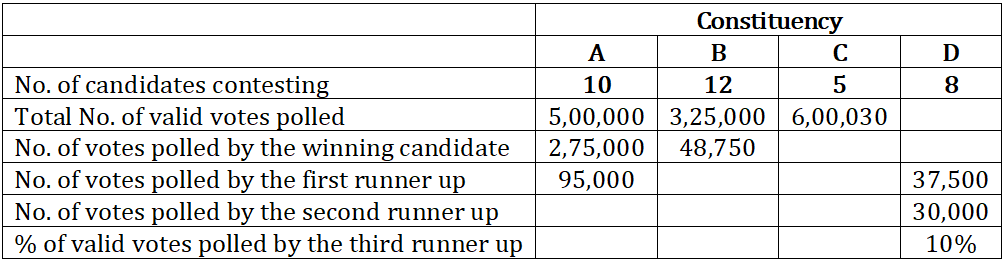
The following additional facts are known:
- The first runner up polled 10,000 more votes than the second runner up in constituency A.
- None of the candidates who contested in constituency C lost their security deposit. The difference in votes polled by any pair of candidates in this constituency was at least 10,000.
- The winning candidate in constituency D polled 5% of valid votes more than that of the first runner up. All the candidates who lost their security deposits while contesting for this constituency, put together, polled 35% of the valid votes.
What was the number of valid votes polled in constituency D?
Answer & solution
Correct answer: 1,75,000
1,75,000
- B
1,25,000
- C
1,50,000
- D
62,500
Let total valid votes polled in D = 100x
The winning candidate in constituency D polled 5% of valid votes more than that of the first runner up. All the candidates who lost their security deposits while contesting for this constituency, put together, polled 35% of the valid votes.
Votes polled by the first runner up = 37,500
Votes polled by the winner = 37,500 + 5x
Votes polled by the third runner up is 10% of valid votes which is less than one-sixth of valid votes. Hence third runner up will lose the security deposit.
Now for the second runner up to lose the security deposit total valid votes to be polled must be greater than 6 × 30,000 = 1,80,000.
Since all the options are less than 1,80,000, we can be sure than second runner up did not lose the security deposit.
Hence, number of candidates losing security deposit = 8 – 3 = 5. These 5 candidates get 35% of the total valid votes.
⇒ Winner, first runner-up and second runner-up polled 65% of the valid votes.
⇒ 37,500 + 5x + 37,500 + 30,000 = 65% of 100x.
⇒ 1,05,000 = 60x
⇒ x = 1750
∴ Total valid votes in D = 100x = 1,75,000
Hence, option (a).
Related Tables questions
- In HomeDecor departments of which cities were the sales amounts the highest in 2…
- What was the increase in sales amount, in Crore Rupees, in the Apparel departmen…
- Among all the 12 departments (i.e., the 3 departments in each of the 4 cities), …
- What was the total sales amount, in Crore Rupees, in 2019 for the chain of depar…
- What is the percentage of votes polled in total by all the candidates who lost t…
- How many candidates who contested in constituency B lost their security deposit?…