CAT 2021 Slot 1 — DILR Question 3
Answer the next 4 questions based on the information given
Ganga, Kaveri, and Narmada are three women who buy four raw materials (Mango, Apple, Banana and Milk) and sell five finished products (Mango smoothie, Apple smoothie, Banana smoothie, Mixed fruit smoothie and Fruit salad). Table-1 gives information about the raw materials required to produce the five finished products. One unit of a finished product requires one unit of each of the raw materials mentioned in the second column of the table.
Table - 1
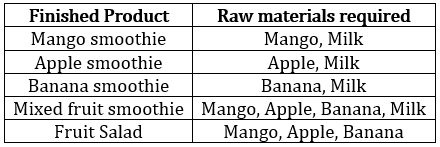
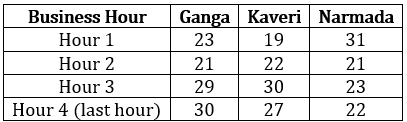
One unit of milk, mango, apple, and banana cost ₹5, ₹3, ₹2, and ₹1 respectively. Each unit of a finished product is sold for a profit equal to two times the number of raw materials used to make that product. For example, apple smoothie is made with two raw materials (apple and milk) and will be sold for a profit of ₹4 per unit. Leftover raw materials are sold during the last business hour of the day for a loss of ₹1 per unit. The amount, in rupees, received from sales (revenue) for each woman in each of the four business hours of the day is given in Table-2.
Table - 2
The following additional facts are known.
- No one except possibly Ganga sold any Mango smoothie.
- Each woman sold either zero or one unit of any single finished product in any hour.
- Each woman had exactly one unit each of two different raw materials as leftovers.
- No one had any banana leftover.
What BEST can be concluded about the total number of units of milk the three women had in the beginning?
Answer & solution
Correct answer: Either 18 or 19 or 20 units.
Either 18 or 19 or 20 units.
- B
Either 19 or 20 units.
- C
Either 17 or 18 or 19 units.
- D
Either 18 or 19 units.
Consider the solution to first question of this set.
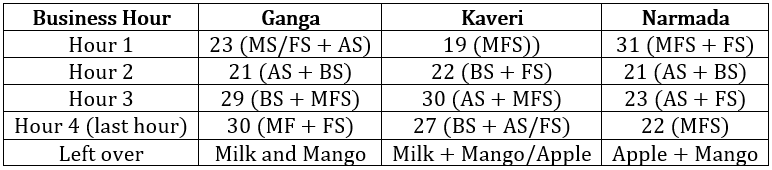
Number of units of milk with
Ganga = 1/2 (Hour 1) + 2 (Hour 2) + 2 (Hour 3) + 1 (Hour 3) + 1 (Left-over) = 7/8 units
Kaveri = 1 (Hour 1) + 1 (Hour 2) + 2 (Hour 3) + 1/2 (Hour 3) + 1 (Left-over) = 6/7 units
Narmada = 1 (Hour 1) + 2 (Hour 2) + 1 (Hour 3) + 1 (Hour 3) + 0 (Left-over) = 5 units
∴ Number of units of milk initially could be 18 or 19 or 20.
Hence, option (a).
Related Distribution questions
- What BEST can be concluded about the number of units of fruit salad sold in the …
- Which of the following is NECESSARILY true?…
- If it is known that three leftover units of mangoes were sold during the last bu…
- What is the correct sequence of number of papers written by B, C, E and G, respe…
- How many papers were written by Indian authors?…
- Which of the following statement(s) MUST be true? Statement A : Every issue had …