CAT 2022 Slot 3 — DILR Question 1
Answer the next 5 questions based on the information given below:
Pulak, Qasim, Ritesh, and Suresh participated in a tournament comprising of eight rounds. In each round, they formed two pairs, with each of them being in exactly one pair. The only restriction in the pairing was that the pairs would change in successive rounds. For example, if Pulak formed a pair with Qasim in the first round, then he would have to form a pair with Ritesh or Suresh in the second round. He would be free to pair with Qasim again in the third round. In each round, each pair decided whether to play the game in that round or not. If they decided not to play, then no money was exchanged between them. If they decided to play, they had to bet either ₹1 or ₹2 in that round. For example, if they chose to bet ₹2, then the player winning the game got ₹2 from the one losing the game.
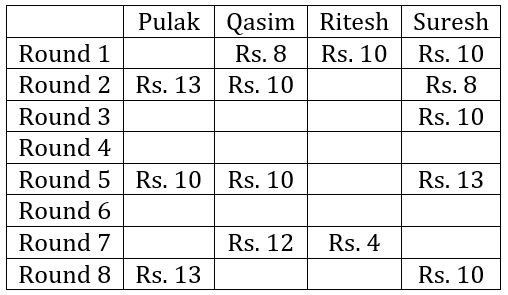
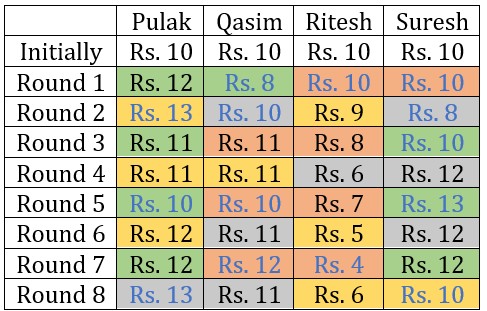
At the beginning of the tournament, the players had ₹10 each. The following table shows partial information about the amounts that the players had at the end of each of the eight rounds. It shows every time a player had ₹10 at the end of a round, as well as every time, at the end of a round, a player had either the minimum or the maximum amount that he would have had across the eight rounds. For example, Suresh had ₹10 at the end of Rounds 1, 3, and 8 and not after any of the other rounds. The maximum amount that he had at the end of any round was ₹13 (at the end of Round 5), and the minimum amount he had at the end of any round was ₹8 (at the end of Round 2). At the end of all other rounds, he must have had either ₹9, ₹11, or ₹12.
It was also known that Pulak and Qasim had the same amount of money with them at the end of Round 4.
What BEST can be said about the amount of money that Ritesh had with him at the end of Round 8?
Answer & solution
Correct answer: Exactly ₹6
- A
Exactly ₹5
- B
₹5 or ₹6
- C
₹4 or ₹5
Exactly ₹6
Whenever a player has Rs. 10, it is already mentioned in the table. Their can be no other entry of Rs. 10.
Also, Highest and Lowest amounts of a player are also already mentioned.
E.g.: Pulak’s highest and lowest amount is Rs. 13 and Rs. 10 respectively in rounds 2, 8, 1 and 5. . Pulak cannot have Rs. 13 or more and Rs. 10 or less in any other round. Hence, the only amount Pulak can have at the end of any round is Rs. 11 or Rs. 12.
Allowed entries for
Pulak: 11 or 12
Qasim: 9 or 11
Ritesh: 5 or 6 or 7 or 8 or 9
Suresh: 9 or 11 or 12
Total amount at the end of any round should be same as the total amount initially i.e., Rs. 40.
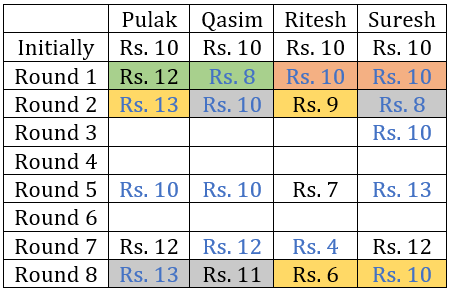
Round 1: Amount with Pulak = 40 – (8 + 10 + 10) = Rs. 12
Ritesh and Suresh did not lose/gain, hence they paired up and decided not to play.
while, Qasim lost Rs. 2 to Pulak.
Round 2: Amount with Ritesh = 40 – (13 + 10 + 8) = Rs. 9
Pulak gained Rs. 1 while Ritesh lost Rs. 1. Hence, Pulak and Ritesh paired and bet Rs. 1.
while, Suresh paired up with Qasim for Rs. 2.
Round 5: Amount with Ritesh = 40 – (10 + 10 + 13) = Rs. 7
Round 7: Amount with Pulak and Suresh together = 40 – 12 – 4 = Rs. 24
Amount with Suresh and Pulak in Round 7 should be less than 13.
Only way this is possible is that both Pulak and Suresh have Rs. 12.
Round 8: Suresh loses Rs. 2. The only one who could gain Rs. 2 is Ritesh. Hence, Suresh paired with Ritesh and Pulak with Qasim.
Round 4: Pulak and Qasim had same amount. This amount can only be Rs. 11.
Now Pulak and Qasim lose Rs. 1 each Round 5, hence Ritesh and Suresh must gain Rs. 1 in round 5.
⇒ Ritesh and Suresh had Rs. 1 less in round 4 than round 5.
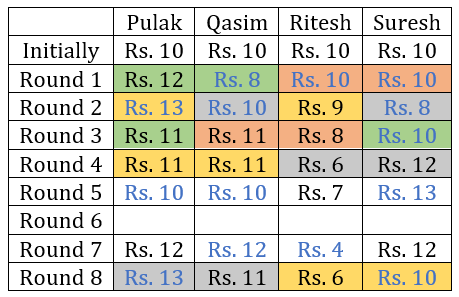
Round 3: Since Suresh paired with Qasim in round 2, he will pair with either Pulak or Ritesh in round 3.
If Suresh pairs with Ritesh, Ritesh will have Rs. 7 in round 3. Hence, Pulak + Qasim will have Rs. 23. This is possible when Pulak has Rs. 12 and Qasim has Rs. 11.
But that would mean that only Qasim doesn’t bet in round 4 which is not possible.
∴ Suresh pairs with Pulak in round 3. Hence, Pulak will have Rs. 12 in round 3.
⇒ Qasim and Ritesh have together Rs. 18. This is possible when Qasim has Rs. and Ritesh has Rs. .
⇒ Pulak paired with Qasim in round 4 and Ritesh with Suresh.
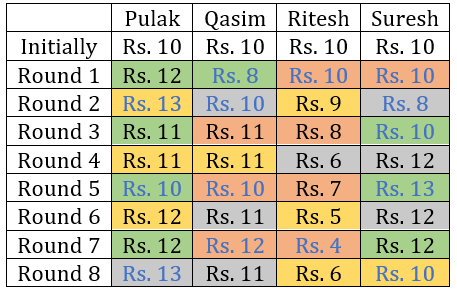
Round 6: Highest amount with Pulak, Qasim and Suresh in round 6 can be 12 + 11 + 12 = 35.
In that case Ritesh will have Rs. 5.
Had the amount with Ritesh been Rs. 6 at the end of round 6. Other three will have a total of Rs. 34. In this case, we would not get proper arrangement for round 7.
Therefore, the final table is as follows:
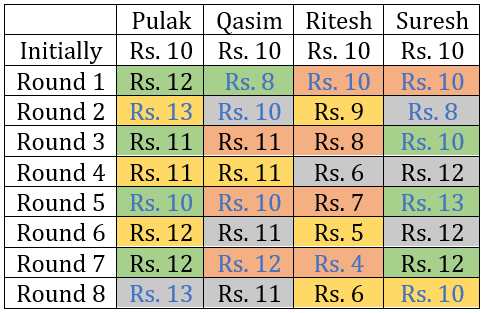
∴ The amount of money that Ritesh had with him at the end of Round 8 is Rs. 6.
Hence, option (d).
Related Tables questions
- What BEST can be said about the amount of money that Pulak had with him at the e…
- How much money (in ₹) did Ritesh have at the end of Round 4?…
- How many games were played with a bet of ₹2?…
- Which of the following pairings was made in Round 5?…