CAT 2024 Slot 2 — DILR Question 1
Answer the following questions based on the information given below.
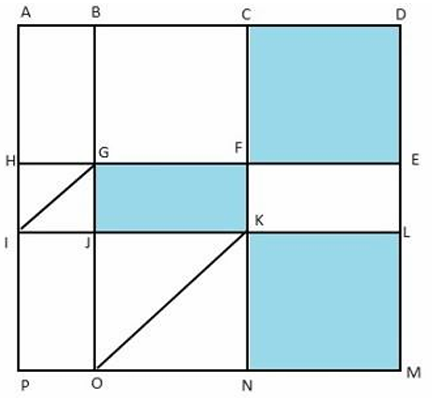
The above is a schematic diagram of walkways (indicated by all the straight-lines) and lakes (3 of them, each in the shape of rectangles – shaded in the diagram) of a gated area. Different points on the walkway are indicated by letters (A through P) with distances being OP = 150 m, ON = MN = 300 m, ML = 400 m, EL = 200 m, DE = 400 m.
The following additional information about the facilities in the area is known.
1. The only entry/exit point is at C.
2. There are many residences within the gated area; all of them are located on the path AH and ML with four of them being at A, H, M, and L.
3. The post office is located at P and the bank is located at B.
| Segment | Length (m) | Segment | Length (m) |
|---|---|---|---|
| AB, HG, IJ, PO | 150 | HI, GJ, FK, EL | 200 |
| BC, CD | 300 | GF, FE | 300 |
| JK, KL | 300 | ON, NM | 300 |
| AH, IP, BG, JO | 400 | CF, KN, DE, LM | 400 |
| GI (diagonal) | 250 | OK (diagonal) | 500 |
Coordinates (m), origin at P, taking the grid columns at x = 0, 150, 450, 750 and rows at y = 0, 400, 600, 1000: A(0,1000) B(150,1000) C(450,1000) D(750,1000); H(0,600) G(150,600) F(450,600) E(750,600); I(0,400) J(150,400) K(450,400) L(750,400); P(0,0) O(150,0) N(450,0) M(750,0). Lakes: C-D-E-F, G-F-K-J, K-L-M-N.
One resident whose house is located at L, needs to visit the post office as well as the bank. What is the minimum distance (in m) he has to walk starting from his residence and returning to his residence after visiting both the post office and the bank?
Answer & solution
Correct answer: 3200
- A
3000
- B
2700
- C
3100
3200
Easy
Model the walkways as a weighted graph and find the shortest distances between L, P (post office) and B (bank). The minimum round trip from L visiting both is L→P→B→L (or its reverse).
Distances (m): outer/inner segments — AB,HG,IJ,PO = 150; HI,GJ,FK,EL = 200; BC,CD,GF,FE,JK,KL,ON,NM = 300; AH,IP,BG,JO,CF,KN,DE,LM = 400; diagonals GI = 250, OK = 500. Post office at P, bank at B, residence at L.
| Shortest path | Route used | Distance (m) |
|---|---|---|
| L → P | L-K-O-P (OK diagonal) | 950 |
| P → B | P-I-G-B | 1050 |
| B → L | B-G-F-E-L | 1200 |
Shortest L to P. The cheapest route uses the OK diagonal: L-K-O-P.
Shortest P to B and B to L. From the chart graph.
Best round trip. Add the three legs (the reverse order gives the same total).
Related Mixed Practice questions
- We can assume that the author would support all of the following views EXCEPT:…
- The author lists all of the following examples as “externalities” of…
- Carrier, Babbage, and Edison are mentioned in the passage to illustrate the auth…
- Which of the following best conveys the main point of the first paragraph?…
- According to the passage, which of the following scenarios would MOST likely exa…
- Given the insights provided by Penteriani’s research and Wilkinson’s…