CAT 2024 Slot 2 — DILR Question 17
Answer the following questions based on the information given below.
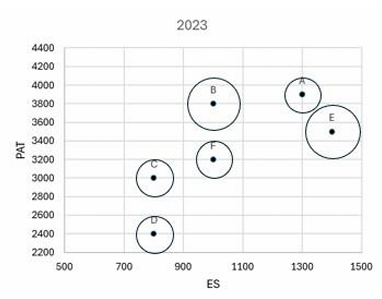
The two plots below give the following information about six firms A, B, C, D, E, and F for 2019 and 2023.
PAT: The firm’s profits after taxes in Rs. crores,
ES: The firm’s employee strength, that is the number of employees in the firm, and
PRD: The percentage of the firm’s PAT that they spend on Research and Development (R&D).
In the plots, the horizontal and vertical coordinates of the point representing each firm give their ES and PAT values respectively. The PRD values of each firm are proportional to the areas around the points representing each firm. The areas are comparable between the two plots, i.e., equal areas in the two plots represent the same PRD values for the two years.
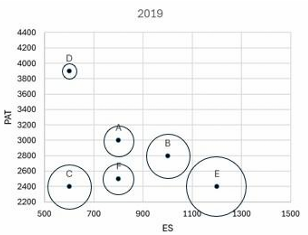
Approximate 2019 readings (ES on the horizontal axis, PAT on the vertical axis; bubble size ∝ PRD):
| Firm (2019) | ES (approx.) | PAT (approx.) | Bubble size (PRD) |
|---|---|---|---|
| A | 800 | 3000 | medium |
| B | 1000 | 2800 | medium-large |
| C | 600 | 2400 | medium |
| D | 600 | 3900 | small |
| E | 1200 | 2500 | large |
| F | 800 | 2500 | small |
Which among the firms C, D, E, and F had the least amount of R&D spending per employee in 2023?
Answer & solution
Correct answer: Firm D
Firm D
- B
Firm F
- C
Firm E
- D
Firm C
Medium
R&D spend and PRD bubble area, so R&D per employee . Use the 2023 bubble sizes for PRD and the 2023 PAT and ES coordinates.
2023 readings (bubble size PRD):
| Firm | ES 2023 | PAT 2023 | PRD (bubble) |
|---|---|---|---|
| C | 800 | 3000 | medium |
| D | 800 | 2400 | small |
| E | 1400 | 3500 | large |
| F | 1000 | 3200 | small |
Express R&D per employee. Since R&D , the per-employee figure is that product divided by ES.
Compare the two small-bubble firms first. C has a medium bubble and E a large bubble, so both carry a higher PRD than the small-bubble firms D and F; the minimum must be D or F. With equal (small) PRD, compare .
Conclude. D and F share the smallest PRD, but D has the lower (and the smaller bubble of the two), so D's R&D per employee is the least. C (medium PRD) and E (large PRD) are clearly higher.
Related Bubble Charts questions
- Assume that the annual rate of growth in PAT over the previous year (ARG) remain…
- The ratio of the amount of money spent by Firm C on R&D in 2019 to that in 2023 …
- Which among the firms A, C, E, and F had the maximum PAT per employee in 2023?…