Selection — CAT Previous-Year Questions
22 previous-year questions on Selection from CAT, with full solutions. Practise free — check answers as you go; sign in to save your progress.
Selection · CAT PYQs
Passage / Data
Answer the next 6 questions based on the information given below:
Three reviewers Amal, Bimal, and Komal are tasked with selecting questions from a pool of 13 questions (Q01 to Q13). Questions can be created by external “subject matter experts” (SMEs) or by one of the three reviewers. Each of the reviewers either approves or disapproves a question that is shown to them. Their decisions lead to eventual acceptance or rejection of the question in the manner described below.
If a question is created by an SME, it is reviewed first by Amal, and then by Bimal. If both of them approve the question, then the question is accepted and is not reviewed by Komal. If both disapprove the question, it is rejected and is not reviewed by Komal. If one of them approves the question and the other disapproves it, then the question is reviewed by Komal. Then the question is accepted only if she approves it.
A question created by one of the reviewers is decided upon by the other two. If a question is created by Amal, then it is first reviewed by Bimal. If Bimal approves the question, then it is accepted. Otherwise, it is reviewed by Komal. The question is then accepted only if Komal approves it. A similar process is followed for questions created by Bimal, whose questions are first reviewed by Komal, and then by Amal only if Komal disapproves it. Questions created by Komal are first reviewed by Amal, and then, if required, by Bimal.
The following facts are known about the review process after its completion.
- Q02, Q06, Q09, Q11, and Q12 were rejected and the other questions were accepted.
- Amal reviewed only Q02, Q03, Q04, Q06, Q08, Q10, Q11, and Q13.
- Bimal reviewed only Q02, Q04, Q06 through Q09, Q12, and Q13.
- Komal reviewed only Q01 through Q05, Q07, Q08, Q09, Q11, and Q12.
How many questions were DEFINITELY created by Amal?
Passage / Data
Answer the next 6 questions based on the information given below:
Three reviewers Amal, Bimal, and Komal are tasked with selecting questions from a pool of 13 questions (Q01 to Q13). Questions can be created by external “subject matter experts” (SMEs) or by one of the three reviewers. Each of the reviewers either approves or disapproves a question that is shown to them. Their decisions lead to eventual acceptance or rejection of the question in the manner described below.
If a question is created by an SME, it is reviewed first by Amal, and then by Bimal. If both of them approve the question, then the question is accepted and is not reviewed by Komal. If both disapprove the question, it is rejected and is not reviewed by Komal. If one of them approves the question and the other disapproves it, then the question is reviewed by Komal. Then the question is accepted only if she approves it.
A question created by one of the reviewers is decided upon by the other two. If a question is created by Amal, then it is first reviewed by Bimal. If Bimal approves the question, then it is accepted. Otherwise, it is reviewed by Komal. The question is then accepted only if Komal approves it. A similar process is followed for questions created by Bimal, whose questions are first reviewed by Komal, and then by Amal only if Komal disapproves it. Questions created by Komal are first reviewed by Amal, and then, if required, by Bimal.
The following facts are known about the review process after its completion.
- Q02, Q06, Q09, Q11, and Q12 were rejected and the other questions were accepted.
- Amal reviewed only Q02, Q03, Q04, Q06, Q08, Q10, Q11, and Q13.
- Bimal reviewed only Q02, Q04, Q06 through Q09, Q12, and Q13.
- Komal reviewed only Q01 through Q05, Q07, Q08, Q09, Q11, and Q12.
How many questions were DEFINITELY created by Komal?
Passage / Data
Answer the next 6 questions based on the information given below:
Three reviewers Amal, Bimal, and Komal are tasked with selecting questions from a pool of 13 questions (Q01 to Q13). Questions can be created by external “subject matter experts” (SMEs) or by one of the three reviewers. Each of the reviewers either approves or disapproves a question that is shown to them. Their decisions lead to eventual acceptance or rejection of the question in the manner described below.
If a question is created by an SME, it is reviewed first by Amal, and then by Bimal. If both of them approve the question, then the question is accepted and is not reviewed by Komal. If both disapprove the question, it is rejected and is not reviewed by Komal. If one of them approves the question and the other disapproves it, then the question is reviewed by Komal. Then the question is accepted only if she approves it.
A question created by one of the reviewers is decided upon by the other two. If a question is created by Amal, then it is first reviewed by Bimal. If Bimal approves the question, then it is accepted. Otherwise, it is reviewed by Komal. The question is then accepted only if Komal approves it. A similar process is followed for questions created by Bimal, whose questions are first reviewed by Komal, and then by Amal only if Komal disapproves it. Questions created by Komal are first reviewed by Amal, and then, if required, by Bimal.
The following facts are known about the review process after its completion.
- Q02, Q06, Q09, Q11, and Q12 were rejected and the other questions were accepted.
- Amal reviewed only Q02, Q03, Q04, Q06, Q08, Q10, Q11, and Q13.
- Bimal reviewed only Q02, Q04, Q06 through Q09, Q12, and Q13.
- Komal reviewed only Q01 through Q05, Q07, Q08, Q09, Q11, and Q12.
How many questions were DEFINITELY created by SMEs?
Passage / Data
Answer the next 6 questions based on the information given below:
Three reviewers Amal, Bimal, and Komal are tasked with selecting questions from a pool of 13 questions (Q01 to Q13). Questions can be created by external “subject matter experts” (SMEs) or by one of the three reviewers. Each of the reviewers either approves or disapproves a question that is shown to them. Their decisions lead to eventual acceptance or rejection of the question in the manner described below.
If a question is created by an SME, it is reviewed first by Amal, and then by Bimal. If both of them approve the question, then the question is accepted and is not reviewed by Komal. If both disapprove the question, it is rejected and is not reviewed by Komal. If one of them approves the question and the other disapproves it, then the question is reviewed by Komal. Then the question is accepted only if she approves it.
A question created by one of the reviewers is decided upon by the other two. If a question is created by Amal, then it is first reviewed by Bimal. If Bimal approves the question, then it is accepted. Otherwise, it is reviewed by Komal. The question is then accepted only if Komal approves it. A similar process is followed for questions created by Bimal, whose questions are first reviewed by Komal, and then by Amal only if Komal disapproves it. Questions created by Komal are first reviewed by Amal, and then, if required, by Bimal.
The following facts are known about the review process after its completion.
- Q02, Q06, Q09, Q11, and Q12 were rejected and the other questions were accepted.
- Amal reviewed only Q02, Q03, Q04, Q06, Q08, Q10, Q11, and Q13.
- Bimal reviewed only Q02, Q04, Q06 through Q09, Q12, and Q13.
- Komal reviewed only Q01 through Q05, Q07, Q08, Q09, Q11, and Q12.
How many questions were DEFINITELY disapproved by Bimal?
Passage / Data
Answer the next 6 questions based on the information given below:
Three reviewers Amal, Bimal, and Komal are tasked with selecting questions from a pool of 13 questions (Q01 to Q13). Questions can be created by external “subject matter experts” (SMEs) or by one of the three reviewers. Each of the reviewers either approves or disapproves a question that is shown to them. Their decisions lead to eventual acceptance or rejection of the question in the manner described below.
If a question is created by an SME, it is reviewed first by Amal, and then by Bimal. If both of them approve the question, then the question is accepted and is not reviewed by Komal. If both disapprove the question, it is rejected and is not reviewed by Komal. If one of them approves the question and the other disapproves it, then the question is reviewed by Komal. Then the question is accepted only if she approves it.
A question created by one of the reviewers is decided upon by the other two. If a question is created by Amal, then it is first reviewed by Bimal. If Bimal approves the question, then it is accepted. Otherwise, it is reviewed by Komal. The question is then accepted only if Komal approves it. A similar process is followed for questions created by Bimal, whose questions are first reviewed by Komal, and then by Amal only if Komal disapproves it. Questions created by Komal are first reviewed by Amal, and then, if required, by Bimal.
The following facts are known about the review process after its completion.
- Q02, Q06, Q09, Q11, and Q12 were rejected and the other questions were accepted.
- Amal reviewed only Q02, Q03, Q04, Q06, Q08, Q10, Q11, and Q13.
- Bimal reviewed only Q02, Q04, Q06 through Q09, Q12, and Q13.
- Komal reviewed only Q01 through Q05, Q07, Q08, Q09, Q11, and Q12.
The approval ratio of a reviewer is the ratio of the number of questions (s)he approved to the number of questions (s)he reviewed. Which option best describes Amal’s approval ratio?
Passage / Data
Answer the next 6 questions based on the information given below:
Three reviewers Amal, Bimal, and Komal are tasked with selecting questions from a pool of 13 questions (Q01 to Q13). Questions can be created by external “subject matter experts” (SMEs) or by one of the three reviewers. Each of the reviewers either approves or disapproves a question that is shown to them. Their decisions lead to eventual acceptance or rejection of the question in the manner described below.
If a question is created by an SME, it is reviewed first by Amal, and then by Bimal. If both of them approve the question, then the question is accepted and is not reviewed by Komal. If both disapprove the question, it is rejected and is not reviewed by Komal. If one of them approves the question and the other disapproves it, then the question is reviewed by Komal. Then the question is accepted only if she approves it.
A question created by one of the reviewers is decided upon by the other two. If a question is created by Amal, then it is first reviewed by Bimal. If Bimal approves the question, then it is accepted. Otherwise, it is reviewed by Komal. The question is then accepted only if Komal approves it. A similar process is followed for questions created by Bimal, whose questions are first reviewed by Komal, and then by Amal only if Komal disapproves it. Questions created by Komal are first reviewed by Amal, and then, if required, by Bimal.
The following facts are known about the review process after its completion.
- Q02, Q06, Q09, Q11, and Q12 were rejected and the other questions were accepted.
- Amal reviewed only Q02, Q03, Q04, Q06, Q08, Q10, Q11, and Q13.
- Bimal reviewed only Q02, Q04, Q06 through Q09, Q12, and Q13.
- Komal reviewed only Q01 through Q05, Q07, Q08, Q09, Q11, and Q12.
How many questions created by Amal or Bimal were disapproved by at least one of the other reviewers?
Passage / Data
Answer the following question based on the information given below.
K, L, M, N, P, Q, R, S, U and W are the only ten members in a department. There is a proposal to form a team from within the members of the department, subject to the following conditions:
- A team must include exactly one among P, R, and S.
- A team must include either M or Q, but not both.
- If a team includes K, then it must also include L, and vice versa.
- If a team includes one among S, U, and W, then it must also include the other two.
- L and N cannot be members of the same team.
- L and U cannot be members of the same team.
- The size of a team is defined as the number of members in the team.
What could be the size of a team that includes K?
Passage / Data
Answer the following question based on the information given below.
K, L, M, N, P, Q, R, S, U and W are the only ten members in a department. There is a proposal to form a team from within the members of the department, subject to the following conditions:
- A team must include exactly one among P, R, and S.
- A team must include either M or Q, but not both.
- If a team includes K, then it must also include L, and vice versa.
- If a team includes one among S, U, and W, then it must also include the other two.
- L and N cannot be members of the same team.
- L and U cannot be members of the same team.
- The size of a team is defined as the number of members in the team.
In how many ways a team can be constituted so that the team includes N?
Passage / Data
Answer the following question based on the information given below.
K, L, M, N, P, Q, R, S, U and W are the only ten members in a department. There is a proposal to form a team from within the members of the department, subject to the following conditions:
- A team must include exactly one among P, R, and S.
- A team must include either M or Q, but not both.
- If a team includes K, then it must also include L, and vice versa.
- If a team includes one among S, U, and W, then it must also include the other two.
- L and N cannot be members of the same team.
- L and U cannot be members of the same team.
- The size of a team is defined as the number of members in the team.
What would be the size of the largest possible team?
Passage / Data
Answer the following question based on the information given below.
K, L, M, N, P, Q, R, S, U and W are the only ten members in a department. There is a proposal to form a team from within the members of the department, subject to the following conditions:
- A team must include exactly one among P, R, and S.
- A team must include either M or Q, but not both.
- If a team includes K, then it must also include L, and vice versa.
- If a team includes one among S, U, and W, then it must also include the other two.
- L and N cannot be members of the same team.
- L and U cannot be members of the same team.
- The size of a team is defined as the number of members in the team.
Who can be a member of a team of size 5?
Passage / Data
Answer the following question based on the information given below.
K, L, M, N, P, Q, R, S, U and W are the only ten members in a department. There is a proposal to form a team from within the members of the department, subject to the following conditions:
- A team must include exactly one among P, R, and S.
- A team must include either M or Q, but not both.
- If a team includes K, then it must also include L, and vice versa.
- If a team includes one among S, U, and W, then it must also include the other two.
- L and N cannot be members of the same team.
- L and U cannot be members of the same team.
- The size of a team is defined as the number of members in the team.
Who cannot be a member of a team of size 3?
Passage / Data
Answer the following question based on the information given below.
The table below reports the gender, designation and age-group of the employees in an organization. It also provides information on their commitment to projects coming up in the months of January (Jan), February (Feb), March (Mar) and April (Apr), as well as their interest in attending workshops on: Business Opportunities (BO), Communication Skills (CS), and E-Governance (EG).
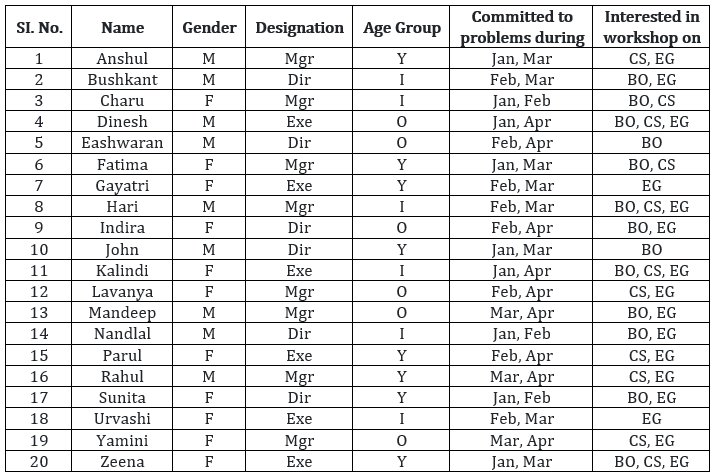
M = Male, F = Female; Exe = Executive, Mgr = Manager, Dir = Director; Y = Young, I = In-between, O = Old
For each workshop, exactly four employees are to be sent, of which at least two should be Females and at least one should be Young. No employee can be sent to a workshop in which he or she is not interested in. An employee cannot attend the workshop on
- Communication Skills, if he or she is committed to internal projects in the month of January;
- Business Opportunities, if he or she is committed to internal projects in the month of February;
- E-governance, if he or she is committed to internal projects in the month of March.
Assuming that Parul and Hari are attending the workshop on Communication Skills (CS), then which of the following employees can possibly attend the CS workshop?
Passage / Data
Answer the following question based on the information given below.
The table below reports the gender, designation and age-group of the employees in an organization. It also provides information on their commitment to projects coming up in the months of January (Jan), February (Feb), March (Mar) and April (Apr), as well as their interest in attending workshops on: Business Opportunities (BO), Communication Skills (CS), and E-Governance (EG).
M = Male, F = Female; Exe = Executive, Mgr = Manager, Dir = Director; Y = Young, I = In-between, O = Old
For each workshop, exactly four employees are to be sent, of which at least two should be Females and at least one should be Young. No employee can be sent to a workshop in which he or she is not interested in. An employee cannot attend the workshop on
- Communication Skills, if he or she is committed to internal projects in the month of January;
- Business Opportunities, if he or she is committed to internal projects in the month of February;
- E-governance, if he or she is committed to internal projects in the month of March.
How many Executives (Exe) cannot attend more than one workshop?
Passage / Data
Answer the following question based on the information given below.
The table below reports the gender, designation and age-group of the employees in an organization. It also provides information on their commitment to projects coming up in the months of January (Jan), February (Feb), March (Mar) and April (Apr), as well as their interest in attending workshops on: Business Opportunities (BO), Communication Skills (CS), and E-Governance (EG).
M = Male, F = Female; Exe = Executive, Mgr = Manager, Dir = Director; Y = Young, I = In-between, O = Old
For each workshop, exactly four employees are to be sent, of which at least two should be Females and at least one should be Young. No employee can be sent to a workshop in which he or she is not interested in. An employee cannot attend the workshop on
- Communication Skills, if he or she is committed to internal projects in the month of January;
- Business Opportunities, if he or she is committed to internal projects in the month of February;
- E-governance, if he or she is committed to internal projects in the month of March.
Which set of employees cannot attend any of the workshops?
Passage / Data
Answer the following question based on the information given below.
The Head of a newly formed government desires to appoint five of the six elected members A, B, C, D, E and F to portfolios of Home, Power, Defence, Telecom and Finance. F does not want any portfolio if D gets one of the five. C wants either Home or Finance or no portfolio. B says that if D gets either Power or Telecom then she must get the other one. E insists on a portfolio if A gets one.
Which is a valid assignment?
Passage / Data
Answer the following question based on the information given below.
The Head of a newly formed government desires to appoint five of the six elected members A, B, C, D, E and F to portfolios of Home, Power, Defence, Telecom and Finance. F does not want any portfolio if D gets one of the five. C wants either Home or Finance or no portfolio. B says that if D gets either Power or Telecom then she must get the other one. E insists on a portfolio if A gets one.
If A gets Home and C gets Finance, then which is NOT a valid assignment for Defence and Telecom?
Passage / Data
Answer the following question based on the information given below.
A group of three or four has to be selected from seven persons. Among are two women: Fiza and Kavita, and five men: Ram, Shyam, David, Peter and Rahim. Ram would not like to be in the group if Shyam is also selected. Shyam and Rahim want to be selected together in the group. Kavita would like to be in the group only if David is also there. David, if selected, would not like Peter in the group. Ram would like to be in the group only if Peter is also there. David insists that Fiza be selected in case he is there in the group.
Which of the following is a feasible group of three?
Passage / Data
Answer the following question based on the information given below.
A group of three or four has to be selected from seven persons. Among are two women: Fiza and Kavita, and five men: Ram, Shyam, David, Peter and Rahim. Ram would not like to be in the group if Shyam is also selected. Shyam and Rahim want to be selected together in the group. Kavita would like to be in the group only if David is also there. David, if selected, would not like Peter in the group. Ram would like to be in the group only if Peter is also there. David insists that Fiza be selected in case he is there in the group.
Which of the following is a feasible group of four?
Passage / Data
Answer the following question based on the information given below.
A group of three or four has to be selected from seven persons. Among are two women: Fiza and Kavita, and five men: Ram, Shyam, David, Peter and Rahim. Ram would not like to be in the group if Shyam is also selected. Shyam and Rahim want to be selected together in the group. Kavita would like to be in the group only if David is also there. David, if selected, would not like Peter in the group. Ram would like to be in the group only if Peter is also there. David insists that Fiza be selected in case he is there in the group.
Which of the following statements is true?
Passage / Data
Answer the following question based on the information given below.
A group of three or four has to be selected from seven persons. Among are two women: Fiza and Kavita, and five men: Ram, Shyam, David, Peter and Rahim. Ram would not like to be in the group if Shyam is also selected. Shyam and Rahim want to be selected together in the group. Kavita would like to be in the group only if David is also there. David, if selected, would not like Peter in the group. Ram would like to be in the group only if Peter is also there. David insists that Fiza be selected in case he is there in the group.
Eight people carrying food baskets are going for a picnic on motorcycles. Their names A, B, C, D, E, F, G, and H. They have four motorcycles, M1, M2, M3 and M4 among them. They also have four food baskets O, P, Q and R of different sizes and shapes and each can be carried only on motorcycles M1, M2, M3, or M4, respectively. No more than two persons can travel on a motorcycle and no more than one basket can be carried on a motorcycle. There are two husband-wife pairs in this group of eight people and each pair will ride on a motorcycle together. C cannot travel with A or B. E cannot travel with B or F. G cannot travel with F or H or D. The husband-wife pairs must carry baskets O and P. Q is with A and P is with D. F travels on M1 and E travels on M2 motorcycles. G is with Q, and B cannot go with R. Who is travelling with H?
Passage / Data
Answer the following question based on the information given below.
A group of three or four has to be selected from seven persons. Among are two women: Fiza and Kavita, and five men: Ram, Shyam, David, Peter and Rahim. Ram would not like to be in the group if Shyam is also selected. Shyam and Rahim want to be selected together in the group. Kavita would like to be in the group only if David is also there. David, if selected, would not like Peter in the group. Ram would like to be in the group only if Peter is also there. David insists that Fiza be selected in case he is there in the group.
In a "keep-fit" gymnasium class there are fifteen females enrolled in a weight-loss program. They all have been grouped in any one of the five weight-groups W1, W2, W3, W4, or W5. One instructor is assigned to one weight-group only. Sonali, Shalini, Shubhra, and Shahira belong to the same weight-group. Sonali and Rupa are in one weight-group, Rupali and Renuka are also in one weight-group. Rupa, Radha, Renuka, Ruchika and Ritu belong to different weight-groups. Somya cannot be with Ritu, and Tara cannot be with Radha. Komal cannot be with Radha, Somya, or Ritu. Shahira is in W1 and Somya is in W4 with Ruchika. Sweta and Jyotika cannot be with Rupali, but are in a weight-group with total membership of four. No weight-group can have more than five or less than one member. Amita, Babita, Chandrika, Deepika, and Elina are instructors of weight-groups with membership sizes 5, 4, 3, 2 and 1, respectively. Who is the instructor of Radha?
Passage / Data
Answer the following question based on the information given below.
A group of three or four has to be selected from seven persons. Among are two women: Fiza and Kavita, and five men: Ram, Shyam, David, Peter and Rahim. Ram would not like to be in the group if Shyam is also selected. Shyam and Rahim want to be selected together in the group. Kavita would like to be in the group only if David is also there. David, if selected, would not like Peter in the group. Ram would like to be in the group only if Peter is also there. David insists that Fiza be selected in case he is there in the group.
A king has unflinching loyalty from eight of his ministers M1 to M8, but he has to select only four to make a cabinet committee. He decides to choose these four such that each selected person shares a liking with at least one of the other three selected. The selected persons must also hate one of the likings of any of the other three persons selected.
A. M1 likes fishing and smoking, but hates gambling.
B. M2 likes smoking and drinking, but hates fishing.
C. M3 likes gambling, but hates smoking.
D. M4 likes mountaineering, but hates drinking.
E. M5 likes drinking, but hates smoking and mountaineering.
F. M6 likes fishing, but hates smoking and mountaineering.
G. M7 likes gambling and mountaineering, but hates fishing.
H. M8 likes smoking and gambling, but hates mountaineering.
Who are the four people selected by the king?