Basics of Triangles — CAT Previous-Year Questions
24 previous-year questions on Basics of Triangles from CAT, with full solutions. Practise free — check answers as you go; sign in to save your progress.
Basics of Triangles · CAT PYQs
In a right-angled triangle △ABC, the altitude AB is 5 cm, and the base BC is 12 cm. P and Q are two points on BC such that the areas of △ABP, △ABQ and △ABC are in arithmetic progression. If the area of △ABC is 1.5 times the area of △ABP, the length of PQ, in cm, is
A triangle is drawn with its vertices on the circle C such that one of its sides is a diameter of C and the other two sides have their lengths in the ratio a : b. If the radius of the circle is r, then the area of the triangle is
In triangle ABC, altitudes AD and BE are drawn to the corresponding bases. If ∠BAC = 45° and ∠ABC = θ, then AD/BE equals
The length of each side of an equilateral triangle ABC is 3 cm. Let D be a point on BC such that the area of triangle ADC is half the area of triangle ABD. Then the length of AD, in cm, is
Two ships are approaching a port along straight routes at constant speeds. Initially, the two ships and the port formed an equilateral triangle with sides of length 24 km. When the slower ship travelled 8 km, the triangle formed by the new positions of the two ships and the port became right-angled. When the faster ship reaches the port, the distance, in km, between the other ship and the port will be
In a triangle ABC, ∠BCA = 50°. D and E are points on AB and AC, respectively, such that AD = DE. If F is a point on BC such that BD = DF, then ∠FDE, in degrees is equal to
From an interior point of an equilateral triangle, perpendiculars are drawn on all three sides. The sum of the lengths of the three perpendiculars is s. Then the area of the triangle is
Corners are cut off from an equilateral triangle T to produce a regular hexagon H. Then, the ratio of the area of H to the area of T is
Let ABC be a right-angled isosceles triangle with hypotenuse BC. Let BQC be a semi-circle, away from A, with diameter BC. Let BPC be an arc of a circle centered at A and lying between BC and BQC. If AB has length 6 cm then the area, in sq. cm, of the region enclosed by BPC and BQC is:
Let ABC be a right-angled triangle with BC as the hypotenuse. Lengths of AB and AC are 15 km and 20 km, respectively. The minimum possible time, in minutes, required to reach the hypotenuse from A at a speed of 30 km per hour is:
Consider obtuse-angled triangles with sides 8 cm, 15 cm and x cm. If x is an integer, then how many such triangles exist?
In a triangle ABC, AB = 6, BC = 8 and AC = 10. A perpendicular dropped from B, meets the side AC at D. A circle of radius BD (with centre B) is drawn. If the circle cuts AB and BC at P and Q respectively, then AP : QC is equal to
Euclid has a triangle in mind, Its longest side has length 20 and another of its sides has length 10. Its area is 80. What is the exact length of its third side?
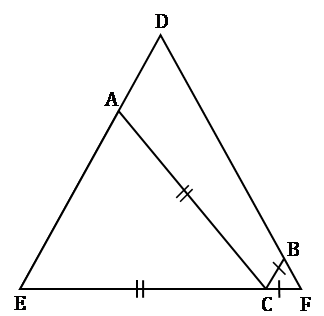
In ∆DEF shown below, points A, B, and C are taken on DE, DF and EF respectively such that EC = AC and CF = BC. If ∠D = 40°, then what is ∠ACB in degrees?
What is the number of distinct triangles with integral valued sides and perimeter 14?
If a, b, c are the sides of a triangle, and a2 + b2 + c2 = bc + ca + ab, then the triangle is
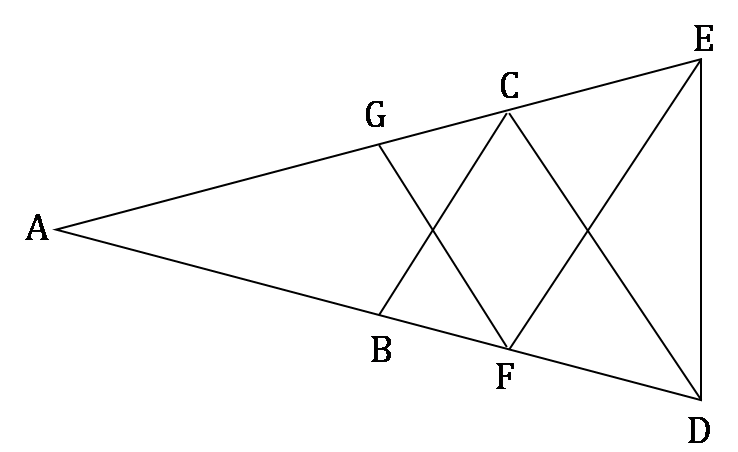
In the figure above, AB = BC = CD = DE = EF = FG = GA. Then ∠DAE is approximately
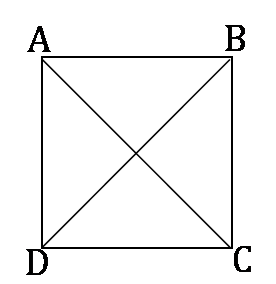
ABCD is a square of area 4, which is divided into four non-over lapping triangles as shown in figure. Then the sum of the perimeters of the triangles is
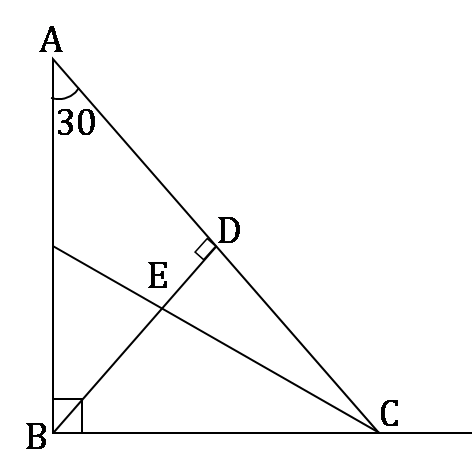
AB ⊥ BC, BD ⊥ AC and CE bisects ∠C, ∠A = 30°. Then what is ∠CED?
The sides of a triangle are 5, 12 and 13 units. A rectangle is constructed, which is equal in area to the triangle, and has a width of 10 units. Then the perimeter of the rectangle is
The length of a ladder is exactly equal to the height of the wall it is learning against. If lower end of the ladder is kept on a stool of height 3 m and the stool is kept 9 m away from the wall, the upper end of the ladder coincides with the top of the wall. Then the height of the wall is
Which one of the following cannot be the ratio of angles in a right-angled triangle?
Passage / Data
Answer the following questions based on the information given below:
ABC forms an equilateral triangle in which B is 2 km from A. A person starts walking from B in a direction parallel to AC and stops when he reaches a point D directly east of C. He, then, reverses direction and walks till he reaches a point E directly south of C.
Then D is
Passage / Data
Answer the following questions based on the information given below:
ABC forms an equilateral triangle in which B is 2 km from A. A person starts walking from B in a direction parallel to AC and stops when he reaches a point D directly east of C. He, then, reverses direction and walks till he reaches a point E directly south of C.
The total distance walked by the person is