Venn Diagram — CAT Previous-Year Questions
48 previous-year questions on Venn Diagram from CAT, with full solutions. Practise free — check answers as you go; sign in to save your progress.
Venn Diagram · CAT PYQs
Passage / Data
Answer the following questions based on the information given below.
The chart below provides complete information about the number of countries visited by Dheeraj, Samantha and Nitesh, in Asia, Europe and the rest of the world (ROW).
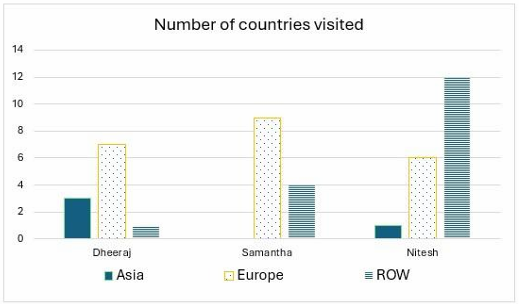
The following additional facts are known about the countries visited by them.
1. 32 countries were visited by at least one of them.
2. USA (in ROW) is the only country that was visited by all three of them.
3. China (in Asia) is the only country that was visited by both Dheeraj and Nitesh, but not by Samantha.
4. France (in Europe) is the only country outside Asia, which was visited by both Dheeraj and Samantha, but not by Nitesh.
5. Half of the countries visited by both Samantha and Nitesh are in Europe.
How many countries in Asia were visited by at least one of Dheeraj, Samantha and Nitesh?
Passage / Data
Answer the following questions based on the information given below.
The chart below provides complete information about the number of countries visited by Dheeraj, Samantha and Nitesh, in Asia, Europe and the rest of the world (ROW).
The following additional facts are known about the countries visited by them.
1. 32 countries were visited by at least one of them.
2. USA (in ROW) is the only country that was visited by all three of them.
3. China (in Asia) is the only country that was visited by both Dheeraj and Nitesh, but not by Samantha.
4. France (in Europe) is the only country outside Asia, which was visited by both Dheeraj and Samantha, but not by Nitesh.
5. Half of the countries visited by both Samantha and Nitesh are in Europe.
How many countries in Europe were visited only by Nitesh?
Passage / Data
Answer the following questions based on the information given below.
The chart below provides complete information about the number of countries visited by Dheeraj, Samantha and Nitesh, in Asia, Europe and the rest of the world (ROW).
The following additional facts are known about the countries visited by them.
1. 32 countries were visited by at least one of them.
2. USA (in ROW) is the only country that was visited by all three of them.
3. China (in Asia) is the only country that was visited by both Dheeraj and Nitesh, but not by Samantha.
4. France (in Europe) is the only country outside Asia, which was visited by both Dheeraj and Samantha, but not by Nitesh.
5. Half of the countries visited by both Samantha and Nitesh are in Europe.
How many countries in the ROW were visited by both Nitesh and Samantha?
Passage / Data
Answer the following questions based on the information given below.
The chart below provides complete information about the number of countries visited by Dheeraj, Samantha and Nitesh, in Asia, Europe and the rest of the world (ROW).
The following additional facts are known about the countries visited by them.
1. 32 countries were visited by at least one of them.
2. USA (in ROW) is the only country that was visited by all three of them.
3. China (in Asia) is the only country that was visited by both Dheeraj and Nitesh, but not by Samantha.
4. France (in Europe) is the only country outside Asia, which was visited by both Dheeraj and Samantha, but not by Nitesh.
5. Half of the countries visited by both Samantha and Nitesh are in Europe.
How many countries in Europe were visited by exactly one of Dheeraj, Samantha and Nitesh?
Passage / Data
Directions for next 5 queestions.
There are 15 girls and some boys among the graduating students in a class. They are planning a get-together, which can be either a 1-day event, or a 2-day event, or a 3-day event. There are 6 singers in the class, 4 of them are boys. There are 10 dancers in the class, 4 of them are girls. No dancer in the class is a singer.
Some students are not interested in attending the get-together. Those students who are interested in attending a 3-day event are also interested in attending a 2-day event; those who are interested in attending a 2-day event are also interested in attending a 1-day event.
The following facts are also known:
1. All the girls and 80% of the boys are interested in attending a 1-day event. 60% of the boys are interested in attending a 2-day event.
2. Some of the girls are interested in attending a 1-day event, but not a 2-day event; some of the other girls are interested in attending both.
3. 70% of the boys who are interested in attending a 2-day event are neither singers nor dancers. 60% of the girls who are interested in attending a 2-day event are neither singers nor dancers.
4. No girl is interested in attending a 3-day event. All male singers and 2 of the dancers are interested in attending a 3-day event.
5. The number of singers interested in attending a 2-day event is one more than the number of dancers interested in attending a 2-day event.
How many boys are there in the class?
Passage / Data
Directions for next 5 queestions.
There are 15 girls and some boys among the graduating students in a class. They are planning a get-together, which can be either a 1-day event, or a 2-day event, or a 3-day event. There are 6 singers in the class, 4 of them are boys. There are 10 dancers in the class, 4 of them are girls. No dancer in the class is a singer.
Some students are not interested in attending the get-together. Those students who are interested in attending a 3-day event are also interested in attending a 2-day event; those who are interested in attending a 2-day event are also interested in attending a 1-day event.
The following facts are also known:
1. All the girls and 80% of the boys are interested in attending a 1-day event. 60% of the boys are interested in attending a 2-day event.
2. Some of the girls are interested in attending a 1-day event, but not a 2-day event; some of the other girls are interested in attending both.
3. 70% of the boys who are interested in attending a 2-day event are neither singers nor dancers. 60% of the girls who are interested in attending a 2-day event are neither singers nor dancers.
4. No girl is interested in attending a 3-day event. All male singers and 2 of the dancers are interested in attending a 3-day event.
5. The number of singers interested in attending a 2-day event is one more than the number of dancers interested in attending a 2-day event.
Which of the following can be determined from the given information?
I. The number of boys who are interested in attending a 1-day event and are neither dancers nor singers.
II. The number of female dancers who are interested in attending a 1-day event.
Passage / Data
Directions for next 5 queestions.
There are 15 girls and some boys among the graduating students in a class. They are planning a get-together, which can be either a 1-day event, or a 2-day event, or a 3-day event. There are 6 singers in the class, 4 of them are boys. There are 10 dancers in the class, 4 of them are girls. No dancer in the class is a singer.
Some students are not interested in attending the get-together. Those students who are interested in attending a 3-day event are also interested in attending a 2-day event; those who are interested in attending a 2-day event are also interested in attending a 1-day event.
The following facts are also known:
1. All the girls and 80% of the boys are interested in attending a 1-day event. 60% of the boys are interested in attending a 2-day event.
2. Some of the girls are interested in attending a 1-day event, but not a 2-day event; some of the other girls are interested in attending both.
3. 70% of the boys who are interested in attending a 2-day event are neither singers nor dancers. 60% of the girls who are interested in attending a 2-day event are neither singers nor dancers.
4. No girl is interested in attending a 3-day event. All male singers and 2 of the dancers are interested in attending a 3-day event.
5. The number of singers interested in attending a 2-day event is one more than the number of dancers interested in attending a 2-day event.
What fraction of the class are interested in attending a 2-day event?
Passage / Data
Directions for next 5 queestions.
There are 15 girls and some boys among the graduating students in a class. They are planning a get-together, which can be either a 1-day event, or a 2-day event, or a 3-day event. There are 6 singers in the class, 4 of them are boys. There are 10 dancers in the class, 4 of them are girls. No dancer in the class is a singer.
Some students are not interested in attending the get-together. Those students who are interested in attending a 3-day event are also interested in attending a 2-day event; those who are interested in attending a 2-day event are also interested in attending a 1-day event.
The following facts are also known:
1. All the girls and 80% of the boys are interested in attending a 1-day event. 60% of the boys are interested in attending a 2-day event.
2. Some of the girls are interested in attending a 1-day event, but not a 2-day event; some of the other girls are interested in attending both.
3. 70% of the boys who are interested in attending a 2-day event are neither singers nor dancers. 60% of the girls who are interested in attending a 2-day event are neither singers nor dancers.
4. No girl is interested in attending a 3-day event. All male singers and 2 of the dancers are interested in attending a 3-day event.
5. The number of singers interested in attending a 2-day event is one more than the number of dancers interested in attending a 2-day event.
What BEST can be concluded about the number of male dancers who are interested in attending a 1-day event?
Passage / Data
Directions for next 5 queestions.
There are 15 girls and some boys among the graduating students in a class. They are planning a get-together, which can be either a 1-day event, or a 2-day event, or a 3-day event. There are 6 singers in the class, 4 of them are boys. There are 10 dancers in the class, 4 of them are girls. No dancer in the class is a singer.
Some students are not interested in attending the get-together. Those students who are interested in attending a 3-day event are also interested in attending a 2-day event; those who are interested in attending a 2-day event are also interested in attending a 1-day event.
The following facts are also known:
1. All the girls and 80% of the boys are interested in attending a 1-day event. 60% of the boys are interested in attending a 2-day event.
2. Some of the girls are interested in attending a 1-day event, but not a 2-day event; some of the other girls are interested in attending both.
3. 70% of the boys who are interested in attending a 2-day event are neither singers nor dancers. 60% of the girls who are interested in attending a 2-day event are neither singers nor dancers.
4. No girl is interested in attending a 3-day event. All male singers and 2 of the dancers are interested in attending a 3-day event.
5. The number of singers interested in attending a 2-day event is one more than the number of dancers interested in attending a 2-day event.
How many female dancers are interested in attending a 2-day event?
Passage / Data
Answer the next 5 questions based on the information given below:
A speciality supermarket sells 320 products. Each of these products was either a cosmetic product or a nutrition product. Each of these products was also either a foreign product or a domestic product. Each of these products had at least one of the two approvals – FDA or EU.
The following facts are also known:
1. There were equal numbers of domestic and foreign products.
2. Half of the domestic products were FDA approved cosmetic products.
3. None of the foreign products had both the approvals, while 60 domestic products had both the approvals.
4. There were 140 nutrition products, half of them were foreign products.
5. There were 200 FDA approved products. 70 of them were foreign products and 120 of them were cosmetic products.
How many foreign products were FDA approved cosmetic products?
Passage / Data
Answer the next 5 questions based on the information given below:
A speciality supermarket sells 320 products. Each of these products was either a cosmetic product or a nutrition product. Each of these products was also either a foreign product or a domestic product. Each of these products had at least one of the two approvals – FDA or EU.
The following facts are also known:
1. There were equal numbers of domestic and foreign products.
2. Half of the domestic products were FDA approved cosmetic products.
3. None of the foreign products had both the approvals, while 60 domestic products had both the approvals.
4. There were 140 nutrition products, half of them were foreign products.
5. There were 200 FDA approved products. 70 of them were foreign products and 120 of them were cosmetic products.
How many cosmetic products did not have FDA approval?
Passage / Data
Answer the next 5 questions based on the information given below:
A speciality supermarket sells 320 products. Each of these products was either a cosmetic product or a nutrition product. Each of these products was also either a foreign product or a domestic product. Each of these products had at least one of the two approvals – FDA or EU.
The following facts are also known:
1. There were equal numbers of domestic and foreign products.
2. Half of the domestic products were FDA approved cosmetic products.
3. None of the foreign products had both the approvals, while 60 domestic products had both the approvals.
4. There were 140 nutrition products, half of them were foreign products.
5. There were 200 FDA approved products. 70 of them were foreign products and 120 of them were cosmetic products.
Which among the following options best represents the number of domestic cosmetic products that had both the approvals?
Passage / Data
Answer the next 5 questions based on the information given below:
A speciality supermarket sells 320 products. Each of these products was either a cosmetic product or a nutrition product. Each of these products was also either a foreign product or a domestic product. Each of these products had at least one of the two approvals – FDA or EU.
The following facts are also known:
1. There were equal numbers of domestic and foreign products.
2. Half of the domestic products were FDA approved cosmetic products.
3. None of the foreign products had both the approvals, while 60 domestic products had both the approvals.
4. There were 140 nutrition products, half of them were foreign products.
5. There were 200 FDA approved products. 70 of them were foreign products and 120 of them were cosmetic products.
If 70 cosmetic products did not have EU approval, then how many nutrition products had both the approvals?
Passage / Data
Answer the next 5 questions based on the information given below:
A speciality supermarket sells 320 products. Each of these products was either a cosmetic product or a nutrition product. Each of these products was also either a foreign product or a domestic product. Each of these products had at least one of the two approvals – FDA or EU.
The following facts are also known:
1. There were equal numbers of domestic and foreign products.
2. Half of the domestic products were FDA approved cosmetic products.
3. None of the foreign products had both the approvals, while 60 domestic products had both the approvals.
4. There were 140 nutrition products, half of them were foreign products.
5. There were 200 FDA approved products. 70 of them were foreign products and 120 of them were cosmetic products.
If 50 nutrition products did not have EU approval, then how many domestic cosmetic products did not have EU approval?
Passage / Data
Answer the next 4 questions based on the information given below.
1000 patients currently suffering from a disease were selected to study the effectiveness of treatment of four types of medicines — A, B, C and D. These patients were first randomly assigned into two groups of equal size, called treatment group and control group. The patients in the control group were not treated with any of these medicines; instead they were given a dummy medicine, called placebo, containing only sugar and starch. The following information is known about the patients in the treatment group.
- A total of 250 patients were treated with type A medicine and a total of 210 patients were treated with type C medicine.
- 25 patients were treated with type A medicine only. 20 patients were treated with type C medicine only. 10 patients were treated with type D medicine only.
- 35 patients were treated with type A and type D medicines only. 20 patients were treated with type A and type B medicines only. 30 patients were treated with type A and type C medicines only. 20 patients were treated with type C and type D medicines only.
- 100 patients were treated with exactly three types of medicines.
- 40 patients were treated with medicines of types A, B and C, but not with medicines of type D. 20 patients were treated with medicines of types A, C and D, but not with medicines of type B.
- 50 patients were given all the four types of medicines. 75 patients were treated with exactly one type of medicine.
How many patients were treated with medicine type B?
Passage / Data
Answer the next 4 questions based on the information given below.
1000 patients currently suffering from a disease were selected to study the effectiveness of treatment of four types of medicines — A, B, C and D. These patients were first randomly assigned into two groups of equal size, called treatment group and control group. The patients in the control group were not treated with any of these medicines; instead they were given a dummy medicine, called placebo, containing only sugar and starch. The following information is known about the patients in the treatment group.
- A total of 250 patients were treated with type A medicine and a total of 210 patients were treated with type C medicine.
- 25 patients were treated with type A medicine only. 20 patients were treated with type C medicine only. 10 patients were treated with type D medicine only.
- 35 patients were treated with type A and type D medicines only. 20 patients were treated with type A and type B medicines only. 30 patients were treated with type A and type C medicines only. 20 patients were treated with type C and type D medicines only.
- 100 patients were treated with exactly three types of medicines.
- 40 patients were treated with medicines of types A, B and C, but not with medicines of type D. 20 patients were treated with medicines of types A, C and D, but not with medicines of type B.
- 50 patients were given all the four types of medicines. 75 patients were treated with exactly one type of medicine.
The number of patients who were treated with medicine types B, C and D, but not type A was:
Passage / Data
Answer the next 4 questions based on the information given below.
1000 patients currently suffering from a disease were selected to study the effectiveness of treatment of four types of medicines — A, B, C and D. These patients were first randomly assigned into two groups of equal size, called treatment group and control group. The patients in the control group were not treated with any of these medicines; instead they were given a dummy medicine, called placebo, containing only sugar and starch. The following information is known about the patients in the treatment group.
- A total of 250 patients were treated with type A medicine and a total of 210 patients were treated with type C medicine.
- 25 patients were treated with type A medicine only. 20 patients were treated with type C medicine only. 10 patients were treated with type D medicine only.
- 35 patients were treated with type A and type D medicines only. 20 patients were treated with type A and type B medicines only. 30 patients were treated with type A and type C medicines only. 20 patients were treated with type C and type D medicines only.
- 100 patients were treated with exactly three types of medicines.
- 40 patients were treated with medicines of types A, B and C, but not with medicines of type D. 20 patients were treated with medicines of types A, C and D, but not with medicines of type B.
- 50 patients were given all the four types of medicines. 75 patients were treated with exactly one type of medicine.
How many patients were treated with medicine types B and D only?
Passage / Data
Answer the next 4 questions based on the information given below.
1000 patients currently suffering from a disease were selected to study the effectiveness of treatment of four types of medicines — A, B, C and D. These patients were first randomly assigned into two groups of equal size, called treatment group and control group. The patients in the control group were not treated with any of these medicines; instead they were given a dummy medicine, called placebo, containing only sugar and starch. The following information is known about the patients in the treatment group.
- A total of 250 patients were treated with type A medicine and a total of 210 patients were treated with type C medicine.
- 25 patients were treated with type A medicine only. 20 patients were treated with type C medicine only. 10 patients were treated with type D medicine only.
- 35 patients were treated with type A and type D medicines only. 20 patients were treated with type A and type B medicines only. 30 patients were treated with type A and type C medicines only. 20 patients were treated with type C and type D medicines only.
- 100 patients were treated with exactly three types of medicines.
- 40 patients were treated with medicines of types A, B and C, but not with medicines of type D. 20 patients were treated with medicines of types A, C and D, but not with medicines of type B.
- 50 patients were given all the four types of medicines. 75 patients were treated with exactly one type of medicine.
The number of patients who were treated with medicine type D was:
Passage / Data
Answer the next 4 questions based on the information given below.
Ten musicians (A, B, C, D, E, F, G, H, I and J) are experts in at least one of the following three percussion instruments: tabla, mridangam, and ghatam. Among them, three are experts in tabla but not in mridangam or ghatam, another three are experts in mridangam but not in tabla or ghatam, and one is an expert in ghatam but not in tabla or mridangam. Further, two are experts in tabla and mridangam but not in ghatam, and one is an expert in tabla and ghatam but not in mridangam.
The following facts are known about these ten musicians.
- Both A and B are experts in mridangam, but only one of them is also an expert in tabla.
- D is an expert in both tabla and ghatam.
- Both F and G are experts in tabla, but only one of them is also an expert in mridangam.
- Neither I nor J is an expert in tabla.
- Neither H nor I is an expert in mridangam, but only one of them is an expert in ghatam.
Who among the following is DEFINITELY an expert in tabla but not in either mridangam or ghatam?
Passage / Data
Answer the next 4 questions based on the information given below.
Ten musicians (A, B, C, D, E, F, G, H, I and J) are experts in at least one of the following three percussion instruments: tabla, mridangam, and ghatam. Among them, three are experts in tabla but not in mridangam or ghatam, another three are experts in mridangam but not in tabla or ghatam, and one is an expert in ghatam but not in tabla or mridangam. Further, two are experts in tabla and mridangam but not in ghatam, and one is an expert in tabla and ghatam but not in mridangam.
The following facts are known about these ten musicians.
- Both A and B are experts in mridangam, but only one of them is also an expert in tabla.
- D is an expert in both tabla and ghatam.
- Both F and G are experts in tabla, but only one of them is also an expert in mridangam.
- Neither I nor J is an expert in tabla.
- Neither H nor I is an expert in mridangam, but only one of them is an expert in ghatam.
Who among the following is DEFINITELY an expert in mridangam but not in either tabla or ghatam?
Passage / Data
Answer the next 4 questions based on the information given below.
Ten musicians (A, B, C, D, E, F, G, H, I and J) are experts in at least one of the following three percussion instruments: tabla, mridangam, and ghatam. Among them, three are experts in tabla but not in mridangam or ghatam, another three are experts in mridangam but not in tabla or ghatam, and one is an expert in ghatam but not in tabla or mridangam. Further, two are experts in tabla and mridangam but not in ghatam, and one is an expert in tabla and ghatam but not in mridangam.
The following facts are known about these ten musicians.
- Both A and B are experts in mridangam, but only one of them is also an expert in tabla.
- D is an expert in both tabla and ghatam.
- Both F and G are experts in tabla, but only one of them is also an expert in mridangam.
- Neither I nor J is an expert in tabla.
- Neither H nor I is an expert in mridangam, but only one of them is an expert in ghatam.
Which of the following pairs CANNOT have any musician who is an expert in both tabla and mridangam but not in ghatam?
Passage / Data
Answer the next 4 questions based on the information given below.
Ten musicians (A, B, C, D, E, F, G, H, I and J) are experts in at least one of the following three percussion instruments: tabla, mridangam, and ghatam. Among them, three are experts in tabla but not in mridangam or ghatam, another three are experts in mridangam but not in tabla or ghatam, and one is an expert in ghatam but not in tabla or mridangam. Further, two are experts in tabla and mridangam but not in ghatam, and one is an expert in tabla and ghatam but not in mridangam.
The following facts are known about these ten musicians.
- Both A and B are experts in mridangam, but only one of them is also an expert in tabla.
- D is an expert in both tabla and ghatam.
- Both F and G are experts in tabla, but only one of them is also an expert in mridangam.
- Neither I nor J is an expert in tabla.
- Neither H nor I is an expert in mridangam, but only one of them is an expert in ghatam.
If C is an expert in mridangam and F is not, then which are the three musicians who are experts in tabla but not in either mridangam or ghatam?
Passage / Data
Answer the next 4 questions based on the information given.
A survey of 600 schools in India was conducted to gather information about their online teaching learning processes (OTLP). The following four facilities were studied.
F1: Own software for OTLP
F2: Trained teachers for OTLP
F3: Training materials for OTLP
F4: All students having Laptops
The following observations were summarized from the survey.
- 80 schools did not have any of the four facilities – F1, F2, F3, F4.
- 40 schools had all four facilities.
- The number of schools with only F1, only F2, only F3, and only F4 was 25, 30, 26 and 20 respectively.
- The number of schools with exactly three of the facilities was the same irrespective of which three were considered.
- 313 schools had F2.
- 26 schools had only F2 and F3 (but neither F1 nor F4).
- Among the schools having F4, 24 had only F3, and 45 had only F2.
- 162 schools had both F1 and F2.
- The number of schools having F1 was the same as the number of schools having F4.
What was the total number of schools having exactly three of the four facilities?
Passage / Data
Answer the next 4 questions based on the information given.
A survey of 600 schools in India was conducted to gather information about their online teaching learning processes (OTLP). The following four facilities were studied.
F1: Own software for OTLP
F2: Trained teachers for OTLP
F3: Training materials for OTLP
F4: All students having Laptops
The following observations were summarized from the survey.
- 80 schools did not have any of the four facilities – F1, F2, F3, F4.
- 40 schools had all four facilities.
- The number of schools with only F1, only F2, only F3, and only F4 was 25, 30, 26 and 20 respectively.
- The number of schools with exactly three of the facilities was the same irrespective of which three were considered.
- 313 schools had F2.
- 26 schools had only F2 and F3 (but neither F1 nor F4).
- Among the schools having F4, 24 had only F3, and 45 had only F2.
- 162 schools had both F1 and F2.
- The number of schools having F1 was the same as the number of schools having F4.
What was the number of schools having facilities F2 and F4?
Passage / Data
Answer the next 4 questions based on the information given.
A survey of 600 schools in India was conducted to gather information about their online teaching learning processes (OTLP). The following four facilities were studied.
F1: Own software for OTLP
F2: Trained teachers for OTLP
F3: Training materials for OTLP
F4: All students having Laptops
The following observations were summarized from the survey.
- 80 schools did not have any of the four facilities – F1, F2, F3, F4.
- 40 schools had all four facilities.
- The number of schools with only F1, only F2, only F3, and only F4 was 25, 30, 26 and 20 respectively.
- The number of schools with exactly three of the facilities was the same irrespective of which three were considered.
- 313 schools had F2.
- 26 schools had only F2 and F3 (but neither F1 nor F4).
- Among the schools having F4, 24 had only F3, and 45 had only F2.
- 162 schools had both F1 and F2.
- The number of schools having F1 was the same as the number of schools having F4.
What was the number of schools having only facilities F1 and F3?
Passage / Data
Answer the next 4 questions based on the information given.
A survey of 600 schools in India was conducted to gather information about their online teaching learning processes (OTLP). The following four facilities were studied.
F1: Own software for OTLP
F2: Trained teachers for OTLP
F3: Training materials for OTLP
F4: All students having Laptops
The following observations were summarized from the survey.
- 80 schools did not have any of the four facilities – F1, F2, F3, F4.
- 40 schools had all four facilities.
- The number of schools with only F1, only F2, only F3, and only F4 was 25, 30, 26 and 20 respectively.
- The number of schools with exactly three of the facilities was the same irrespective of which three were considered.
- 313 schools had F2.
- 26 schools had only F2 and F3 (but neither F1 nor F4).
- Among the schools having F4, 24 had only F3, and 45 had only F2.
- 162 schools had both F1 and F2.
- The number of schools having F1 was the same as the number of schools having F4.
What was the number of schools having only facilities F1 andF4?
Passage / Data
Answer the following question based on the information given below.
1600 satellites were sent up by a country for several purposes. The purposes are classified as broadcasting (B), communication (C), surveillance (S), and others (O). A satellite can serve multiple purposes; however a satellite serving either B, or C, or S does not serve O.
The following facts are known about the satellites:
- The numbers of satellites serving B, C, and S (though may be not exclusively) are in the ratio 2 : 1 : 1.
- The number of satellites serving all three of B, C, and S is 100.
- The number of satellites exclusively serving C is the same as the number of satellites exclusively serving S. This number is 30% of the number of satellites exclusively serving B.
- The number of satellites serving O is the same as the number of satellites serving both Cand S but not B.
What best can be said about the number of satellites serving C?
Passage / Data
Answer the following question based on the information given below.
1600 satellites were sent up by a country for several purposes. The purposes are classified as broadcasting (B), communication (C), surveillance (S), and others (O). A satellite can serve multiple purposes; however a satellite serving either B, or C, or S does not serve O.
The following facts are known about the satellites:
- The numbers of satellites serving B, C, and S (though may be not exclusively) are in the ratio 2 : 1 : 1.
- The number of satellites serving all three of B, C, and S is 100.
- The number of satellites exclusively serving C is the same as the number of satellites exclusively serving S. This number is 30% of the number of satellites exclusively serving B.
- The number of satellites serving O is the same as the number of satellites serving both Cand S but not B.
What is the minimum possible number of satellites serving B exclusively?
Passage / Data
Answer the following question based on the information given below.
1600 satellites were sent up by a country for several purposes. The purposes are classified as broadcasting (B), communication (C), surveillance (S), and others (O). A satellite can serve multiple purposes; however a satellite serving either B, or C, or S does not serve O.
The following facts are known about the satellites:
- The numbers of satellites serving B, C, and S (though may be not exclusively) are in the ratio 2 : 1 : 1.
- The number of satellites serving all three of B, C, and S is 100.
- The number of satellites exclusively serving C is the same as the number of satellites exclusively serving S. This number is 30% of the number of satellites exclusively serving B.
- The number of satellites serving O is the same as the number of satellites serving both Cand S but not B.
If at least 100 of the 1600 satellites were serving O, what can be said about the number of satellites serving S?
Passage / Data
Answer the following question based on the information given below.
1600 satellites were sent up by a country for several purposes. The purposes are classified as broadcasting (B), communication (C), surveillance (S), and others (O). A satellite can serve multiple purposes; however a satellite serving either B, or C, or S does not serve O.
The following facts are known about the satellites:
- The numbers of satellites serving B, C, and S (though may be not exclusively) are in the ratio 2 : 1 : 1.
- The number of satellites serving all three of B, C, and S is 100.
- The number of satellites exclusively serving C is the same as the number of satellites exclusively serving S. This number is 30% of the number of satellites exclusively serving B.
- The number of satellites serving O is the same as the number of satellites serving both Cand S but not B.
If the number of satellites serving at least two among B, C, and S is 1200, which of the following MUST be FALSE?
Passage / Data
Answer the following question based on the information given below.
Fun Sports (FS) provides training in three sports – Gilli-danda (G), Kho-Kho (K), and Ludo (L). Currently it has an enrollment of 39 students each of whom is enrolled in at least one of the three sports. The following details are known:
- The number of students enrolled only in L is double the number of students enrolled in all the three sports.
- There are a total of 17 students enrolled in G.
- The number of students enrolled only in G is one less than the number of students enrolled only in L.
- The number of students enrolled only in K is equal to the number of students who are enrolled in both K and L.
- The maximum student enrollment is in L.
- Ten students enrolled in G are also enrolled in at least one more sport.
What is the minimum number of students enrolled in both G and L but not in K?
Passage / Data
Answer the following question based on the information given below.
Fun Sports (FS) provides training in three sports – Gilli-danda (G), Kho-Kho (K), and Ludo (L). Currently it has an enrollment of 39 students each of whom is enrolled in at least one of the three sports. The following details are known:
- The number of students enrolled only in L is double the number of students enrolled in all the three sports.
- There are a total of 17 students enrolled in G.
- The number of students enrolled only in G is one less than the number of students enrolled only in L.
- The number of students enrolled only in K is equal to the number of students who are enrolled in both K and L.
- The maximum student enrollment is in L.
- Ten students enrolled in G are also enrolled in at least one more sport.
If the numbers of students enrolled in K and L are in the ratio 19:22, then what is the number of students enrolled in L?
Passage / Data
Answer the following question based on the information given below.
Fun Sports (FS) provides training in three sports – Gilli-danda (G), Kho-Kho (K), and Ludo (L). Currently it has an enrollment of 39 students each of whom is enrolled in at least one of the three sports. The following details are known:
- The number of students enrolled only in L is double the number of students enrolled in all the three sports.
- There are a total of 17 students enrolled in G.
- The number of students enrolled only in G is one less than the number of students enrolled only in L.
- The number of students enrolled only in K is equal to the number of students who are enrolled in both K and L.
- The maximum student enrollment is in L.
- Ten students enrolled in G are also enrolled in at least one more sport.
Due to academic pressure, students who were enrolled in all three sports were asked to withdraw from one of the three sports. After the withdrawal, the number of students enrolled in G was six less than the number of students enrolled in L, while the number of students enrolled in K went down by one. After the withdrawal, how many students were enrolled in both G and K?
Passage / Data
Answer the following question based on the information given below.
Fun Sports (FS) provides training in three sports – Gilli-danda (G), Kho-Kho (K), and Ludo (L). Currently it has an enrollment of 39 students each of whom is enrolled in at least one of the three sports. The following details are known:
- The number of students enrolled only in L is double the number of students enrolled in all the three sports.
- There are a total of 17 students enrolled in G.
- The number of students enrolled only in G is one less than the number of students enrolled only in L.
- The number of students enrolled only in K is equal to the number of students who are enrolled in both K and L.
- The maximum student enrollment is in L.
- Ten students enrolled in G are also enrolled in at least one more sport.
Due to academic pressure, students who were enrolled in all three sports were asked to withdraw from one of the three sports. After the withdrawal, the number of students enrolled in G was six less than the number of students enrolled in L, while the number of students enrolled in K went down by one. After the withdrawal, how many students were enrolled in both G and L?
Passage / Data
Answer the following question based on the information given below.
Applicants for the doctoral programmes of Ambi Institute of Engineering (AIE) and Bambi Institute of Enginneering (BIE) have to appear for a Common Entrance Test (CET). The test has three sections: Physics (P), Chemistry (C), and Maths (M). Among those appearing for CET, those at or above the 80th percentile in at least two sections, and at or above the 90th percentile overall, are selected for Advanced Entrance Test (AET) conducted by AIE. AET is used by AIE for final selection.
For the 200 candidates who are at or above the 90th percentile overall based on CET, the following are known about their performance in CET:
- No one is below the 80th percentile in all 3 sections.
- 150 are at or above the 80th percentile in exactly two sections.
- The number of candidates at or above the 80th percentile only in P is the same as the number of candidates at or above the 80th percentile only in C. The same is the number of candidates at or above the 80th percentile only in M.
- Number of candidates below 80th percentile in P : Number of candidates below 80th percentile in C : Number of candidates below 80th percentile in M = 4 : 2 : 1.
BIE uses a different process for selection. If any candidates is appearing in the AET by AIE, BIE consider their AET score for final selection provided the candidates is at or above the 80th percentile in P. Any other candidate at or above the 80th percentile in P in CET, but who is not eligible for AET, is required to appear in a separate test to be conducted by BIE for being considered for final selection. Altogether, there are 400 candidates this year who are at or above the 80th percentile in P.
What best can be concluded about the number of candidates sitting for the separate test for BIE who were at or above the 90th percentile overall in CET?
Passage / Data
Answer the following question based on the information given below.
Applicants for the doctoral programmes of Ambi Institute of Engineering (AIE) and Bambi Institute of Enginneering (BIE) have to appear for a Common Entrance Test (CET). The test has three sections: Physics (P), Chemistry (C), and Maths (M). Among those appearing for CET, those at or above the 80th percentile in at least two sections, and at or above the 90th percentile overall, are selected for Advanced Entrance Test (AET) conducted by AIE. AET is used by AIE for final selection.
For the 200 candidates who are at or above the 90th percentile overall based on CET, the following are known about their performance in CET:
- No one is below the 80th percentile in all 3 sections.
- 150 are at or above the 80th percentile in exactly two sections.
- The number of candidates at or above the 80th percentile only in P is the same as the number of candidates at or above the 80th percentile only in C. The same is the number of candidates at or above the 80th percentile only in M.
- Number of candidates below 80th percentile in P : Number of candidates below 80th percentile in C : Number of candidates below 80th percentile in M = 4 : 2 : 1.
BIE uses a different process for selection. If any candidates is appearing in the AET by AIE, BIE consider their AET score for final selection provided the candidates is at or above the 80th percentile in P. Any other candidate at or above the 80th percentile in P in CET, but who is not eligible for AET, is required to appear in a separate test to be conducted by BIE for being considered for final selection. Altogether, there are 400 candidates this year who are at or above the 80th percentile in P.
If the number of candidates who are at or above the 90th percentile overall and also at or above the 80th percentile in all three sections in CET is actually a multiple of 5, what is the number of candidates who are at or above the 90th percentile overall and at or above the 80th percentile in both P and M in CET?
Passage / Data
Answer the following question based on the information given below.
Applicants for the doctoral programmes of Ambi Institute of Engineering (AIE) and Bambi Institute of Enginneering (BIE) have to appear for a Common Entrance Test (CET). The test has three sections: Physics (P), Chemistry (C), and Maths (M). Among those appearing for CET, those at or above the 80th percentile in at least two sections, and at or above the 90th percentile overall, are selected for Advanced Entrance Test (AET) conducted by AIE. AET is used by AIE for final selection.
For the 200 candidates who are at or above the 90th percentile overall based on CET, the following are known about their performance in CET:
- No one is below the 80th percentile in all 3 sections.
- 150 are at or above the 80th percentile in exactly two sections.
- The number of candidates at or above the 80th percentile only in P is the same as the number of candidates at or above the 80th percentile only in C. The same is the number of candidates at or above the 80th percentile only in M.
- Number of candidates below 80th percentile in P : Number of candidates below 80th percentile in C : Number of candidates below 80th percentile in M = 4 : 2 : 1.
BIE uses a different process for selection. If any candidates is appearing in the AET by AIE, BIE consider their AET score for final selection provided the candidates is at or above the 80th percentile in P. Any other candidate at or above the 80th percentile in P in CET, but who is not eligible for AET, is required to appear in a separate test to be conducted by BIE for being considered for final selection. Altogether, there are 400 candidates this year who are at or above the 80th percentile in P.
If the number of candidates who are at or above the 90th percentile overall and also at or above the 80th percentile in all three sections in CET is actually a multiple of 5, then how many candidates were shortlisted for the AET for AIE?
Passage / Data
Answer the following question based on the information given below.
Applicants for the doctoral programmes of Ambi Institute of Engineering (AIE) and Bambi Institute of Enginneering (BIE) have to appear for a Common Entrance Test (CET). The test has three sections: Physics (P), Chemistry (C), and Maths (M). Among those appearing for CET, those at or above the 80th percentile in at least two sections, and at or above the 90th percentile overall, are selected for Advanced Entrance Test (AET) conducted by AIE. AET is used by AIE for final selection.
For the 200 candidates who are at or above the 90th percentile overall based on CET, the following are known about their performance in CET:
- No one is below the 80th percentile in all 3 sections.
- 150 are at or above the 80th percentile in exactly two sections.
- The number of candidates at or above the 80th percentile only in P is the same as the number of candidates at or above the 80th percentile only in C. The same is the number of candidates at or above the 80th percentile only in M.
- Number of candidates below 80th percentile in P : Number of candidates below 80th percentile in C : Number of candidates below 80th percentile in M = 4 : 2 : 1.
BIE uses a different process for selection. If any candidates is appearing in the AET by AIE, BIE consider their AET score for final selection provided the candidates is at or above the 80th percentile in P. Any other candidate at or above the 80th percentile in P in CET, but who is not eligible for AET, is required to appear in a separate test to be conducted by BIE for being considered for final selection. Altogether, there are 400 candidates this year who are at or above the 80th percentile in P.
If the number of candidates who are at or above the 90th percentile overall and also are at or above the 80th percentile in P in CET, is more than 100, how many candidates had to sit for the separate test for BIE?
Passage / Data
Answer the following question based on the information given below.
Help Distress (HD) is an NGO involved in providing assistance to people suffering from natural disasters. Currently, it has 37 volunteers. They are involved in three projects: Tsunami Relief (TR) in Tamil Nadu, FloodRelief (FR) in Maharashtra, and Earthquake Relief (ER) in Gujarat. Each volunteer working with Help Distress has to be involved in at least one relief work project.
- A Maximum number of volunteers are involved in the FR project. Among them, the number of volunteers involved in FR project alone is equal to the volunteers having additional involvement in the ER project.
- The number of volunteers involved in the ER project alone is double the number of volunteers involved in all the three projects.
- 17 volunteers are involved in the TR project.
- The number of volunteers involved in the TR project alone is one less than the number of volunteers involved in ER Project alone.
- Ten volunteers involved in the TR project are also involved in at least one more project.
Based on the information given above, the minimum number of volunteers involved in both FR and TR projects, but not in the ER project is:
Passage / Data
Answer the following question based on the information given below.
Help Distress (HD) is an NGO involved in providing assistance to people suffering from natural disasters. Currently, it has 37 volunteers. They are involved in three projects: Tsunami Relief (TR) in Tamil Nadu, FloodRelief (FR) in Maharashtra, and Earthquake Relief (ER) in Gujarat. Each volunteer working with Help Distress has to be involved in at least one relief work project.
- A Maximum number of volunteers are involved in the FR project. Among them, the number of volunteers involved in FR project alone is equal to the volunteers having additional involvement in the ER project.
- The number of volunteers involved in the ER project alone is double the number of volunteers involved in all the three projects.
- 17 volunteers are involved in the TR project.
- The number of volunteers involved in the TR project alone is one less than the number of volunteers involved in ER Project alone.
- Ten volunteers involved in the TR project are also involved in at least one more project.
Which of the following additional information would enable to find the exact number of volunteers involved in various projects?
Passage / Data
Answer the following question based on the information given below.
Help Distress (HD) is an NGO involved in providing assistance to people suffering from natural disasters. Currently, it has 37 volunteers. They are involved in three projects: Tsunami Relief (TR) in Tamil Nadu, FloodRelief (FR) in Maharashtra, and Earthquake Relief (ER) in Gujarat. Each volunteer working with Help Distress has to be involved in at least one relief work project.
- A Maximum number of volunteers are involved in the FR project. Among them, the number of volunteers involved in FR project alone is equal to the volunteers having additional involvement in the ER project.
- The number of volunteers involved in the ER project alone is double the number of volunteers involved in all the three projects.
- 17 volunteers are involved in the TR project.
- The number of volunteers involved in the TR project alone is one less than the number of volunteers involved in ER Project alone.
- Ten volunteers involved in the TR project are also involved in at least one more project.
After some time, the volunteers who were involved in all the three projects were asked to withdraw from one project. As a result, one of the volunteers opted out of the TR project, and one opted out of the ER project, while the remaining ones involved in all the three projects opted out of the FR project. Which of the following statements, then, necessarily follows?
Passage / Data
Answer the following question based on the information given below.
Help Distress (HD) is an NGO involved in providing assistance to people suffering from natural disasters. Currently, it has 37 volunteers. They are involved in three projects: Tsunami Relief (TR) in Tamil Nadu, FloodRelief (FR) in Maharashtra, and Earthquake Relief (ER) in Gujarat. Each volunteer working with Help Distress has to be involved in at least one relief work project.
- A Maximum number of volunteers are involved in the FR project. Among them, the number of volunteers involved in FR project alone is equal to the volunteers having additional involvement in the ER project.
- The number of volunteers involved in the ER project alone is double the number of volunteers involved in all the three projects.
- 17 volunteers are involved in the TR project.
- The number of volunteers involved in the TR project alone is one less than the number of volunteers involved in ER Project alone.
- Ten volunteers involved in the TR project are also involved in at least one more project.
After the withdrawal of volunteers, as indicated in Question 89, some new volunteers joined the NGO. Each one of them was allotted only one project in a manner such that, the number of volunteers working in one project alone for each of the three projects became identical. At that point, it was also found that the number of volunteers involved in FR and ER projects was the same as the number of volunteers involved in TR and ER projects. Which of the projects now has the highest number of volunteers?
Passage / Data
Choose 1, if the question can be answered by using statement A alone but not by using B alone.
Choose 2, if the question can be answered by using statement B alone but not by using A alone.
Choose 3, if the question can be answered by using either statement alone.
Choose 4, if the question can be answered by using both the statements together but not by either statement.
70 percent of the employees in a multinational corporation have VCD players, 75 percent have microwave ovens, 80 percent have ACs and 85 percent have washing machines. At least what percentage of employees has all four gadgets?
Passage / Data
Answer the following question based on the information given below.
A group of three or four has to be selected from seven persons. Among are two women: Fiza and Kavita, and five men: Ram, Shyam, David, Peter and Rahim. Ram would not like to be in the group if Shyam is also selected. Shyam and Rahim want to be selected together in the group. Kavita would like to be in the group only if David is also there. David, if selected, would not like Peter in the group. Ram would like to be in the group only if Peter is also there. David insists that Fiza be selected in case he is there in the group.
On her walk through the park, Hansa collected 50 coloured leaves, all either maple or oak. She sorted them by category when she got home, and found the following:
A. The number of red oak leaves with spots is even and positive.
B. The number of red oak leaves without any spot equals the number of red maple leaves without spots.
C. All non-red oak leaves have spots, and there are five times as many of them as there are red spotted oak leaves.
D. There are no spotted maple leaves that are not red.
E. There are exactly 6 red spotted maple leaves.
F. There are exactly 22 maple leaves that are neither spotted nor red.
How many oak leaves did she collect?
Passage / Data
Answer the following question based on the information given below.
A and B are two sets (e.g. A = mothers, B = women). The elements that could belong to both the sets (e.g. women who are mothers) is given by the set C = A.B. The elements which could belong to either A or B, or both, is indicated by the set D = A ∪ B. A set that does not contain any elements is known as a null set, represented by Ï (for example, if none of the women in the set B is a mother, they C = A.B is a null set, or C = Ï).
Let 'V' signify the set of all vertebrates; 'M' the set of all mammals; 'D' dogs; 'F' fish; 'A' Alsatian and 'P', a dog named Pluto.
Given that X = M.D is such that X = D, which of the following is true?
Passage / Data
Answer the following question based on the information given below.
A and B are two sets (e.g. A = mothers, B = women). The elements that could belong to both the sets (e.g. women who are mothers) is given by the set C = A.B. The elements which could belong to either A or B, or both, is indicated by the set D = A ∪ B. A set that does not contain any elements is known as a null set, represented by Ï (for example, if none of the women in the set B is a mother, they C = A.B is a null set, or C = Ï).
Let 'V' signify the set of all vertebrates; 'M' the set of all mammals; 'D' dogs; 'F' fish; 'A' Alsatian and 'P', a dog named Pluto.
If Y = F. (D.V), is not a null set, it implies that
Passage / Data
Answer the following question based on the information given below.
A and B are two sets (e.g. A = mothers, B = women). The elements that could belong to both the sets (e.g. women who are mothers) is given by the set C = A.B. The elements which could belong to either A or B, or both, is indicated by the set D = A ∪ B. A set that does not contain any elements is known as a null set, represented by Ï (for example, if none of the women in the set B is a mother, they C = A.B is a null set, or C = Ï).
Let 'V' signify the set of all vertebrates; 'M' the set of all mammals; 'D' dogs; 'F' fish; 'A' Alsatian and 'P', a dog named Pluto.
If Z = (P.D) ∪ M, then
Passage / Data
Answer the following question based on the information given below.
A and B are two sets (e.g. A = mothers, B = women). The elements that could belong to both the sets (e.g. women who are mothers) is given by the set C = A.B. The elements which could belong to either A or B, or both, is indicated by the set D = A ∪ B. A set that does not contain any elements is known as a null set, represented by Ï (for example, if none of the women in the set B is a mother, they C = A.B is a null set, or C = Ï).
Let 'V' signify the set of all vertebrates; 'M' the set of all mammals; 'D' dogs; 'F' fish; 'A' Alsatian and 'P', a dog named Pluto.
If P.A = Ï and P ∪ A = D, then which of the following is true?