Arrangements — CAT Previous-Year Questions
65 previous-year questions on Arrangements from CAT, with full solutions. Practise free — check answers as you go; sign in to save your progress.
Arrangements · CAT PYQs
Passage / Data
A round table has seven chairs around it. The chairs are numbered 1 through 7 in a clockwise direction. Four friends, Aslam, Bashir, Chhavi, and Davies, sit on four of the chairs. In the starting position, Aslam and Chhavi are sitting next to each other, while for Bashir as well as Davies, there are empty chairs on either side of the chairs that are sitting on.
The friends take turns moving either clockwise or counterclockwise from their chair. The friend who has to move in a turn occupies the first empty chair in whichever direction (s)he chooses to move. Aslam moves first (Turn 1), followed by Bashir, Chhavi, and Davies (Turns 2, 3, and 4, respectively). Then Aslam moves again followed by Bashir, and Chhavi (Turns 5, 6, and 7, respectively).
The following information is known.
1. The four friends occupy adjacent chairs only at the end of Turn 2 and Turn 6.
2. Davies occupies Chair 2 after Turn 1 and Chair 4 after Turn 5, and Chhavi occupies Chair 7 after Turn 2.
What is the number of the chair initially occupied by Bashir?
Passage / Data
A round table has seven chairs around it. The chairs are numbered 1 through 7 in a clockwise direction. Four friends, Aslam, Bashir, Chhavi, and Davies, sit on four of the chairs. In the starting position, Aslam and Chhavi are sitting next to each other, while for Bashir as well as Davies, there are empty chairs on either side of the chairs that are sitting on.
The friends take turns moving either clockwise or counterclockwise from their chair. The friend who has to move in a turn occupies the first empty chair in whichever direction (s)he chooses to move. Aslam moves first (Turn 1), followed by Bashir, Chhavi, and Davies (Turns 2, 3, and 4, respectively). Then Aslam moves again followed by Bashir, and Chhavi (Turns 5, 6, and 7, respectively).
The following information is known.
1. The four friends occupy adjacent chairs only at the end of Turn 2 and Turn 6.
2. Davies occupies Chair 2 after Turn 1 and Chair 4 after Turn 5, and Chhavi occupies Chair 7 after Turn 2.
Who sits on the chair numbered 4 at the end of Turn 3?
Passage / Data
A round table has seven chairs around it. The chairs are numbered 1 through 7 in a clockwise direction. Four friends, Aslam, Bashir, Chhavi, and Davies, sit on four of the chairs. In the starting position, Aslam and Chhavi are sitting next to each other, while for Bashir as well as Davies, there are empty chairs on either side of the chairs that are sitting on.
The friends take turns moving either clockwise or counterclockwise from their chair. The friend who has to move in a turn occupies the first empty chair in whichever direction (s)he chooses to move. Aslam moves first (Turn 1), followed by Bashir, Chhavi, and Davies (Turns 2, 3, and 4, respectively). Then Aslam moves again followed by Bashir, and Chhavi (Turns 5, 6, and 7, respectively).
The following information is known.
1. The four friends occupy adjacent chairs only at the end of Turn 2 and Turn 6.
2. Davies occupies Chair 2 after Turn 1 and Chair 4 after Turn 5, and Chhavi occupies Chair 7 after Turn 2.
Which of the chairs are occupied at the end of Turn 6?
Passage / Data
A round table has seven chairs around it. The chairs are numbered 1 through 7 in a clockwise direction. Four friends, Aslam, Bashir, Chhavi, and Davies, sit on four of the chairs. In the starting position, Aslam and Chhavi are sitting next to each other, while for Bashir as well as Davies, there are empty chairs on either side of the chairs that are sitting on.
The friends take turns moving either clockwise or counterclockwise from their chair. The friend who has to move in a turn occupies the first empty chair in whichever direction (s)he chooses to move. Aslam moves first (Turn 1), followed by Bashir, Chhavi, and Davies (Turns 2, 3, and 4, respectively). Then Aslam moves again followed by Bashir, and Chhavi (Turns 5, 6, and 7, respectively).
The following information is known.
1. The four friends occupy adjacent chairs only at the end of Turn 2 and Turn 6.
2. Davies occupies Chair 2 after Turn 1 and Chair 4 after Turn 5, and Chhavi occupies Chair 7 after Turn 2.
Which of the following BEST describes the friends sitting on chairs adjacent to the one occupied by Bashir at the end of Turn 7?
Passage / Data
Seven children, Aarav, Bina, Chirag, Diya, Eshan, Farhan, and Gaurav, are
sitting in a circle facing inside (not necessarily in the same order) and playing a game of
'Passing the Buck'.
The game is played over 10 rounds. In each round, the child
holding the Buck must pass it directly to a child sitting in one of the following
positions:
• Immediately to the left;
• Immediate to the right;
•
Second to the left; or
• Second to the right.
The game starts with Bina
passing the Buck and ends with Chirag receiving the Buck. The table below provides some
information about the pass types and the child receiving the Buck. Some information is
missing and labelled as '?'.
| Round | Position | Name |
|---|---|---|
| 1 | Immediately to the left | Aarav |
| 2 | Second to the right | ? |
| 3 | Immediately to the right | Diya |
| 4 | ? | ? |
| 5 | ? | Aarav |
| 6 | Second to the left | ? |
| 7 | Immediately to the left | Gaurav |
| 8 | Immediately to the left | ? |
| 9 | ? | Farhan |
| 10 | ? | Chirag |
Who is sitting immediately to the right of Bina?
Passage / Data
Seven children, Aarav, Bina, Chirag, Diya, Eshan, Farhan, and Gaurav, are
sitting in a circle facing inside (not necessarily in the same order) and playing a game of
'Passing the Buck'.
The game is played over 10 rounds. In each round, the child
holding the Buck must pass it directly to a child sitting in one of the following
positions:
• Immediately to the left;
• Immediate to the right;
•
Second to the left; or
• Second to the right.
The game starts with Bina
passing the Buck and ends with Chirag receiving the Buck. The table below provides some
information about the pass types and the child receiving the Buck. Some information is
missing and labelled as '?'.
| Round | Position | Name |
|---|---|---|
| 1 | Immediately to the left | Aarav |
| 2 | Second to the right | ? |
| 3 | Immediately to the right | Diya |
| 4 | ? | ? |
| 5 | ? | Aarav |
| 6 | Second to the left | ? |
| 7 | Immediately to the left | Gaurav |
| 8 | Immediately to the left | ? |
| 9 | ? | Farhan |
| 10 | ? | Chirag |
Who is sitting third to the left of Eshan?
Passage / Data
Seven children, Aarav, Bina, Chirag, Diya, Eshan, Farhan, and Gaurav, are
sitting in a circle facing inside (not necessarily in the same order) and playing a game of
'Passing the Buck'.
The game is played over 10 rounds. In each round, the child
holding the Buck must pass it directly to a child sitting in one of the following
positions:
• Immediately to the left;
• Immediate to the right;
•
Second to the left; or
• Second to the right.
The game starts with Bina
passing the Buck and ends with Chirag receiving the Buck. The table below provides some
information about the pass types and the child receiving the Buck. Some information is
missing and labelled as '?'.
| Round | Position | Name |
|---|---|---|
| 1 | Immediately to the left | Aarav |
| 2 | Second to the right | ? |
| 3 | Immediately to the right | Diya |
| 4 | ? | ? |
| 5 | ? | Aarav |
| 6 | Second to the left | ? |
| 7 | Immediately to the left | Gaurav |
| 8 | Immediately to the left | ? |
| 9 | ? | Farhan |
| 10 | ? | Chirag |
For which of the following pass types can the total number of occurrences be uniquely determined?
Passage / Data
Seven children, Aarav, Bina, Chirag, Diya, Eshan, Farhan, and Gaurav, are
sitting in a circle facing inside (not necessarily in the same order) and playing a game of
'Passing the Buck'.
The game is played over 10 rounds. In each round, the child
holding the Buck must pass it directly to a child sitting in one of the following
positions:
• Immediately to the left;
• Immediate to the right;
•
Second to the left; or
• Second to the right.
The game starts with Bina
passing the Buck and ends with Chirag receiving the Buck. The table below provides some
information about the pass types and the child receiving the Buck. Some information is
missing and labelled as '?'.
| Round | Position | Name |
|---|---|---|
| 1 | Immediately to the left | Aarav |
| 2 | Second to the right | ? |
| 3 | Immediately to the right | Diya |
| 4 | ? | ? |
| 5 | ? | Aarav |
| 6 | Second to the left | ? |
| 7 | Immediately to the left | Gaurav |
| 8 | Immediately to the left | ? |
| 9 | ? | Farhan |
| 10 | ? | Chirag |
For which of the following children is it possible to determine how many times they received the Buck?
Passage / Data
Answer the following questions based on the information given below:
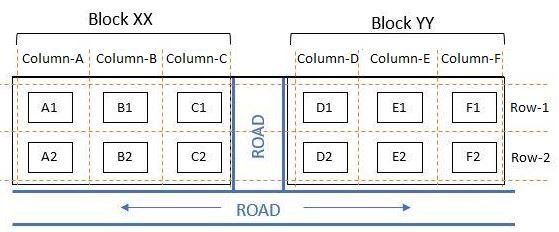
The schematic diagram below shows 12 rectangular houses in a housing complex. House numbers are mentioned in the rectangles representing the houses. The houses are located in six columns – Column-A through Column-F, and two rows – Row-1 and Row-2. The houses are divided into two blocks - Block XX and Block YY. The diagram also shows two roads, one passing in front of the houses in Row-2 and another between the two blocks.
Some of the houses are occupied. The remaining ones are vacant and are the only ones available for sale.
The road adjacency value of a house is the number of its sides adjacent to a road. For example, the road adjacency values of C2, F2, and B1 are 2, 1, and 0, respectively. The neighbour count of a house is the number of sides of that house adjacent to occupied houses in the same block. For example, E1 and C1 can have the maximum possible neighbour counts of 3 and 2, respectively.
The base price of a vacant house is Rs. 10 lakhs if the house does not have a parking space, and Rs. 12 lakhs if it does. The quoted price (in lakhs of Rs.) of a vacant house is calculated as (base price) + 5 × (road adjacency value) + 3 × (neighbour count).
The following information is also known.
1. The maximum quoted price of a house in Block XX is Rs. 24 lakhs. The minimum quoted price of a house in block YY is Rs. 15 lakhs, and one such house is in Column-E.
2. Row-1 has two occupied houses, one in each block.
3. Both houses in Column-E are vacant. Each of Column-D and Column-F has at least one occupied house.
4. There is only one house with parking space in Block YY.
How many houses are vacant in Block XX?
Passage / Data
Answer the following questions based on the information given below:
The schematic diagram below shows 12 rectangular houses in a housing complex. House numbers are mentioned in the rectangles representing the houses. The houses are located in six columns – Column-A through Column-F, and two rows – Row-1 and Row-2. The houses are divided into two blocks - Block XX and Block YY. The diagram also shows two roads, one passing in front of the houses in Row-2 and another between the two blocks.
Some of the houses are occupied. The remaining ones are vacant and are the only ones available for sale.
The road adjacency value of a house is the number of its sides adjacent to a road. For example, the road adjacency values of C2, F2, and B1 are 2, 1, and 0, respectively. The neighbour count of a house is the number of sides of that house adjacent to occupied houses in the same block. For example, E1 and C1 can have the maximum possible neighbour counts of 3 and 2, respectively.
The base price of a vacant house is Rs. 10 lakhs if the house does not have a parking space, and Rs. 12 lakhs if it does. The quoted price (in lakhs of Rs.) of a vacant house is calculated as (base price) + 5 × (road adjacency value) + 3 × (neighbour count).
The following information is also known.
1. The maximum quoted price of a house in Block XX is Rs. 24 lakhs. The minimum quoted price of a house in block YY is Rs. 15 lakhs, and one such house is in Column-E.
2. Row-1 has two occupied houses, one in each block.
3. Both houses in Column-E are vacant. Each of Column-D and Column-F has at least one occupied house.
4. There is only one house with parking space in Block YY.
Which of the following houses is definitely occupied?
[Two options are correct in this question and both were accepted as correct answer by IIM Lucknow]
Passage / Data
Answer the following questions based on the information given below:
The schematic diagram below shows 12 rectangular houses in a housing complex. House numbers are mentioned in the rectangles representing the houses. The houses are located in six columns – Column-A through Column-F, and two rows – Row-1 and Row-2. The houses are divided into two blocks - Block XX and Block YY. The diagram also shows two roads, one passing in front of the houses in Row-2 and another between the two blocks.
Some of the houses are occupied. The remaining ones are vacant and are the only ones available for sale.
The road adjacency value of a house is the number of its sides adjacent to a road. For example, the road adjacency values of C2, F2, and B1 are 2, 1, and 0, respectively. The neighbour count of a house is the number of sides of that house adjacent to occupied houses in the same block. For example, E1 and C1 can have the maximum possible neighbour counts of 3 and 2, respectively.
The base price of a vacant house is Rs. 10 lakhs if the house does not have a parking space, and Rs. 12 lakhs if it does. The quoted price (in lakhs of Rs.) of a vacant house is calculated as (base price) + 5 × (road adjacency value) + 3 × (neighbour count).
The following information is also known.
1. The maximum quoted price of a house in Block XX is Rs. 24 lakhs. The minimum quoted price of a house in block YY is Rs. 15 lakhs, and one such house is in Column-E.
2. Row-1 has two occupied houses, one in each block.
3. Both houses in Column-E are vacant. Each of Column-D and Column-F has at least one occupied house.
4. There is only one house with parking space in Block YY.
Which of the following options best describes the number of vacant houses in Row-2?
Passage / Data
Answer the following questions based on the information given below:
The schematic diagram below shows 12 rectangular houses in a housing complex. House numbers are mentioned in the rectangles representing the houses. The houses are located in six columns – Column-A through Column-F, and two rows – Row-1 and Row-2. The houses are divided into two blocks - Block XX and Block YY. The diagram also shows two roads, one passing in front of the houses in Row-2 and another between the two blocks.
Some of the houses are occupied. The remaining ones are vacant and are the only ones available for sale.
The road adjacency value of a house is the number of its sides adjacent to a road. For example, the road adjacency values of C2, F2, and B1 are 2, 1, and 0, respectively. The neighbour count of a house is the number of sides of that house adjacent to occupied houses in the same block. For example, E1 and C1 can have the maximum possible neighbour counts of 3 and 2, respectively.
The base price of a vacant house is Rs. 10 lakhs if the house does not have a parking space, and Rs. 12 lakhs if it does. The quoted price (in lakhs of Rs.) of a vacant house is calculated as (base price) + 5 × (road adjacency value) + 3 × (neighbour count).
The following information is also known.
1. The maximum quoted price of a house in Block XX is Rs. 24 lakhs. The minimum quoted price of a house in block YY is Rs. 15 lakhs, and one such house is in Column-E.
2. Row-1 has two occupied houses, one in each block.
3. Both houses in Column-E are vacant. Each of Column-D and Column-F has at least one occupied house.
4. There is only one house with parking space in Block YY.
What is the maximum possible quoted price (in lakhs of Rs.) for a vacant house in Column-E?
Passage / Data
Answer the following questions based on the information given below:
The schematic diagram below shows 12 rectangular houses in a housing complex. House numbers are mentioned in the rectangles representing the houses. The houses are located in six columns – Column-A through Column-F, and two rows – Row-1 and Row-2. The houses are divided into two blocks - Block XX and Block YY. The diagram also shows two roads, one passing in front of the houses in Row-2 and another between the two blocks.
Some of the houses are occupied. The remaining ones are vacant and are the only ones available for sale.
The road adjacency value of a house is the number of its sides adjacent to a road. For example, the road adjacency values of C2, F2, and B1 are 2, 1, and 0, respectively. The neighbour count of a house is the number of sides of that house adjacent to occupied houses in the same block. For example, E1 and C1 can have the maximum possible neighbour counts of 3 and 2, respectively.
The base price of a vacant house is Rs. 10 lakhs if the house does not have a parking space, and Rs. 12 lakhs if it does. The quoted price (in lakhs of Rs.) of a vacant house is calculated as (base price) + 5 × (road adjacency value) + 3 × (neighbour count).
The following information is also known.
1. The maximum quoted price of a house in Block XX is Rs. 24 lakhs. The minimum quoted price of a house in block YY is Rs. 15 lakhs, and one such house is in Column-E.
2. Row-1 has two occupied houses, one in each block.
3. Both houses in Column-E are vacant. Each of Column-D and Column-F has at least one occupied house.
4. There is only one house with parking space in Block YY.
Which house in Block YY has parking space?
Passage / Data
Answer the following questions based on the information given below:
There are nine boxes arranged in a 3×3 array as shown in Tables 1 and 2. Each box contains three sacks. Each sack has a certain number of coins, between 1 and 9, both inclusive.
The average number of coins per sack in the boxes are all distinct integers. The total number of coins in each row is the same. The total number of coins in each column is also the same.
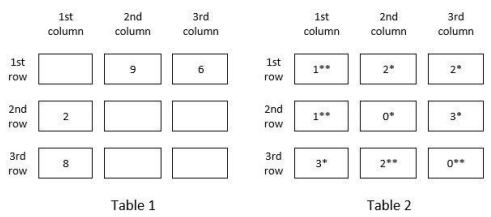
Table 1 gives information regarding the median of the numbers of coins in the three sacks in a box for some of the boxes. In Table 2 each box has a number which represents the number of sacks in that box having more than 5 coins. That number is followed by a * if the sacks in that box satisfy exactly one among the following three conditions, and it is followed by ** if two or more of these conditions are satisfied.
- The minimum among the numbers of coins in the three sacks in the box is 1.
- The median of the numbers of coins in the three sacks is 1.
- The maximum among the numbers of coins in the three sacks in the box is 9.
What is the total number of coins in all the boxes in the 3rd row?
Passage / Data
Answer the following questions based on the information given below:
There are nine boxes arranged in a 3×3 array as shown in Tables 1 and 2. Each box contains three sacks. Each sack has a certain number of coins, between 1 and 9, both inclusive.
The average number of coins per sack in the boxes are all distinct integers. The total number of coins in each row is the same. The total number of coins in each column is also the same.
Table 1 gives information regarding the median of the numbers of coins in the three sacks in a box for some of the boxes. In Table 2 each box has a number which represents the number of sacks in that box having more than 5 coins. That number is followed by a * if the sacks in that box satisfy exactly one among the following three conditions, and it is followed by ** if two or more of these conditions are satisfied.
- The minimum among the numbers of coins in the three sacks in the box is 1.
- The median of the numbers of coins in the three sacks is 1.
- The maximum among the numbers of coins in the three sacks in the box is 9.
How many boxes have at least one sack containing 9 coins?
Passage / Data
Answer the following questions based on the information given below:
There are nine boxes arranged in a 3×3 array as shown in Tables 1 and 2. Each box contains three sacks. Each sack has a certain number of coins, between 1 and 9, both inclusive.
The average number of coins per sack in the boxes are all distinct integers. The total number of coins in each row is the same. The total number of coins in each column is also the same.
Table 1 gives information regarding the median of the numbers of coins in the three sacks in a box for some of the boxes. In Table 2 each box has a number which represents the number of sacks in that box having more than 5 coins. That number is followed by a * if the sacks in that box satisfy exactly one among the following three conditions, and it is followed by ** if two or more of these conditions are satisfied.
- The minimum among the numbers of coins in the three sacks in the box is 1.
- The median of the numbers of coins in the three sacks is 1.
- The maximum among the numbers of coins in the three sacks in the box is 9.
For how many boxes are the average and median of the numbers of coins contained in the three sacks in that box the same?
Passage / Data
Answer the following questions based on the information given below:
There are nine boxes arranged in a 3×3 array as shown in Tables 1 and 2. Each box contains three sacks. Each sack has a certain number of coins, between 1 and 9, both inclusive.
The average number of coins per sack in the boxes are all distinct integers. The total number of coins in each row is the same. The total number of coins in each column is also the same.
Table 1 gives information regarding the median of the numbers of coins in the three sacks in a box for some of the boxes. In Table 2 each box has a number which represents the number of sacks in that box having more than 5 coins. That number is followed by a * if the sacks in that box satisfy exactly one among the following three conditions, and it is followed by ** if two or more of these conditions are satisfied.
- The minimum among the numbers of coins in the three sacks in the box is 1.
- The median of the numbers of coins in the three sacks is 1.
- The maximum among the numbers of coins in the three sacks in the box is 9.
How many sacks have exactly one coin?
Passage / Data
Answer the following questions based on the information given below:
There are nine boxes arranged in a 3×3 array as shown in Tables 1 and 2. Each box contains three sacks. Each sack has a certain number of coins, between 1 and 9, both inclusive.
The average number of coins per sack in the boxes are all distinct integers. The total number of coins in each row is the same. The total number of coins in each column is also the same.
Table 1 gives information regarding the median of the numbers of coins in the three sacks in a box for some of the boxes. In Table 2 each box has a number which represents the number of sacks in that box having more than 5 coins. That number is followed by a * if the sacks in that box satisfy exactly one among the following three conditions, and it is followed by ** if two or more of these conditions are satisfied.
- The minimum among the numbers of coins in the three sacks in the box is 1.
- The median of the numbers of coins in the three sacks is 1.
- The maximum among the numbers of coins in the three sacks in the box is 9.
In how many boxes do all three sacks contain different numbers of coins?
Passage / Data
Answer the next 5 questions based on the information given below:
There are only four neighbourhoods in a city - Levmisto, Tyhrmisto, Pesmisto and Kitmisto. During the onset of a pandemic, the number of new cases of a disease in each of these neighbourhoods was recorded over a period of five days. On each day, the number of new cases recorded in any of the neighbourhoods was either 0, 1, 2 or 3.
The following facts are also known:
1. There was at least one new case in every neighbourhood on Day 1.
2. On each of the five days, there were more new cases in Kitmisto than in Pesmisto.
3. The number of new cases in the city in a day kept increasing during the five-day period. The number of new cases on Day 3 was exactly one more than that on Day 2.
4. The maximum number of new cases in a day in Pesmisto was 2, and this happened only once during the five-day period.
5. Kitmisto is the only place to have 3 new cases on Day 2.
6. The total numbers of new cases in Levmisto, Tyhrmisto, Pesmisto and Kitmisto over the five-day period were 12, 12, 5 and 14 respectively.
What BEST can be concluded about the total number of new cases in the city on Day 2?
Passage / Data
Answer the next 5 questions based on the information given below:
There are only four neighbourhoods in a city - Levmisto, Tyhrmisto, Pesmisto and Kitmisto. During the onset of a pandemic, the number of new cases of a disease in each of these neighbourhoods was recorded over a period of five days. On each day, the number of new cases recorded in any of the neighbourhoods was either 0, 1, 2 or 3.
The following facts are also known:
1. There was at least one new case in every neighbourhood on Day 1.
2. On each of the five days, there were more new cases in Kitmisto than in Pesmisto.
3. The number of new cases in the city in a day kept increasing during the five-day period. The number of new cases on Day 3 was exactly one more than that on Day 2.
4. The maximum number of new cases in a day in Pesmisto was 2, and this happened only once during the five-day period.
5. Kitmisto is the only place to have 3 new cases on Day 2.
6. The total numbers of new cases in Levmisto, Tyhrmisto, Pesmisto and Kitmisto over the five-day period were 12, 12, 5 and 14 respectively.
What BEST can be concluded about the number of new cases in Levmisto on Day 3?
Passage / Data
Answer the next 5 questions based on the information given below:
There are only four neighbourhoods in a city - Levmisto, Tyhrmisto, Pesmisto and Kitmisto. During the onset of a pandemic, the number of new cases of a disease in each of these neighbourhoods was recorded over a period of five days. On each day, the number of new cases recorded in any of the neighbourhoods was either 0, 1, 2 or 3.
The following facts are also known:
1. There was at least one new case in every neighbourhood on Day 1.
2. On each of the five days, there were more new cases in Kitmisto than in Pesmisto.
3. The number of new cases in the city in a day kept increasing during the five-day period. The number of new cases on Day 3 was exactly one more than that on Day 2.
4. The maximum number of new cases in a day in Pesmisto was 2, and this happened only once during the five-day period.
5. Kitmisto is the only place to have 3 new cases on Day 2.
6. The total numbers of new cases in Levmisto, Tyhrmisto, Pesmisto and Kitmisto over the five-day period were 12, 12, 5 and 14 respectively.
On which day(s) did Pesmisto not have any new case?
Passage / Data
Answer the next 5 questions based on the information given below:
There are only four neighbourhoods in a city - Levmisto, Tyhrmisto, Pesmisto and Kitmisto. During the onset of a pandemic, the number of new cases of a disease in each of these neighbourhoods was recorded over a period of five days. On each day, the number of new cases recorded in any of the neighbourhoods was either 0, 1, 2 or 3.
The following facts are also known:
1. There was at least one new case in every neighbourhood on Day 1.
2. On each of the five days, there were more new cases in Kitmisto than in Pesmisto.
3. The number of new cases in the city in a day kept increasing during the five-day period. The number of new cases on Day 3 was exactly one more than that on Day 2.
4. The maximum number of new cases in a day in Pesmisto was 2, and this happened only once during the five-day period.
5. Kitmisto is the only place to have 3 new cases on Day 2.
6. The total numbers of new cases in Levmisto, Tyhrmisto, Pesmisto and Kitmisto over the five-day period were 12, 12, 5 and 14 respectively.
Which of the two statements below is/are necessarily false?
Statement A: There were 2 new cases in Tyhrmisto on Day 3.
Statement B: There were no new cases in Pesmisto on Day 2.
Passage / Data
Answer the next 5 questions based on the information given below:
There are only four neighbourhoods in a city - Levmisto, Tyhrmisto, Pesmisto and Kitmisto. During the onset of a pandemic, the number of new cases of a disease in each of these neighbourhoods was recorded over a period of five days. On each day, the number of new cases recorded in any of the neighbourhoods was either 0, 1, 2 or 3.
The following facts are also known:
1. There was at least one new case in every neighbourhood on Day 1.
2. On each of the five days, there were more new cases in Kitmisto than in Pesmisto.
3. The number of new cases in the city in a day kept increasing during the five-day period. The number of new cases on Day 3 was exactly one more than that on Day 2.
4. The maximum number of new cases in a day in Pesmisto was 2, and this happened only once during the five-day period.
5. Kitmisto is the only place to have 3 new cases on Day 2.
6. The total numbers of new cases in Levmisto, Tyhrmisto, Pesmisto and Kitmisto over the five-day period were 12, 12, 5 and 14 respectively.
On how many days did Levmisto and Tyhrmisto have the same number of new cases?
Passage / Data
Answer the following question based on the information given below.
A supermarket has to place 12 items (coded A to L) in shelves numbered 1 to 16. Five of these items are types of biscuits, three are types of candies and the rest are types of savouries. Only one item can be kept in a shelf. Items are to be placed such that all items of same type are clustered together with no empty shelf between items of the same type and at least one empty shelf between two different types of items. At most two empty shelves can have consecutive numbers.
The following additional facts are known.
- A and B are to be placed in consecutively numbered shelves in increasing order.
- I and J are to be placed in consecutively numbered shelves both higher numbered than the shelves in which A and B are kept.
- D, E and F are savouries and are to be placed in consecutively numbered shelves in increasing order after all the biscuits and candies.
- K is to be placed in shelf number 16.
- L and J are items of the same type, while H is an item of a different type.
- C is a candy and is to be placed in a shelf preceded by two empty shelves.
- L is to be placed in a shelf preceded by exactly one empty shelf.
In how many different ways can the items be arranged on the shelves?
Passage / Data
Answer the following question based on the information given below.
A supermarket has to place 12 items (coded A to L) in shelves numbered 1 to 16. Five of these items are types of biscuits, three are types of candies and the rest are types of savouries. Only one item can be kept in a shelf. Items are to be placed such that all items of same type are clustered together with no empty shelf between items of the same type and at least one empty shelf between two different types of items. At most two empty shelves can have consecutive numbers.
The following additional facts are known.
- A and B are to be placed in consecutively numbered shelves in increasing order.
- I and J are to be placed in consecutively numbered shelves both higher numbered than the shelves in which A and B are kept.
- D, E and F are savouries and are to be placed in consecutively numbered shelves in increasing order after all the biscuits and candies.
- K is to be placed in shelf number 16.
- L and J are items of the same type, while H is an item of a different type.
- C is a candy and is to be placed in a shelf preceded by two empty shelves.
- L is to be placed in a shelf preceded by exactly one empty shelf.
Which of the following items is not a type of biscuit?
Passage / Data
Answer the following question based on the information given below.
A supermarket has to place 12 items (coded A to L) in shelves numbered 1 to 16. Five of these items are types of biscuits, three are types of candies and the rest are types of savouries. Only one item can be kept in a shelf. Items are to be placed such that all items of same type are clustered together with no empty shelf between items of the same type and at least one empty shelf between two different types of items. At most two empty shelves can have consecutive numbers.
The following additional facts are known.
- A and B are to be placed in consecutively numbered shelves in increasing order.
- I and J are to be placed in consecutively numbered shelves both higher numbered than the shelves in which A and B are kept.
- D, E and F are savouries and are to be placed in consecutively numbered shelves in increasing order after all the biscuits and candies.
- K is to be placed in shelf number 16.
- L and J are items of the same type, while H is an item of a different type.
- C is a candy and is to be placed in a shelf preceded by two empty shelves.
- L is to be placed in a shelf preceded by exactly one empty shelf.
Which of the following can represent the numbers of the empty shelves in a possible arrangement?
Passage / Data
Answer the following question based on the information given below.
A supermarket has to place 12 items (coded A to L) in shelves numbered 1 to 16. Five of these items are types of biscuits, three are types of candies and the rest are types of savouries. Only one item can be kept in a shelf. Items are to be placed such that all items of same type are clustered together with no empty shelf between items of the same type and at least one empty shelf between two different types of items. At most two empty shelves can have consecutive numbers.
The following additional facts are known.
- A and B are to be placed in consecutively numbered shelves in increasing order.
- I and J are to be placed in consecutively numbered shelves both higher numbered than the shelves in which A and B are kept.
- D, E and F are savouries and are to be placed in consecutively numbered shelves in increasing order after all the biscuits and candies.
- K is to be placed in shelf number 16.
- L and J are items of the same type, while H is an item of a different type.
- C is a candy and is to be placed in a shelf preceded by two empty shelves.
- L is to be placed in a shelf preceded by exactly one empty shelf.
Which of the following statements is necessarily true?
Passage / Data
Answer the following question based on the information given below.
In a square layout of size 5m × 5m, 25 equal-sized square platforms of different heights are built.
The heights (in metres) of individual platforms are as shown below:
6 1 2 4 3
9 5 3 2 8
7 8 4 6 5
3 9 5 1 2
1 7 6 3 9
Individuals (all of same height) are seated on these platforms. We say an individual A can reach an individual B if all the three following conditions are met:
(i) A and B are in the same row or column
(ii) A is at a lower height than B
(iii) If there is / are any individual(s) between A and B, such individual(s) must be at a height lower than that of A.
Thus in the table given above, consider the individual seated at height 8 on 3rd row and 2nd column. He can be reached by four individuals. He can be reached by the individual on his left at height 7, by the two individuals on his right at heights of 4 and 6 and by the individual above at height 5.
Rows in the layout are numbered from top to bottom and columns are numbered from left to right.
How many individuals in this layout can be reached by just one individual?
Passage / Data
Answer the following question based on the information given below.
In a square layout of size 5m × 5m, 25 equal-sized square platforms of different heights are built.
The heights (in metres) of individual platforms are as shown below:
6 1 2 4 3
9 5 3 2 8
7 8 4 6 5
3 9 5 1 2
1 7 6 3 9
Individuals (all of same height) are seated on these platforms. We say an individual A can reach an individual B if all the three following conditions are met:
(i) A and B are in the same row or column
(ii) A is at a lower height than B
(iii) If there is / are any individual(s) between A and B, such individual(s) must be at a height lower than that of A.
Thus in the table given above, consider the individual seated at height 8 on 3rd row and 2nd column. He can be reached by four individuals. He can be reached by the individual on his left at height 7, by the two individuals on his right at heights of 4 and 6 and by the individual above at height 5.
Rows in the layout are numbered from top to bottom and columns are numbered from left to right.
Which of the following is true for any individual at a platform of height 1 m in this layout?
Passage / Data
Answer the following question based on the information given below.
In a square layout of size 5m × 5m, 25 equal-sized square platforms of different heights are built.
The heights (in metres) of individual platforms are as shown below:
6 1 2 4 3
9 5 3 2 8
7 8 4 6 5
3 9 5 1 2
1 7 6 3 9
Individuals (all of same height) are seated on these platforms. We say an individual A can reach an individual B if all the three following conditions are met:
(i) A and B are in the same row or column
(ii) A is at a lower height than B
(iii) If there is / are any individual(s) between A and B, such individual(s) must be at a height lower than that of A.
Thus in the table given above, consider the individual seated at height 8 on 3rd row and 2nd column. He can be reached by four individuals. He can be reached by the individual on his left at height 7, by the two individuals on his right at heights of 4 and 6 and by the individual above at height 5.
Rows in the layout are numbered from top to bottom and columns are numbered from left to right.
We can find two individuals who cannot be reached anyone in
Passage / Data
Answer the following question based on the information given below.
In a square layout of size 5m × 5m, 25 equal-sized square platforms of different heights are built.
The heights (in metres) of individual platforms are as shown below:
6 1 2 4 3
9 5 3 2 8
7 8 4 6 5
3 9 5 1 2
1 7 6 3 9
Individuals (all of same height) are seated on these platforms. We say an individual A can reach an individual B if all the three following conditions are met:
(i) A and B are in the same row or column
(ii) A is at a lower height than B
(iii) If there is / are any individual(s) between A and B, such individual(s) must be at a height lower than that of A.
Thus in the table given above, consider the individual seated at height 8 on 3rd row and 2nd column. He can be reached by four individuals. He can be reached by the individual on his left at height 7, by the two individuals on his right at heights of 4 and 6 and by the individual above at height 5.
Rows in the layout are numbered from top to bottom and columns are numbered from left to right.
Which of the following statements is true about this layout?
Passage / Data
Answer the following question based on the information given below.
A tea taster was assigned to rate teas from six different locations – Munnar, Wayanand, Ooty, Darjeeling, Assam and Himachal. These teas were placed in six cups, numbered 1 to 6, not necessarily in the same order. The tea taster was asked to rate these teas on the strength of their flavour on a scale of 1 to 10. He gave a unique integer rating to each tea. Some other information is given below:
- Cup 6 contained tea from Himachal.
- Tea from Ooty got the highest rating, but it was not in Cup 3.
- The rating of tea in Cup 3 was double the rating of the tea in Cup 5.
- Only two cups got ratings in even numbers.
- Cup 2 got the minimum rating and this rating was an even number.
- Tea in Cup 3 got a higher rating than that in Cup 1.
- The rating of tea from Wayanad was more than the rating of tea from Munnar, but less than that from Assam.
What was the second highest rating given?
Passage / Data
Answer the following question based on the information given below.
A tea taster was assigned to rate teas from six different locations – Munnar, Wayanand, Ooty, Darjeeling, Assam and Himachal. These teas were placed in six cups, numbered 1 to 6, not necessarily in the same order. The tea taster was asked to rate these teas on the strength of their flavour on a scale of 1 to 10. He gave a unique integer rating to each tea. Some other information is given below:
- Cup 6 contained tea from Himachal.
- Tea from Ooty got the highest rating, but it was not in Cup 3.
- The rating of tea in Cup 3 was double the rating of the tea in Cup 5.
- Only two cups got ratings in even numbers.
- Cup 2 got the minimum rating and this rating was an even number.
- Tea in Cup 3 got a higher rating than that in Cup 1.
- The rating of tea from Wayanad was more than the rating of tea from Munnar, but less than that from Assam.
What was the number of the cup that contained tea from Ooty?
Passage / Data
Answer the following question based on the information given below.
A tea taster was assigned to rate teas from six different locations – Munnar, Wayanand, Ooty, Darjeeling, Assam and Himachal. These teas were placed in six cups, numbered 1 to 6, not necessarily in the same order. The tea taster was asked to rate these teas on the strength of their flavour on a scale of 1 to 10. He gave a unique integer rating to each tea. Some other information is given below:
- Cup 6 contained tea from Himachal.
- Tea from Ooty got the highest rating, but it was not in Cup 3.
- The rating of tea in Cup 3 was double the rating of the tea in Cup 5.
- Only two cups got ratings in even numbers.
- Cup 2 got the minimum rating and this rating was an even number.
- Tea in Cup 3 got a higher rating than that in Cup 1.
- The rating of tea from Wayanad was more than the rating of tea from Munnar, but less than that from Assam.
If the tea from Munnar did not get the minimum rating, what was the rating of the tea from Wayanad?
Passage / Data
Answer the following question based on the information given below.
A tea taster was assigned to rate teas from six different locations – Munnar, Wayanand, Ooty, Darjeeling, Assam and Himachal. These teas were placed in six cups, numbered 1 to 6, not necessarily in the same order. The tea taster was asked to rate these teas on the strength of their flavour on a scale of 1 to 10. He gave a unique integer rating to each tea. Some other information is given below:
- Cup 6 contained tea from Himachal.
- Tea from Ooty got the highest rating, but it was not in Cup 3.
- The rating of tea in Cup 3 was double the rating of the tea in Cup 5.
- Only two cups got ratings in even numbers.
- Cup 2 got the minimum rating and this rating was an even number.
- Tea in Cup 3 got a higher rating than that in Cup 1.
- The rating of tea from Wayanad was more than the rating of tea from Munnar, but less than that from Assam.
If cups containing teas from Wayanad and Ooty had consecutive numbers, which of the following statements may be true?
Passage / Data
Answer the following question based on the information given below.
Eight friends: Ajit, Byomkesh, Gargi, Jayanta, Kikira, Manik, Prodosh and Tapesh are goin to Delhi from Kolkatta by a flight operated by Cheap Air. In the flight, sitting is arranged in 30 rows, numbered 1 to 30, each consisting of 6 seats, marked by letters A to F from left to right, respectively. Seats A to C are to the left of the aisle (the passage running from the front of the aircraft to the back), and seats D to F are to the right of the aisle. Seats A and F are by the windows and referred to as Window seats, C and D are by the aisle and are referred to as Aisle seats while B and E are referred to as Middle seats. Seats marked by consecutive letters are called consecutive seats (or seats next to each other).A seat number is a combination of the row number, followed by the letter indicating the position in the row, e.g, 1A is the left window seat in the first row, while 12E is the right middle seat in the 12th row.
Cheap Air charges Rs. 1000 extra for any seats in Rows 1, 12 and 13 as those have extra legroom. For Rows 2-10, it charges Rs. 300 extra for Window seats and Rs. 500 extra for Aisle seats. For Rows 11 and 14 to 20, it charges Rs. 200 extra for Window seats and Rs. 400 extra for Aisle seats. All other seats are available at no extra charge.
The following are known:
- The eight friends were seated in six different rows.
- They occupied 3 Window seats, 4 Aisle seats and 1 Middle seat.
- Seven of them had to pay extra amounts, totaling to Rs. 4600, for their choices of seat. One of them did not pay any additional amount of his/her choice of seat.
- Jayanta, Ajit and Byomkesh were sitting in seats marked by the same letter, in consecutive rows in increasing order of row numbers; but all of them paid different amounts for their choices of seat. One of these amounts may be zero.
- Gargi was sitting next to Kikira, and Manik was sitting next to Jayanta.
- Prodosh and Tapesh were sitting in seats marked by the same letter, in consecutive rows in increasing order of row numbers; but they paid different amounts for their choices of seat. One of these amounts may be zero.
In which row was Manik sitting?
Passage / Data
Answer the following question based on the information given below.
Eight friends: Ajit, Byomkesh, Gargi, Jayanta, Kikira, Manik, Prodosh and Tapesh are goin to Delhi from Kolkatta by a flight operated by Cheap Air. In the flight, sitting is arranged in 30 rows, numbered 1 to 30, each consisting of 6 seats, marked by letters A to F from left to right, respectively. Seats A to C are to the left of the aisle (the passage running from the front of the aircraft to the back), and seats D to F are to the right of the aisle. Seats A and F are by the windows and referred to as Window seats, C and D are by the aisle and are referred to as Aisle seats while B and E are referred to as Middle seats. Seats marked by consecutive letters are called consecutive seats (or seats next to each other).A seat number is a combination of the row number, followed by the letter indicating the position in the row, e.g, 1A is the left window seat in the first row, while 12E is the right middle seat in the 12th row.
Cheap Air charges Rs. 1000 extra for any seats in Rows 1, 12 and 13 as those have extra legroom. For Rows 2-10, it charges Rs. 300 extra for Window seats and Rs. 500 extra for Aisle seats. For Rows 11 and 14 to 20, it charges Rs. 200 extra for Window seats and Rs. 400 extra for Aisle seats. All other seats are available at no extra charge.
The following are known:
- The eight friends were seated in six different rows.
- They occupied 3 Window seats, 4 Aisle seats and 1 Middle seat.
- Seven of them had to pay extra amounts, totaling to Rs. 4600, for their choices of seat. One of them did not pay any additional amount of his/her choice of seat.
- Jayanta, Ajit and Byomkesh were sitting in seats marked by the same letter, in consecutive rows in increasing order of row numbers; but all of them paid different amounts for their choices of seat. One of these amounts may be zero.
- Gargi was sitting next to Kikira, and Manik was sitting next to Jayanta.
- Prodosh and Tapesh were sitting in seats marked by the same letter, in consecutive rows in increasing order of row numbers; but they paid different amounts for their choices of seat. One of these amounts may be zero.
How much extra did Jayanta pay for his choice of seat?
Passage / Data
Answer the following question based on the information given below.
Eight friends: Ajit, Byomkesh, Gargi, Jayanta, Kikira, Manik, Prodosh and Tapesh are goin to Delhi from Kolkatta by a flight operated by Cheap Air. In the flight, sitting is arranged in 30 rows, numbered 1 to 30, each consisting of 6 seats, marked by letters A to F from left to right, respectively. Seats A to C are to the left of the aisle (the passage running from the front of the aircraft to the back), and seats D to F are to the right of the aisle. Seats A and F are by the windows and referred to as Window seats, C and D are by the aisle and are referred to as Aisle seats while B and E are referred to as Middle seats. Seats marked by consecutive letters are called consecutive seats (or seats next to each other).A seat number is a combination of the row number, followed by the letter indicating the position in the row, e.g, 1A is the left window seat in the first row, while 12E is the right middle seat in the 12th row.
Cheap Air charges Rs. 1000 extra for any seats in Rows 1, 12 and 13 as those have extra legroom. For Rows 2-10, it charges Rs. 300 extra for Window seats and Rs. 500 extra for Aisle seats. For Rows 11 and 14 to 20, it charges Rs. 200 extra for Window seats and Rs. 400 extra for Aisle seats. All other seats are available at no extra charge.
The following are known:
- The eight friends were seated in six different rows.
- They occupied 3 Window seats, 4 Aisle seats and 1 Middle seat.
- Seven of them had to pay extra amounts, totaling to Rs. 4600, for their choices of seat. One of them did not pay any additional amount of his/her choice of seat.
- Jayanta, Ajit and Byomkesh were sitting in seats marked by the same letter, in consecutive rows in increasing order of row numbers; but all of them paid different amounts for their choices of seat. One of these amounts may be zero.
- Gargi was sitting next to Kikira, and Manik was sitting next to Jayanta.
- Prodosh and Tapesh were sitting in seats marked by the same letter, in consecutive rows in increasing order of row numbers; but they paid different amounts for their choices of seat. One of these amounts may be zero.
How much extra did Gargi pay for her choice of seat?
Passage / Data
Answer the following question based on the information given below.
Eight friends: Ajit, Byomkesh, Gargi, Jayanta, Kikira, Manik, Prodosh and Tapesh are goin to Delhi from Kolkatta by a flight operated by Cheap Air. In the flight, sitting is arranged in 30 rows, numbered 1 to 30, each consisting of 6 seats, marked by letters A to F from left to right, respectively. Seats A to C are to the left of the aisle (the passage running from the front of the aircraft to the back), and seats D to F are to the right of the aisle. Seats A and F are by the windows and referred to as Window seats, C and D are by the aisle and are referred to as Aisle seats while B and E are referred to as Middle seats. Seats marked by consecutive letters are called consecutive seats (or seats next to each other).A seat number is a combination of the row number, followed by the letter indicating the position in the row, e.g, 1A is the left window seat in the first row, while 12E is the right middle seat in the 12th row.
Cheap Air charges Rs. 1000 extra for any seats in Rows 1, 12 and 13 as those have extra legroom. For Rows 2-10, it charges Rs. 300 extra for Window seats and Rs. 500 extra for Aisle seats. For Rows 11 and 14 to 20, it charges Rs. 200 extra for Window seats and Rs. 400 extra for Aisle seats. All other seats are available at no extra charge.
The following are known:
- The eight friends were seated in six different rows.
- They occupied 3 Window seats, 4 Aisle seats and 1 Middle seat.
- Seven of them had to pay extra amounts, totaling to Rs. 4600, for their choices of seat. One of them did not pay any additional amount of his/her choice of seat.
- Jayanta, Ajit and Byomkesh were sitting in seats marked by the same letter, in consecutive rows in increasing order of row numbers; but all of them paid different amounts for their choices of seat. One of these amounts may be zero.
- Gargi was sitting next to Kikira, and Manik was sitting next to Jayanta.
- Prodosh and Tapesh were sitting in seats marked by the same letter, in consecutive rows in increasing order of row numbers; but they paid different amounts for their choices of seat. One of these amounts may be zero.
Who among the following did not pay any extra amount for his/her choice of seat?
Passage / Data
Answer the following question based on the information given below.
i. There are three houses on each side of the road.
ii. These six houses are labeled as P, Q, R, S, T and U.
iii. The houses are of different colours, namely, Red, Blue, Green, Orange, Yellow and White.
iv. The houses are of different heights.
v. T, the tallest house, is exactly opposite to the Red coloured house.
vi. The shortest house is exactly opposite to the Green coloured house.
vii. U, the Orange coloured house, is located between P and S.
viii. R, the Yellow coloured house, is exactly opposite to P.
ix. Q, the Green coloured house, is exactly opposite to U.
x. P, the White coloured house, is taller than R, but shorter than S and Q.
What is the colour of the tallest house?
Passage / Data
Answer the following question based on the information given below.
i. There are three houses on each side of the road.
ii. These six houses are labeled as P, Q, R, S, T and U.
iii. The houses are of different colours, namely, Red, Blue, Green, Orange, Yellow and White.
iv. The houses are of different heights.
v. T, the tallest house, is exactly opposite to the Red coloured house.
vi. The shortest house is exactly opposite to the Green coloured house.
vii. U, the Orange coloured house, is located between P and S.
viii. R, the Yellow coloured house, is exactly opposite to P.
ix. Q, the Green coloured house, is exactly opposite to U.
x. P, the White coloured house, is taller than R, but shorter than S and Q.
What is the colour of the house diagonally opposite to the Yellow coloured house?
Passage / Data
Answer the following question based on the information given below.
i. There are three houses on each side of the road.
ii. These six houses are labeled as P, Q, R, S, T and U.
iii. The houses are of different colours, namely, Red, Blue, Green, Orange, Yellow and White.
iv. The houses are of different heights.
v. T, the tallest house, is exactly opposite to the Red coloured house.
vi. The shortest house is exactly opposite to the Green coloured house.
vii. U, the Orange coloured house, is located between P and S.
viii. R, the Yellow coloured house, is exactly opposite to P.
ix. Q, the Green coloured house, is exactly opposite to U.
x. P, the White coloured house, is taller than R, but shorter than S and Q.
Which is the second tallest house?
Passage / Data
Answer the following question based on the information given below.
Seven varsity basketball players (A, B, C, D, E, F, and G) are to be honoured at a special luncheon. The players will be seated on the dais in a row. A and G have to leave the luncheon early and so must be seated at the extreme right. B will receive the most valuable player's trophy and so must be in the centre to facilitate presentation. C and D are bitter rivals and therefore must be seated as far apart as possible.
Which of the following cannot be seated at either end?
Passage / Data
Answer the following question based on the information given below.
Seven varsity basketball players (A, B, C, D, E, F, and G) are to be honoured at a special luncheon. The players will be seated on the dais in a row. A and G have to leave the luncheon early and so must be seated at the extreme right. B will receive the most valuable player's trophy and so must be in the centre to facilitate presentation. C and D are bitter rivals and therefore must be seated as far apart as possible.
Which of the following pairs cannot be seated together?
Passage / Data
Answer the following question based on the information given below.
Seven varsity basketball players (A, B, C, D, E, F, and G) are to be honoured at a special luncheon. The players will be seated on the dais in a row. A and G have to leave the luncheon early and so must be seated at the extreme right. B will receive the most valuable player's trophy and so must be in the centre to facilitate presentation. C and D are bitter rivals and therefore must be seated as far apart as possible.
Which of the following pairs cannot occupy the seats on either side of B?
Passage / Data
Answer the following question based on the information given below.
Four families decided to attend the marriage ceremony of one of their colleagues. One family has no kids, while the others have at least one kid each. Each family with kids has at least one kid attending the marriage. Given below is some information about the families, and who reached when to attend the marriage.
The family with 2 kids came just before the family with no kids.
Shanthi who does not have any kids reached just before Sridevi’s family.
Sunil and his wife reached last with their only kid.
Anil is not the husband of Joya.
Anil and Raj are fathers.
Sridevi’s and Anita’s daughters go to the same school.
Joya came before Shanthi and met Anita when she reached the venue.
Raman stays the farthest from the venue.
Raj said his son could not come because of his exams.
Which woman arrived third?
Passage / Data
Answer the following question based on the information given below.
Four families decided to attend the marriage ceremony of one of their colleagues. One family has no kids, while the others have at least one kid each. Each family with kids has at least one kid attending the marriage. Given below is some information about the families, and who reached when to attend the marriage.
The family with 2 kids came just before the family with no kids.
Shanthi who does not have any kids reached just before Sridevi’s family.
Sunil and his wife reached last with their only kid.
Anil is not the husband of Joya.
Anil and Raj are fathers.
Sridevi’s and Anita’s daughters go to the same school.
Joya came before Shanthi and met Anita when she reached the venue.
Raman stays the farthest from the venue.
Raj said his son could not come because of his exams.
Name the correct pair of husband and wife.
Passage / Data
Answer the following question based on the information given below.
Four families decided to attend the marriage ceremony of one of their colleagues. One family has no kids, while the others have at least one kid each. Each family with kids has at least one kid attending the marriage. Given below is some information about the families, and who reached when to attend the marriage.
The family with 2 kids came just before the family with no kids.
Shanthi who does not have any kids reached just before Sridevi’s family.
Sunil and his wife reached last with their only kid.
Anil is not the husband of Joya.
Anil and Raj are fathers.
Sridevi’s and Anita’s daughters go to the same school.
Joya came before Shanthi and met Anita when she reached the venue.
Raman stays the farthest from the venue.
Raj said his son could not come because of his exams.
Of the following pairs, whose daughters go to the same school?
Passage / Data
Answer the following question based on the information given below.
Four families decided to attend the marriage ceremony of one of their colleagues. One family has no kids, while the others have at least one kid each. Each family with kids has at least one kid attending the marriage. Given below is some information about the families, and who reached when to attend the marriage.
The family with 2 kids came just before the family with no kids.
Shanthi who does not have any kids reached just before Sridevi’s family.
Sunil and his wife reached last with their only kid.
Anil is not the husband of Joya.
Anil and Raj are fathers.
Sridevi’s and Anita’s daughters go to the same school.
Joya came before Shanthi and met Anita when she reached the venue.
Raman stays the farthest from the venue.
Raj said his son could not come because of his exams.
Whose family is known to have more than one kid for certain?
Passage / Data
Answer the following question based on the information given below.
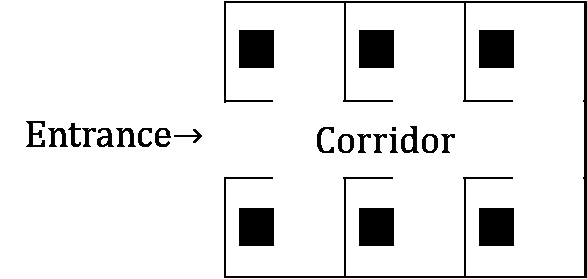
The plan above shows an office block for six officers, A, B, C, D, E and F. Both B and C occupy offices to the right of corridor (as one enters the office block) and A occupies an office to the left of the corridor. E and F occupy offices on opposite sides of the corridor but their offices do not face each other. The offices of C and D face each other. E does not have a corner office. F’s office is further down the corridor than A’s, but on the same side.
If E sits in his office and faces the corridor, whose office is to his left?
Passage / Data
Answer the following question based on the information given below.
The plan above shows an office block for six officers, A, B, C, D, E and F. Both B and C occupy offices to the right of corridor (as one enters the office block) and A occupies an office to the left of the corridor. E and F occupy offices on opposite sides of the corridor but their offices do not face each other. The offices of C and D face each other. E does not have a corner office. F’s office is further down the corridor than A’s, but on the same side.
Whose office faces A’s office?
Passage / Data
Answer the following question based on the information given below.
The plan above shows an office block for six officers, A, B, C, D, E and F. Both B and C occupy offices to the right of corridor (as one enters the office block) and A occupies an office to the left of the corridor. E and F occupy offices on opposite sides of the corridor but their offices do not face each other. The offices of C and D face each other. E does not have a corner office. F’s office is further down the corridor than A’s, but on the same side.
Who is/are F’s neighbour(s)?
Passage / Data
Answer the following question based on the information given below.
The plan above shows an office block for six officers, A, B, C, D, E and F. Both B and C occupy offices to the right of corridor (as one enters the office block) and A occupies an office to the left of the corridor. E and F occupy offices on opposite sides of the corridor but their offices do not face each other. The offices of C and D face each other. E does not have a corner office. F’s office is further down the corridor than A’s, but on the same side.
D was heard telling someone to go further down the corridor to the last office on the right. To whose room was he trying to direct that person?
Passage / Data
Answer the following question based on the information given below.
A causes B or C, but not both.
F occurs only if B occurs.
D occurs if B or C occurs.
E occurs only if C occurs.
J occurs only if E or F occurs.
D causes G or H or both.
H occurs if E occurs.
G occurs if F occurs.
There are six persons sitting around a round table. Pankaj is sitting left of Dayanand who is facing Kundan. Ranjan is sitting right of Dayanand. Yash is sitting left of Pankaj and Abhishek is sitting right of Ranjan. If Pankaj and Ranjan swap their positions and Yash and Abhishek also swap their positions, then who will be to left of Abhishek?
Persons X, Y, Z and Q live in red, green, yellow or blue coloured houses placed in a sequence on a street. Z lives in a yellow house. The green house is adjacent to the blue house. X does not live adjacent to Z. The yellow house is in between the green and red houses. The colour of the house X lives in is
Passage / Data
Direction : Answer the questions based on the following information.
Seven university cricket players are to be honoured at a special luncheon. The players will be seated on the dais along one side of a single rectangular table.
I. A and G have to leave the luncheon early and must be seated at the extreme right end of the table, which is closest to the exit.
II. B will receive the Man of the Match Award and must be in the centre chair.
III. C and D who are bitter rivals for the position of wicketkeeper, dislike one another and should be seated as far apart as possible.
IV. E and F are best friends and want to sit together.
Which of the following pairs may not be seated together?
Passage / Data
Direction : Answer the questions based on the following information.
Seven university cricket players are to be honoured at a special luncheon. The players will be seated on the dais along one side of a single rectangular table.
I. A and G have to leave the luncheon early and must be seated at the extreme right end of the table, which is closest to the exit.
II. B will receive the Man of the Match Award and must be in the centre chair.
III. C and D who are bitter rivals for the position of wicketkeeper, dislike one another and should be seated as far apart as possible.
IV. E and F are best friends and want to sit together.
Which of the following may not be seated at either end of the table?
Passage / Data
Direction : Answer the questions based on the following information.
Seven university cricket players are to be honoured at a special luncheon. The players will be seated on the dais along one side of a single rectangular table.
I. A and G have to leave the luncheon early and must be seated at the extreme right end of the table, which is closest to the exit.
II. B will receive the Man of the Match Award and must be in the centre chair.
III. C and D who are bitter rivals for the position of wicketkeeper, dislike one another and should be seated as far apart as possible.
IV. E and F are best friends and want to sit together.
Abraham, Border, Charlie, Dennis and Elmer, and their respective wives recently dined together and were seated at a circular table. The seats were so arranged that men and women alternated and each woman was three places away from her husband. Mrs Charlie sat to the left of Mr Abraham. Mrs Elmer sat two places to the right of Mrs Border. Who sat to the right of Mr Abraham?
Passage / Data
Direction: Answer the questions based on the following information.
Mr Bankatlal acted as a judge for the beauty contest. There were four participants, viz. Ms Andhra Pradesh, Ms Uttar Pradesh, Ms West Bengal and Ms Maharashtra. Mrs Bankatlal, who was very anxious about the result, asked him about it as soon as he was back home. Mr Bankatlal just told that the one who was wearing the yellow saree won the contest. When Mrs Bankatlal pressed for further details, he elaborated as follows:
- All of them were sitting in a row.
- All of them wore sarees of different colours, viz. green, yellow, white, red.
- There was only one runner-up and she was sitting beside Ms. Maharashtra.
- The runner-up was wearing the green saree.
- Ms West Bengal was not sitting at the ends and was not the runner up.
- The winner and the runner-up are not sitting adjacent to each other.
- Ms Maharashtra was wearing white saree.
- Ms Andhra Pradesh was not wearing the green saree.
- Participants wearing yellow saree and white saree were at the ends.
Who wore the red saree?
Passage / Data
Direction: Answer the questions based on the following information.
Mr Bankatlal acted as a judge for the beauty contest. There were four participants, viz. Ms Andhra Pradesh, Ms Uttar Pradesh, Ms West Bengal and Ms Maharashtra. Mrs Bankatlal, who was very anxious about the result, asked him about it as soon as he was back home. Mr Bankatlal just told that the one who was wearing the yellow saree won the contest. When Mrs Bankatlal pressed for further details, he elaborated as follows:
- All of them were sitting in a row.
- All of them wore sarees of different colours, viz. green, yellow, white, red.
- There was only one runner-up and she was sitting beside Ms. Maharashtra.
- The runner-up was wearing the green saree.
- Ms West Bengal was not sitting at the ends and was not the runner up.
- The winner and the runner-up are not sitting adjacent to each other.
- Ms Maharashtra was wearing white saree.
- Ms Andhra Pradesh was not wearing the green saree.
- Participants wearing yellow saree and white saree were at the ends.
Ms. West Bengal was sitting adjacent to
Passage / Data
Direction: Answer the questions based on the following information.
Mr Bankatlal acted as a judge for the beauty contest. There were four participants, viz. Ms Andhra Pradesh, Ms Uttar Pradesh, Ms West Bengal and Ms Maharashtra. Mrs Bankatlal, who was very anxious about the result, asked him about it as soon as he was back home. Mr Bankatlal just told that the one who was wearing the yellow saree won the contest. When Mrs Bankatlal pressed for further details, he elaborated as follows:
- All of them were sitting in a row.
- All of them wore sarees of different colours, viz. green, yellow, white, red.
- There was only one runner-up and she was sitting beside Ms. Maharashtra.
- The runner-up was wearing the green saree.
- Ms West Bengal was not sitting at the ends and was not the runner up.
- The winner and the runner-up are not sitting adjacent to each other.
- Ms Maharashtra was wearing white saree.
- Ms Andhra Pradesh was not wearing the green saree.
- Participants wearing yellow saree and white saree were at the ends.
Which saree was worn by Ms Andhra Pradesh?
Passage / Data
Direction: Answer the questions based on the following information.
Mr Bankatlal acted as a judge for the beauty contest. There were four participants, viz. Ms Andhra Pradesh, Ms Uttar Pradesh, Ms West Bengal and Ms Maharashtra. Mrs Bankatlal, who was very anxious about the result, asked him about it as soon as he was back home. Mr Bankatlal just told that the one who was wearing the yellow saree won the contest. When Mrs Bankatlal pressed for further details, he elaborated as follows:
- All of them were sitting in a row.
- All of them wore sarees of different colours, viz. green, yellow, white, red.
- There was only one runner-up and she was sitting beside Ms. Maharashtra.
- The runner-up was wearing the green saree.
- Ms West Bengal was not sitting at the ends and was not the runner up.
- The winner and the runner-up are not sitting adjacent to each other.
- Ms Maharashtra was wearing white saree.
- Ms Andhra Pradesh was not wearing the green saree.
- Participants wearing yellow saree and white saree were at the ends.
Who was the runner-up?
Passage / Data
Direction: Answer the questions based on the following information.
A, B, C and D are to be seated in a row. But C and D cannot be together. Also B cannot be at the third place.
Which of the following must be false?
Passage / Data
Direction: Answer the questions based on the following information.
A, B, C and D are to be seated in a row. But C and D cannot be together. Also B cannot be at the third place.
If A is not at the third place, then which of the following options does C have?
Passage / Data
Direction: Answer the questions based on the following information.
A, B, C and D are to be seated in a row. But C and D cannot be together. Also B cannot be at the third place.
If A and B are together, then which of the following must be necessarily true?