Arithmetic — XAT Previous-Year Questions
72 previous-year questions on Arithmetic from XAT, with full solutions. Practise free — check answers as you go; sign in to save your progress.
Arithmetic · XAT PYQs
A flight, traveling to a destination 11,200 kms away, was supposed to take off at 6:30 AM. Due to bad weather, the departure of the flight got delayed by three hours. The pilot increased the average speed of the airplane by 100 km/hr from the initially planned average speed, to reduce the overall delay to one hour. Had the pilot increased the average speed by 350 km/hr from the initially planned average speed, when would have the flight reached its destination?
The cost of running a movie theatre is Rs. 10,000 per day, plus additional Rs. 5000 per show. The theatre has 200 seats. A new movie released on Friday. There were three shows, where the ticket price was Rs. 250 each for the first two shows and Rs. 200 for the late-night show. For all shows together, total occupancy was 80%. What was the maximum amount of profit possible?
FS food stall sells only chicken biryani. If FS fixes a selling price of Rs. 160 per plate, 300 plates of biriyani are sold. For each increase in the selling price by Rs. 10 per plate, 10 fewer plates are sold. Similarly, for each decrease in the selling price by Rs. 10 per plate, 10 more plates are sold. FS incurs a cost of Rs. 120 per plate of biriyani, and has decided that the selling price will never be less than the cost price. Moreover, due to capacity constraints, more than 400 plates cannot be produced in a day. If the selling price on any given day is the same for all the plates and can only be a multiple of Rs. 10, then what is the maximum profit that FS can achieve in a day?
A king has distributed all his rare jewels in three boxes. The first box contains 1/3 of the rare jewels, while the second box contains k/5 of the rare jewels, for some positive integer value of k. The third box contains 66 rare jewels. How many rare jewels does the king have?
Passage / Data
Read the following scenario and answer the THREE questions that follow.
The upper hinge of a dataset is the median of all the values to the right of the median of the dataset in an ascending arrangement, while the lower hinge of the dataset is the median of all the values to the left of the median of the dataset in the same arrangement. For example, consider the dataset 4, 3, 2, 6, 4, 2, 7. When arranged in the ascending order, it becomes 2, 2, 3, 4, 4, 6, 7. The median is 4 (the bold value), and hence the upper hinge is the median of 4, 6, 7, i.e., 6. Similarly, the lower hinge is 2.
A student has surveyed thirteen of her teachers, and recorded their work experience (in integer years). Two of the values recorded by the student got smudged, and she cannot recall those values. All she remembers is that those two values were unequal, so let us write them as A and B, where A < B. The remaining eleven values, as recorded, are: 5, 6, 7, 8, 12, 16, 19, 21, 21, 27, 29. Moreover, the student also remembers the following summary measures, calculated based on all the thirteen values:
Minimum: 2
Lower Hinge: 6.5
Median: 12
Upper Hinge: 21
Maximum: 29
Which of the following is a possible value of B?
Passage / Data
Read the following scenario and answer the THREE questions that follow.
The upper hinge of a dataset is the median of all the values to the right of the median of the dataset in an ascending arrangement, while the lower hinge of the dataset is the median of all the values to the left of the median of the dataset in the same arrangement. For example, consider the dataset 4, 3, 2, 6, 4, 2, 7. When arranged in the ascending order, it becomes 2, 2, 3, 4, 4, 6, 7. The median is 4 (the bold value), and hence the upper hinge is the median of 4, 6, 7, i.e., 6. Similarly, the lower hinge is 2.
A student has surveyed thirteen of her teachers, and recorded their work experience (in integer years). Two of the values recorded by the student got smudged, and she cannot recall those values. All she remembers is that those two values were unequal, so let us write them as A and B, where A < B. The remaining eleven values, as recorded, are: 5, 6, 7, 8, 12, 16, 19, 21, 21, 27, 29. Moreover, the student also remembers the following summary measures, calculated based on all the thirteen values:
Minimum: 2
Lower Hinge: 6.5
Median: 12
Upper Hinge: 21
Maximum: 29
Based on the information recorded, which of the following can be the average work experience of the thirteen teachers?
Passage / Data
Read the following scenario and answer the THREE questions that follow.
The upper hinge of a dataset is the median of all the values to the right of the median of the dataset in an ascending arrangement, while the lower hinge of the dataset is the median of all the values to the left of the median of the dataset in the same arrangement. For example, consider the dataset 4, 3, 2, 6, 4, 2, 7. When arranged in the ascending order, it becomes 2, 2, 3, 4, 4, 6, 7. The median is 4 (the bold value), and hence the upper hinge is the median of 4, 6, 7, i.e., 6. Similarly, the lower hinge is 2.
A student has surveyed thirteen of her teachers, and recorded their work experience (in integer years). Two of the values recorded by the student got smudged, and she cannot recall those values. All she remembers is that those two values were unequal, so let us write them as A and B, where A < B. The remaining eleven values, as recorded, are: 5, 6, 7, 8, 12, 16, 19, 21, 21, 27, 29. Moreover, the student also remembers the following summary measures, calculated based on all the thirteen values:
Minimum: 2
Lower Hinge: 6.5
Median: 12
Upper Hinge: 21
Maximum: 29
While rechecking her original notes to re-enter the smudged values of A and B in the records, the student found that one of the eleven recorded work experience values that did not get smudged was recorded wrongly as half of its correct value. After re-entering the values of A and B, and correcting the wrongly recorded value, she recalculated all the summary measures. The recalculated average value was 15.
Passage / Data
Read the following scenario and answer the THREE questions that follow.
A T20 cricket match consists of two teams playing twenty overs each, numbered 1 to 20. The runs scored in any over is a non-negative integer. The run rate at the end of any over is the average runs scored up to and including that over, i.e., the run rate at the end of the k-th over is the average number of runs scored in overs numbered 1, 2, …, k, where 1 ≤ k ≤ 20, k a positive integer. The following table indicates the run rate of a team at the end of some of the overs during a T20 cricket match (correct up to 2 decimal places), where 1 ≤ N – 2 < N + 6 ≤ 20, N a positive integer. It is also known that the team did not score less than 6 runs and more than 15 runs in any over.
| Over Number | Run Rate |
| N - 2 | 8.00 |
| N | 7.43 |
| N + 2 | 8.11 |
| N + 4 | 8.45 |
| N + 6 | 8.08 |
What is the value of N?
Passage / Data
Read the following scenario and answer the THREE questions that follow.
A T20 cricket match consists of two teams playing twenty overs each, numbered 1 to 20. The runs scored in any over is a non-negative integer. The run rate at the end of any over is the average runs scored up to and including that over, i.e., the run rate at the end of the k-th over is the average number of runs scored in overs numbered 1, 2, …, k, where 1 ≤ k ≤ 20, k a positive integer. The following table indicates the run rate of a team at the end of some of the overs during a T20 cricket match (correct up to 2 decimal places), where 1 ≤ N – 2 < N + 6 ≤ 20, N a positive integer. It is also known that the team did not score less than 6 runs and more than 15 runs in any over.
| Over Number | Run Rate |
| N - 2 | 8.00 |
| N | 7.43 |
| N + 2 | 8.11 |
| N + 4 | 8.45 |
| N + 6 | 8.08 |
In which of these pairs of over numbers, the team could have scored 22 runs in total?
Passage / Data
Read the following scenario and answer the THREE questions that follow.
A T20 cricket match consists of two teams playing twenty overs each, numbered 1 to 20. The runs scored in any over is a non-negative integer. The run rate at the end of any over is the average runs scored up to and including that over, i.e., the run rate at the end of the k-th over is the average number of runs scored in overs numbered 1, 2, …, k, where 1 ≤ k ≤ 20, k a positive integer. The following table indicates the run rate of a team at the end of some of the overs during a T20 cricket match (correct up to 2 decimal places), where 1 ≤ N – 2 < N + 6 ≤ 20, N a positive integer. It is also known that the team did not score less than 6 runs and more than 15 runs in any over.
| Over Number | Run Rate |
| N - 2 | 8.00 |
| N | 7.43 |
| N + 2 | 8.11 |
| N + 4 | 8.45 |
| N + 6 | 8.08 |
In which of the following over numbers, the team MUST have scored the least number of runs?
Passage / Data
Read the following scenario and answer the THREE questions that follow.
A store offers a choice of five different discount coupons to its customers, described as follows:
Coupon A: A flat discount of Rs. 250 on a minimum spend of Rs. 1200 in one transaction.
Coupon B: A 15% discount on a minimum spend of Rs. 500 in one transaction, up to a maximum discount of Rs. 300.
Coupon C: A flat discount of Rs. 100 on a minimum spend of Rs. 600 in one transaction.
Coupon D: A 10% discount on a minimum spend of Rs. 250 in one transaction, up to a maximum discount of Rs. 100.
Coupon E: A flat discount of Rs. 50 on a minimum spend of Rs. 200 in one transaction.
The customers are allowed to use at most one coupon in one transaction, i.e., two or more coupons cannot be combined for the same transaction.
Four customers used four different discount coupons for their respective transactions in such a way that they obtained a total discount of Rs. 710.
Passage / Data
Read the following scenario and answer the THREE questions that follow.
A store offers a choice of five different discount coupons to its customers, described as follows:
Coupon A: A flat discount of Rs. 250 on a minimum spend of Rs. 1200 in one transaction.
Coupon B: A 15% discount on a minimum spend of Rs. 500 in one transaction, up to a maximum discount of Rs. 300.
Coupon C: A flat discount of Rs. 100 on a minimum spend of Rs. 600 in one transaction.
Coupon D: A 10% discount on a minimum spend of Rs. 250 in one transaction, up to a maximum discount of Rs. 100.
Coupon E: A flat discount of Rs. 50 on a minimum spend of Rs. 200 in one transaction.
The customers are allowed to use at most one coupon in one transaction, i.e., two or more coupons cannot be combined for the same transaction.
Four customers used four different discount coupons for their respective transactions in such a way that nobody used any discount coupon sub-optimally. (A discount coupon is used suboptimally if using another discount coupon could have resulted in a higher discount for the same transaction.)
Passage / Data
Read the following scenario and answer the THREE questions that follow.
A store offers a choice of five different discount coupons to its customers, described as follows:
Coupon A: A flat discount of Rs. 250 on a minimum spend of Rs. 1200 in one transaction.
Coupon B: A 15% discount on a minimum spend of Rs. 500 in one transaction, up to a maximum discount of Rs. 300.
Coupon C: A flat discount of Rs. 100 on a minimum spend of Rs. 600 in one transaction.
Coupon D: A 10% discount on a minimum spend of Rs. 250 in one transaction, up to a maximum discount of Rs. 100.
Coupon E: A flat discount of Rs. 50 on a minimum spend of Rs. 200 in one transaction.
The customers are allowed to use at most one coupon in one transaction, i.e., two or more coupons cannot be combined for the same transaction.
A family wanted to purchase four products worth Rs. 1000 each, and another product worth Rs. 300.
They were told that they could:
I) pay for the five products through one or more transactions in any way they wanted, as long as the purchase amount of any one product would not get split into different transactions, and
II) use the same discount coupon repeatedly for separate transactions, if they opt for more than one transaction.
What was the maximum discount that they could obtain for their purchase?
Jose borrowed some money from his friend at simple interest rate of 10% and invested the entire amount in stocks. At the end of the first year, he repaid 1/5th of the principal amount. At the end of the second year, he repaid half of the remaining principal amount. At the end of third year, he repaid the entire remaining principal amount. At the end of the fourth year, he paid the last three years’ interest amount. As there was no principal amount left, his friend did not charge any interest in the fourth year. At the end of fourth year, he sold out all his stocks. Later, he calculated that he gained Rs. 97500 after paying principal and interest amounts to his friend. If his invested amount in the stocks became double at the end of the fourth year, how much money did he borrow from his friend?
Amit has forgotten his 4-digit locker key. He remembers that all the digits are positive integers and are different from each other. Moreover, the fourth digit is the smallest and the maximum value of the first digit is 3. Also, he recalls that if he divides the second digit by the third digit, he gets the first digit. How many different combinations does Amit have to try for unlocking the locker?
Rajnish bought an item at 25% discount on the printed price. He sold it at 10% discount on the printed price. What is his profit in percentage?
Five students appeared for an examination. The average mark obtained by these five students is 40. The maximum mark of the examination is 100, and each of the five students scored more than 10 marks. However, none of them scored exactly 40 marks. Based on the information given, which of the following MUST BE true?
The Guava club has won 40% of their football matches in the Apple Cup that they have played so far. If they play another n matches and win all of them, their winning percentage will improve to 50. Further, if they play 15 more matches and win all of them, their winning percentage will improve from 50 to 60. How many matches has the Guava club played in the Apple Cup so far? In the Apple Cup matches, there are only two possible outcomes, win or loss; draw is not possible.
Separately, Jack and Sristi invested the same amount of money in a stock market. Jack’s invested amount kept getting reduced by 50% every month. Sristi’s investment also reduced every month, but in an arithmetic progression with a common difference of Rs. 15000. They both withdrew their respective amounts at the end of the sixth month. They observed that if they had withdrawn their respective amounts at the end of the fourth month, the ratio of their amounts would have been the same as the ratio after the sixth month. What amount of money was invested by Jack in the stock market?
The problem below consists of a question and two statements numbered 1 & 2. You have to decide whether the data provided in the statements are sufficient to answer the question.
Rahim is riding upstream on a boat, from point A to B, at a constant speed. The distance from A to B is 30 km. One minute after Rahim leaves from point A, a speedboat starts from point A to go to point B. It crosses Rahim’s boat after 4 minutes. If the speed of the speedboat is constant from A to B, what is Rahim’s speed in still water?
1. The speed of the speedboat in still water is 30 km/hour.
2. Rahim takes three hours to reach point B from point A.
A small jar contained water, lime and sugar in the ratio of 90 : 7 : 3. A glass contained only water and sugar in it. Contents of both (small jar and glass) were mixed in a bigger jar and the ratio of contents in the bigger jar was 85 : 5 : 10 (water, lime and sugar respectively). Find the percentage of water in the bigger jar?
The problem below consists of a question and two statements numbered 1 & 2. You have to decide whether the data provided in the statements are sufficient to answer the question.
In a cricket match, three slip fielders are positioned on a straight line. The distance between 1st slip and 2nd slip is the same as the distance between 2nd slip and the 3rd slip. The player X, who is not on the same line of slip fielders, throws a ball to the 3rd slip and the ball takes 5 seconds to reach the player at the 3rd slip. If he had thrown the ball at the same speed to the 1st slip or to the 2nd slip, it would have taken 3 seconds or 4 seconds, respectively. What is the distance between the 2nd slip and the player X?
1. The ball travels at a speed of 3.6 km/hour.
2. The distance between the 1st slip and the 3rd slip is 2 meters.
Some members of a social service organization in Kolkata decide to prepare 2400 laddoos to gift to children in various orphanages and slums in the city, during Durga puja. The plan is that each of them makes the same number of laddoos. However, on the laddoo-making day, ten members are absent, thus each remaining member makes 12 laddoos more than earlier decided.
How many members actually make the laddoos?
Sheela purchases two varieties of apples - A and B - for a total of Rupees 2800. The weights in kg of A and B purchased by Sheela are in the ratio 5 : 8 but the cost per kg of A is 20% more than that of B. Sheela sells A and B with profits of 15% and 10% respectively. What is the overall profit in Rupees?
Passage / Data
Read the following scenario and answer the three questions that follow.
The following plot describes the height (in cm), weight (in kg), age (in years) and gender (F for female, M for male) of 20 patients visiting a hospital.
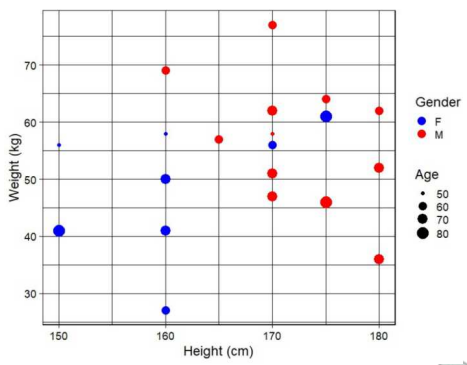
A person’s body mass index (BMI) is calculated as weight (in kg) divided by squared height (measured in square metres). For example, a person weighing 100 kg and of height 100 cm (1m) will have a BMI of 100. A person with BMI less than or equal to 18.5 is considered as underweight, above 18.5 but less than or equal to 25 as normal weight, above 25 but less than or equal to 30 as overweight, and above 30 as obese.
The topmost point of a perfectly vertical pole is marked A. The pole stands on a flat ground at point D. The points B and C are somewhere between A and D on the pole. From a point E, located on the ground at a certain distance from D, the points A, B and C are at angles of 60, 45 and 30 degrees respectively. What is AB : BC : CD?
Passage / Data
Read the following scenario and answer the three questions that follow.
The following plot describes the height (in cm), weight (in kg), age (in years) and gender (F for female, M for male) of 20 patients visiting a hospital.
A person’s body mass index (BMI) is calculated as weight (in kg) divided by squared height (measured in square metres). For example, a person weighing 100 kg and of height 100 cm (1m) will have a BMI of 100. A person with BMI less than or equal to 18.5 is considered as underweight, above 18.5 but less than or equal to 25 as normal weight, above 25 but less than or equal to 30 as overweight, and above 30 as obese.
Four friends, Ashish, Brian, Chaitra, and Dorothy, decide to jog for 30 minutes inside a stadium with a circular running track that is 200 metres long. The friends run at different speeds. Ashish completes a lap exactly every 60 seconds. Likewise, Brian, Chaitra and Dorothy complete a lap exactly every 1 minute 30 seconds, 40 seconds and 1 minute 20 seconds respectively. The friends begin together at the start line exactly at 4 p.m. What is the total of the numbers of laps the friends would have completed when they next cross the start line together ?
Mr. Jose buys some eggs. After bringing the eggs home, he finds two to be rotten and throws them away. Of the remaining eggs, he puts five-ninth in his fridge, and brings the rest to his mother’s house. She cooks two eggs and puts the rest in her fridge. If her fridge cannot hold more than five eggs, what is the maximum possible number of eggs bought by Mr. Jose?
Mohan has some money (₹M) that he divides in the ratio of 1:2. He then deposits the smaller amount in a savings scheme that offers a certain rate of interest, and the larger amount in another savings scheme that offers half of that rate of interest. Both interests compound yearly. At the end of two years, the total interest earned from the two savings schemes is ₹830. It is known that one of the interest rates is 10% and that Mohan deposited more than ₹1000 in each saving scheme at the start. What is the value of M?
One third of the buses from City A to City B stop at City C, while the rest go non-stop to City B. One third of the passengers, in the buses stopping at City C, continue to City B, while the rest alight at City C. All the buses have equal capacity and always start full from City A. What proportion of the passengers going to City B from City A travel by a bus stopping at City C?
Rajesh, a courier delivery agent, starts at point A and makes a delivery each at points B, C and D, in that order. He travels in a straight line between any two consecutive points. The following are known:
(i) AB and CD intersect at a right angle at E, and
(ii) BC, CE and ED are respectively 1.3 km, 0.5 km and 2.5 km long.
If AD is parallel to BC, then what is the total distance (in km) that Rajesh covers in travelling from A to D?
Swati can row a boat on still water at a speed of 5 km/hr. However, on a given river, it takes her 1 hour more to row the boat 12 km upstream than downstream. One day, Swati rows the boat on this river from X to Y, which is N km upstream from X. Then she rows back to X immediately. If she takes at least 2 hours to complete this round trip, what is the minimum possible value of N?
On the bank of the pristine Tunga river, a deer and a tiger are joyfully playing with each other. The deer notices that it is 40 steps away from the tiger and starts running towards it. At the same time, the tiger starts running away from the deer. Both run on the same straight line. For every five steps the deer takes, the tiger takes six. However, the deer takes only two steps to cover the distance that the tiger covers in three. In how many steps can the deer catch the tiger?
Passage / Data
Read the following scenario and answer the three questions that follow.
A company awards incentives to its employees for successful project performances. It rates successful project performance in categories A*, A, B, and C. Employees, in solo projects rated A*, A, B, and C, are awarded incentives ₹6 lakh, ₹5 lakh, ₹3 lakh, and ₹1 lakh respectively. When a project has multiple team members, the following scheme is used to award the incentives:
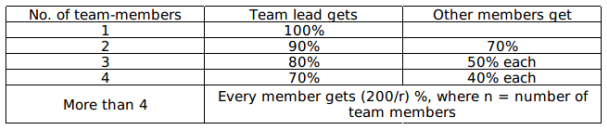
For example, for a project rated A, with three members, the team lead gets ₹4 lakh, and the other team members get ₹2.5 lakh each. A project always has a single team lead. Six employees: Altaf, Bose, Chakrabarthi, Dipa, Ernie, and Fatima receive a total of ₹45 lakh in incentives by participating in a total of eight different projects that does not involve any other person. Not all six employees are involved in all eight projects.
The following are additionally known about these eight projects:
1. One project involves all six employees. Four projects involve three each, and the rest, two each.
2. Exactly three projects are rated C, for which a total of ₹4.8 lakh is paid.
3. Only one project is rated A*
What BEST is known about the team composition for the project rated A*?
Nalini has received a total of 600 WhatsApp messages from four friends Anita, Bina, Chaitra and Divya. Bina and Divya have respectively sent 30% and 20% of these messages, while Anita has sent an equal number of messages as Chaitra. Moreover, Nalini finds that of Anita’s, Bina’s, Chaitra’s and Divya’s messages, 60%, 40%, 80% and 50% respectively are jokes. What percentage of the jokes, received by Nalini, have been sent neither by Divya nor by Bina?
Two friends, Ram and Shyam, start at the same point, at the same time. Ram travels straight north at a speed of 10km/hr, while Shyam travels straight east at twice the speed of Ram. After 15 minutes, Shyam messages Ram that he is just passing by a large telephone tower and after another 15 minutes Ram messages Shyam that he is just passing by an old banyan tree. After some more time has elapsed, Ram and Shyam stop. They stop at the same point of time. If the straight-line distance between Ram and Shyam now is 50 km, how far is Shyam from the banyan tree (in km)? (Assume that Ram and Shyam travel on a flat surface.)
X, Y, and Z are three software experts, who work on upgrading the software in a number of identical systems. X takes a day off after every 3 days of work, Y takes a day off after every 4 days of work and Z takes a day off after every 5 days of work.
Starting afresh after a common day off,
i) X and Y working together can complete one new upgrade job in 6 days
ii) Z and X working together can complete two new upgrade jobs in 8 days
iii) Y and Z working together can complete three new upgrade jobs in 12 days
If X, Y and Z together start afresh on a new upgrade job (after a common day off), exactly how many days will be required to complete this job?
A box contains 6 cricket balls, 5 tennis balls and 4 rubber balls. Of these, some balls are defective. The proportion of defective cricket balls is more than the proportion of defective tennis balls but less than the proportion of defective rubber balls. Moreover, the overall proportion of defective balls is twice the proportion of defective tennis balls. What BEST can be said about the number of defective rubber balls in the box?
A hare and a tortoise run between points O and P located exactly 6 km from each other on a straight line. They start together at O, go straight to P and then return to O along the same line. They run at constant speeds of 12 km/hr and 1 km/hr respectively. Since the tortoise is slower than the hare, the hare shuttles between O and P until the tortoise goes once to P and returns to O. During the run, how many times are the hare and the tortoise separated by an exact distance of 1 km from each other?
X, Y and Z start a web-based venture together. X invests Rs. 2.5 lakhs, Y invests Rs. 3.5 lakhs, and Z invests Rs. 4 lakhs. In the first year, the venture makes a profit of Rs. 2 lakhs. A part of the profit is shared between Y and Z in the ratio of 2 : 3, and the remaining profit is divided among X, Y and Z in the ratio of their initial investments.
The amount that Z receives is four times the amount that X receives. How much amount does Y receive?
Two numbers a and b are inversely proportional to each other. If a increases by 100%, then b decreases by
A, B, C, D and E are five employees working in a company. In two successive years, each of them got hikes in his salary as follows:
A : p% and (p + 1)%,
B : (p + 2)% and (p - 1)%,
C : (p + 3)% and (p - 2)%,
D : (p + 4)% and (p - 3)%,
E : (p + 5)% and (p - 4)%.
If all of them have the same salary at the end of two years, who got the least hike in his salary?
A firm pays its five clerks Rs. 15,000 each, three assistants Rs. 40,000 each and its accountant Rs. 66,000. Then the mean salary in the firm comprising of these nine employees exceeds its median salary by rupees
An article is marked x% above the cost price. A discount of 2/3x% if given on the marked price. If the profit is 4% of the cost price and the value of x lies between 25 and 50, then the value of 50% of x is:
A computer is sold either for Rs.19200 cash or for Rs.4800 cash down payment together with five equal monthly installments. If the rate of interest charged is 12% per annum, then the amount of each installment (nearest to a rupee) is
Abdul, Bimal, Charlie and Dilbar can finish a task in 10, 12, 15 and 18 days respectively. They can either choose to work or remain absent on a particular day. If 50 percent of the total work gets completed after 3 days, then, which of the following options is possible?
The price of a product is P. A shopkeeper raises its price by X% and then offers a discount of Y% on the raised price. The discounted price again becomes P. If Y is the difference between X and Y, then find X.
A mixture comprises water and liquids A and B. The volume of water is 1/3rd of the total mixture and the volume of liquids A and B are in the ratio 5:3. To remove the water, the mixture is passed through a porous medium which completely absorbs the water and partially absorbs liquid A. Altogether this porous medium absorbs 200 ml of the initial mixture. If the ratio of volume of liquids A and B in the residual concentrated mixture becomes 7:9 then find the volume of water absorbed by the porous medium.
Every day a person walks at a constant speed, V1 for 30 minutes. On a particular day, after walking for 10 minutes at V1, he rested for 5 minutes. He finished the remaining distance of his regular walk at a constant speed, V2, in another 30 minutes. On that day, find the ratio of V2 and his average speed (i.e., total distance covered /total time taken including resting time).
The number of boys in a school was 30 more than the number of girls. Subsequently, a few more girls joined the same school. Consequently, the ratio of boys and girls became 3:5. Find the minimum number of girls, who joined subsequently.
A girl travels along a straight line, from point A to B at a constant speed, V1 meters/sec for T seconds. Next, she travels from point B to C along a straight line, at a constant speed of V2 meters/sec for another T seconds. BC makes an angle 105° with AB. If CA makes an angle 30° with BC, how much time will she take to travel back from point C to A at a constant speed of V2 meters/sec, if she travels along a straight line from C to A?
Four two-way pipes A, B, C and D can either fill an empty tank or drain the full tank in 4, 10, 12 and 20 minutes respectively. All four pipes were opened simultaneously when the tank is empty. Under which of the following conditions the tank would be half filled after 30 minutes?
A shop, which sold same marked price shirts, announced an offer - if one buys three shirts then the fourth shirt is sold at a discounted price of ₹ 100 only. Patel took the offer. He left the shop with 20 shirts after paying ₹ 20,000. What is the marked price of a shirt?
Arup and Swarup leave point A at 8 AM to point B. To reach B, they have to walk the first 2 km, then travel 4 km by boat and complete the final 20 km by car. Arup and Swarup walk at a constant speed of 4 km/hr and 5 km/hr respectively. Each rows his boat for 30 minutes. Arup drives his car at a constant speed of 50 km/hr while Swarup drives at 40 km/hr. If no time is wasted in transit, when will they meet again?
Rani bought more apples than oranges. She sells apples at Rs. 23 apiece and makes 15% profit. She sells oranges at Rs. 10 apiece and marks 25% profit. If she gets Rs. 653 after selling all the apples and oranges, find her profit percentage.
Pradeep could either walk or drive to office. The time taken to walk to the office is 8 times the driving time. One day, his wife took the car making him walk to office. After walking 1 km, he reached a temple when his wife call to say that he can now take the car. Pradeep figure that continuing to walk to the office will take as long as walking back home and then driving to the office. Calculate the distance between the temple and the office.
A water tank has M inlet pipes and N outlet pipes. An inlet pipe can fill the tank in 8 hours while an outlet pipe can empty the full tank in 12 hours. If all pipes are left open simultaneously, it takes 6 hours to fill the empty tank. What is the relationship between M and N?
Company ABC starts an educational program in collaboration with Institute XYZ. As per the agreement, ABC and XYZ will share profit in 60 : 40 ratio. The initial investment of Rs. 100,000 on infrastructure is borne entirely by ABC whereas the running cost of Rs. 400 per student is borne by XYZ. If each student pays Rs. 2000 for the program find the minimum number of students required to make the program profitable, assuming ABC wants to recover its investment in the very first year and the program has no seat limits.
Study the figure below and answer the question:
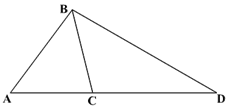
Four persons walk from Point A to Point D following different routes. The one following ABCD takes 70 minutes. Another person takes 45 minutes following ABD. The third person takes 30 minutes following route ACD. The last person takes 65 minutes following route ACBD. IF all were to walk at the same speed, how long will it take to go from point B to point C?
The Maximum Retail Price (MRP) of a product is 55% above its manufacturing cost. The product is sold through a retailer, who earns 23% profit on his purchase price. What is the profit percentage (expressed in nearest integer) for the manufacturer who sells his product to the retailer? The retailer gives 10% discount on MRP.
Product M is produced by mixing chemical X and chemical Y in the ratio of 5 : 4. Chemical X is prepared by mixing two raw materials, A and B, in the ratio of 1 : 3. Chemical Y is prepared by mixing raw materials, B and C, in the ratio of 2 : 1. Then the final mixture is prepared by mixing 864 units of product M with water. If the concentration of the raw material B in the final mixture is 50%, how much water had been added to product M?
In the beginning of the year 2004, a person invests some amount in a bank. In the beginning of 2007, the accumulated interest is Rs. 10,000 and in the beginning of 2010, the accumulated interest becomes Rs. 25,000. The interest rate is compounded annually and the annual interest rate is fixed. The principal amount is:
The tax rates for various income slabs are given below.
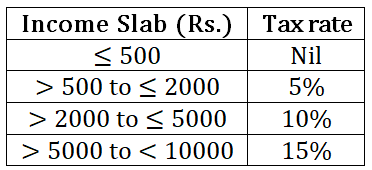
There are 15 persons working in an organization. Out of them, 3 to 5 persons are falling in each of the income slabs mentioned above. Which of the following is the correct tax range of the 15 persons? (E.g. If one is earning Rs. 2000, the tax would be: 500 × 0 + 1500 × 0.05)
The median of 11 different positive integers is 15 and seven of those 11 integers are 8, 12, 20, 6, 14, 22, and 13.
Statement I: The difference between the averages of four largest integers and four smallest integers is 13.25.
Statement II: The average of all the 11 integers is 16.
Which of the following statements would be sufficient to find the largest possible integer of these numbers?
Three pipes are connected to an inverted cone, with its base at the top. Two inlet pipes, A and B, are connected to the top of the cone and can fill the empty in 8 hours and 12 hours, respectively. The outlet pipe C, connected to the bottom, can empty a filled cone in 4 hours. When the cone is completely filled with water, all three pipes are opened. Two of the three pipes remain open for 20 hours continuously and the third pipe remains open for a lesser time. As a result, the height of the water inside the cone comes down to 50%. Which of the following options would be possible?
Ramesh analysed the monthly salary figures of five vice presidents of his company. All the salary figures are integers. The mean and the median salary figures are Rs. 5 lakh, and the only mode is Rs. 8 lakh. Which of the options below is the sum (in Rs. lakh) of the highest and the lowest salaries?
Passage / Data
Answer the following question based on the information given below.
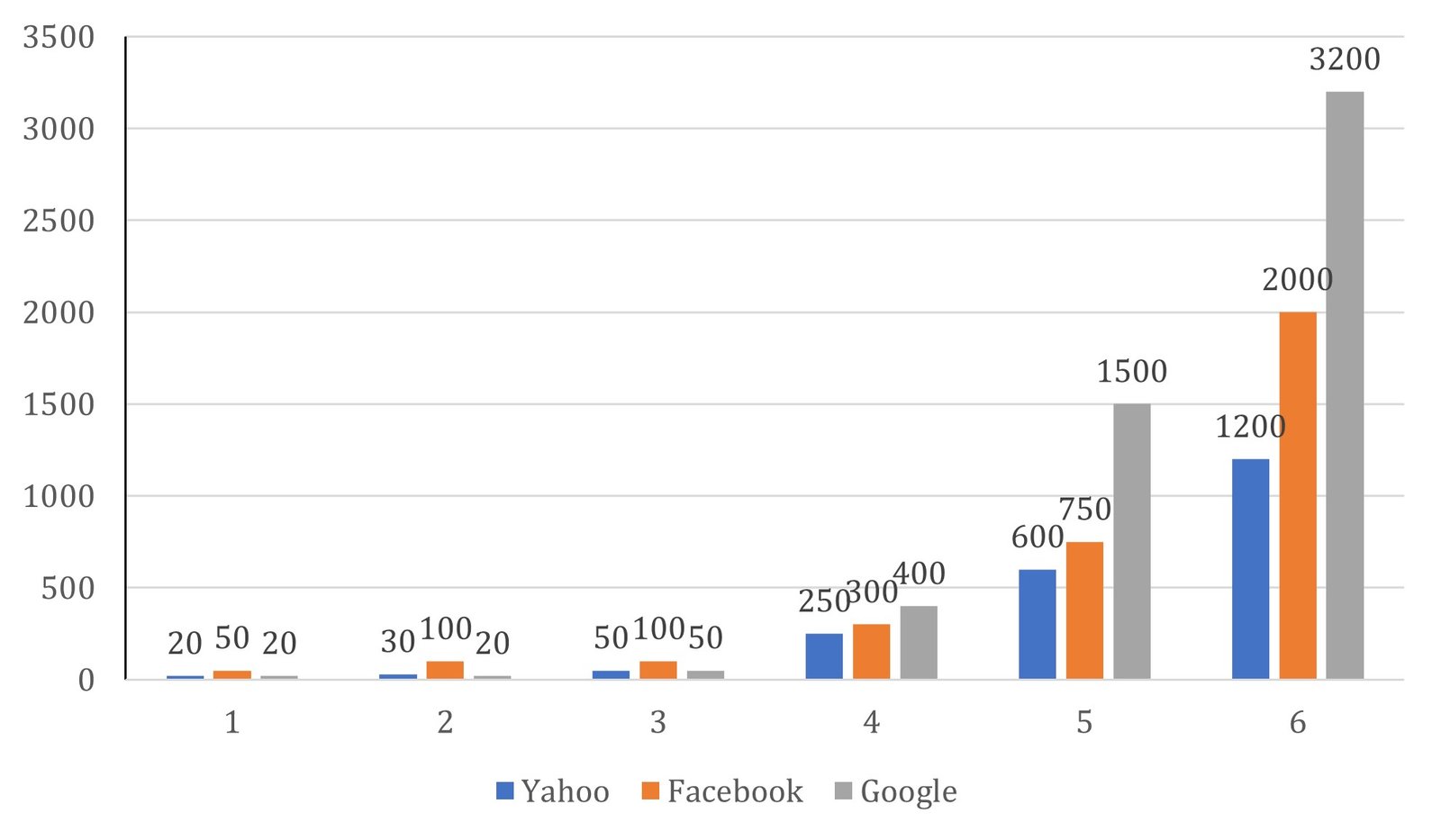
The following graphs shows the revenue (in $ million) of three companies in their initial six years of operations, in an economy which is characterized by a persistent inflation.
Tina, Mina, Gina, Lina and Bina are 5 sisters, aged in that order, with Tina being the eldest. Each of them had to carry a bucket of water from a well to their house. Their buckets’ capacities were proportional to their ages. While returning, equal amount of water got splashed out of their buckets. Who lost maximum amount of water as a percentage of the bucket capacity?
Passage / Data
Answer the following question based on the information given below.
The following graphs shows the revenue (in $ million) of three companies in their initial six years of operations, in an economy which is characterized by a persistent inflation.
A man borrows Rs. 6000 at 5% interest, on reducing balance, at the start of the year. If he repays Rs. 1200 at the end of each year, find the amount of loan outstanding, in Rs., at the beginning of the third year.
Passage / Data
Answer the following question based on the information given below.
The following graphs shows the revenue (in $ million) of three companies in their initial six years of operations, in an economy which is characterized by a persistent inflation.
Gopal sells fruit juice mixture using orange juice and pineapple juice. Gopal prepares this mixture by drawing out a jug of orange juice from a 10 litre container filled with orange juice, and replacing it with pineapple juice. If Gopal draws out another jug of the resultant mixture and replaces it with pineapple juice, the container will have equal volumes of orange juice and pineapple juice. The volume of the jug in litres, is
Passage / Data
Answer the following question based on the information given below.
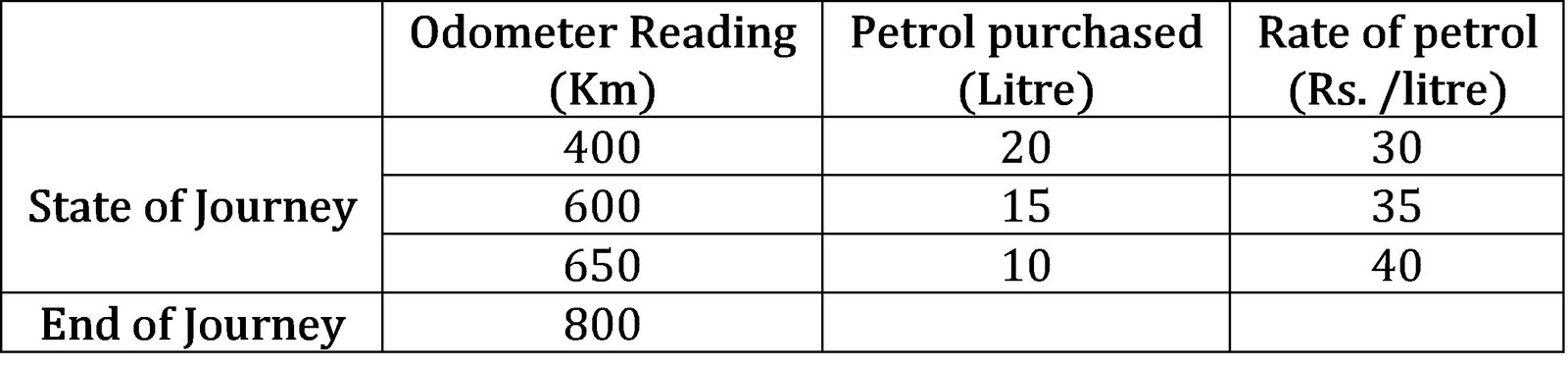
Ramya, based in Shanpur, took her car for a 400 km trip to Rampur. She maintained a log of the odometer readings and the amount of petrol she purchased at different petrol pumps at different prices (given below). Her car already had 10 litres of petrol at the start of the journey, and she first purchased petrol at the start of the journey, as given in table below, and she had 5 litres remaining at the end of the journey.
A medical practitioner has created different potencies of a commonly used medicine by dissolving tables in water and using the resultant solution.
Potency 1 solution: When 1 tablet is dissolved in 50 ml, the entire 50 ml is equivalent to one dose.Potency 2 solution: When 2 tablets are dissolved in 50 ml, the entire 50 ml of this solution is equivalent to 2 doses,… and so on.
This way he can give fractions of tablets based on the intensity of infection and the age of the patient.
For particular patient, he administers 10 ml of potency 1, 15 ml of potency 2 and 30 ml of potency 4. The dosage administered to the patient is equivalent to
Passage / Data
Answer the following question based on the information given below.
Ramya, based in Shanpur, took her car for a 400 km trip to Rampur. She maintained a log of the odometer readings and the amount of petrol she purchased at different petrol pumps at different prices (given below). Her car already had 10 litres of petrol at the start of the journey, and she first purchased petrol at the start of the journey, as given in table below, and she had 5 litres remaining at the end of the journey.
Ram prepares solutions of alcohol in water according to customers’ needs. This morning Ram has prepared 27 litres of a 12% alcohol solution and kept it ready in a 27 litre delivery container to be shipped to the customer. Just before delivery, he finds out that the customer had asked for 27 litres of 21% alcohol solution. To prepare what the customer wants, Ram replaces a portion of 12% solution by 39% solution. How many litres of 12% solution are replaced?
Passage / Data
Answer the following question based on the information given below.
Ramya, based in Shanpur, took her car for a 400 km trip to Rampur. She maintained a log of the odometer readings and the amount of petrol she purchased at different petrol pumps at different prices (given below). Her car already had 10 litres of petrol at the start of the journey, and she first purchased petrol at the start of the journey, as given in table below, and she had 5 litres remaining at the end of the journey.
City Bus Corporation runs two buses from terminus A to terminus B, each bus making 5 round trips in a day. There are no stops in between. These buses ply back and forth on the same route at different but uniform speeds. Each morning the buses start at 7 AM from the respective terminuses. They meet for the first time at a distance of 7 km from terminus A. Their next meeting is at a distance of 4 km from terminus B, while travelling in opposite directions. Assuming that the time taken by the buses at the terminuses is negligibly small, and the cost of running a bus is Rs. 20 per km, find the daily cost of running the buses (in Rs.).
Passage / Data
Answer the following question based on the information given below.
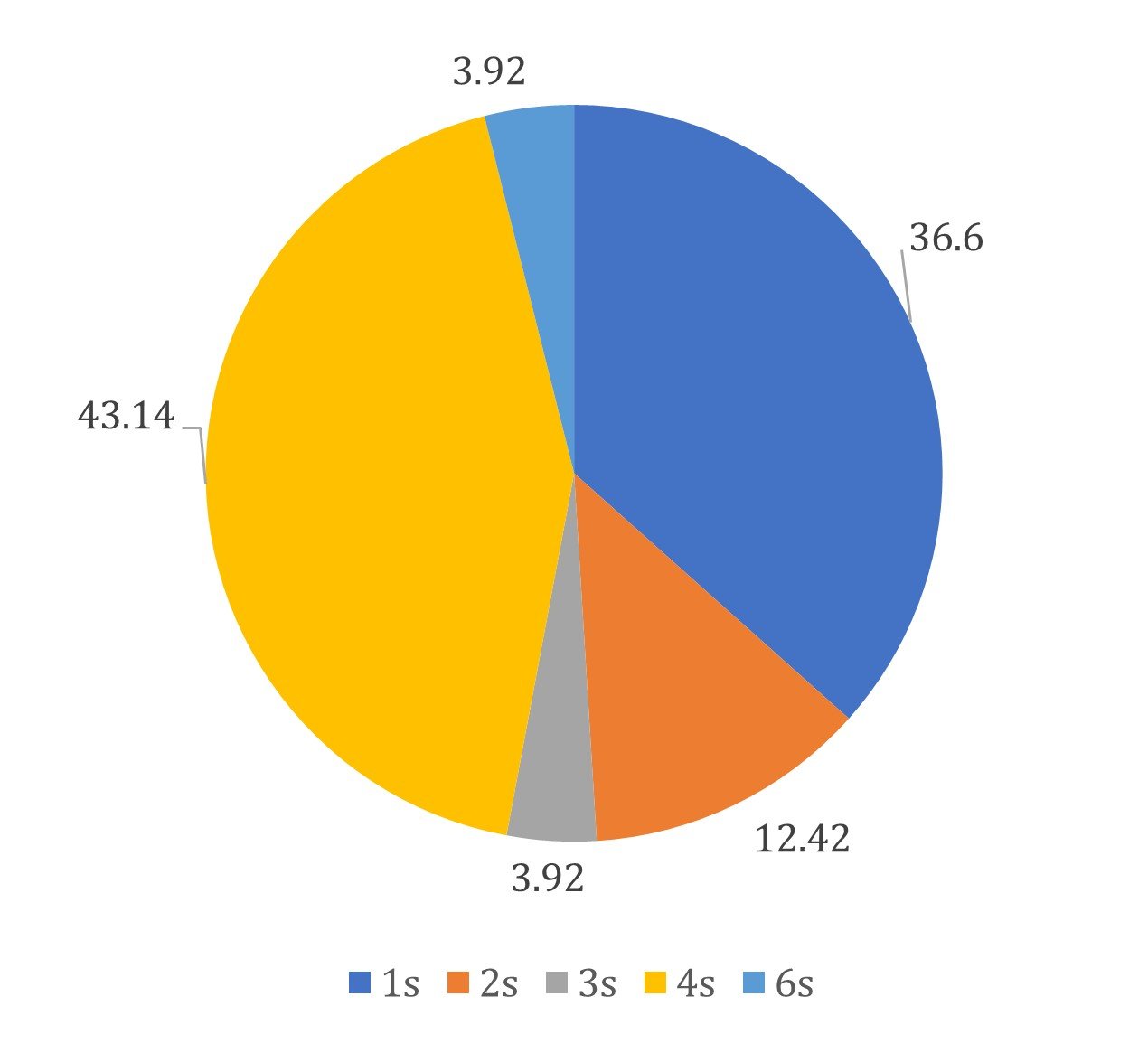
The following pie chart shows the percentage distribution of runs scored by a batsman in a test innings.
Ram and Shyam form a partnership (with Shyam as working partner) and start a business by investing Rs. 4000 and Rs. 6000 respectively. The conditions of partnership were as follows:
- In case of profits till Rs. 200,000 per annum, profits would be shared in the radio of the invested capital.
- Profits from Rs. 200,001 till Rs. 400,000 Shyam would take 20% out of the profit, before the division of remaining profits, which will then be based on ratio of invested capital.
- Profits in excess of Rs. 400,000, Shyam would take 35% out of the profits beyond Rs. 400,000, before the division of remaining profits, which will then be based on ratio of invested capital.
If Shyam’s share in a particular year was Rs. 367000, which option indicates the total business profit (in Rs.) for that year?