Verbal Ability — XAT Previous-Year Questions
90 previous-year questions on Verbal Ability from XAT, with full solutions. Practise free — check answers as you go; sign in to save your progress.
Verbal Ability · XAT PYQs
Read the following statements and answer the question that follows.
- Back then, they were owned by companies and installed on their premises.
- Rooms and servers began to replace computer mainframes in the 1990’s.
- These were supplemented by processors from Intel, which by the mid-2000s translated its dominance of PC semiconductors into a near monopoly of the server market.
- They mostly ran on chips made by IBM and HP, the big tech of the day.
- Things started to change once again around a decade ago, when Amazon began selling some of its spare server capacity.
Which of the following combinations is the MOST logically ordered?
Read the following statement carefully and fill up the blanks from the given options.
As _________evolved and eventually moved to cities, close proximity ____________how we viewed and assessed each_________.
Read the following statement carefully.
___________like a fake can be a sign of___________, and clinging too tightly to what feels like one’s authentic self can ________that growth.
Fill in the blanks meaningfully, in the above statement, from the following options.
Read the following sentences carefully.
A. Everybody accepts his responsibilities.
B. Nobody in that group have their reports up to date, as they should have.
C. Either of the boys is acceptable to do the errands.
D. Both of the mice is underfed.
E. It is I who am next.
F. The teacher told he and I to leave early.
Which of the following combinations has all the sentences grammatically CORRECT?
Read the following sentences carefully.
A. I shall be there at about 9: 00 a.m.
B. Keep off of the grass.
C. My old car was much faster than the new one.
D. I was angry at my friend.
E. Rohit is as capable as Virat.
Which of the following combinations has all the INCORRECT sentences?
Read the following passage and answer the question that follows.
That’s how life plays out for all of us. We lose some. Like sportspersons, we too pack our gear and go to work. But unlike them, the gaze of the world is not upon us. Most of us do our business in anonymity, very few of us are emotionally wired to the outcomes of our day jobs. We don’t come back feeling like winners. Or losers. As sports fans we can summon empathy for those who stretch their bodies and minds to the limit in the pursuit of athletic excellence and provide such joys in the process.
But we will never experience the highs that are their reward. And we will never know the depth of their lows, which are their burden.
Still, no one will know better than Rohit and Dravid that its already a new day. There might never be a World Cup win for them. But there are loved ones to go to. Life awaits still.
Which of the following statements BEST summarizes the above passage?
Go through the statements below and answer the question that follows.
- Maybe you have survived major trauma and have a hard time feeling safe.
- You’ll probably discover that your fear and struggles make sense on account of what you’ve lived through.
- Instead of beating yourself up for reacting in ways you don’t understand, you can develop compassion for yourself and what you’ve been through.
- Perhaps you have experienced a sudden death, and you are often anxious about the health of your loved ones.
- You may also find out that you have more strength than you knew, the same strength that has sustained you this far….
Which of the following combinations is the MOST logically ordered?
Arrange the following into a meaningful sequence:
- I’m not sure when I first became aware of the Singularity.
- In the almost half century that I've immersed myself in computer and related technologies, I've sought to understand the meaning and purpose of the continual upheaval that I have witnessed at many levels.
- Gradually, I've become aware of a transforming event looming in the first half of the twenty first century.
- I'd have to say it was a progressive awakening.
- Just as a black hole in space dramatically alters the patterns of matter and energy accelerating toward its event horizon, this impending Singularity in our future is increasingly transforming every institution and aspect of human life, from sexuality to spirituality.
Read the following passage and answer the question that follows.
As a generation, we are rethinking what we are to others. Our technological prowess has become a wireless lifeline for others. Some of us apply ourselves to innovation: hackathons and other forms of technological creativity. Our families look to us to know how to use technology both to waste time and to make meaning. Some of us set up Facetime for those denied face‐to‐face time. We show them it will be OK, that digital relationships are real relationships – though in fact we are not always sure.
Which of the following, will be a most MEANINGFUL conclusion of the passage?
Read the following sentences carefully.
- The boss accused her employee for stealing information.
- The boss had better discuss the issue with the employee concerned.
- The India of 2022 is very different from the India of 1947.
- The government is committed to providing people with food.
- He is good in playing the piano.
From the following, identify the option with INCORRECT sentences.
Arrange the following into a meaningful sequence:
- Our knowledge about life developed over the centuries thanks to the many philosophers, physicists, chemists and biologists, who examined such complex matters according to their different points of view.
- Out of this long history, I wish to quote here only one date, the year 1953.
- In that year, Miller and Urey carried out their famous experiment about the primordial universal soup, whose foundations had already been expounded by the Russian chemist Alexandre Oparin in 1924.
- From a mixture of five gases, methane, ammonia, carbon dioxide, hydrogen and water vapor, and an electric discharge as the source of energy, complex molecules were produced, including amino acids.
Read the following sentences carefully.
- The exam will begin from 2:00 p.m. on January 8th.
- While entering into the college building, he saw the statue of Mahatma Gandhi.
- The government has entered into a discussion with the local bodies for keeping the streets clean.
- I will start my world tour from Sri Lanka.
- Amitabh Bacchan is married with Jaya Bacchan
- I have been working on this project for three weeks.
From the following, choose the option having all the CORRECT sentences.
Which of the following sentences have the CORRECT usage of punctuation?
Read the following excerpt carefully.
In the future, hydrogen may form a significant part of our energy systems. Today it is mostly used in oil refineries and fertiliser but in the future hydrogen could power our cars, heat our homes, and fuel industry. A recent McKinsey study suggested that in less than 25 years, hydrogen could account for 18% of global energy consumption and reduce carbon dioxide emissions from current levels by some 6 gigatons….
Which of the following sentences will MOST logically complete the above excerpt?
Fill up the blanks with appropriate words.
Oil painting did to appearance what capital did to social____________. It reduced everything to the __________of objects. Everything became __________because everything became a commodity. All reality was mechanically__________ by its materiality.
Which of the following sentences are grammatically CORRECT?
1. Have you any clothes to dispose of?
2. I saw a pleasant dream last night.
3. I have done it many a times safely.
4. Students struggle to cope up with academic pressure.
5. You need not give negative feedback to your employees.
6. My friend is good at playing football.
Read the poem carefully, and answer the following question.
I smiled at you because I thought that you
Were someone else; you smiled back; and there grew
Between two strangers in a library
Something that seems like love; but you loved me
(If that’s the word) because you thought that I
Was other than I was. And by and by
We found we’d been mistaken all the while
From that first glance, that first mistaken smile
Which of the following CANNOT be inferred from the poem?
Carefully read the following statement:
The moment we no longer have a free press, anything can happen. What makes it_____ for a totalitarian or any other dictatorship to rule is that _____ are not informed; how can you have an opinion if you are not informed? If everybody always lies to you, the ________ is not that you believe the lies, but rather that nobody believes anything any longer. This is because lies, by their very nature, have to be changed, and a lying government has ________ to rewrite its own history.
Which of the following options will BEST fill up the above blanks meaningfully?
Read the passage carefully and answer the following question.
Geologists have been investigating a potential cycle in geological events for a long time. Back in the 1920s and 30s, scientists of the era had suggested that the geological record had a 30-million-year cycle, while in the 1980s and 90s researchers used the best-dated geological events at the time to give them a range of the length between 'pulses' of 26.2 to 30.6 million years. Now, everything seems to be in order -27.5 million years is right about where we'd expect. A study late last year suggested that this 27.5-million-year mark is when mass extinctions happen, too.
Which of the following statements can be BEST concluded from the passage?
Carefully read the following statement:
When I ask people to name three recently implemented technologies that most impact our world today, they usually propose the computers, the Internet and the laser. All three were unplanned, ___________, and_____________ upon their discovery and remained __________ well after their initial use.
Which of the following options will BEST fill up the above blanks meaningfully?
Which of the following sentences have INCORRECT usage of preposition?
1. The manager was sitting at the desk.
2. My work is superior to yours.
3. I prefer coffee than tea.
4. She was accused for stealing gold.
5. This is an exception to the rule.
6. They are leaving to England soon.
Arrange the following sentences in a LOGICAL sequence:
1. But when it comes to companies that lack computer programmers, the government is far more sympathetic.
2. As a result, limited access to foreign talent is a common gripe of tech founders and venture capitalists.
3. And, demand for the latter has soared among British startups.
4. This is less inconsistent than it may seem.
5. An HGV driver takes between six and ten weeks to train; a competent coder several years.
Passage / Data
Read the passage carefully and answer the THREE questions that follow.
Stupidity is a very specific cognitive failing. Crudely put, it occurs when you don’t have the right conceptual tools for the job. The result is an inability to make sense of what is happening and a resulting tendency to force phenomena into crude, distorting pigeonholes.
This is easiest to introduce with a tragic case. British high command during the First World War frequently understood trench warfare using concepts and strategies from the cavalry battles of their youth. As one of Field Marshal Douglas Haig’s subordinates later remarked, they thought of the trenches as ‘mobile operations at the halt’: i.e., as fluid battle lines with the simple caveat that nothing in fact budged for years.
Unsurprisingly, this did not serve them well in formulating a strategy: they were hampered, beyond the shortage of material resources, by a kind of ‘conceptual obsolescence’, a failure to update their cognitive tools to fit the task in hand. In at least some cases, intelligence actively abets stupidity by allowing pernicious rationalisation.
Stupidity will often arise in cases like this, when an outdated conceptual framework is forced into service,mangling the user’s grip on some new phenomenon. It is important to distinguish this from mere error. We make mistakes for all kinds of reasons. Stupidity is rather one specific and stubborn cause of error. Historically, philosophers have worried a great deal about the irrationality of not taking the available means to achieve goals: Tom wants to get fit, yet his running shoes are quietly gathering dust. The stock solution to Tom’s quandary is simple willpower. Stupidity is very different from this. It is rather a lack of the necessary means, a lack of the necessary intellectual equipment. Combatting it will typically require not brute willpower but the construction of a new way of seeing our self and our world. Such stupidity is perfectly compatible with intelligence: Haig was by any standard a smart man.
Read the excerpt carefully and answer the following question.
The over-whelming preponderance of people have not freely decided what to believe, but, rather, have been socially conditioned (indoctrinated) into their beliefs. They are unreflective thinkers.
Which of the following statements CANNOT be concluded from the excerpt?
Read the following statements and answer the question that follows.
1. Some countries are, at least, trying to curb emissions.
2. Morocco is building a colossal solar-power plant in the desert.
3. States in the Middle East and North Africa can do little on their own to mitigate climate change.
4. Saudi Arabia is not going to stop exporting oil, but it plans to build a solar plant that will be about 200 times the size of the biggest such facility operating today.
5. Politics often gets in the way of problem solving.
Arrange the above five statements in a logical sequence.
Read the following statements and answer the question that follows.
1. Behavioral models in finance most often critique the efficient market hypothesis, which states that if investors behave rationally then prices should reflect all available information about the financial asset in consideration.
2. A number of behavioral models, including feedback models where investors bid up the price, have been used to explain this phenomenon.
3. But asset price bubbles and crashes belie this conclusion.
4. Finance is one of the fields where behavioral models have been used extensively, enough for behavioral finance.
5. This idea of “irrational exuberance” is now widely accepted and used in financial analysis, especially while analyzing asset price bubbles.
Arrange the above five statements in a logical sequence.
Read the following statement:
While start-ups have__________ reach, _____ they introduce ________ products, they open-up ________ markets.
Fill in the blanks meaningfully, in the above statement, from the following options.
Passage / Data
Read the following passage and answer the question that follows.
The painting, which is in poor condition, suggests that a highly advanced artistic culture existed some 44,000 years ago, punctuated by folklore, religious myths and spiritual belief. The scene may be regarded not only as the earliest dated figurative art in the world but also as the oldest evidence for the communication of a narrative in Palaeolithic art.
"This is noteworthy, given that the ability to invent fictional stories may have been the last and most crucial stage in the evolutionary history of human language and the development of modern-like patterns of cognition” researchers said.
Which of the following can be BEST concluded from the passage?
Passage / Data
Read the following passage and answer the two questions that follow.
We stand before this great world. The truth of our life depends upon our attitude of mind towards it - an attitude which is formed by our habit of dealing with it according to the special circumstance of our surroundings and our temperaments. It guides our attempts to establish relations with the universe either by conquest or by union, either through the cultivation of power or through that of sympathy.
And thus, in our realization of the truth of existence, we put our emphasis either upon the principle of dualism or upon the principle of unity.
Which of the following statements can be BEST inferred from the passage?
Passage / Data
Read the following passage and answer the two questions that follow.
We stand before this great world. The truth of our life depends upon our attitude of mind towards it - an attitude which is formed by our habit of dealing with it according to the special circumstance of our surroundings and our temperaments. It guides our attempts to establish relations with the universe either by conquest or by union, either through the cultivation of power or through that of sympathy.
And thus, in our realization of the truth of existence, we put our emphasis either upon the principle of dualism or upon the principle of unity.
According to the passage, our emphasis on dualism or on unity is BEST guided by:
Carefully read the paragraph below:
A map is a useful metaphor for our brain when talking about _______ because at its most basic level our brain __________to be our atlas of sorts, a system of routes _______to navigate us toward just one destination: staying alive!
From the options below, choose the set that MOST appropriately fills up the blanks.
Carefully read the paragraph below:
__________, medicine has been operated by trial and error, in other words, __________. We know by now that there can be entirely_________ connections between symptoms and treatment, and some medications succeed in medical trials for mere random reasons.
From the options below, choose the one that MOST appropriately fills up the blanks.
Read the following sentences and answer the question that follows:
1. I have good knowledge of German.
2. Except for Rajiv, everybody was there.
3. Whole Delhi was celebrating Independence Day.
4. Neither the dog, nor is the cat responsible for this mess.
5. He knows to swim.
6. I look forward to seeing you.
Which of the above are grammatically INCORRECT?
Which of the following is a grammatically CORRECT sentence?
Passage / Data
Read the passage below and answer the 3 associated questions:
It’s as if someone were out there making up pointless jobs just for the sake of keeping us all working. And here, precisely, lies the mystery. In capitalism, this is precisely what is not supposed to happen. Sure, in the old inefficient socialist states like the Soviet Union, where employment was considered both a right and a sacred duty, the system made up as many jobs as it had to. (This is why in Soviet department stores it took three clerks to sell a piece of meat.) But, of course, this is the very sort of problem market competition is supposed to fix. According to economic theory, at least, the last thing a profit-seeking firm is going to do is shell out money to workers they don’t really need to employ. Still, somehow, it happens. While corporations may engage in ruthless downsizing, the layoffs and speed-ups invariably fall on that class of people who are actually making, moving, fixing, and maintaining things. Through some strange alchemy no one can quite explain, the number of salaried paper pushers ultimately seems to expand, and more and more employees
find themselves—not unlike Soviet workers, actually—working forty- or even fifty-hour weeks on paper but effectively working fifteen hours just as Keynes predicted, since the rest of their time is spent organizing or attending motivational seminars, updating their Facebook profiles, or downloading TV box sets. The answer clearly isn’t economic: it’s moral and political. The ruling class has figured out that a happy and productive population with free time on their hands is a mortal danger. (Think of what started to happen when this even began to be approximated in the sixties.) And, on the other hand, the feeling that work is a moral value in itself, and that anyone not willing to submit themselves to some kind of intense work discipline for most of their waking hours deserves nothing, is extraordinarily convenient for them.
Go through the statements below and answer the question that follows:
P. Fast food intake for more than three times a week is associated with greater odds of atopic disorders such as asthma, eczema or rhinitis. Thus, it should be definitely and strictly controlled in children as it does no good.
Q. Regular junk food intake can lead to physical and psychological issues among children.
R. Lack of Vitamins such as A and C, and minerals such as magnesium and calcium, encourage the development of deficiency diseases and osteoporosis, as well as dental caries due to higher intake.
S. Junk food, which are rich in energy with lots of fat and sugar, are relatively low in other important nutrients such as protein, fiber,
vitamins and minerals.
T. Emotional and self-esteem problems, along with chronic illnesses in later life due to obesity, are the issues associated with the
junk food.
Which of the following combinations is the MOST logically ordered?
Passage / Data
Read the passage below and answer the 3 associated questions:
It’s as if someone were out there making up pointless jobs just for the sake of keeping us all working. And here, precisely, lies the mystery. In capitalism, this is precisely what is not supposed to happen. Sure, in the old inefficient socialist states like the Soviet Union, where employment was considered both a right and a sacred duty, the system made up as many jobs as it had to. (This is why in Soviet department stores it took three clerks to sell a piece of meat.) But, of course, this is the very sort of problem market competition is supposed to fix. According to economic theory, at least, the last thing a profit-seeking firm is going to do is shell out money to workers they don’t really need to employ. Still, somehow, it happens. While corporations may engage in ruthless downsizing, the layoffs and speed-ups invariably fall on that class of people who are actually making, moving, fixing, and maintaining things. Through some strange alchemy no one can quite explain, the number of salaried paper pushers ultimately seems to expand, and more and more employees
find themselves—not unlike Soviet workers, actually—working forty- or even fifty-hour weeks on paper but effectively working fifteen hours just as Keynes predicted, since the rest of their time is spent organizing or attending motivational seminars, updating their Facebook profiles, or downloading TV box sets. The answer clearly isn’t economic: it’s moral and political. The ruling class has figured out that a happy and productive population with free time on their hands is a mortal danger. (Think of what started to happen when this even began to be approximated in the sixties.) And, on the other hand, the feeling that work is a moral value in itself, and that anyone not willing to submit themselves to some kind of intense work discipline for most of their waking hours deserves nothing, is extraordinarily convenient for them.
Go through the statements below and answer the question that follows:
P. Surabhi’s Instagram profile has 1.4 million followers. It is filled with pictures of her posing in different settings.
Q. In India, reports suggest that WhatsApp (Much more than Facebook or Twitter) is the primary tool for the dissemination of political
communication.
R. Political campaigns pay social media companies to promote their content.
S. Political advertising on social media comes in many forms and remains underexamined in India.
T. Social media influencers are used for the dissemination of content.
Which of the following combinations is the MOST logically ordered?
Passage / Data
In 1942, the French writer Albert Camus composed an essay, ‘The Myth of Sisyphus’. It draws on the Greek fable of a man condemned to roll a rock up a mountain only to have it roll back down under its own weight, a ______ that lasts for eternity. Camus argues that this image ______ the human condition in a world where we can no longer make sense of events; but instead of committing suicide, we should ______ ourselves to this ‘elusive feeling of absurdity’ and bear it as best we can. In this sense, Sisyphus is the ideal hero.
Consider the following words:
- surrender
- choice
- symbolises
- quandary
- attune
- option
- reconcile
- depicts
Which of the following options is the most appropriate sequence that best fits the blanks in the above paragraph?
Passage / Data
In 1942, the French writer Albert Camus composed an essay, ‘The Myth of Sisyphus’. It draws on the Greek fable of a man condemned to roll a rock up a mountain only to have it roll back down under its own weight, a ______ that lasts for eternity. Camus argues that this image ______ the human condition in a world where we can no longer make sense of events; but instead of committing suicide, we should ______ ourselves to this ‘elusive feeling of absurdity’ and bear it as best we can. In this sense, Sisyphus is the ideal hero.
Consider the following words:
- surrender
- choice
- symbolises
- quandary
- attune
- option
- reconcile
- depicts
______ the importance of ‘horizontal stratification’ ______ higher education is widely acknowledged, ______ attention has been applied to horizontal stratification ______ compulsory schooling.
Passage / Data
In 1942, the French writer Albert Camus composed an essay, ‘The Myth of Sisyphus’. It draws on the Greek fable of a man condemned to roll a rock up a mountain only to have it roll back down under its own weight, a ______ that lasts for eternity. Camus argues that this image ______ the human condition in a world where we can no longer make sense of events; but instead of committing suicide, we should ______ ourselves to this ‘elusive feeling of absurdity’ and bear it as best we can. In this sense, Sisyphus is the ideal hero.
Consider the following words:
- surrender
- choice
- symbolises
- quandary
- attune
- option
- reconcile
- depicts
Study the first sentence and then identify from among the options given the closest antonym of the highlighted word in the second sentence
It’s conventional wisdom that procreation between first cousins is unhealthy. But what are the actual genetic risks?
Passage / Data
Read the following statements and answer the question that follows
- They subjected the residues from sherds of the rhyta- vessels to radiocarbon dating to determine their ages and chromatography – mass spectrometry (GC-MS) – to identify their structure and isotopic composition and found that the vessels were used to store cheese.
- In many Neolithic sites near the Adriatic Sea, researchers unearthed cone-shaped clay vessels, known as rhyta, with four legs on the bottom and a round opening on the side.
- Fresh milk couldn’t be kept for long without going bad; cheese, on the other hand, could be stored for months at a time, providing much-needed calories to early farmers between harvests.
- Archaeologists who used to assume animals such as cows and goats were mainly used for meat early in their domestication history are thus forced to admit that humans might have been using animals for dairy quite early in their domestication history.
- “If you kill one cow, you eat meat for about a week until it goes off; but by milking the animals, the farmer would be spreading the food gain from that animal over several months rather than just one week”
Rank the above five statements so as to make it a logical sequence:
Passage / Data
Who could resist the idea of remembering everything they wanted to, without trying? Learning would be made easy, exams a ______ and you would never forget where you left your keys. And memory-related disorders like Alzheimer’s would have met their match. So, it is of little surprise that scientists have turned their attention to ways of ______ human memory using techniques that ______, supplement or even mimic parts of the brain. The immediate goal is to treat memory disorders, but the idea of a memory ______ for everyday life is gaining ground.
Fill in the blanks in the above paragraph, with the best option from among the following:
Passage / Data
Read the following statements and answer the question that follows
- An in-depth exploration of the Indian case and case studies of early adopters of mobile technology will provide spectrum managers a pragmatic and modern approach whereby they could utilize their resources efficiently and optimally.
- Even as spectrum management regimes are moving from a command and control regime to a flexible use regime, new technological developments are suggesting that there are significant opportunities in managing large swathes of spectrum as a common property resource, in addition to flexible use.
- Political legacies and market realities in different regimes pose unique challenges for spectrum managers who must negotiate a tricky path to the land promised by technological possibility.
- On the other hand, supply of spectrum is restricted due to competing nature of uses and vested interests of incumbent holders.
- The demand for spectrum has never been so acute as today's communication services extend beyond simple voice to complex data and video, augmented by evolving technologies such as peer-to-peer sharing, social networking, Fourth and Fifth Generation networks, Big Data, and cloud computing.
Rank the above five statements so as to make it a logical sequence:
Passage / Data
Read the passage below and answer the questions that follow.
Labor and capital are the opposite poles of capitalist society. This polarity begins in each enterprise and is realized on a national and even international scale as a giant duality of classes which dominates the social structure. And yet this polarity is incorporated in a necessary identity between the two. Whatever its form, whether as money or commodities or means of production, capital is labor: it is labor that has been performed in the past, the objectified product of preceding phases of the cycle of production which becomes capital only through appropriation by the capitalist and its use in the accumulation of more capital. At the same time, as living labor which is purchased by the capitalist to set the production process into motion, labor is capital. That portion of money capital which is set aside for the payment of labor, the portion which in each cycle is converted into living labor power, is the portion of capital which stands for and corresponds to the
working population, and upon which the latter subsists. Before it is anything else, therefore, the working class is the animate part of capital, the part which will set in motion the process that
yields to the total capital its increment of surplus value. As such, the working class is first of all, raw material for exploitation. This working class lives a social and political existence of its own,
outside the direct grip of capital. It protests and submits, rebels or is integrated into bourgeois society, sees itself as a class or loses sight of its own existence, in accordance with the forces that act upon it and the moods, conjunctures, and conflicts of social and political life. But since, in its permanent existence, it is the living part of capital, its occupational structure, modes of work,
and distribution through the industries of society are determined by the ongoing processes of the accumulation of capital. It is seized, released, flung into various parts of the social machinery and expelled by others, not in accord with its own will or self-activity, but in accord with the movement of capital.
Read the following statements and answer the questions that follow:
- But its most advanced formulation is called superstring theory, which even predicts the precise number of dimensions: ten.
- However, the theory has already swept across the major physics research laboratories of the world and has irrevocably altered the scientific landscape of modern physics, generating a staggering number of research papers in the scientific literature (over 5,000 by one count).
- Scientifically, the hyperspace theory goes by the names of Kaluza-Klein theory and supergravity.
- The usual three dimensions of space (length, width, and breadth) and one of time are now extended by six more spatial dimensions.
- We caution that the theory of hyperspace has not yet been experimentally confirmed and would, in fact, be exceedingly difficult to prove in the laboratory.
Rank the above five statements so as to make it a logical sequence:
Passage / Data
Read the passage below and answer the questions that follow.
Labor and capital are the opposite poles of capitalist society. This polarity begins in each enterprise and is realized on a national and even international scale as a giant duality of classes which dominates the social structure. And yet this polarity is incorporated in a necessary identity between the two. Whatever its form, whether as money or commodities or means of production, capital is labor: it is labor that has been performed in the past, the objectified product of preceding phases of the cycle of production which becomes capital only through appropriation by the capitalist and its use in the accumulation of more capital. At the same time, as living labor which is purchased by the capitalist to set the production process into motion, labor is capital. That portion of money capital which is set aside for the payment of labor, the portion which in each cycle is converted into living labor power, is the portion of capital which stands for and corresponds to the
working population, and upon which the latter subsists. Before it is anything else, therefore, the working class is the animate part of capital, the part which will set in motion the process that
yields to the total capital its increment of surplus value. As such, the working class is first of all, raw material for exploitation. This working class lives a social and political existence of its own,
outside the direct grip of capital. It protests and submits, rebels or is integrated into bourgeois society, sees itself as a class or loses sight of its own existence, in accordance with the forces that act upon it and the moods, conjunctures, and conflicts of social and political life. But since, in its permanent existence, it is the living part of capital, its occupational structure, modes of work,
and distribution through the industries of society are determined by the ongoing processes of the accumulation of capital. It is seized, released, flung into various parts of the social machinery and expelled by others, not in accord with its own will or self-activity, but in accord with the movement of capital.
Read the following statements and answer the questions that follow:
- It is less appealing, but morally more urgent, to understand the actions of the perpetrators.
- It is easy to sanctify policies or identities by the deaths of the victims.
- The victims were people; a true identification with them would involve grasping their lives rather than grasping at their deaths.
- The moral danger, after all, is never that one might become a victim but that one might be a perpetrator or a bystander.
- By definition the victims are dead, and unable to defend themselves from the use that others make of their deaths.
Rank the above five statements so as to make it a logical sequence:
Passage / Data
Read the passage below and answer the questions that follow.
Labor and capital are the opposite poles of capitalist society. This polarity begins in each enterprise and is realized on a national and even international scale as a giant duality of classes which dominates the social structure. And yet this polarity is incorporated in a necessary identity between the two. Whatever its form, whether as money or commodities or means of production, capital is labor: it is labor that has been performed in the past, the objectified product of preceding phases of the cycle of production which becomes capital only through appropriation by the capitalist and its use in the accumulation of more capital. At the same time, as living labor which is purchased by the capitalist to set the production process into motion, labor is capital. That portion of money capital which is set aside for the payment of labor, the portion which in each cycle is converted into living labor power, is the portion of capital which stands for and corresponds to the
working population, and upon which the latter subsists. Before it is anything else, therefore, the working class is the animate part of capital, the part which will set in motion the process that
yields to the total capital its increment of surplus value. As such, the working class is first of all, raw material for exploitation. This working class lives a social and political existence of its own,
outside the direct grip of capital. It protests and submits, rebels or is integrated into bourgeois society, sees itself as a class or loses sight of its own existence, in accordance with the forces that act upon it and the moods, conjunctures, and conflicts of social and political life. But since, in its permanent existence, it is the living part of capital, its occupational structure, modes of work,
and distribution through the industries of society are determined by the ongoing processes of the accumulation of capital. It is seized, released, flung into various parts of the social machinery and expelled by others, not in accord with its own will or self-activity, but in accord with the movement of capital.
Read the following statements carefully:
The payoff from ________ in education is so ______ and _______ that it is almost ________ as a predictor of economic change over a five to ten year period.
Fill in the blanks meaningfully, in the above statement, from the following options.
Passage / Data
Read the passage below and answer the questions that follow.
Labor and capital are the opposite poles of capitalist society. This polarity begins in each enterprise and is realized on a national and even international scale as a giant duality of classes which dominates the social structure. And yet this polarity is incorporated in a necessary identity between the two. Whatever its form, whether as money or commodities or means of production, capital is labor: it is labor that has been performed in the past, the objectified product of preceding phases of the cycle of production which becomes capital only through appropriation by the capitalist and its use in the accumulation of more capital. At the same time, as living labor which is purchased by the capitalist to set the production process into motion, labor is capital. That portion of money capital which is set aside for the payment of labor, the portion which in each cycle is converted into living labor power, is the portion of capital which stands for and corresponds to the
working population, and upon which the latter subsists. Before it is anything else, therefore, the working class is the animate part of capital, the part which will set in motion the process that
yields to the total capital its increment of surplus value. As such, the working class is first of all, raw material for exploitation. This working class lives a social and political existence of its own,
outside the direct grip of capital. It protests and submits, rebels or is integrated into bourgeois society, sees itself as a class or loses sight of its own existence, in accordance with the forces that act upon it and the moods, conjunctures, and conflicts of social and political life. But since, in its permanent existence, it is the living part of capital, its occupational structure, modes of work,
and distribution through the industries of society are determined by the ongoing processes of the accumulation of capital. It is seized, released, flung into various parts of the social machinery and expelled by others, not in accord with its own will or self-activity, but in accord with the movement of capital.
Read the following paragraph carefully and answer the question that follows:
The Lannisters had ______ gold than the Tyrells until the Lannister army sacked Highgarden and took the Tyrell fortune to pay back the Iron Bank. On the other hand, the Northern army has
______ than 10,000 men and therefore, Jon needs to bend the knee to Daenerys. What happens in the story next is dependent on George R. Martin, the writer of the series. For ______, he has not written anything further and we hope George R. Martin will get around to finishing the book _______. But as it happens, ________, book releases are delayed.
Fill in the blanks meaningfully, in the above paragraph, from the following options.
Passage / Data
Read the passage below and answer the questions that follow.
Labor and capital are the opposite poles of capitalist society. This polarity begins in each enterprise and is realized on a national and even international scale as a giant duality of classes which dominates the social structure. And yet this polarity is incorporated in a necessary identity between the two. Whatever its form, whether as money or commodities or means of production, capital is labor: it is labor that has been performed in the past, the objectified product of preceding phases of the cycle of production which becomes capital only through appropriation by the capitalist and its use in the accumulation of more capital. At the same time, as living labor which is purchased by the capitalist to set the production process into motion, labor is capital. That portion of money capital which is set aside for the payment of labor, the portion which in each cycle is converted into living labor power, is the portion of capital which stands for and corresponds to the
working population, and upon which the latter subsists. Before it is anything else, therefore, the working class is the animate part of capital, the part which will set in motion the process that
yields to the total capital its increment of surplus value. As such, the working class is first of all, raw material for exploitation. This working class lives a social and political existence of its own,
outside the direct grip of capital. It protests and submits, rebels or is integrated into bourgeois society, sees itself as a class or loses sight of its own existence, in accordance with the forces that act upon it and the moods, conjunctures, and conflicts of social and political life. But since, in its permanent existence, it is the living part of capital, its occupational structure, modes of work,
and distribution through the industries of society are determined by the ongoing processes of the accumulation of capital. It is seized, released, flung into various parts of the social machinery and expelled by others, not in accord with its own will or self-activity, but in accord with the movement of capital.
Which of the following sentences contains correct and meaningful usage of the underlined words?
Passage / Data
Read the following poem and answer the questions that follow:
A spirit that lives in this world and does not wear the shirt of love, such an existence in a deep disgrace.
Be foolish in love, because love is all there is.
There is no way into presence except through love exchange.
If someone asks, But what is love? Answer, dissolving the will.
True freedom comes to those who have escaped the question of freewill and fate.
Love is an emperor. The two worlds play across him. He barely notices their tumbling game.
Love and lover live in eternity. Other desires are substitute for that way of being.
How long do you lay embracing a corpse? Love rather the soul, which cannot be held.
Anything born in spring dies in the fall, but love is not seasonal.
With wine pressed from grapes, expect a hangover.
But this love path has no expectations. You are uneasy riding the body?
Dismount, travel lighter. Wings will be given.
Be clear like mirror holding nothing.
Be clean of pictures and the worry that comes with images.
Gaze into what is not ashamed or afraid of any truth.
Contain all human faces in your own without any judgment of them.
Be pure emptiness. What is inside of that? You ask. Silence is all I can say.
Lovers have some secrets they keep.
Read the following statements carefully:
Though he thought of himself as a/an ______ person, his boss's abusive behaviour made him talk back. However, as he engaged in a/an _______ with his boss, all he got in response was a/an
_______, which only filled him with _____
Fill in the blanks meaningfully, in the above statement, from the following options:
Passage / Data
Read the following statements and answer the question that follows:
- This is Russia’s Wild West, though the mountains lie to the south of Moscow and St. Petersburg.
- The Caucasus range has throughout history held Russians, especially fierce nationalists like Solzhenitsyn, in fear and awe.
- Here, between the Black and Caspian seas, is a land bridge where Europe gradually vanishes amid a six-hundred-mile chain of mountains as high as eighteen thousand feet – mesmerizing in their spangled beauty, especially after the yawning and flat mileage of the steppe lands to the north.
- Here, since the seventeenth century, Russian colonizers have tried to subdue congeries of proud peoples: Chechens, Ingush, Ossetes, Daghestanis, Abkhaz, Kartvelians, Kakhetians, Armenians, Azeris, and others.
- Here, the Russians encountered Islam in both its moderation and implacability.
Which of the following options is the best logical order of the above statements?
Passage / Data
Read the following statements and answer the question that follows:
- The periodic table orders the elements in a way that helps to understand why atoms behave as they do.
- The properties of the elements are due to electronic configuration, and their recurring pattern gives rise to periodicity.
- In other words, what gives the elements their properties and what order lies below the surface of their seemingly random nature?
- What makes Fluorine react violently with Caesium while its nearest neighbour neon is reluctant to react with anything?
Which of the following options is the best logical order of the above statements?
Passage / Data
The serious study of popular films by critics is regularly credited with having rendered obsolete a once-dominant view that popular mainstream films are inherently inferior to art films. Yet the change of attitude may be somewhat _________ Although, it is now academically respectable to analyse popular films, the fact that many critics feel compelled to rationalize their own _________ action movies or mass-market fiction reveals, perhaps unwittingly, their continued _________ the old hierarchy of popular and art films.
Consider the following words:
- unproductive
- not appreciated
- overstated
- penchant for
- dislike for
- investment in
- exposure to
Which of the following options is the most appropriate sequence that would meaningfully fit the blanks in the above paragraph?
Passage / Data
Carefully read the statements below:
- Chatterjee loves books; therefore, he reads them all the time.
- Chatterjee loves books. Therefore, he reads them all the time.
- Chatterjee loves books and, therefore, reads them all the time.
Which of the above statement(s) is (are) correct in grammar and meaning?
Passage / Data
Carefully read the statements below:
- Chatterjee loves books; therefore, he reads them all the time.
- Chatterjee loves books. Therefore, he reads them all the time.
- Chatterjee loves books and, therefore, reads them all the time.
Choose the option with all the correct words and their correct accent (underlined syllable) that fits the blanks.
The suspension of the captain may _________ the number of spectators, who turn up for this match.
Transportation costs will directly _________ the cost of retail goods.
Grandmother’s advancing age could _________ her ability to take care of the house.
She _________ a Texan accent throughout the interview.
Passage / Data
Read the following poem and answer the question that follows:
I sought a soul in the sea
And found a coral there
Beneath the foam for me
An ocean was all laid bare.
Into my heart’s night
Along a narrow way
I groped; and lo! The light,
An infinite land of day.
… there is a degree of convergence in the definition of trust which can be summarized as follows: Trust is a particular level of the subjective probability with which an agent assesses that another agent or group of agents will perform a particular action. When we say we trust someone or that someone is trustworthy, we implicitly mean that the probability that he will perform an action that is beneficial to us….
Which of the following statement BEST COMPLETES the passage above?
Passage / Data
Read the following poem and answer the question that follows:
I sought a soul in the sea
And found a coral there
Beneath the foam for me
An ocean was all laid bare.
Into my heart’s night
Along a narrow way
I groped; and lo! The light,
An infinite land of day.
The FIRST and the LAST sentences of the paragraph are numbered 1 & 6. The others, labelled as P, Q, R and S are given below:
1. Suppose I know someone, Smith.
P. One day you come to me and say: “Smith is in Cambridge.”
Q. I inquire, and find you stood at Guildhall and saw at the other end a man and said: “That was Smith.”
R. I’d say: “Listen. This isn’t sufficient evidence.”
S. I’ve heard that he has been killed in a battle in this war.
6. If we had a fair amount of evidence he was killed I would try to make you say that you’re being credulous.
Which of the following combinations is the MOST LOGICALLY ORDERED?
Passage / Data
Read the following poem and answer the question that follows:
I sought a soul in the sea
And found a coral there
Beneath the foam for me
An ocean was all laid bare.
Into my heart’s night
Along a narrow way
I groped; and lo! The light,
An infinite land of day.
The FIRST and the LAST sentences of the paragraph are numbered 1 & 6. The others, labelled as P, Q, R and S are given below:
1. The word “symmetry” is used here with a special meaning, and therefore needs to be defined.
P. For instance, if we look at a vase that is left-and-right symmetrical, then turn it 180⁰ around the vertical axis, it looks at the same.
Q. When we have a picture symmetrical, one side is somehow the same as the other side.
R. When is a thing symmetrical – how can we define it?
S. Professor Hermann Weyl has given this definition of symmetry: a thing is symmetrical if one can subject it to a certain operation and it appears exactly the same after operation.
6. We shall adopt the definition of symmetry in Weyl’s more general form, and in that form we shall discuss symmetry of physical laws.
Which of the following combinations is the MOST LOGICALLY ORDERED?
Passage / Data
Read the following poem and answer the question that follows:
I sought a soul in the sea
And found a coral there
Beneath the foam for me
An ocean was all laid bare.
Into my heart’s night
Along a narrow way
I groped; and lo! The light,
An infinite land of day.
Choose the best pronunciation of the word, Sobriquet, from the following options:
Passage / Data
Read the following poem and answer the question that follows:
I sought a soul in the sea
And found a coral there
Beneath the foam for me
An ocean was all laid bare.
Into my heart’s night
Along a narrow way
I groped; and lo! The light,
An infinite land of day.
The subject of this book is knavery, skullduggery, cheating, betrayal, unfairness, crime, sneakiness, malingering, cutting corner, immorality, dishonesty, betrayal, graft, wickedness, and sin.
Which of the following options best captures ALL the italicized words above?
The first and the last sentences of the paragraph are numbered 1 & 6. The others, labeled as P, Q, R and S, are given below:
1. The world of cinema is indeed a strange one and baffles many a critic.
P. But there are incorrigible optimists who see a bright future.
Q. The pundits still predict doom and they insist that it is the end of the road for cinema.
R. At the temples of the box office, fortunes are made and unmade.
S. The world of cinema has, they say, its own attraction.
6. Perhaps a positive outlook is not unwarranted. A doomsday approach is far too fatal at this stage.
Which of the following combinations given below is the most logically ordered?
Which of the following is not a term of ‘disapproval’?
Read the following sentences and choose the option that best arranges them in a logical order.
- It is certainly true that the critics–those persons whom the dictionary describes as “skilled in judging the qualities or merits of some class of things, especially of literary or artistic work” – have long harboured murderous thoughts about the conditions of drama, but their ineffectuality as public executioners is legendary.
- But not close enough, it would seem, for this “marriage” constitutes the case of an absolute desire encountering a relative compliance.
- The reviewers, by contrast, come close to being the most loyal and effective allies the commercial theatre could possibly desire.
- Perhaps the greatest irony in a situation bursting with ironies is the reiterated idea that the critics are killing the theatre.
- We all know that when theatre people or members of the public refer to the critics, they nearly always mean the reviewers.
In the traditions of many religions throughout the world (including Judaeo – Christian beliefs), there has long been a sustained belie that the Universe as we know it today did not exist forever in the past, and that there was a spontaneous act which gave birth to all that has been, and all that will be. In other words, the Universe itself has not been eternal as our senses might indicates at first glance, …
Which of the following options can meaningfully complete the above sentence?
It is a curious historical fact that modern quantum mechanics began with two quite different mathematical formulations: the different equation of Schroedinger, and the matrix algebra of Heisenberg. The two, apparently dissimilar, approaches were proved to be mathematically equivalent.
Which of the following sentences would most meaningfully follow the above paragraph?
Read the four sentences given below:
He is the most ______ of the speakers to address us today.
The belief in ______ justice is the essence of his talk.
This hall would have been full but for the _____ rain.
Many in the audience have achieved _____ in their respective fields.
Which of the following sequence of words would most appropriately fit the blanks?
Six words are given below
Cacophonic
Cacographic
Calamitous
Catastrophic
Contraindicative
Cataclysmic
Which of the above words have similar meanings?
Identify the correct sequence of words would most that aptly fit the blanks in the following passage.
It is _____ (i) _____ that the accused had _____ (ii) _____ _____ (iii) _____ from all criminal activities by adopting the _____ (iv) _____ of a sanyasi. However, despite repeated requests from the counsel for prosecution, the court has _____ (v) _____ a lie detector to ascertain the truth.
In the following pages, I shall demonstrate that there is a psychological technique which makes it possible to interpret dreams, and that on the application of this technique, every dream will reveal itself as a psychological structure, full of significance, and one which may be assigned a specific place in the psychic activities of the walking state, Further, I shall endeavour to elucidate the processes the nature of the psychic forces whose conflict or cooperation is responsible for our dreams. This done, my investigation will terminate, as it will have reached the point where the problem of the dream merges into more comprehensive problems, and to solve these we must have recourse to material of a different kind.
Which of the followings would be closest to the ideas expresses in the first two sentences of the above passages?
Passage / Data
Analyse the following passage and provide appropriate answers for questions that follow.
Alone – he was alone again – again condemned to silence – again face to face with nothingness! Alone! – never again to see the face, never again to hear the voice of the only human being who united him to earth! Was not Faria’s fate the better, after all – to solve the problem of life at its source, even at the risk of horrible suffering? The idea of suicide, which his friend had driven away and kept away by his cheerful presence, now hovered like a phantom over the abbe’s dead body.
“If I could die,” he said, “I should go where he goes, and should assuredly find him again. But how to die? It is very easy,” he went on with a smile; “I will remain here, rush on the first person that opens the door, strangle him, and then they will guillotine me.” But excessive grief is like a storm at sea, where the frail bark is tossed from the depths to the top of the wave. Dantes recoiled from the idea of so infamous a death, and passed suddenly from despair to an ardent desire for life and liberty.
“Die? Oh, no,” he exclaimed – “not die now, after having lived and suffered so long and so much! Die? yes, had I died years ago; but now to die would be, indeed, to give way to the sarcasm of destiny. No, I want to live; I shall struggle to the very last; I will yet win back the happiness of which I have been deprived. Before I die I must not forget that I have my executioners to punish, and perhaps, too, who knows, some friends to reward. Yet they will forget me here, and I shall die in my dungeon like Faria, ” As he said this, he became silent and gazed straight before him like one overwhelmed with a strange and amazing thought. Suddenly he arose, lifted his hand to his brow as if his brain were giddy, paced twice or thrice round the dungeon, and then paused abruptly by the bed.
“Just God!” he muttered, “whence comes this thought? Is it from thee? Since none but the dead pass freely from this dungeon, let me take the place of the dead!” Without giving himself time to reconsider his decision, and , indeed, that he might not allow his thoughts to be distracted from his desperate resolution, he bent over the appalling shroud, opened it with the knife which Faria had made, drew the corpse from the sack, and bore it along the tunnel to his own chamber, laid it on his couch, tied around its head the rag he wore at night around his own, covered it with his counterpane, once again kissed the ice-cold brow, and tried vainly to close the resisting eyes, which glared horribly, turned the head towards the wall, so that the jailer might, when he brought the evening meal, believe that he was asleep, as was his frequent custom; entered the tunnel again, drew the bed against the wall, returned to the other cell, took from the hiding – place the needle and thread, flung off his rags, that they might feel only naked flesh beneath the coarse canvas, and getting inside the sack, placed himself in the posture in which the dead body had been laid, and sewed up the mouth of the sack from the inside.
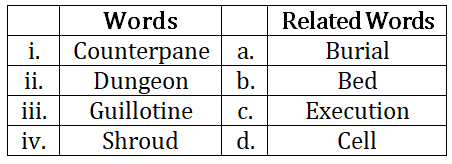
Which of the above ‘related words’ on the right – hand side are correctly matched with ‘words’ on the left – hand side?
Passage / Data
Read the definitions below and select the best match between the numbered sentences and the definitions.
Premise: A proposition from which another statement is inferred or follows a conclusion.
Assumption: Something, which is accepted as true.
Facts: Something, which can be checked.
Reason: A cause, explanation or justification for an action or event.
Conclusion: An end, finish or summarization of process or argument.
Proposition: A statement that expresses judgment or opinion.
Question: A sentence worded or expressed so as to elicit opinion.
Inductive inference: An end, finish or summarization reached for “the whole”, based on “a particular” real incidence.
Deductive Inference: An end, finish or summarization reached based on the combining and recombining two or more than two assumptions.
The MBA (1) is hardly a prerequisite for success, but it (2) certainly helps (3), and it has been getting more important (4) in recent years. Most (5) MBA programs equip their graduates to understand how (6) to deal with many of the important questions that their organizations will need to tackle (7) over time, and (8) that they will face in their careers.
The above italicized numbered words will be correctly represented by the following parts of speech:
Passage / Data
Read the definitions below and select the best match between the numbered sentences and the definitions.
Premise: A proposition from which another statement is inferred or follows a conclusion.
Assumption: Something, which is accepted as true.
Facts: Something, which can be checked.
Reason: A cause, explanation or justification for an action or event.
Conclusion: An end, finish or summarization of process or argument.
Proposition: A statement that expresses judgment or opinion.
Question: A sentence worded or expressed so as to elicit opinion.
Inductive inference: An end, finish or summarization reached for “the whole”, based on “a particular” real incidence.
Deductive Inference: An end, finish or summarization reached based on the combining and recombining two or more than two assumptions.
Read the following paragraph carefully and answer the question that follows:
It is one week since Uttarakhand’s worst disaster in living memory. Flash floods resulting from extremely intense rainfall swept away mountainsides, villages and towns, thousands of people, animals, agriculture fields, irrigation canals, domestic water sources, dams, roads, bridges, and buildings – anything that stood in the way.
A week later, media attention remains riveted on the efforts to rescue tens of thousands of pilgrims and tourist visiting the shrines in the uppermost reaches of Uttarakhand’s sacred rivers. But the deluge spread far beyond th Char Dhams – Yamunotri, Gangotri, Kedarnath and Badrinath – to cover the entire state. The catchments of many smaller rivers also witnessed flash floods but the media has yet to report on the destruction there. Eyewitness accounts being gathered by official agencies and voluntary organizations have reported devastation from more than 200 villages so far and more affected villages are being reported every day.
Which of the following would the author agree the most with?
Passage / Data
Read the definitions below and select the best match between the numbered sentences and the definitions.
Premise: A proposition from which another statement is inferred or follows a conclusion.
Assumption: Something, which is accepted as true.
Facts: Something, which can be checked.
Reason: A cause, explanation or justification for an action or event.
Conclusion: An end, finish or summarization of process or argument.
Proposition: A statement that expresses judgment or opinion.
Question: A sentence worded or expressed so as to elicit opinion.
Inductive inference: An end, finish or summarization reached for “the whole”, based on “a particular” real incidence.
Deductive Inference: An end, finish or summarization reached based on the combining and recombining two or more than two assumptions.
Which of the following is the correct form of expression for the underlined part of the sentence below?
Patna is not only the capital of Bihar, but it is also one of the oldest cities in the world and the largest city in the state.
Passage / Data
Read the definitions below and select the best match between the numbered sentences and the definitions.
Premise: A proposition from which another statement is inferred or follows a conclusion.
Assumption: Something, which is accepted as true.
Facts: Something, which can be checked.
Reason: A cause, explanation or justification for an action or event.
Conclusion: An end, finish or summarization of process or argument.
Proposition: A statement that expresses judgment or opinion.
Question: A sentence worded or expressed so as to elicit opinion.
Inductive inference: An end, finish or summarization reached for “the whole”, based on “a particular” real incidence.
Deductive Inference: An end, finish or summarization reached based on the combining and recombining two or more than two assumptions.
Read the following sentences and choose the option that best arranges them in a logical order.
Choose the best option:
- The mechanism of electroweak symmetry breaking is one of the most important issues in the present Particle Physics.
- They are required to give masses for all quarks and leptons and to guarantee the absence of the gauge anomaly.
- In the standard electroweak model a fundamental Higgs doublet is introduced to cause the spontaneous symmetry breaking.
- Supersymmetry (SUSY), eliminating all quadratic divergences, may provide a better theoretical basis to describe a fundamental Higgs boson with a relatively small mass to a high energy cutoff scale, say the Planck scale for example.
- In the minimal SUSY extension of the standards electroweak model the Higgs sector consists of two chiral superfields of Higgs doublets (H1 and H2 with opposite hypercharges).
Passage / Data
Read the definitions below and select the best match between the numbered sentences and the definitions.
Premise: A proposition from which another statement is inferred or follows a conclusion.
Assumption: Something, which is accepted as true.
Facts: Something, which can be checked.
Reason: A cause, explanation or justification for an action or event.
Conclusion: An end, finish or summarization of process or argument.
Proposition: A statement that expresses judgment or opinion.
Question: A sentence worded or expressed so as to elicit opinion.
Inductive inference: An end, finish or summarization reached for “the whole”, based on “a particular” real incidence.
Deductive Inference: An end, finish or summarization reached based on the combining and recombining two or more than two assumptions.
Read the following sentences and choose the option that best arranges them in a logical order.
Choose the best option:
- Shakespeare did not personally prepare his plays for publication, and no official collection of them appeared until after his death.
- Some were probably based on actors’ memories of plays.
- Many of these quartos are quite unreliable.
- A collection of his sonnets, considered by critics to be among the best ever written in English, appeared in 1609.
- Many individual plays were published during his lifetime in unauthorized editions known as quartos.
Passage / Data
Read the definitions below and select the best match between the numbered sentences and the definitions.
Premise: A proposition from which another statement is inferred or follows a conclusion.
Assumption: Something, which is accepted as true.
Facts: Something, which can be checked.
Reason: A cause, explanation or justification for an action or event.
Conclusion: An end, finish or summarization of process or argument.
Proposition: A statement that expresses judgment or opinion.
Question: A sentence worded or expressed so as to elicit opinion.
Inductive inference: An end, finish or summarization reached for “the whole”, based on “a particular” real incidence.
Deductive Inference: An end, finish or summarization reached based on the combining and recombining two or more than two assumptions.
Fill in the blanks with the most appropriate option that follows:
The defense proposes to show that the incident that the prosecution so _________ rejects as __________ did indeed take place.
Passage / Data
Read the definitions below and select the best match between the numbered sentences and the definitions.
Premise: A proposition from which another statement is inferred or follows a conclusion.
Assumption: Something, which is accepted as true.
Facts: Something, which can be checked.
Reason: A cause, explanation or justification for an action or event.
Conclusion: An end, finish or summarization of process or argument.
Proposition: A statement that expresses judgment or opinion.
Question: A sentence worded or expressed so as to elicit opinion.
Inductive inference: An end, finish or summarization reached for “the whole”, based on “a particular” real incidence.
Deductive Inference: An end, finish or summarization reached based on the combining and recombining two or more than two assumptions.
Fill in the blanks with the most appropriate option that follows:
Not just the absence of ____________ , but also the presence of ____________ and honesty is required to bind up the nation’s wound.
Passage / Data
Read the definitions below and select the best match between the numbered sentences and the definitions.
Premise: A proposition from which another statement is inferred or follows a conclusion.
Assumption: Something, which is accepted as true.
Facts: Something, which can be checked.
Reason: A cause, explanation or justification for an action or event.
Conclusion: An end, finish or summarization of process or argument.
Proposition: A statement that expresses judgment or opinion.
Question: A sentence worded or expressed so as to elicit opinion.
Inductive inference: An end, finish or summarization reached for “the whole”, based on “a particular” real incidence.
Deductive Inference: An end, finish or summarization reached based on the combining and recombining two or more than two assumptions.
Fill in the blanks with the most appropriate option that follows:
In many cases in physics, one has to deal simultaneously with collective and single-particle excitations of the system. The collective excitations are usually bosonic in nature while the single-particle excitations are often fermionic. One is therefore led to consider a system which includes bosons and fermions. Hence, ______________
Which of the following options is most likely to follow the paragraph given above?
Passage / Data
Read the definitions below and select the best match between the numbered sentences and the definitions.
Premise: A proposition from which another statement is inferred or follows a conclusion.
Assumption: Something, which is accepted as true.
Facts: Something, which can be checked.
Reason: A cause, explanation or justification for an action or event.
Conclusion: An end, finish or summarization of process or argument.
Proposition: A statement that expresses judgment or opinion.
Question: A sentence worded or expressed so as to elicit opinion.
Inductive inference: An end, finish or summarization reached for “the whole”, based on “a particular” real incidence.
Deductive Inference: An end, finish or summarization reached based on the combining and recombining two or more than two assumptions.
Fill in the blanks with the most appropriate option that follows:
Peter has suggested to me that the _____________ of highly systematic and _____________ planning techniques may have led to a substantial _____________ in firms’ notions of what is likely to happen in the future, and thus to a _____________ in the incidence of mistakes, especially on the part of the _____________modern corporations.
Passage / Data
Read the definitions below and select the best match between the numbered sentences and the definitions.
Premise: A proposition from which another statement is inferred or follows a conclusion.
Assumption: Something, which is accepted as true.
Facts: Something, which can be checked.
Reason: A cause, explanation or justification for an action or event.
Conclusion: An end, finish or summarization of process or argument.
Proposition: A statement that expresses judgment or opinion.
Question: A sentence worded or expressed so as to elicit opinion.
Inductive inference: An end, finish or summarization reached for “the whole”, based on “a particular” real incidence.
Deductive Inference: An end, finish or summarization reached based on the combining and recombining two or more than two assumptions.
Fill in the blanks with the most appropriate option that follows:
Clinical practitioners _____________ integrated mindfulness _____________ treatment of _____________ host of emotional and behavioural disorders, _____________ borderline personality disorder, major depression, chronic pain, or eating disorders. Number of such practitioners _____________ increased substantially.
Passage / Data
Read the definitions below and select the best match between the numbered sentences and the definitions.
Premise: A proposition from which another statement is inferred or follows a conclusion.
Assumption: Something, which is accepted as true.
Facts: Something, which can be checked.
Reason: A cause, explanation or justification for an action or event.
Conclusion: An end, finish or summarization of process or argument.
Proposition: A statement that expresses judgment or opinion.
Question: A sentence worded or expressed so as to elicit opinion.
Inductive inference: An end, finish or summarization reached for “the whole”, based on “a particular” real incidence.
Deductive Inference: An end, finish or summarization reached based on the combining and recombining two or more than two assumptions.
Fill in the blanks with the most appropriate option that follows:
Ontologies are _____________ equated with taxonomic hierarchies of classes, class definitions, and _____________ subsumption relation, _____________ ontologies need not be limited to _____________ forms.
It _____________ not look like a great deal today, but back then it was a coup: no man before ___________ to import tea directly into Ireland.
The option that will best fill the blanks in the above sentences would be:
Ravindra Dubey was guilty of embezzlement. It means that Ravindra Dubey
Read the sentences and choose the option that best arrange them in a logical order.
A. Some of these are tangible while others are not.
B. The micro factors look at brand building, product development, competition, pricing, decision making within organizations etc.
C. Another way to classify these factors is to distinguish which of them are macro in nature and which of them are micro.
D. The macro factors comprise government policies, state of the economy, changing demographics etc.
E. The factors influencing forecasts include social, technological, economic, political, religious, ethnic, governmental, and natural factors.
Passage / Data
Read the following passage and answer the questions.
There is an essential and irreducible ‘duality’ in the normative conceptualization of an individual person. We can see the person in terms of his or her ‘agency’, recognizing and respecting his or her ability to form goals, commitments, values, etc., and we can also see the person in terms of his or her ‘well-being’. This dichotomy is lost in a model of exclusively self-interested motivation, in which a person’s agency must be entirely geared to his or her own well-being. But once that straitjacket of self-interested motivation is removed, it becomes possible to recognize the indisputable fact that the person’s agency can well be geared to considerations not covered – or at least not fully covered – by his or her own well-being. Agency may be seen as important (not just instrumentally for the pursuit of well-being, but also intrinsically), but that still leaves open the question as to how that agency is to be evaluated and appraised. Even though the use of one’s agency is a matter for oneself to judge, the need for careful assessment of aims, objective, allegiances, etc., and the conception of the good, may be important and exacting.
To recognize the distinction between the ‘agency aspect’ and the ‘well-being aspect’ of a person does not require us to take the view that the person’s success as an agent must be independent, or completely separable from, his or her success in terms of well-being. A person may well feel happier and better off as a result of achieving what he or she wanted to achieve – perhaps for his or her family, or community, or class, or party, or some other cause. Also it is quite possible that a person’s well-being will go down as a result of frustration if there is some failure to achieve what he or she wanted to achieve as an agent, even though those achievements are not directly concerned with his or her well-being. There is really no sound basis for demanding that the agency aspect and the well-being aspect of a person should be independent of each other, and it is, I suppose, even possible that every change in one will affect the other as well. However, the point at issue is not the plausibility of their independence, but the sustainability and relevance of the distinction. The fact that two variables may be so related that one cannot change without the other, does not imply that they are the same variable, or that they will have the same values, or that the value of one can be obtained from the other on basis of some simple transformation.
The importance of an agency achievement does not rest entirely on the enhancement of well-being that it may indirectly cause. The agency achievement and well-being achievement, both of which have some distinct importance, may be casually linked with each other, but this fact does not compromise the specific importance of either. In so far as utility – based welfare calculations concentrate only on the well-being of the person, ignoring the agency aspect, or actually fails to distinguish between the agency aspect and well-being aspect altogether, something of real importance is lost.
Which of the following sentences is grammatically incorrect?
Passage / Data
Read the following passage and answer the questions.
There is an essential and irreducible ‘duality’ in the normative conceptualization of an individual person. We can see the person in terms of his or her ‘agency’, recognizing and respecting his or her ability to form goals, commitments, values, etc., and we can also see the person in terms of his or her ‘well-being’. This dichotomy is lost in a model of exclusively self-interested motivation, in which a person’s agency must be entirely geared to his or her own well-being. But once that straitjacket of self-interested motivation is removed, it becomes possible to recognize the indisputable fact that the person’s agency can well be geared to considerations not covered – or at least not fully covered – by his or her own well-being. Agency may be seen as important (not just instrumentally for the pursuit of well-being, but also intrinsically), but that still leaves open the question as to how that agency is to be evaluated and appraised. Even though the use of one’s agency is a matter for oneself to judge, the need for careful assessment of aims, objective, allegiances, etc., and the conception of the good, may be important and exacting.
To recognize the distinction between the ‘agency aspect’ and the ‘well-being aspect’ of a person does not require us to take the view that the person’s success as an agent must be independent, or completely separable from, his or her success in terms of well-being. A person may well feel happier and better off as a result of achieving what he or she wanted to achieve – perhaps for his or her family, or community, or class, or party, or some other cause. Also it is quite possible that a person’s well-being will go down as a result of frustration if there is some failure to achieve what he or she wanted to achieve as an agent, even though those achievements are not directly concerned with his or her well-being. There is really no sound basis for demanding that the agency aspect and the well-being aspect of a person should be independent of each other, and it is, I suppose, even possible that every change in one will affect the other as well. However, the point at issue is not the plausibility of their independence, but the sustainability and relevance of the distinction. The fact that two variables may be so related that one cannot change without the other, does not imply that they are the same variable, or that they will have the same values, or that the value of one can be obtained from the other on basis of some simple transformation.
The importance of an agency achievement does not rest entirely on the enhancement of well-being that it may indirectly cause. The agency achievement and well-being achievement, both of which have some distinct importance, may be casually linked with each other, but this fact does not compromise the specific importance of either. In so far as utility – based welfare calculations concentrate only on the well-being of the person, ignoring the agency aspect, or actually fails to distinguish between the agency aspect and well-being aspect altogether, something of real importance is lost.
Choose the grammatically correct sentence from the options given below.
Passage / Data
Read the following passage and answer the questions.
There is an essential and irreducible ‘duality’ in the normative conceptualization of an individual person. We can see the person in terms of his or her ‘agency’, recognizing and respecting his or her ability to form goals, commitments, values, etc., and we can also see the person in terms of his or her ‘well-being’. This dichotomy is lost in a model of exclusively self-interested motivation, in which a person’s agency must be entirely geared to his or her own well-being. But once that straitjacket of self-interested motivation is removed, it becomes possible to recognize the indisputable fact that the person’s agency can well be geared to considerations not covered – or at least not fully covered – by his or her own well-being. Agency may be seen as important (not just instrumentally for the pursuit of well-being, but also intrinsically), but that still leaves open the question as to how that agency is to be evaluated and appraised. Even though the use of one’s agency is a matter for oneself to judge, the need for careful assessment of aims, objective, allegiances, etc., and the conception of the good, may be important and exacting.
To recognize the distinction between the ‘agency aspect’ and the ‘well-being aspect’ of a person does not require us to take the view that the person’s success as an agent must be independent, or completely separable from, his or her success in terms of well-being. A person may well feel happier and better off as a result of achieving what he or she wanted to achieve – perhaps for his or her family, or community, or class, or party, or some other cause. Also it is quite possible that a person’s well-being will go down as a result of frustration if there is some failure to achieve what he or she wanted to achieve as an agent, even though those achievements are not directly concerned with his or her well-being. There is really no sound basis for demanding that the agency aspect and the well-being aspect of a person should be independent of each other, and it is, I suppose, even possible that every change in one will affect the other as well. However, the point at issue is not the plausibility of their independence, but the sustainability and relevance of the distinction. The fact that two variables may be so related that one cannot change without the other, does not imply that they are the same variable, or that they will have the same values, or that the value of one can be obtained from the other on basis of some simple transformation.
The importance of an agency achievement does not rest entirely on the enhancement of well-being that it may indirectly cause. The agency achievement and well-being achievement, both of which have some distinct importance, may be casually linked with each other, but this fact does not compromise the specific importance of either. In so far as utility – based welfare calculations concentrate only on the well-being of the person, ignoring the agency aspect, or actually fails to distinguish between the agency aspect and well-being aspect altogether, something of real importance is lost.
Most of the Asian countries have trade-deficit with China. Bangladesh’s trade deficit with China this year has increased by 35%. Despite large increases in exports to China, Indonesia’s trade deficit with China continues to increase. So does that of South Korea, home of Samsung Electronics, one of the world’s largest manufacturers of electronic gadgets.
Which of the following, if true, would be most inconsistent with the above passage?
Passage / Data
Read the following passage and answer the questions.
There is an essential and irreducible ‘duality’ in the normative conceptualization of an individual person. We can see the person in terms of his or her ‘agency’, recognizing and respecting his or her ability to form goals, commitments, values, etc., and we can also see the person in terms of his or her ‘well-being’. This dichotomy is lost in a model of exclusively self-interested motivation, in which a person’s agency must be entirely geared to his or her own well-being. But once that straitjacket of self-interested motivation is removed, it becomes possible to recognize the indisputable fact that the person’s agency can well be geared to considerations not covered – or at least not fully covered – by his or her own well-being. Agency may be seen as important (not just instrumentally for the pursuit of well-being, but also intrinsically), but that still leaves open the question as to how that agency is to be evaluated and appraised. Even though the use of one’s agency is a matter for oneself to judge, the need for careful assessment of aims, objective, allegiances, etc., and the conception of the good, may be important and exacting.
To recognize the distinction between the ‘agency aspect’ and the ‘well-being aspect’ of a person does not require us to take the view that the person’s success as an agent must be independent, or completely separable from, his or her success in terms of well-being. A person may well feel happier and better off as a result of achieving what he or she wanted to achieve – perhaps for his or her family, or community, or class, or party, or some other cause. Also it is quite possible that a person’s well-being will go down as a result of frustration if there is some failure to achieve what he or she wanted to achieve as an agent, even though those achievements are not directly concerned with his or her well-being. There is really no sound basis for demanding that the agency aspect and the well-being aspect of a person should be independent of each other, and it is, I suppose, even possible that every change in one will affect the other as well. However, the point at issue is not the plausibility of their independence, but the sustainability and relevance of the distinction. The fact that two variables may be so related that one cannot change without the other, does not imply that they are the same variable, or that they will have the same values, or that the value of one can be obtained from the other on basis of some simple transformation.
The importance of an agency achievement does not rest entirely on the enhancement of well-being that it may indirectly cause. The agency achievement and well-being achievement, both of which have some distinct importance, may be casually linked with each other, but this fact does not compromise the specific importance of either. In so far as utility – based welfare calculations concentrate only on the well-being of the person, ignoring the agency aspect, or actually fails to distinguish between the agency aspect and well-being aspect altogether, something of real importance is lost.
Fill in the blanks with the most appropriate word/set of words from the given options.
The head ___________ was annoyed to see a _________ in the soup.
The option that would best fill the blanks in the above sentence would be:
Passage / Data
Read the following passage and answer the questions.
There is an essential and irreducible ‘duality’ in the normative conceptualization of an individual person. We can see the person in terms of his or her ‘agency’, recognizing and respecting his or her ability to form goals, commitments, values, etc., and we can also see the person in terms of his or her ‘well-being’. This dichotomy is lost in a model of exclusively self-interested motivation, in which a person’s agency must be entirely geared to his or her own well-being. But once that straitjacket of self-interested motivation is removed, it becomes possible to recognize the indisputable fact that the person’s agency can well be geared to considerations not covered – or at least not fully covered – by his or her own well-being. Agency may be seen as important (not just instrumentally for the pursuit of well-being, but also intrinsically), but that still leaves open the question as to how that agency is to be evaluated and appraised. Even though the use of one’s agency is a matter for oneself to judge, the need for careful assessment of aims, objective, allegiances, etc., and the conception of the good, may be important and exacting.
To recognize the distinction between the ‘agency aspect’ and the ‘well-being aspect’ of a person does not require us to take the view that the person’s success as an agent must be independent, or completely separable from, his or her success in terms of well-being. A person may well feel happier and better off as a result of achieving what he or she wanted to achieve – perhaps for his or her family, or community, or class, or party, or some other cause. Also it is quite possible that a person’s well-being will go down as a result of frustration if there is some failure to achieve what he or she wanted to achieve as an agent, even though those achievements are not directly concerned with his or her well-being. There is really no sound basis for demanding that the agency aspect and the well-being aspect of a person should be independent of each other, and it is, I suppose, even possible that every change in one will affect the other as well. However, the point at issue is not the plausibility of their independence, but the sustainability and relevance of the distinction. The fact that two variables may be so related that one cannot change without the other, does not imply that they are the same variable, or that they will have the same values, or that the value of one can be obtained from the other on basis of some simple transformation.
The importance of an agency achievement does not rest entirely on the enhancement of well-being that it may indirectly cause. The agency achievement and well-being achievement, both of which have some distinct importance, may be casually linked with each other, but this fact does not compromise the specific importance of either. In so far as utility – based welfare calculations concentrate only on the well-being of the person, ignoring the agency aspect, or actually fails to distinguish between the agency aspect and well-being aspect altogether, something of real importance is lost.
Which word is the opposite of the word ‘hypothesize’?
Passage / Data
Read the following passage and answer the questions.
There is an essential and irreducible ‘duality’ in the normative conceptualization of an individual person. We can see the person in terms of his or her ‘agency’, recognizing and respecting his or her ability to form goals, commitments, values, etc., and we can also see the person in terms of his or her ‘well-being’. This dichotomy is lost in a model of exclusively self-interested motivation, in which a person’s agency must be entirely geared to his or her own well-being. But once that straitjacket of self-interested motivation is removed, it becomes possible to recognize the indisputable fact that the person’s agency can well be geared to considerations not covered – or at least not fully covered – by his or her own well-being. Agency may be seen as important (not just instrumentally for the pursuit of well-being, but also intrinsically), but that still leaves open the question as to how that agency is to be evaluated and appraised. Even though the use of one’s agency is a matter for oneself to judge, the need for careful assessment of aims, objective, allegiances, etc., and the conception of the good, may be important and exacting.
To recognize the distinction between the ‘agency aspect’ and the ‘well-being aspect’ of a person does not require us to take the view that the person’s success as an agent must be independent, or completely separable from, his or her success in terms of well-being. A person may well feel happier and better off as a result of achieving what he or she wanted to achieve – perhaps for his or her family, or community, or class, or party, or some other cause. Also it is quite possible that a person’s well-being will go down as a result of frustration if there is some failure to achieve what he or she wanted to achieve as an agent, even though those achievements are not directly concerned with his or her well-being. There is really no sound basis for demanding that the agency aspect and the well-being aspect of a person should be independent of each other, and it is, I suppose, even possible that every change in one will affect the other as well. However, the point at issue is not the plausibility of their independence, but the sustainability and relevance of the distinction. The fact that two variables may be so related that one cannot change without the other, does not imply that they are the same variable, or that they will have the same values, or that the value of one can be obtained from the other on basis of some simple transformation.
The importance of an agency achievement does not rest entirely on the enhancement of well-being that it may indirectly cause. The agency achievement and well-being achievement, both of which have some distinct importance, may be casually linked with each other, but this fact does not compromise the specific importance of either. In so far as utility – based welfare calculations concentrate only on the well-being of the person, ignoring the agency aspect, or actually fails to distinguish between the agency aspect and well-being aspect altogether, something of real importance is lost.
Read the sentences and choose the option that best arrange them in a logical order.
A. In fact, it is considered as a dumping ground for unwanted people in quite a few organizations.
B. In many parts of the country, traditional castes such as Kothari, Kotwal, Bhandari and Bhandarkar have for generations been dealing in procuring, stocking, distributing goods and merchandise.
C. This is due to the fact that Indian traders have been trading with many parts of the world.
D. However, though the concept of warehousing has been prevalent for over 2000 years, the warehouse has not yet obtained due recognition in modern times.
E. The concept of warehousing or stores function is not new in India.
Passage / Data
Read the following passage and answer the questions.
There is an essential and irreducible ‘duality’ in the normative conceptualization of an individual person. We can see the person in terms of his or her ‘agency’, recognizing and respecting his or her ability to form goals, commitments, values, etc., and we can also see the person in terms of his or her ‘well-being’. This dichotomy is lost in a model of exclusively self-interested motivation, in which a person’s agency must be entirely geared to his or her own well-being. But once that straitjacket of self-interested motivation is removed, it becomes possible to recognize the indisputable fact that the person’s agency can well be geared to considerations not covered – or at least not fully covered – by his or her own well-being. Agency may be seen as important (not just instrumentally for the pursuit of well-being, but also intrinsically), but that still leaves open the question as to how that agency is to be evaluated and appraised. Even though the use of one’s agency is a matter for oneself to judge, the need for careful assessment of aims, objective, allegiances, etc., and the conception of the good, may be important and exacting.
To recognize the distinction between the ‘agency aspect’ and the ‘well-being aspect’ of a person does not require us to take the view that the person’s success as an agent must be independent, or completely separable from, his or her success in terms of well-being. A person may well feel happier and better off as a result of achieving what he or she wanted to achieve – perhaps for his or her family, or community, or class, or party, or some other cause. Also it is quite possible that a person’s well-being will go down as a result of frustration if there is some failure to achieve what he or she wanted to achieve as an agent, even though those achievements are not directly concerned with his or her well-being. There is really no sound basis for demanding that the agency aspect and the well-being aspect of a person should be independent of each other, and it is, I suppose, even possible that every change in one will affect the other as well. However, the point at issue is not the plausibility of their independence, but the sustainability and relevance of the distinction. The fact that two variables may be so related that one cannot change without the other, does not imply that they are the same variable, or that they will have the same values, or that the value of one can be obtained from the other on basis of some simple transformation.
The importance of an agency achievement does not rest entirely on the enhancement of well-being that it may indirectly cause. The agency achievement and well-being achievement, both of which have some distinct importance, may be casually linked with each other, but this fact does not compromise the specific importance of either. In so far as utility – based welfare calculations concentrate only on the well-being of the person, ignoring the agency aspect, or actually fails to distinguish between the agency aspect and well-being aspect altogether, something of real importance is lost.
Concurrence means all of the following except:
Passage / Data
Read the following passage and answer the questions.
There is an essential and irreducible ‘duality’ in the normative conceptualization of an individual person. We can see the person in terms of his or her ‘agency’, recognizing and respecting his or her ability to form goals, commitments, values, etc., and we can also see the person in terms of his or her ‘well-being’. This dichotomy is lost in a model of exclusively self-interested motivation, in which a person’s agency must be entirely geared to his or her own well-being. But once that straitjacket of self-interested motivation is removed, it becomes possible to recognize the indisputable fact that the person’s agency can well be geared to considerations not covered – or at least not fully covered – by his or her own well-being. Agency may be seen as important (not just instrumentally for the pursuit of well-being, but also intrinsically), but that still leaves open the question as to how that agency is to be evaluated and appraised. Even though the use of one’s agency is a matter for oneself to judge, the need for careful assessment of aims, objective, allegiances, etc., and the conception of the good, may be important and exacting.
To recognize the distinction between the ‘agency aspect’ and the ‘well-being aspect’ of a person does not require us to take the view that the person’s success as an agent must be independent, or completely separable from, his or her success in terms of well-being. A person may well feel happier and better off as a result of achieving what he or she wanted to achieve – perhaps for his or her family, or community, or class, or party, or some other cause. Also it is quite possible that a person’s well-being will go down as a result of frustration if there is some failure to achieve what he or she wanted to achieve as an agent, even though those achievements are not directly concerned with his or her well-being. There is really no sound basis for demanding that the agency aspect and the well-being aspect of a person should be independent of each other, and it is, I suppose, even possible that every change in one will affect the other as well. However, the point at issue is not the plausibility of their independence, but the sustainability and relevance of the distinction. The fact that two variables may be so related that one cannot change without the other, does not imply that they are the same variable, or that they will have the same values, or that the value of one can be obtained from the other on basis of some simple transformation.
The importance of an agency achievement does not rest entirely on the enhancement of well-being that it may indirectly cause. The agency achievement and well-being achievement, both of which have some distinct importance, may be casually linked with each other, but this fact does not compromise the specific importance of either. In so far as utility – based welfare calculations concentrate only on the well-being of the person, ignoring the agency aspect, or actually fails to distinguish between the agency aspect and well-being aspect altogether, something of real importance is lost.
Read the sentences and choose the option that best arrange them in a logical order.
i. All it has to do is to drive up the inflation rate-examples are the damage Lyndon Johnson’s inflationary policies did to the US economy and the damage which consistently pro-inflationary policies have done to the economy of Italy.
ii. It is easy, the record shows, for a government to do harm to its domestic economy.
iii. Contrary to what economists confidently promised forty years ago, business cycles have not been abolished.
iv. They still operate pretty much the way they have been operating for the past 150 years.
v. But there is not the slightest evidence that any government policy to stimulate the economy has impact, whether that policy be Keynesian, monetarist, supply – side or neoclassical.
Passage / Data
Read the following passage and answer the questions.
There is an essential and irreducible ‘duality’ in the normative conceptualization of an individual person. We can see the person in terms of his or her ‘agency’, recognizing and respecting his or her ability to form goals, commitments, values, etc., and we can also see the person in terms of his or her ‘well-being’. This dichotomy is lost in a model of exclusively self-interested motivation, in which a person’s agency must be entirely geared to his or her own well-being. But once that straitjacket of self-interested motivation is removed, it becomes possible to recognize the indisputable fact that the person’s agency can well be geared to considerations not covered – or at least not fully covered – by his or her own well-being. Agency may be seen as important (not just instrumentally for the pursuit of well-being, but also intrinsically), but that still leaves open the question as to how that agency is to be evaluated and appraised. Even though the use of one’s agency is a matter for oneself to judge, the need for careful assessment of aims, objective, allegiances, etc., and the conception of the good, may be important and exacting.
To recognize the distinction between the ‘agency aspect’ and the ‘well-being aspect’ of a person does not require us to take the view that the person’s success as an agent must be independent, or completely separable from, his or her success in terms of well-being. A person may well feel happier and better off as a result of achieving what he or she wanted to achieve – perhaps for his or her family, or community, or class, or party, or some other cause. Also it is quite possible that a person’s well-being will go down as a result of frustration if there is some failure to achieve what he or she wanted to achieve as an agent, even though those achievements are not directly concerned with his or her well-being. There is really no sound basis for demanding that the agency aspect and the well-being aspect of a person should be independent of each other, and it is, I suppose, even possible that every change in one will affect the other as well. However, the point at issue is not the plausibility of their independence, but the sustainability and relevance of the distinction. The fact that two variables may be so related that one cannot change without the other, does not imply that they are the same variable, or that they will have the same values, or that the value of one can be obtained from the other on basis of some simple transformation.
The importance of an agency achievement does not rest entirely on the enhancement of well-being that it may indirectly cause. The agency achievement and well-being achievement, both of which have some distinct importance, may be casually linked with each other, but this fact does not compromise the specific importance of either. In so far as utility – based welfare calculations concentrate only on the well-being of the person, ignoring the agency aspect, or actually fails to distinguish between the agency aspect and well-being aspect altogether, something of real importance is lost.
Fill in the blanks with the most appropriate word/set of words from the given options.
Not wanting to present an unwanted optimistic picture in the board meeting, the CEO estimated the sales growth _____________.
The option that will best fill the blank in the above sentence would be: