Logical Reasoning — XAT Previous-Year Questions
19 previous-year questions on Logical Reasoning from XAT, with full solutions. Practise free — check answers as you go; sign in to save your progress.
Logical Reasoning · XAT PYQs
Arrange the following sentences in a LOGICAL sequence:
1. In America, primary-age pupils are on average five months behind where they would usually be in maths, and four months in reading, according to McKinsey, a consultancy.
2. As a new school year gets under way in many countries, the harm caused by months of closure is becoming ever clearer.
3. The crisis will accelerate that trend.
4. The damage is almost certainly worse in places such as India and Mexico, where the disruption to schooling has been greater.
5. Even before pandemic, parents around the world were growing more willing to pay for extra lessons in the hope of boosting their children’s education.
Passage / Data
Read the following scenario and answer the THREE questions that follow.
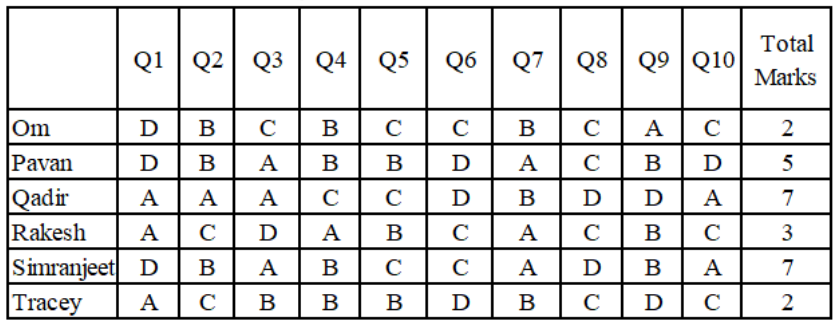
An examination had ten multiple choice questions; labelled Q1 to Q10 respectively. Each question had four answer options — A, B, C and D — of which one and only one was the correct answer. For each correct answer, the candidate obtained 1 mark. There were no negative marks for wrong answers. The answers chosen by six candidates named Om, Pavan, Qadir, Rakesh, Simranjeet and Tracey to each of the ten questions and the total marks obtained by each of them are shown in the table.
What is the correct answer for Q5?
Passage / Data
Read the following scenario and answer the THREE questions that follow.
An examination had ten multiple choice questions; labelled Q1 to Q10 respectively. Each question had four answer options — A, B, C and D — of which one and only one was the correct answer. For each correct answer, the candidate obtained 1 mark. There were no negative marks for wrong answers. The answers chosen by six candidates named Om, Pavan, Qadir, Rakesh, Simranjeet and Tracey to each of the ten questions and the total marks obtained by each of them are shown in the table.
For which of these questions is D the correct answer?
Passage / Data
Read the following scenario and answer the THREE questions that follow.
An examination had ten multiple choice questions; labelled Q1 to Q10 respectively. Each question had four answer options — A, B, C and D — of which one and only one was the correct answer. For each correct answer, the candidate obtained 1 mark. There were no negative marks for wrong answers. The answers chosen by six candidates named Om, Pavan, Qadir, Rakesh, Simranjeet and Tracey to each of the ten questions and the total marks obtained by each of them are shown in the table.
Which of these questions witnessed the least number of the students answering correctly?
Passage / Data
Read the following scenario and answer the THREE questions that follow.
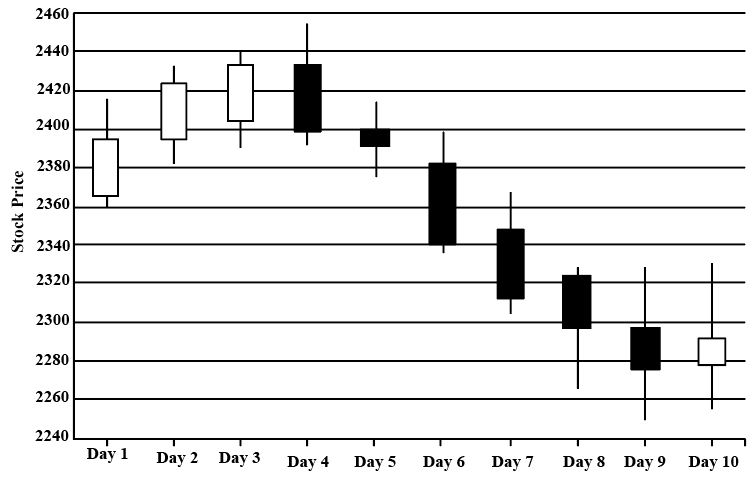
The given candlestick chart depicts the prices of a particular stock over 10 consecutive days. A candlestick comprises of a rectangular box pieced by a line. The top and bottom ends of the line respectively indicate the maximum and minimum prices of the stock on that day, while the horizontal edges of the rectangle correspond to the stock's opening and closing prices. If the rectangle is white, the opening price is lower than the closing price, but if the rectangle is black, then it is the other way around.
Using the above information, answer the questions that follow:
Kim’s wristwatch always shows the correct time, including ‘am’ and ‘pm’. Jim’s watch is identical to Kim’s watch in all aspects except its pace, which is slower than the pace of Kim’s watch. At 12 noon on January 1st, Jim sets his watch to the correct time, but an hour later, it shows 12:57 pm. At 12 noon on the next June 1st, Jim resets his watch to the correct time.
On how many instances between, and including 12 noon on the two dates mentioned, do Jim’s and Kim’s watches show the exact same time, including the ‘am’ and the ‘pm’?
Passage / Data
Read the following scenario and answer the three questions that follow.
A quick survey at the end of a purchase at buyagain.com asks the following three questions to each shopper:
1. Are you shopping at the website for the first time? (YES or NO)
2. Specify your gender: (MALE or FEMALE)
3. How satisfied are you? (HAPPY, NEUTRAL or UNHAPPY)
240 shoppers answer the survey, among whom 65 are first time shoppers. Furthermore:
i. The ratio of the numbers of male to female shoppers is 1 : 2 while the ratio of the numbers of unhappy, happy and neutral shoppers is 3 : 4 : 5
ii. The ratio of the numbers of happy first-time male shoppers, happy returning male shoppers, unhappy female shoppers, neutral male shoppers, neutral female shoppers and happy female shoppers is 1 : 1 : 4 : 4 : 6 : 6
iii. Among the first-time shoppers, the ratio of the numbers of happy male, neutral male, unhappy female and the remaining female shoppers is 1 : 1 : 1 : 2, while the number of happy first-time female shoppers is equal to the number of unhappy first-time male shoppers
The six faces of a wooden cube of side 6 cm are labelled A, B, C, D, E and F respectively. Three of these faces A, B, and C are each adjacent to the other two, and are painted red. The other three faces are not painted. Then, the wooden cube is neatly cut into 216 little cubes of equal size. How many of the little cubes have no sides painted?
Passage / Data
Read the information given below and answer the 2 associated questions.
190 students have to choose at least one elective and at most two electives from a list of three electives: E1, E2 and E3. It is found that the number of students choosing E1 is half the number of students choosing E2, and one third the number of students choosing E3.
Moreover, the number of students choosing two electives is 50.
Which of the following CANNOT be obtained from the given information?
Passage / Data
Read the information given below and answer the 2 associated questions.
190 students have to choose at least one elective and at most two electives from a list of three electives: E1, E2 and E3. It is found that the number of students choosing E1 is half the number of students choosing E2, and one third the number of students choosing E3.
Moreover, the number of students choosing two electives is 50.
In addition to the given information, which of the following information is NECESSARY and SUFFICIENT to compute the number of students choosing only E1, only E2 and only E3?
Passage / Data
Answer the next 3 questions based on the information given below.
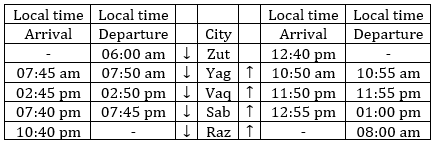
Given below is the time table for a trans-continental train that cuts across several time zones. All timings are in local time in the respective cities. The average speed of the train between any two cities is the same in both directions.
Which of the following pairs of cities are in the same time zone?
Passage / Data
Answer the next 3 questions based on the information given below.
Given below is the time table for a trans-continental train that cuts across several time zones. All timings are in local time in the respective cities. The average speed of the train between any two cities is the same in both directions.
What is the total time taken in minutes by the train to go from Zut to Raz?
Passage / Data
Answer the next 3 questions based on the information given below.
Given below is the time table for a trans-continental train that cuts across several time zones. All timings are in local time in the respective cities. The average speed of the train between any two cities is the same in both directions.
What time is it at Yag when it is 12:00 noon at Sab?
Passage / Data
Read the following case – let and answer the questions that follow.
Ms. Banerjee, class teacher for 12th standard, wants to send teams (based on past performance) of three students each to district, state, national, and international competition in mathematics. Till now, every student of the class has appeared in 100 school level tests. The students had following distribution of marks in the tests, in terms of “average” and “number of times a student scored cent per cent marks”.
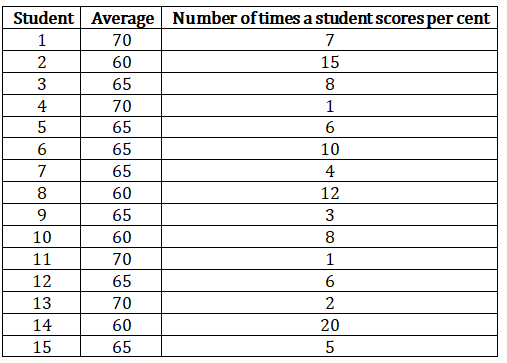
Ms. Banerjee has carefully studied chances of her school winning each of the competitions. Based on in-depth calculations, she realized that her school is quite likely to win district level competition but has low chances of winning the international competition. She listed down the following probabilities of wins for different competitions. Prize was highest for international competition and lowest for district level competition (in that order).
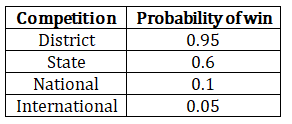
All the students are studying in the school for last twelve years. She wanted to select the best team for all four competitions (Ms. Banerjee had no other information to select students).
Which of three members should form the team for the International competition?
Passage / Data
Read the following case – let and answer the questions that follow.
Ms. Banerjee, class teacher for 12th standard, wants to send teams (based on past performance) of three students each to district, state, national, and international competition in mathematics. Till now, every student of the class has appeared in 100 school level tests. The students had following distribution of marks in the tests, in terms of “average” and “number of times a student scored cent per cent marks”.
Ms. Banerjee has carefully studied chances of her school winning each of the competitions. Based on in-depth calculations, she realized that her school is quite likely to win district level competition but has low chances of winning the international competition. She listed down the following probabilities of wins for different competitions. Prize was highest for international competition and lowest for district level competition (in that order).
All the students are studying in the school for last twelve years. She wanted to select the best team for all four competitions (Ms. Banerjee had no other information to select students).
Which of the following members should constitute the team for the district level competition?
Passage / Data
Read the following case – let and answer the questions that follow.
Ms. Banerjee, class teacher for 12th standard, wants to send teams (based on past performance) of three students each to district, state, national, and international competition in mathematics. Till now, every student of the class has appeared in 100 school level tests. The students had following distribution of marks in the tests, in terms of “average” and “number of times a student scored cent per cent marks”.
Ms. Banerjee has carefully studied chances of her school winning each of the competitions. Based on in-depth calculations, she realized that her school is quite likely to win district level competition but has low chances of winning the international competition. She listed down the following probabilities of wins for different competitions. Prize was highest for international competition and lowest for district level competition (in that order).
All the students are studying in the school for last twelve years. She wanted to select the best team for all four competitions (Ms. Banerjee had no other information to select students).
Ms. Banerjee has to select the team for national competition after she has selected the team for international competition. A student selected for international competition cannot be a part of national competition. Which is the best team for the national competition?
Passage / Data
Read the following passage and answer the questions.
There is an essential and irreducible ‘duality’ in the normative conceptualization of an individual person. We can see the person in terms of his or her ‘agency’, recognizing and respecting his or her ability to form goals, commitments, values, etc., and we can also see the person in terms of his or her ‘well-being’. This dichotomy is lost in a model of exclusively self-interested motivation, in which a person’s agency must be entirely geared to his or her own well-being. But once that straitjacket of self-interested motivation is removed, it becomes possible to recognize the indisputable fact that the person’s agency can well be geared to considerations not covered – or at least not fully covered – by his or her own well-being. Agency may be seen as important (not just instrumentally for the pursuit of well-being, but also intrinsically), but that still leaves open the question as to how that agency is to be evaluated and appraised. Even though the use of one’s agency is a matter for oneself to judge, the need for careful assessment of aims, objective, allegiances, etc., and the conception of the good, may be important and exacting.
To recognize the distinction between the ‘agency aspect’ and the ‘well-being aspect’ of a person does not require us to take the view that the person’s success as an agent must be independent, or completely separable from, his or her success in terms of well-being. A person may well feel happier and better off as a result of achieving what he or she wanted to achieve – perhaps for his or her family, or community, or class, or party, or some other cause. Also it is quite possible that a person’s well-being will go down as a result of frustration if there is some failure to achieve what he or she wanted to achieve as an agent, even though those achievements are not directly concerned with his or her well-being. There is really no sound basis for demanding that the agency aspect and the well-being aspect of a person should be independent of each other, and it is, I suppose, even possible that every change in one will affect the other as well. However, the point at issue is not the plausibility of their independence, but the sustainability and relevance of the distinction. The fact that two variables may be so related that one cannot change without the other, does not imply that they are the same variable, or that they will have the same values, or that the value of one can be obtained from the other on basis of some simple transformation.
The importance of an agency achievement does not rest entirely on the enhancement of well-being that it may indirectly cause. The agency achievement and well-being achievement, both of which have some distinct importance, may be casually linked with each other, but this fact does not compromise the specific importance of either. In so far as utility – based welfare calculations concentrate only on the well-being of the person, ignoring the agency aspect, or actually fails to distinguish between the agency aspect and well-being aspect altogether, something of real importance is lost.
All who studied commerce enjoy sports. No tax consultant enjoys sports. All those who enjoy sports love classical music.
If the above sentences are true, which of the following also must be true?
Passage / Data
Answer the following question based on the information given below.
Ramya, based in Shanpur, took her car for a 400 km trip to Rampur. She maintained a log of the odometer readings and the amount of petrol she purchased at different petrol pumps at different prices (given below). Her car already had 10 litres of petrol at the start of the journey, and she first purchased petrol at the start of the journey, as given in table below, and she had 5 litres remaining at the end of the journey.
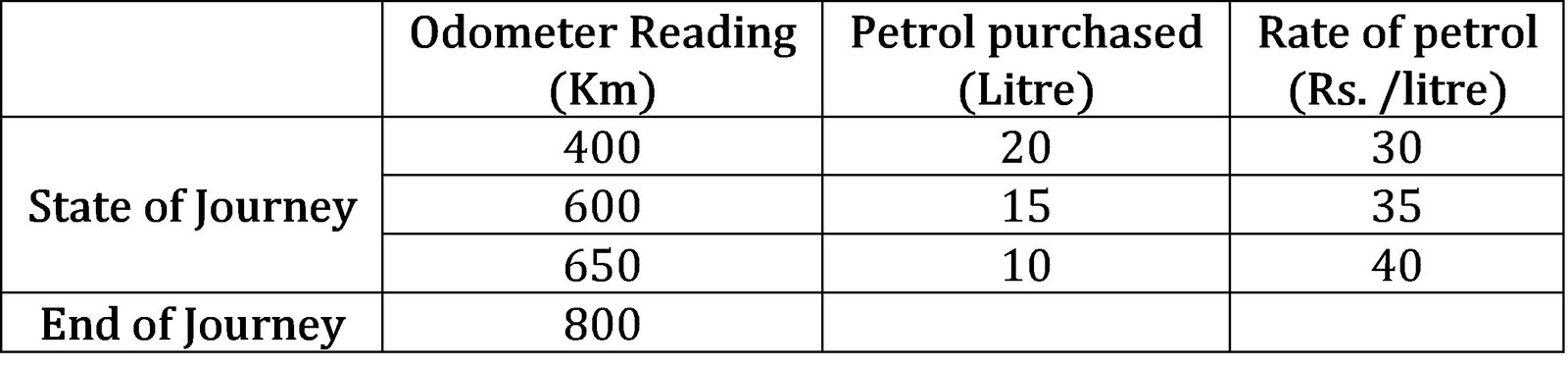
What has been the mileage (in kilometers per litre) of her car over the entire trip?
Passage / Data
Answer the following question based on the information given below.
Ramya, based in Shanpur, took her car for a 400 km trip to Rampur. She maintained a log of the odometer readings and the amount of petrol she purchased at different petrol pumps at different prices (given below). Her car already had 10 litres of petrol at the start of the journey, and she first purchased petrol at the start of the journey, as given in table below, and she had 5 litres remaining at the end of the journey.
Her car’s tank-capacity is 35 litres. Petrol costs Rs. 45/- litre in Rampur. What is the minimum amount of money she would need for purchasing petrol for the return trip from Rampur to Shanpur, using the same route? Assume that the mileage of the car remains unchanged throughout the route, and she did not use her car to travel around in Rampur.
Passage / Data
Answer the following question based on the information given below.
Ramya, based in Shanpur, took her car for a 400 km trip to Rampur. She maintained a log of the odometer readings and the amount of petrol she purchased at different petrol pumps at different prices (given below). Her car already had 10 litres of petrol at the start of the journey, and she first purchased petrol at the start of the journey, as given in table below, and she had 5 litres remaining at the end of the journey.
Shyam, a fertilizer salesman, sells directly to farmers. He visits two villages A and B. Shyam starts from A, and travels 50 meters to the East, then 50 meters North-East at exactly 45° to his earlier direction, and then another 50 meters East to reach village B. If the shortest distance between villages A and B is in the form of meters, find the value of a + b + c.
Passage / Data
Answer the following question based on the information given below.
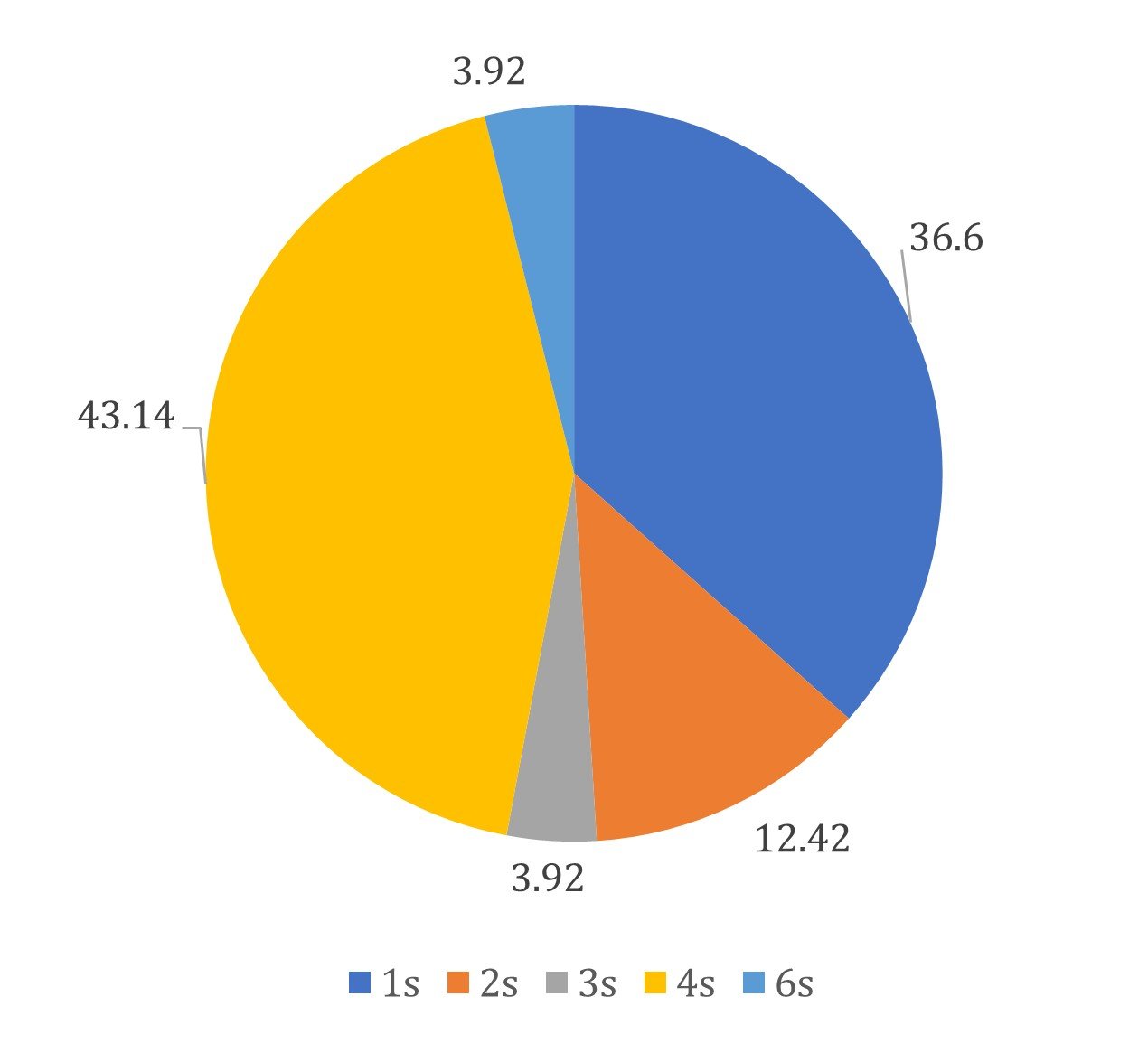
The following pie chart shows the percentage distribution of runs scored by a batsman in a test innings.
Lionel and Ronaldo had a discussion on the ages of Jose’s sons. Ronaldo made following statements about Jose’s sons:
- Jose has three sons.
- The sum of the ages of Jose’s sons is 13.
- The product of the ages of the sons is the same as the age of Lionel.
- Jose’s eldest son, Zizou weighs 32 kilos.
- The sum of the ages of the younger sons of Jose is 4.
- Jose has fathered a twin.
- Jose is not the father of a triplet.
- The LCM of the ages of Jose’s sons is more than the sum of their ages.
Which of the following combination gives information sufficient to determine the ages of Jose’s sons?