Mixtures — XAT Previous-Year Questions
4 previous-year questions on Mixtures from XAT, with full solutions. Practise free — check answers as you go; sign in to save your progress.
Mixtures · XAT PYQs
A small jar contained water, lime and sugar in the ratio of 90 : 7 : 3. A glass contained only water and sugar in it. Contents of both (small jar and glass) were mixed in a bigger jar and the ratio of contents in the bigger jar was 85 : 5 : 10 (water, lime and sugar respectively). Find the percentage of water in the bigger jar?
A mixture comprises water and liquids A and B. The volume of water is 1/3rd of the total mixture and the volume of liquids A and B are in the ratio 5:3. To remove the water, the mixture is passed through a porous medium which completely absorbs the water and partially absorbs liquid A. Altogether this porous medium absorbs 200 ml of the initial mixture. If the ratio of volume of liquids A and B in the residual concentrated mixture becomes 7:9 then find the volume of water absorbed by the porous medium.
Product M is produced by mixing chemical X and chemical Y in the ratio of 5 : 4. Chemical X is prepared by mixing two raw materials, A and B, in the ratio of 1 : 3. Chemical Y is prepared by mixing raw materials, B and C, in the ratio of 2 : 1. Then the final mixture is prepared by mixing 864 units of product M with water. If the concentration of the raw material B in the final mixture is 50%, how much water had been added to product M?
Passage / Data
Answer the following question based on the information given below.
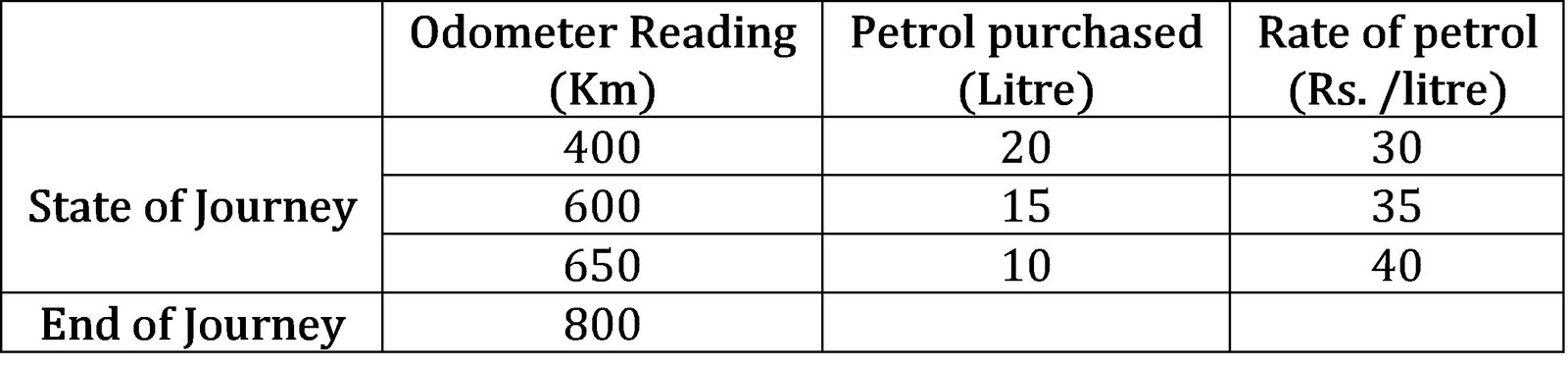
Ramya, based in Shanpur, took her car for a 400 km trip to Rampur. She maintained a log of the odometer readings and the amount of petrol she purchased at different petrol pumps at different prices (given below). Her car already had 10 litres of petrol at the start of the journey, and she first purchased petrol at the start of the journey, as given in table below, and she had 5 litres remaining at the end of the journey.
A medical practitioner has created different potencies of a commonly used medicine by dissolving tables in water and using the resultant solution.
Potency 1 solution: When 1 tablet is dissolved in 50 ml, the entire 50 ml is equivalent to one dose.Potency 2 solution: When 2 tablets are dissolved in 50 ml, the entire 50 ml of this solution is equivalent to 2 doses,… and so on.
This way he can give fractions of tablets based on the intensity of infection and the age of the patient.
For particular patient, he administers 10 ml of potency 1, 15 ml of potency 2 and 30 ml of potency 4. The dosage administered to the patient is equivalent to