Basics of Circles — XAT Previous-Year Questions
5 previous-year questions on Basics of Circles from XAT, with full solutions. Practise free — check answers as you go; sign in to save your progress.
Basics of Circles · XAT PYQs
In the figure given below, the circle has a chord AB of length 12 cm, which makes an angle of 60° at the center of the circle, O. ABCD, as shown in the diagram, is a rectangle. OQ is the perpendicular bisector of AB, intersecting the chord AB at P, the arc AB at M and CD at Q. OM = MQ. The area of the region enclosed by the line segments AQ and QB, and the arc BMA, is closest to (in cm2):
XYZ is an equilateral triangle, inscribed in a circle. P is a point on the arc YZ such that X and P are on opposite sides of the chord YZ. Which of the following MUST always be true?
What is the maximum number of points that can be placed on a circular disk of radius 1 metre (some of the points could be placed on the bounding circle of the disk) such that no two points are at a distance of less than 1 metre from each other?
AB is a chord of a circle. The length of AB is 24 cm. P is the midpoint of AB. Perpendiculars from P on either side of the chord meets the circle at M and N respectively. If PM < PN and PM = 8 cm. then what will be the length of PN?
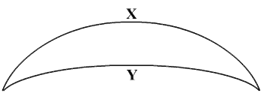
In the figure below, two circular curves create 60° and 90° angles with their respective centres. If the length of the bottom curve Y is 10, find the length of the other curve.