Vocabulary — XAT Previous-Year Questions
28 previous-year questions on Vocabulary from XAT, with full solutions. Practise free — check answers as you go; sign in to save your progress.
Vocabulary · XAT PYQs
Read the following statement carefully and fill up the blanks from the given options.
As _________evolved and eventually moved to cities, close proximity ____________how we viewed and assessed each_________.
Read the following statement carefully.
___________like a fake can be a sign of___________, and clinging too tightly to what feels like one’s authentic self can ________that growth.
Fill in the blanks meaningfully, in the above statement, from the following options.
Fill up the blanks with appropriate words.
Oil painting did to appearance what capital did to social____________. It reduced everything to the __________of objects. Everything became __________because everything became a commodity. All reality was mechanically__________ by its materiality.
Carefully read the paragraph below:
A map is a useful metaphor for our brain when talking about _______ because at its most basic level our brain __________to be our atlas of sorts, a system of routes _______to navigate us toward just one destination: staying alive!
From the options below, choose the set that MOST appropriately fills up the blanks.
Carefully read the paragraph below:
__________, medicine has been operated by trial and error, in other words, __________. We know by now that there can be entirely_________ connections between symptoms and treatment, and some medications succeed in medical trials for mere random reasons.
From the options below, choose the one that MOST appropriately fills up the blanks.
Passage / Data
In 1942, the French writer Albert Camus composed an essay, ‘The Myth of Sisyphus’. It draws on the Greek fable of a man condemned to roll a rock up a mountain only to have it roll back down under its own weight, a ______ that lasts for eternity. Camus argues that this image ______ the human condition in a world where we can no longer make sense of events; but instead of committing suicide, we should ______ ourselves to this ‘elusive feeling of absurdity’ and bear it as best we can. In this sense, Sisyphus is the ideal hero.
Consider the following words:
- surrender
- choice
- symbolises
- quandary
- attune
- option
- reconcile
- depicts
Which of the following options is the most appropriate sequence that best fits the blanks in the above paragraph?
Passage / Data
In 1942, the French writer Albert Camus composed an essay, ‘The Myth of Sisyphus’. It draws on the Greek fable of a man condemned to roll a rock up a mountain only to have it roll back down under its own weight, a ______ that lasts for eternity. Camus argues that this image ______ the human condition in a world where we can no longer make sense of events; but instead of committing suicide, we should ______ ourselves to this ‘elusive feeling of absurdity’ and bear it as best we can. In this sense, Sisyphus is the ideal hero.
Consider the following words:
- surrender
- choice
- symbolises
- quandary
- attune
- option
- reconcile
- depicts
______ the importance of ‘horizontal stratification’ ______ higher education is widely acknowledged, ______ attention has been applied to horizontal stratification ______ compulsory schooling.
Passage / Data
In 1942, the French writer Albert Camus composed an essay, ‘The Myth of Sisyphus’. It draws on the Greek fable of a man condemned to roll a rock up a mountain only to have it roll back down under its own weight, a ______ that lasts for eternity. Camus argues that this image ______ the human condition in a world where we can no longer make sense of events; but instead of committing suicide, we should ______ ourselves to this ‘elusive feeling of absurdity’ and bear it as best we can. In this sense, Sisyphus is the ideal hero.
Consider the following words:
- surrender
- choice
- symbolises
- quandary
- attune
- option
- reconcile
- depicts
Study the first sentence and then identify from among the options given the closest antonym of the highlighted word in the second sentence
It’s conventional wisdom that procreation between first cousins is unhealthy. But what are the actual genetic risks?
Passage / Data
Who could resist the idea of remembering everything they wanted to, without trying? Learning would be made easy, exams a ______ and you would never forget where you left your keys. And memory-related disorders like Alzheimer’s would have met their match. So, it is of little surprise that scientists have turned their attention to ways of ______ human memory using techniques that ______, supplement or even mimic parts of the brain. The immediate goal is to treat memory disorders, but the idea of a memory ______ for everyday life is gaining ground.
Fill in the blanks in the above paragraph, with the best option from among the following:
Passage / Data
Read the passage below and answer the questions that follow.
Labor and capital are the opposite poles of capitalist society. This polarity begins in each enterprise and is realized on a national and even international scale as a giant duality of classes which dominates the social structure. And yet this polarity is incorporated in a necessary identity between the two. Whatever its form, whether as money or commodities or means of production, capital is labor: it is labor that has been performed in the past, the objectified product of preceding phases of the cycle of production which becomes capital only through appropriation by the capitalist and its use in the accumulation of more capital. At the same time, as living labor which is purchased by the capitalist to set the production process into motion, labor is capital. That portion of money capital which is set aside for the payment of labor, the portion which in each cycle is converted into living labor power, is the portion of capital which stands for and corresponds to the
working population, and upon which the latter subsists. Before it is anything else, therefore, the working class is the animate part of capital, the part which will set in motion the process that
yields to the total capital its increment of surplus value. As such, the working class is first of all, raw material for exploitation. This working class lives a social and political existence of its own,
outside the direct grip of capital. It protests and submits, rebels or is integrated into bourgeois society, sees itself as a class or loses sight of its own existence, in accordance with the forces that act upon it and the moods, conjunctures, and conflicts of social and political life. But since, in its permanent existence, it is the living part of capital, its occupational structure, modes of work,
and distribution through the industries of society are determined by the ongoing processes of the accumulation of capital. It is seized, released, flung into various parts of the social machinery and expelled by others, not in accord with its own will or self-activity, but in accord with the movement of capital.
Read the following statements carefully:
The payoff from ________ in education is so ______ and _______ that it is almost ________ as a predictor of economic change over a five to ten year period.
Fill in the blanks meaningfully, in the above statement, from the following options.
Passage / Data
Read the passage below and answer the questions that follow.
Labor and capital are the opposite poles of capitalist society. This polarity begins in each enterprise and is realized on a national and even international scale as a giant duality of classes which dominates the social structure. And yet this polarity is incorporated in a necessary identity between the two. Whatever its form, whether as money or commodities or means of production, capital is labor: it is labor that has been performed in the past, the objectified product of preceding phases of the cycle of production which becomes capital only through appropriation by the capitalist and its use in the accumulation of more capital. At the same time, as living labor which is purchased by the capitalist to set the production process into motion, labor is capital. That portion of money capital which is set aside for the payment of labor, the portion which in each cycle is converted into living labor power, is the portion of capital which stands for and corresponds to the
working population, and upon which the latter subsists. Before it is anything else, therefore, the working class is the animate part of capital, the part which will set in motion the process that
yields to the total capital its increment of surplus value. As such, the working class is first of all, raw material for exploitation. This working class lives a social and political existence of its own,
outside the direct grip of capital. It protests and submits, rebels or is integrated into bourgeois society, sees itself as a class or loses sight of its own existence, in accordance with the forces that act upon it and the moods, conjunctures, and conflicts of social and political life. But since, in its permanent existence, it is the living part of capital, its occupational structure, modes of work,
and distribution through the industries of society are determined by the ongoing processes of the accumulation of capital. It is seized, released, flung into various parts of the social machinery and expelled by others, not in accord with its own will or self-activity, but in accord with the movement of capital.
Which of the following sentences contains correct and meaningful usage of the underlined words?
Passage / Data
Read the following poem and answer the questions that follow:
A spirit that lives in this world and does not wear the shirt of love, such an existence in a deep disgrace.
Be foolish in love, because love is all there is.
There is no way into presence except through love exchange.
If someone asks, But what is love? Answer, dissolving the will.
True freedom comes to those who have escaped the question of freewill and fate.
Love is an emperor. The two worlds play across him. He barely notices their tumbling game.
Love and lover live in eternity. Other desires are substitute for that way of being.
How long do you lay embracing a corpse? Love rather the soul, which cannot be held.
Anything born in spring dies in the fall, but love is not seasonal.
With wine pressed from grapes, expect a hangover.
But this love path has no expectations. You are uneasy riding the body?
Dismount, travel lighter. Wings will be given.
Be clear like mirror holding nothing.
Be clean of pictures and the worry that comes with images.
Gaze into what is not ashamed or afraid of any truth.
Contain all human faces in your own without any judgment of them.
Be pure emptiness. What is inside of that? You ask. Silence is all I can say.
Lovers have some secrets they keep.
Read the following statements carefully:
Though he thought of himself as a/an ______ person, his boss's abusive behaviour made him talk back. However, as he engaged in a/an _______ with his boss, all he got in response was a/an
_______, which only filled him with _____
Fill in the blanks meaningfully, in the above statement, from the following options:
Passage / Data
The serious study of popular films by critics is regularly credited with having rendered obsolete a once-dominant view that popular mainstream films are inherently inferior to art films. Yet the change of attitude may be somewhat _________ Although, it is now academically respectable to analyse popular films, the fact that many critics feel compelled to rationalize their own _________ action movies or mass-market fiction reveals, perhaps unwittingly, their continued _________ the old hierarchy of popular and art films.
Consider the following words:
- unproductive
- not appreciated
- overstated
- penchant for
- dislike for
- investment in
- exposure to
Which of the following options is the most appropriate sequence that would meaningfully fit the blanks in the above paragraph?
Passage / Data
Carefully read the statements below:
- Chatterjee loves books; therefore, he reads them all the time.
- Chatterjee loves books. Therefore, he reads them all the time.
- Chatterjee loves books and, therefore, reads them all the time.
Choose the option with all the correct words and their correct accent (underlined syllable) that fits the blanks.
The suspension of the captain may _________ the number of spectators, who turn up for this match.
Transportation costs will directly _________ the cost of retail goods.
Grandmother’s advancing age could _________ her ability to take care of the house.
She _________ a Texan accent throughout the interview.
Passage / Data
Read the following poem and answer the question that follows:
I sought a soul in the sea
And found a coral there
Beneath the foam for me
An ocean was all laid bare.
Into my heart’s night
Along a narrow way
I groped; and lo! The light,
An infinite land of day.
Choose the best pronunciation of the word, Sobriquet, from the following options:
Passage / Data
Read the following poem and answer the question that follows:
I sought a soul in the sea
And found a coral there
Beneath the foam for me
An ocean was all laid bare.
Into my heart’s night
Along a narrow way
I groped; and lo! The light,
An infinite land of day.
The subject of this book is knavery, skullduggery, cheating, betrayal, unfairness, crime, sneakiness, malingering, cutting corner, immorality, dishonesty, betrayal, graft, wickedness, and sin.
Which of the following options best captures ALL the italicized words above?
Which of the following is not a term of ‘disapproval’?
Read the four sentences given below:
He is the most ______ of the speakers to address us today.
The belief in ______ justice is the essence of his talk.
This hall would have been full but for the _____ rain.
Many in the audience have achieved _____ in their respective fields.
Which of the following sequence of words would most appropriately fit the blanks?
Six words are given below
Cacophonic
Cacographic
Calamitous
Catastrophic
Contraindicative
Cataclysmic
Which of the above words have similar meanings?
Identify the correct sequence of words would most that aptly fit the blanks in the following passage.
It is _____ (i) _____ that the accused had _____ (ii) _____ _____ (iii) _____ from all criminal activities by adopting the _____ (iv) _____ of a sanyasi. However, despite repeated requests from the counsel for prosecution, the court has _____ (v) _____ a lie detector to ascertain the truth.
Passage / Data
Analyse the following passage and provide appropriate answers for questions that follow.
Alone – he was alone again – again condemned to silence – again face to face with nothingness! Alone! – never again to see the face, never again to hear the voice of the only human being who united him to earth! Was not Faria’s fate the better, after all – to solve the problem of life at its source, even at the risk of horrible suffering? The idea of suicide, which his friend had driven away and kept away by his cheerful presence, now hovered like a phantom over the abbe’s dead body.
“If I could die,” he said, “I should go where he goes, and should assuredly find him again. But how to die? It is very easy,” he went on with a smile; “I will remain here, rush on the first person that opens the door, strangle him, and then they will guillotine me.” But excessive grief is like a storm at sea, where the frail bark is tossed from the depths to the top of the wave. Dantes recoiled from the idea of so infamous a death, and passed suddenly from despair to an ardent desire for life and liberty.
“Die? Oh, no,” he exclaimed – “not die now, after having lived and suffered so long and so much! Die? yes, had I died years ago; but now to die would be, indeed, to give way to the sarcasm of destiny. No, I want to live; I shall struggle to the very last; I will yet win back the happiness of which I have been deprived. Before I die I must not forget that I have my executioners to punish, and perhaps, too, who knows, some friends to reward. Yet they will forget me here, and I shall die in my dungeon like Faria, ” As he said this, he became silent and gazed straight before him like one overwhelmed with a strange and amazing thought. Suddenly he arose, lifted his hand to his brow as if his brain were giddy, paced twice or thrice round the dungeon, and then paused abruptly by the bed.
“Just God!” he muttered, “whence comes this thought? Is it from thee? Since none but the dead pass freely from this dungeon, let me take the place of the dead!” Without giving himself time to reconsider his decision, and , indeed, that he might not allow his thoughts to be distracted from his desperate resolution, he bent over the appalling shroud, opened it with the knife which Faria had made, drew the corpse from the sack, and bore it along the tunnel to his own chamber, laid it on his couch, tied around its head the rag he wore at night around his own, covered it with his counterpane, once again kissed the ice-cold brow, and tried vainly to close the resisting eyes, which glared horribly, turned the head towards the wall, so that the jailer might, when he brought the evening meal, believe that he was asleep, as was his frequent custom; entered the tunnel again, drew the bed against the wall, returned to the other cell, took from the hiding – place the needle and thread, flung off his rags, that they might feel only naked flesh beneath the coarse canvas, and getting inside the sack, placed himself in the posture in which the dead body had been laid, and sewed up the mouth of the sack from the inside.
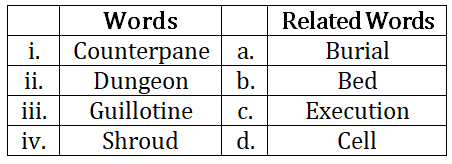
Which of the above ‘related words’ on the right – hand side are correctly matched with ‘words’ on the left – hand side?
Passage / Data
Read the definitions below and select the best match between the numbered sentences and the definitions.
Premise: A proposition from which another statement is inferred or follows a conclusion.
Assumption: Something, which is accepted as true.
Facts: Something, which can be checked.
Reason: A cause, explanation or justification for an action or event.
Conclusion: An end, finish or summarization of process or argument.
Proposition: A statement that expresses judgment or opinion.
Question: A sentence worded or expressed so as to elicit opinion.
Inductive inference: An end, finish or summarization reached for “the whole”, based on “a particular” real incidence.
Deductive Inference: An end, finish or summarization reached based on the combining and recombining two or more than two assumptions.
Fill in the blanks with the most appropriate option that follows:
The defense proposes to show that the incident that the prosecution so _________ rejects as __________ did indeed take place.
Passage / Data
Read the definitions below and select the best match between the numbered sentences and the definitions.
Premise: A proposition from which another statement is inferred or follows a conclusion.
Assumption: Something, which is accepted as true.
Facts: Something, which can be checked.
Reason: A cause, explanation or justification for an action or event.
Conclusion: An end, finish or summarization of process or argument.
Proposition: A statement that expresses judgment or opinion.
Question: A sentence worded or expressed so as to elicit opinion.
Inductive inference: An end, finish or summarization reached for “the whole”, based on “a particular” real incidence.
Deductive Inference: An end, finish or summarization reached based on the combining and recombining two or more than two assumptions.
Fill in the blanks with the most appropriate option that follows:
Not just the absence of ____________ , but also the presence of ____________ and honesty is required to bind up the nation’s wound.
It _____________ not look like a great deal today, but back then it was a coup: no man before ___________ to import tea directly into Ireland.
The option that will best fill the blanks in the above sentences would be:
Ravindra Dubey was guilty of embezzlement. It means that Ravindra Dubey
Passage / Data
Read the following passage and answer the questions.
There is an essential and irreducible ‘duality’ in the normative conceptualization of an individual person. We can see the person in terms of his or her ‘agency’, recognizing and respecting his or her ability to form goals, commitments, values, etc., and we can also see the person in terms of his or her ‘well-being’. This dichotomy is lost in a model of exclusively self-interested motivation, in which a person’s agency must be entirely geared to his or her own well-being. But once that straitjacket of self-interested motivation is removed, it becomes possible to recognize the indisputable fact that the person’s agency can well be geared to considerations not covered – or at least not fully covered – by his or her own well-being. Agency may be seen as important (not just instrumentally for the pursuit of well-being, but also intrinsically), but that still leaves open the question as to how that agency is to be evaluated and appraised. Even though the use of one’s agency is a matter for oneself to judge, the need for careful assessment of aims, objective, allegiances, etc., and the conception of the good, may be important and exacting.
To recognize the distinction between the ‘agency aspect’ and the ‘well-being aspect’ of a person does not require us to take the view that the person’s success as an agent must be independent, or completely separable from, his or her success in terms of well-being. A person may well feel happier and better off as a result of achieving what he or she wanted to achieve – perhaps for his or her family, or community, or class, or party, or some other cause. Also it is quite possible that a person’s well-being will go down as a result of frustration if there is some failure to achieve what he or she wanted to achieve as an agent, even though those achievements are not directly concerned with his or her well-being. There is really no sound basis for demanding that the agency aspect and the well-being aspect of a person should be independent of each other, and it is, I suppose, even possible that every change in one will affect the other as well. However, the point at issue is not the plausibility of their independence, but the sustainability and relevance of the distinction. The fact that two variables may be so related that one cannot change without the other, does not imply that they are the same variable, or that they will have the same values, or that the value of one can be obtained from the other on basis of some simple transformation.
The importance of an agency achievement does not rest entirely on the enhancement of well-being that it may indirectly cause. The agency achievement and well-being achievement, both of which have some distinct importance, may be casually linked with each other, but this fact does not compromise the specific importance of either. In so far as utility – based welfare calculations concentrate only on the well-being of the person, ignoring the agency aspect, or actually fails to distinguish between the agency aspect and well-being aspect altogether, something of real importance is lost.
Which word is the opposite of the word ‘hypothesize’?
Passage / Data
Read the following passage and answer the questions.
There is an essential and irreducible ‘duality’ in the normative conceptualization of an individual person. We can see the person in terms of his or her ‘agency’, recognizing and respecting his or her ability to form goals, commitments, values, etc., and we can also see the person in terms of his or her ‘well-being’. This dichotomy is lost in a model of exclusively self-interested motivation, in which a person’s agency must be entirely geared to his or her own well-being. But once that straitjacket of self-interested motivation is removed, it becomes possible to recognize the indisputable fact that the person’s agency can well be geared to considerations not covered – or at least not fully covered – by his or her own well-being. Agency may be seen as important (not just instrumentally for the pursuit of well-being, but also intrinsically), but that still leaves open the question as to how that agency is to be evaluated and appraised. Even though the use of one’s agency is a matter for oneself to judge, the need for careful assessment of aims, objective, allegiances, etc., and the conception of the good, may be important and exacting.
To recognize the distinction between the ‘agency aspect’ and the ‘well-being aspect’ of a person does not require us to take the view that the person’s success as an agent must be independent, or completely separable from, his or her success in terms of well-being. A person may well feel happier and better off as a result of achieving what he or she wanted to achieve – perhaps for his or her family, or community, or class, or party, or some other cause. Also it is quite possible that a person’s well-being will go down as a result of frustration if there is some failure to achieve what he or she wanted to achieve as an agent, even though those achievements are not directly concerned with his or her well-being. There is really no sound basis for demanding that the agency aspect and the well-being aspect of a person should be independent of each other, and it is, I suppose, even possible that every change in one will affect the other as well. However, the point at issue is not the plausibility of their independence, but the sustainability and relevance of the distinction. The fact that two variables may be so related that one cannot change without the other, does not imply that they are the same variable, or that they will have the same values, or that the value of one can be obtained from the other on basis of some simple transformation.
The importance of an agency achievement does not rest entirely on the enhancement of well-being that it may indirectly cause. The agency achievement and well-being achievement, both of which have some distinct importance, may be casually linked with each other, but this fact does not compromise the specific importance of either. In so far as utility – based welfare calculations concentrate only on the well-being of the person, ignoring the agency aspect, or actually fails to distinguish between the agency aspect and well-being aspect altogether, something of real importance is lost.
Concurrence means all of the following except:
Passage / Data
Read the following passage and answer the questions.
There is an essential and irreducible ‘duality’ in the normative conceptualization of an individual person. We can see the person in terms of his or her ‘agency’, recognizing and respecting his or her ability to form goals, commitments, values, etc., and we can also see the person in terms of his or her ‘well-being’. This dichotomy is lost in a model of exclusively self-interested motivation, in which a person’s agency must be entirely geared to his or her own well-being. But once that straitjacket of self-interested motivation is removed, it becomes possible to recognize the indisputable fact that the person’s agency can well be geared to considerations not covered – or at least not fully covered – by his or her own well-being. Agency may be seen as important (not just instrumentally for the pursuit of well-being, but also intrinsically), but that still leaves open the question as to how that agency is to be evaluated and appraised. Even though the use of one’s agency is a matter for oneself to judge, the need for careful assessment of aims, objective, allegiances, etc., and the conception of the good, may be important and exacting.
To recognize the distinction between the ‘agency aspect’ and the ‘well-being aspect’ of a person does not require us to take the view that the person’s success as an agent must be independent, or completely separable from, his or her success in terms of well-being. A person may well feel happier and better off as a result of achieving what he or she wanted to achieve – perhaps for his or her family, or community, or class, or party, or some other cause. Also it is quite possible that a person’s well-being will go down as a result of frustration if there is some failure to achieve what he or she wanted to achieve as an agent, even though those achievements are not directly concerned with his or her well-being. There is really no sound basis for demanding that the agency aspect and the well-being aspect of a person should be independent of each other, and it is, I suppose, even possible that every change in one will affect the other as well. However, the point at issue is not the plausibility of their independence, but the sustainability and relevance of the distinction. The fact that two variables may be so related that one cannot change without the other, does not imply that they are the same variable, or that they will have the same values, or that the value of one can be obtained from the other on basis of some simple transformation.
The importance of an agency achievement does not rest entirely on the enhancement of well-being that it may indirectly cause. The agency achievement and well-being achievement, both of which have some distinct importance, may be casually linked with each other, but this fact does not compromise the specific importance of either. In so far as utility – based welfare calculations concentrate only on the well-being of the person, ignoring the agency aspect, or actually fails to distinguish between the agency aspect and well-being aspect altogether, something of real importance is lost.
Fill in the blanks with the most appropriate word/set of words from the given options.
Not wanting to present an unwanted optimistic picture in the board meeting, the CEO estimated the sales growth _____________.
The option that will best fill the blank in the above sentence would be: