Mathematical Reasoning — XAT Previous-Year Questions
8 previous-year questions on Mathematical Reasoning from XAT, with full solutions. Practise free — check answers as you go; sign in to save your progress.
Mathematical Reasoning · XAT PYQs
Passage / Data
Read the following scenario and answer the THREE questions that follow.
An examination had ten multiple choice questions; labelled Q1 to Q10 respectively. Each question had four answer options — A, B, C and D — of which one and only one was the correct answer. For each correct answer, the candidate obtained 1 mark. There were no negative marks for wrong answers. The answers chosen by six candidates named Om, Pavan, Qadir, Rakesh, Simranjeet and Tracey to each of the ten questions and the total marks obtained by each of them are shown in the table.
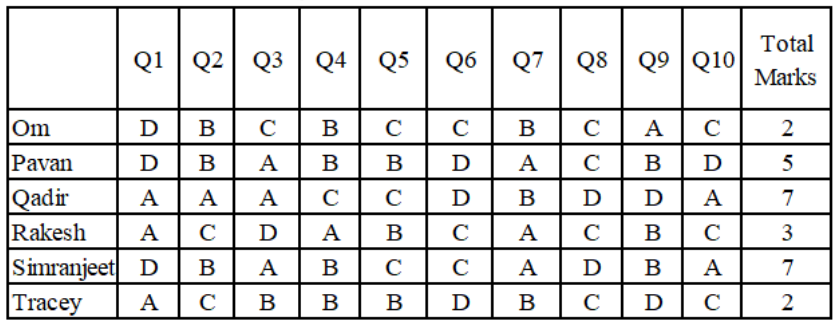
What is the correct answer for Q5?
Passage / Data
Read the following scenario and answer the THREE questions that follow.
An examination had ten multiple choice questions; labelled Q1 to Q10 respectively. Each question had four answer options — A, B, C and D — of which one and only one was the correct answer. For each correct answer, the candidate obtained 1 mark. There were no negative marks for wrong answers. The answers chosen by six candidates named Om, Pavan, Qadir, Rakesh, Simranjeet and Tracey to each of the ten questions and the total marks obtained by each of them are shown in the table.
For which of these questions is D the correct answer?
Passage / Data
Read the following scenario and answer the THREE questions that follow.
An examination had ten multiple choice questions; labelled Q1 to Q10 respectively. Each question had four answer options — A, B, C and D — of which one and only one was the correct answer. For each correct answer, the candidate obtained 1 mark. There were no negative marks for wrong answers. The answers chosen by six candidates named Om, Pavan, Qadir, Rakesh, Simranjeet and Tracey to each of the ten questions and the total marks obtained by each of them are shown in the table.
Which of these questions witnessed the least number of the students answering correctly?
Passage / Data
Answer the next 3 questions based on the information given below.
Given below is the time table for a trans-continental train that cuts across several time zones. All timings are in local time in the respective cities. The average speed of the train between any two cities is the same in both directions.
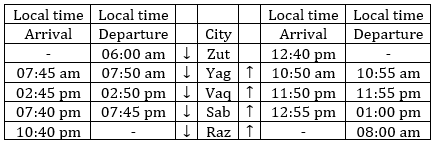
Which of the following pairs of cities are in the same time zone?
Passage / Data
Answer the next 3 questions based on the information given below.
Given below is the time table for a trans-continental train that cuts across several time zones. All timings are in local time in the respective cities. The average speed of the train between any two cities is the same in both directions.
What is the total time taken in minutes by the train to go from Zut to Raz?
Passage / Data
Answer the next 3 questions based on the information given below.
Given below is the time table for a trans-continental train that cuts across several time zones. All timings are in local time in the respective cities. The average speed of the train between any two cities is the same in both directions.
What time is it at Yag when it is 12:00 noon at Sab?
Passage / Data
Answer the following question based on the information given below.
Ramya, based in Shanpur, took her car for a 400 km trip to Rampur. She maintained a log of the odometer readings and the amount of petrol she purchased at different petrol pumps at different prices (given below). Her car already had 10 litres of petrol at the start of the journey, and she first purchased petrol at the start of the journey, as given in table below, and she had 5 litres remaining at the end of the journey.
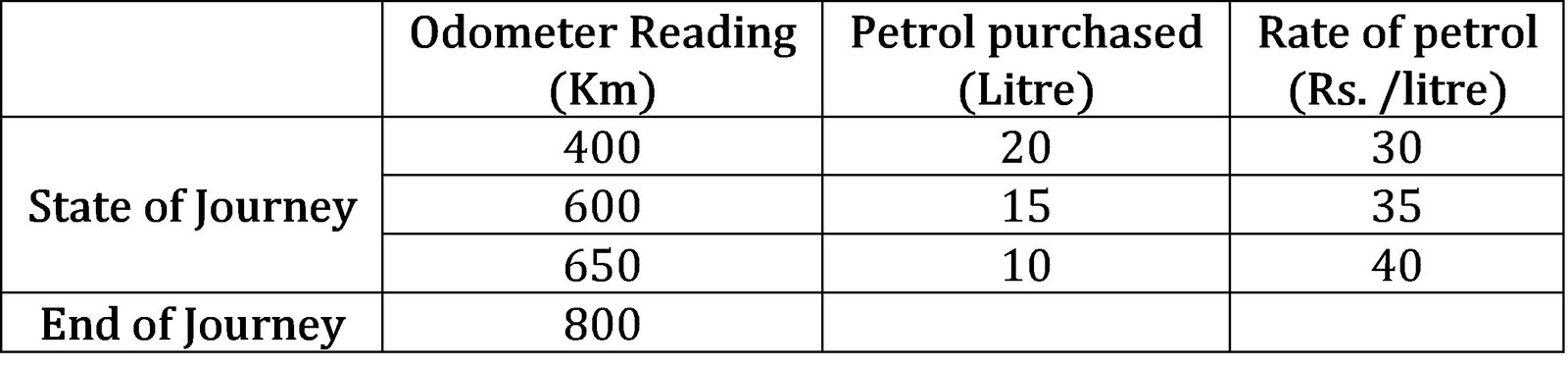
What has been the mileage (in kilometers per litre) of her car over the entire trip?
Passage / Data
Answer the following question based on the information given below.
Ramya, based in Shanpur, took her car for a 400 km trip to Rampur. She maintained a log of the odometer readings and the amount of petrol she purchased at different petrol pumps at different prices (given below). Her car already had 10 litres of petrol at the start of the journey, and she first purchased petrol at the start of the journey, as given in table below, and she had 5 litres remaining at the end of the journey.
Her car’s tank-capacity is 35 litres. Petrol costs Rs. 45/- litre in Rampur. What is the minimum amount of money she would need for purchasing petrol for the return trip from Rampur to Shanpur, using the same route? Assume that the mileage of the car remains unchanged throughout the route, and she did not use her car to travel around in Rampur.