Progressions — XAT Previous-Year Questions
11 previous-year questions on Progressions from XAT, with full solutions. Practise free — check answers as you go; sign in to save your progress.
Progressions · XAT PYQs
In a school, the number of students in each class, from Class I to X, in that order, are in an arithmetic progression. The total number of students from Class I to V is twice the total number of students from Class VI to X. If the total number of students from Class I to IV is 462, how many students are there in Class VI?
Suppose Haruka has a special key ∆ in her calculator called delta key:
Rule 1: If the display shows a one-digit number, pressing delta key ∆ replaces the displayed number with twice its value.
Rule 2: If the display shows a two-digit number, pressing delta key ∆ replaces the displayed number with the sum of the two digits.
Suppose Haruka enters the value 1 and then presses delta key ∆ repeatedly.
After pressing the ∆ key for 68 times, what will be the displayed number?
Consider an + 1 = for n = 1, 2, ...., 2008, 2009 where a1 = 1. Find the value of a1 a2 + a2 a3 + a3 a4 + ... + a2008 a2009
A marble is dropped from a height of 3 metres onto the ground. After the hitting theground, it bounces and reaches 80% of the height from which it was dropped. This repeats multiple times. Each time it bounces, the marble reaches 80% of the height previously reached. Eventually, the marble comes to rest on the ground.
What is the maximum distance that the marble travels from the time it was dropped until it comes to rest?
Passage / Data
Read the following scenario and answer the THREE questions that follow.
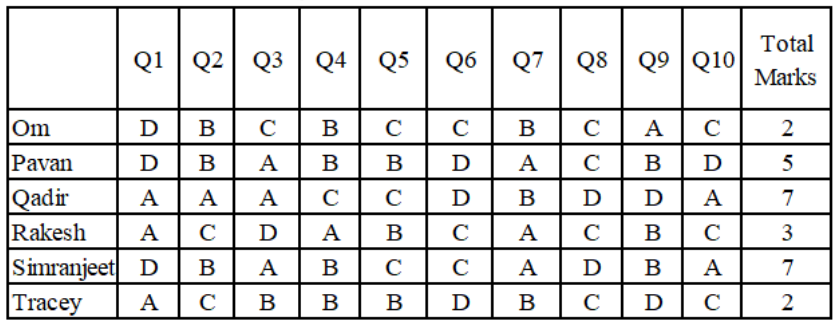
An examination had ten multiple choice questions; labelled Q1 to Q10 respectively. Each question had four answer options — A, B, C and D — of which one and only one was the correct answer. For each correct answer, the candidate obtained 1 mark. There were no negative marks for wrong answers. The answers chosen by six candidates named Om, Pavan, Qadir, Rakesh, Simranjeet and Tracey to each of the ten questions and the total marks obtained by each of them are shown in the table.
Shireen draws a circle in her courtyard. She then measures the circle’s circumference and its diameter with her measuring tape and records them as two integers, A and B respectively. She finds that A and B are coprimes, that is, their greatest common divisor is 1. She also finds their ratio, A : B, to be: 3.141614161416… (repeating endlessly).
What is A - B?
Passage / Data
Read the following scenario and answer the THREE questions that follow.
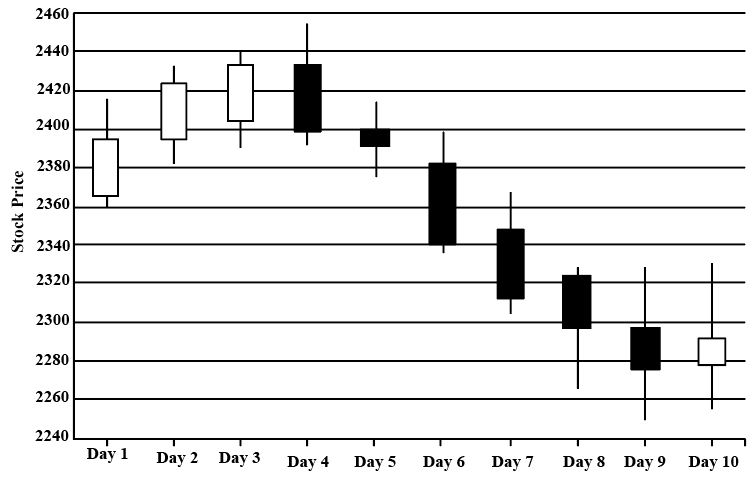
The given candlestick chart depicts the prices of a particular stock over 10 consecutive days. A candlestick comprises of a rectangular box pieced by a line. The top and bottom ends of the line respectively indicate the maximum and minimum prices of the stock on that day, while the horizontal edges of the rectangle correspond to the stock's opening and closing prices. If the rectangle is white, the opening price is lower than the closing price, but if the rectangle is black, then it is the other way around.
Using the above information, answer the questions that follow:
If both the sequences x, a1, a2, y and x, b1, b2, z are in A.P. and it is given that y > x and z < x, then which of the following values can possibly take?
A man is laying stones, from start to end, along the two sides of a 200-meter-walkway. The stones are to be laid 5 meters apart from each other. When he begins, all the stones are present at the start of the walkway. He places the first stone on each side at the walkway’s start. For all the other stones, the man lays the stones first along one of the walkway’s sides, then along the other side in an exactly similar fashion. However, he can carry only one stone at a time. To lay each stone, the man walks to the spot, lays the stone, and then walks back to pick another. After laying all the stones, the man walks back to the start, which marks the end of his work. What is the total distance that the man walks in executing this work? Assume that the width of the walkway is negligible.
An antique store has a collection of eight clocks. At a particular moment, the displayed times on seven of the eight clocks were as follows: 1:55 pm, 2:03 pm, 2:11 pm, 2:24 pm, 2:45 pm, 3:19 pm and 4:14 pm. If the displayed times of all eight clocks form a mathematical series, then what was the displayed time on the remaining clock?
The sum of the series, (-100) + (-95) + (-90) + … + 110 + 115 + 120, is
Consider the set of numbers {1, 3, 32, 33,…...,3100}. The ratio of the last number and the sum of the remaining numbers is closest to:
What is the sum of the following series?
–64, –66, –68,……..….., –100