XAT 2012 — QA & DI Question 12
Answer the following question based on the information given below.
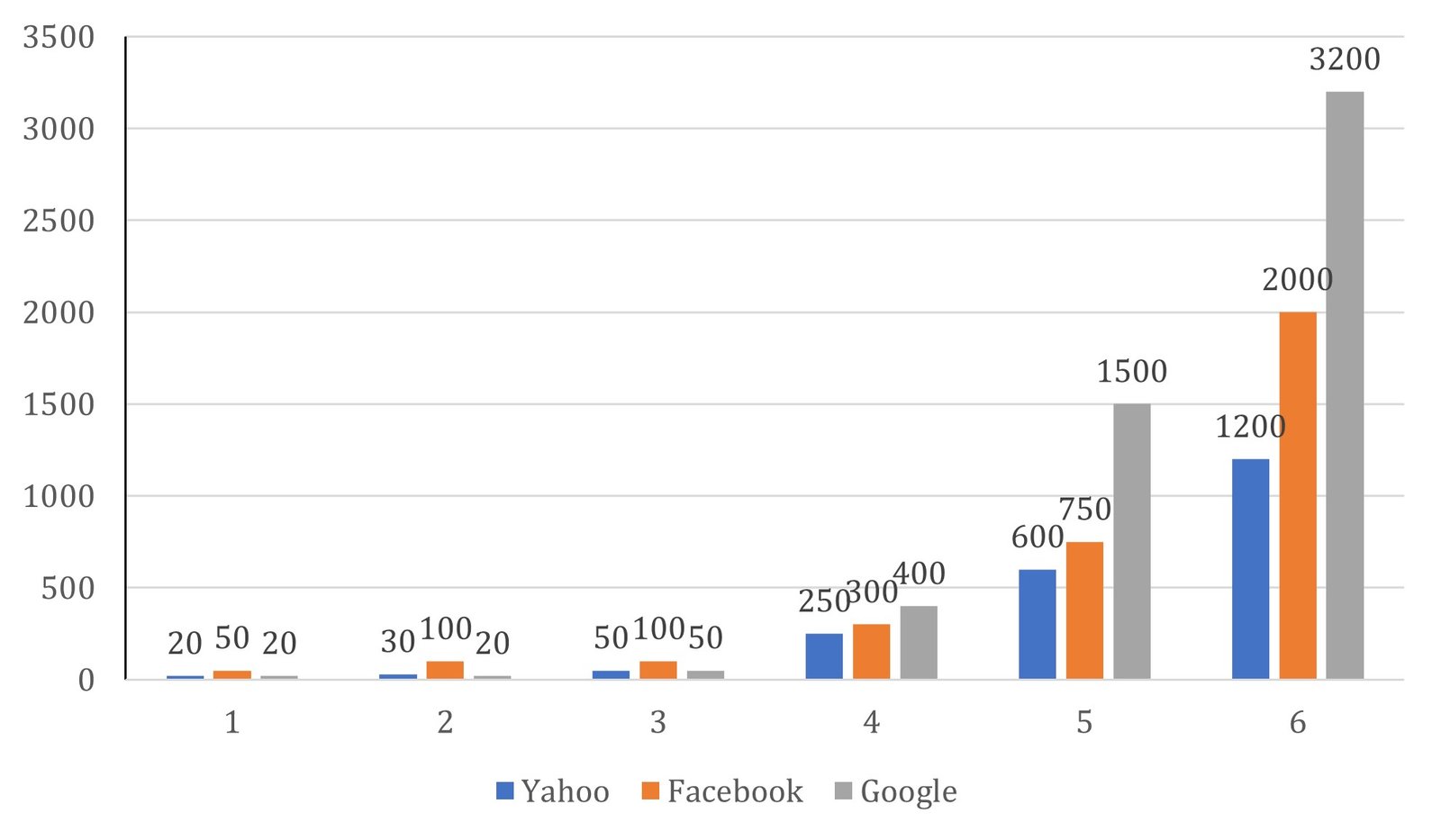
The following graphs shows the revenue (in $ million) of three companies in their initial six years of operations, in an economy which is characterized by a persistent inflation.
A potter asked his two sons to sell some pots in the market. The amount received for each pot was same as the number of pots sold. The two brothers spent the entire amount on some packets of potato chips and one packet of banana chips. One brother had the packet of banana chips along with some packets of potato chips, while the other brother just had potato chips. Each packet of potato chips costs Rs. 10/- and the packet of banana chips costs less than Rs. 10/-. The packets of chips were divided between the two brothers so each brother received equal number of packets. How much money should one brother give to the other to make the division financially equitable?
Answer & solution
Correct answer: 2
- A
1
2
- C
4
- D
5
- E
7
Let the potter’s sons have x pots.
Hence, they received Rs. x2 after selling these pots.
As the price of one banana wafer packet is less than Rs. 10 hence, x2 will not be a multiple of 100.
Assume that they bought n packets of potato wafers.
Hence, total number of wafers packet = n + 1
Hence, each son gets (n + 1)/2 packets.
Hence, n is odd.
Let b be the price of banana wafers.
Hence, they have Rs. (n × 10 + b)
As n is odd, tens place of (n × 10 + b) is odd.
Now, each brother can have equal money if total amount earned by them is even.
Hence, b must be even.
Hence, we have the following condition,
x2 = 10 × n + b such that b is even and n is odd.
Hence, x is an even number.
Now, if unit’s digit is of x is 2 or 8, then tens place of x2 will be even.
This is violates our condition that tens digit of x2 is odd and hence it is not possible.
Hence, unit’s place digit of x is 4 or 6.
In either case, unit digit of x2 is 6.
Hence, b = 6.
Hence, the son having banana wafers owes Rs. ((n – 1) × 10/2 + 6) and the other son owes ((n + 1) × 10/2)
Hence, one of the son has Rs. ((n + 1) × 10/2) – ((n – 1) × 10/2 + 6) = Rs. 4 more than the other.
Hence, he must give Rs. 2 to the other to have financially equitable division.
Hence, option (b).
Related Simple Equations questions
- Nikhil’s mother asks him to buy 100 pieces of sweets worth Rs. 100/-. The …
- Three truck drivers, Amar, Akbar and Anthony stop at a road side eating joint. A…
- A computer program was tested 300 times before its release. The testing was done…