XAT 2015 — LRDI Question 1
Answer the questions on the basis of information given in the following case.
Bright Engineering College (BEC) has listed 20 elective courses for the next term and students have to choose any 7 of them. Simran, a student of BEC, notices that there are three categories of electives: Job-oriented (J), Quantitative-oriented (Q) and Grade-oriented (G). Among these 20 electives, some electives are both Job and Grade-oriented but are not Quantitative-oriented (JG type). QJ type electives are both job and Quantitative-oriented but are not Grade-oriented and QG type electives are both Quantitative and Grade-oriented but are not Job-oriented. Simran also notes that the total number of QJ type electives is 2 less than QG type electives. Similarly, the total number of QG type electives is 2 less than JG type and there is only 1 common elective (JQG) across three categories. Furthermore, the number of only Quantitative-oriented electives is same as only Job-oriented electives, but less than the number of only Grade-oriented electives. Each elective has at least one registration and there is at least one elective in each category, or combinations of categories.
On her way back Simran met her friend Raj and shared the above information. Raj is preparing for XAT and is only interested in Grade-oriented (G) electives. He wanted to know the number of G-type electives being offered. Simran replied, “You have all the information. Calculate the number of G-type electives yourself. It would help your XAT preparation”. Raj calculates correctly and says that there can be _______ possible answers.
Which of the following options would best fit the blank above?
Answer & solution
Correct answer: 5
- A
3
5
- C
8
- D
9
- E
11
Let QJ type electives, only Grade-oriented electives and only Quantitative-oriented electives be z, y and x respectively.
Note: y > x
∴ Number of QG type electives = z + 2
∴ Number of JG type electives = z + 4
The given data can be represented in the form of the following Venn diagram,
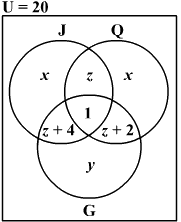
Thus, the following equation is obtained,
3z + 2x + y = 13
(x, z ≥ 1 and y ≥ 2 )
For z = 1, 2x + y = 10 and possible values of (x, y): (1, 8), (2, 6) and (3, 4).
For z = 2, 2x + y = 7 and possible values of (x, y): (1, 5) and (2, 3).
For z = 3, 2x + y = 4 and possible values of (x, y): (1, 2).
Now, G = 2z + y + 7
If z = 1, G = 17, 15, 13
If z = 2, G = 16, 14
If z = 3, G = 15
Only 5 unique values of G are possible i.e. 13, 14, 15, 16 and 17.
Hence, option (b).
Related Simple Equations questions
- Read the following statements and answer the question that follows. The …
- In an examination, two types of questions are asked: one mark questions and two …
- Simran prefers J-type electives and wants to avoid Q-type electives. She noted t…
- Vijay and Raj want to avoid each other. Vijay is interested in J-type electives …
- Initially, the e-mail distracted Dipangshu but he decided to focus on the job. W…
- The scheduled presentation went off smoothly. Back in his cabin, Dipangshu read …