XAT 2017 — QA & DI Question 21
Answer the next 4 questions based on the following information:
Abdul has 8 factories, with different capacities, producing boutique kurtas. In the production process, he incurs raw material cost, selling cost (for packaging and transportation) and labour cost. These costs per kurta vary across factories. In all these factories, a worker takes 2 hours to produce a kurta. Profit per kurta is calculated by deducting raw material cost, selling cost and labour cost from the selling price (Profit = selling price - raw materials cost - selling cost - labour cost). Any other cost can be ignored.
Exhibit: Business Details of Abdul’s 8 Factories
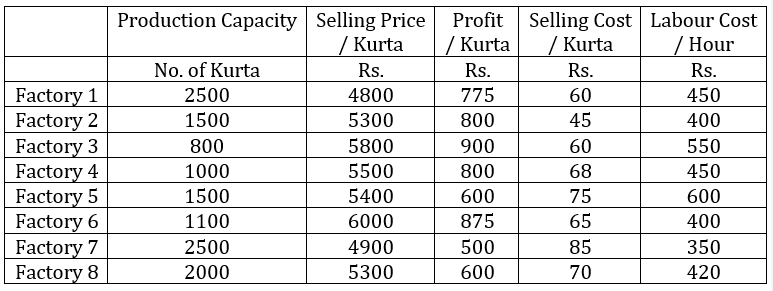
Abdul has received an order for 2,000 kurtas from a big retail chain. They will collect the finished pre-packaged kurtas directly from the factories, saving him the selling cost. To deliver this order, he can use multiple factories for production. Which of the following options will ensure maximum profit from this order?
Answer & solution
Correct answer: Factories 3, 6 and 4
- A
Factory 1
- B
Factories 2 and 3
- C
Factories 4 and 6
Factories 3, 6 and 4
- E
Factory 1 or Factory 7 or Factory 8
Here, selling cost would be added to the profit.
F1: Profit = 775 + 60 = 835
F2: Profit = 800 + 45 = 845
F2: Profit = 900+60 = 960
F4: Profit = 800 + 68 = 868
F5: Profit = 600 + 75 = 675
F6: Profit = 875 + 65 = 940
F7: Profit = 500 + 85 = 585
F8: Profit = 600 + 70 = 670
Maximum profit margin is from factory 3. But it can only produce 800 kurtas.
Next best profit margin is from factory 6. It can produce additional 1100 kurtas.
∴ 1900 kurtas can be produced by factory 3 and 6 together.
Remaining 100 kurtas should be produced by factory 4 since it has the third highest profit margin.
Hence option (d).
Related Bar Graphs questions
- Which of the following options is in decreasing order of raw materials cost?…
- Which of the factories listed in the options below has the lowest sales margin (…
- Abdul has introduced a new technology in all his factories. As a result, a worke…