CAT 1991 — QA Question 19
Use the following information:
Prakash has to decide whether or not to test a batch of 1000 widgets before sending them to the buyer. In case he decides to test, he has two options: (a) Use test I ; (b) Use test II. Test I cost Rs. 2 per widget. However, the test is not perfect. It sends 20% of the bad ones to the buyer as good. Test II costs Rs. 3 per widget. It brings out all the bad ones. A defective widget identified before sending can be corrected at a cost of Rs. 25 per widget. All defective widgets are identified at the buyer’s end and penalty of Rs. 50 per defective widget has to be paid by Prakash.
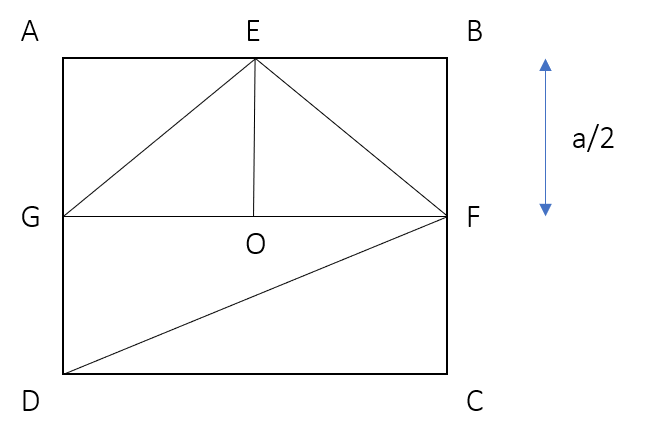
Let the consecutive vertices of a square S be A, B, C & D. Let E, F & G be the mid-points of the sides AB, BC & AD respectively of the square. Then the ratio of the area of the quadrilateral EFDG to that of the square S is nearest to
Answer & solution
1/2
- B
1/3
- C
1/4
- D
1/8
Let the side of square be a.

Area of quadrilateral EFDG = Ar(â³DGF) + Ar(â³GEF) = 1/2 × a/2 × a + 1/2 × a × a/2 = 1/2 × a2
Ar(EFDG) : Ar(S) = 1/2 × a2 : a2 = 1 : 2
Hence, option (a).