CAT 1991 — QA
All 58 QA questions from CAT 1991, with the answer key and detailed solutions. Practise free — check answers as you go, or tap Show solution.
CAT 1991 · QA
Read the following information and answer the questions that follows:
Ghosh Babu deposited a certain sum of money in a bank in 1986. The bank calculated interest on the principal at 10 percent simple interest, and credited it to the account once a year. After the 1st year, Ghosh Babu withdrew the entire interest and 20% of the initial amount. After the 2nd year, he withdrew the interest and 50% of the remaining amount. After the 3rd year, he withdrew the interest and 50% of the remaining amount. Finally after the 4th year, Ghosh Babu closed the account and collected the entire balance of Rs. 11,000.
The initial amount in rupees, deposited by Ghosh Babu was:
Read the following information and answer the questions that follows:
Ghosh Babu deposited a certain sum of money in a bank in 1986. The bank calculated interest on the principal at 10 percent simple interest, and credited it to the account once a year. After the 1st year, Ghosh Babu withdrew the entire interest and 20% of the initial amount. After the 2nd year, he withdrew the interest and 50% of the remaining amount. After the 3rd year, he withdrew the interest and 50% of the remaining amount. Finally after the 4th year, Ghosh Babu closed the account and collected the entire balance of Rs. 11,000.
The year, at the end of which, Ghosh Babu withdrew the smallest amount was:
Read the following information and answer the questions that follows:
Ghosh Babu deposited a certain sum of money in a bank in 1986. The bank calculated interest on the principal at 10 percent simple interest, and credited it to the account once a year. After the 1st year, Ghosh Babu withdrew the entire interest and 20% of the initial amount. After the 2nd year, he withdrew the interest and 50% of the remaining amount. After the 3rd year, he withdrew the interest and 50% of the remaining amount. Finally after the 4th year, Ghosh Babu closed the account and collected the entire balance of Rs. 11,000.
The year, at the end of which, Ghosh Babu collected the maximum interest was:
Read the following information and answer the questions that follows:
Ghosh Babu deposited a certain sum of money in a bank in 1986. The bank calculated interest on the principal at 10 percent simple interest, and credited it to the account once a year. After the 1st year, Ghosh Babu withdrew the entire interest and 20% of the initial amount. After the 2nd year, he withdrew the interest and 50% of the remaining amount. After the 3rd year, he withdrew the interest and 50% of the remaining amount. Finally after the 4th year, Ghosh Babu closed the account and collected the entire balance of Rs. 11,000.
The year, at the end of which, Ghosh Babu withdrew the maximum amount was:
Read the following information and answer the questions that follows:
Ghosh Babu deposited a certain sum of money in a bank in 1986. The bank calculated interest on the principal at 10 percent simple interest, and credited it to the account once a year. After the 1st year, Ghosh Babu withdrew the entire interest and 20% of the initial amount. After the 2nd year, he withdrew the interest and 50% of the remaining amount. After the 3rd year, he withdrew the interest and 50% of the remaining amount. Finally after the 4th year, Ghosh Babu closed the account and collected the entire balance of Rs. 11,000.
The total interest, in rupees, collected by Ghosh Babu was:
Use the following information:
Prakash has to decide whether or not to test a batch of 1000 widgets before sending them to the buyer. In case he decides to test, he has two options: (a) Use test I ; (b) Use test II. Test I cost Rs. 2 per widget. However, the test is not perfect. It sends 20% of the bad ones to the buyer as good. Test II costs Rs. 3 per widget. It brings out all the bad ones. A defective widget identified before sending can be corrected at a cost of Rs. 25 per widget. All defective widgets are identified at the buyer’s end and penalty of Rs. 50 per defective widget has to be paid by Prakash.
Prakash should not test if the number of bad widgets in the lot is:
Use the following information:
Prakash has to decide whether or not to test a batch of 1000 widgets before sending them to the buyer. In case he decides to test, he has two options: (a) Use test I ; (b) Use test II. Test I cost Rs. 2 per widget. However, the test is not perfect. It sends 20% of the bad ones to the buyer as good. Test II costs Rs. 3 per widget. It brings out all the bad ones. A defective widget identified before sending can be corrected at a cost of Rs. 25 per widget. All defective widgets are identified at the buyer’s end and penalty of Rs. 50 per defective widget has to be paid by Prakash.
If there are 120 defective widgets in the lot, Prakash:
Use the following information:
Prakash has to decide whether or not to test a batch of 1000 widgets before sending them to the buyer. In case he decides to test, he has two options: (a) Use test I ; (b) Use test II. Test I cost Rs. 2 per widget. However, the test is not perfect. It sends 20% of the bad ones to the buyer as good. Test II costs Rs. 3 per widget. It brings out all the bad ones. A defective widget identified before sending can be corrected at a cost of Rs. 25 per widget. All defective widgets are identified at the buyer’s end and penalty of Rs. 50 per defective widget has to be paid by Prakash.
If the number of defective widgets in the lot is between 200 and 400, Prakash:
Use the following information:
Prakash has to decide whether or not to test a batch of 1000 widgets before sending them to the buyer. In case he decides to test, he has two options: (a) Use test I ; (b) Use test II. Test I cost Rs. 2 per widget. However, the test is not perfect. It sends 20% of the bad ones to the buyer as good. Test II costs Rs. 3 per widget. It brings out all the bad ones. A defective widget identified before sending can be corrected at a cost of Rs. 25 per widget. All defective widgets are identified at the buyer’s end and penalty of Rs. 50 per defective widget has to be paid by Prakash.
If Prakash is told that the lot has 160 defective widgets, he should:
Use the following information:
Prakash has to decide whether or not to test a batch of 1000 widgets before sending them to the buyer. In case he decides to test, he has two options: (a) Use test I ; (b) Use test II. Test I cost Rs. 2 per widget. However, the test is not perfect. It sends 20% of the bad ones to the buyer as good. Test II costs Rs. 3 per widget. It brings out all the bad ones. A defective widget identified before sending can be corrected at a cost of Rs. 25 per widget. All defective widgets are identified at the buyer’s end and penalty of Rs. 50 per defective widget has to be paid by Prakash.
If there are 200 defective widgets in the lot, Prakash:
Use the following information:
Prakash has to decide whether or not to test a batch of 1000 widgets before sending them to the buyer. In case he decides to test, he has two options: (a) Use test I ; (b) Use test II. Test I cost Rs. 2 per widget. However, the test is not perfect. It sends 20% of the bad ones to the buyer as good. Test II costs Rs. 3 per widget. It brings out all the bad ones. A defective widget identified before sending can be corrected at a cost of Rs. 25 per widget. All defective widgets are identified at the buyer’s end and penalty of Rs. 50 per defective widget has to be paid by Prakash.
A function can sometimes reflect on itself, i.e. if y = f(x), then x = f(y). Both of them retain the same structure and form. Which of the following functions has this property?
Use the following information:
Prakash has to decide whether or not to test a batch of 1000 widgets before sending them to the buyer. In case he decides to test, he has two options: (a) Use test I ; (b) Use test II. Test I cost Rs. 2 per widget. However, the test is not perfect. It sends 20% of the bad ones to the buyer as good. Test II costs Rs. 3 per widget. It brings out all the bad ones. A defective widget identified before sending can be corrected at a cost of Rs. 25 per widget. All defective widgets are identified at the buyer’s end and penalty of Rs. 50 per defective widget has to be paid by Prakash.
What is the value of k for which the following system of equations has no solution:
2x – 8y = 3 and kx +4y = 10
Use the following information:
Prakash has to decide whether or not to test a batch of 1000 widgets before sending them to the buyer. In case he decides to test, he has two options: (a) Use test I ; (b) Use test II. Test I cost Rs. 2 per widget. However, the test is not perfect. It sends 20% of the bad ones to the buyer as good. Test II costs Rs. 3 per widget. It brings out all the bad ones. A defective widget identified before sending can be corrected at a cost of Rs. 25 per widget. All defective widgets are identified at the buyer’s end and penalty of Rs. 50 per defective widget has to be paid by Prakash.
How many 3-digit even numbers can you form such that if one of the digits is 5 then the following digit must be 7?
Use the following information:
Prakash has to decide whether or not to test a batch of 1000 widgets before sending them to the buyer. In case he decides to test, he has two options: (a) Use test I ; (b) Use test II. Test I cost Rs. 2 per widget. However, the test is not perfect. It sends 20% of the bad ones to the buyer as good. Test II costs Rs. 3 per widget. It brings out all the bad ones. A defective widget identified before sending can be corrected at a cost of Rs. 25 per widget. All defective widgets are identified at the buyer’s end and penalty of Rs. 50 per defective widget has to be paid by Prakash.
Alord got an order from a garment manufacturer for 480 Denim Shirts. He brought 12 sewing machines and appointed some expert tailors to do the job. However, many didn’t report to duty. As a result, each of those who did, had to stitch 32 more shirts than originally planned by Alord, with equal distribution of work. How many tailors had been appointed earlier and how many had not reported for work?
Use the following information:
Prakash has to decide whether or not to test a batch of 1000 widgets before sending them to the buyer. In case he decides to test, he has two options: (a) Use test I ; (b) Use test II. Test I cost Rs. 2 per widget. However, the test is not perfect. It sends 20% of the bad ones to the buyer as good. Test II costs Rs. 3 per widget. It brings out all the bad ones. A defective widget identified before sending can be corrected at a cost of Rs. 25 per widget. All defective widgets are identified at the buyer’s end and penalty of Rs. 50 per defective widget has to be paid by Prakash.
Iqbal dealt some cards to Mushtaq and himself from a full pack of playing cards and laid the rest aside. Iqbal then said to Mushtaq. “If you give me a certain number of your cards, I will have four times as many cards as you will have. If I give you the same number of cards, I will have thrice as many cards as you will have “. Of the given choices, which could represent the number of cards with Iqbal?
Use the following information:
Prakash has to decide whether or not to test a batch of 1000 widgets before sending them to the buyer. In case he decides to test, he has two options: (a) Use test I ; (b) Use test II. Test I cost Rs. 2 per widget. However, the test is not perfect. It sends 20% of the bad ones to the buyer as good. Test II costs Rs. 3 per widget. It brings out all the bad ones. A defective widget identified before sending can be corrected at a cost of Rs. 25 per widget. All defective widgets are identified at the buyer’s end and penalty of Rs. 50 per defective widget has to be paid by Prakash.
Fifty college teachers are surveyed as to their possession of colour TV, VCR and tape recorder. Of them, 22 own colour TV, 15 own VCR and 14 own tape recorders. Nine of these college teachers own exactly two items out of colour TV, VCR and tape recorder; and, one college teacher owns all three. How many of the 50 teachers own none of the three, colour TV, VCR or tape recorder?
Use the following information:
Prakash has to decide whether or not to test a batch of 1000 widgets before sending them to the buyer. In case he decides to test, he has two options: (a) Use test I ; (b) Use test II. Test I cost Rs. 2 per widget. However, the test is not perfect. It sends 20% of the bad ones to the buyer as good. Test II costs Rs. 3 per widget. It brings out all the bad ones. A defective widget identified before sending can be corrected at a cost of Rs. 25 per widget. All defective widgets are identified at the buyer’s end and penalty of Rs. 50 per defective widget has to be paid by Prakash.
Three times the first of three consecutive odd integers is 3 more than twice the third. What is the third integer?
Use the following information:
Prakash has to decide whether or not to test a batch of 1000 widgets before sending them to the buyer. In case he decides to test, he has two options: (a) Use test I ; (b) Use test II. Test I cost Rs. 2 per widget. However, the test is not perfect. It sends 20% of the bad ones to the buyer as good. Test II costs Rs. 3 per widget. It brings out all the bad ones. A defective widget identified before sending can be corrected at a cost of Rs. 25 per widget. All defective widgets are identified at the buyer’s end and penalty of Rs. 50 per defective widget has to be paid by Prakash.
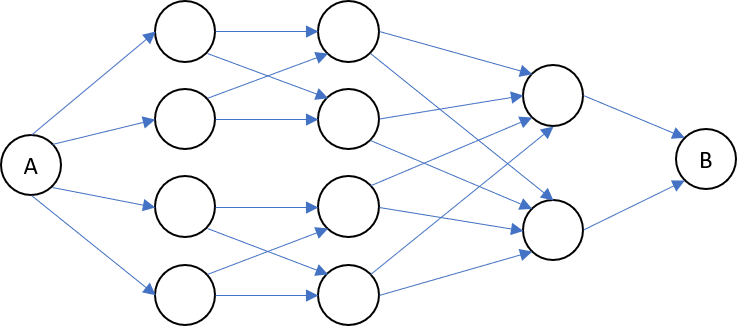
What is the total number of ways to reach A to B in the network given?
Use the following information:
Prakash has to decide whether or not to test a batch of 1000 widgets before sending them to the buyer. In case he decides to test, he has two options: (a) Use test I ; (b) Use test II. Test I cost Rs. 2 per widget. However, the test is not perfect. It sends 20% of the bad ones to the buyer as good. Test II costs Rs. 3 per widget. It brings out all the bad ones. A defective widget identified before sending can be corrected at a cost of Rs. 25 per widget. All defective widgets are identified at the buyer’s end and penalty of Rs. 50 per defective widget has to be paid by Prakash.
Let the consecutive vertices of a square S be A, B, C & D. Let E, F & G be the mid-points of the sides AB, BC & AD respectively of the square. Then the ratio of the area of the quadrilateral EFDG to that of the square S is nearest to
Use the following information:
Prakash has to decide whether or not to test a batch of 1000 widgets before sending them to the buyer. In case he decides to test, he has two options: (a) Use test I ; (b) Use test II. Test I cost Rs. 2 per widget. However, the test is not perfect. It sends 20% of the bad ones to the buyer as good. Test II costs Rs. 3 per widget. It brings out all the bad ones. A defective widget identified before sending can be corrected at a cost of Rs. 25 per widget. All defective widgets are identified at the buyer’s end and penalty of Rs. 50 per defective widget has to be paid by Prakash.
273 – 272 – 271 is the same as
Use the following information:
Prakash has to decide whether or not to test a batch of 1000 widgets before sending them to the buyer. In case he decides to test, he has two options: (a) Use test I ; (b) Use test II. Test I cost Rs. 2 per widget. However, the test is not perfect. It sends 20% of the bad ones to the buyer as good. Test II costs Rs. 3 per widget. It brings out all the bad ones. A defective widget identified before sending can be corrected at a cost of Rs. 25 per widget. All defective widgets are identified at the buyer’s end and penalty of Rs. 50 per defective widget has to be paid by Prakash.
The number of integers n satisfying –n + 2 ≥ 0 and 2n ≥ 4 is
Use the following information:
Prakash has to decide whether or not to test a batch of 1000 widgets before sending them to the buyer. In case he decides to test, he has two options: (a) Use test I ; (b) Use test II. Test I cost Rs. 2 per widget. However, the test is not perfect. It sends 20% of the bad ones to the buyer as good. Test II costs Rs. 3 per widget. It brings out all the bad ones. A defective widget identified before sending can be corrected at a cost of Rs. 25 per widget. All defective widgets are identified at the buyer’s end and penalty of Rs. 50 per defective widget has to be paid by Prakash.
The sum of two integers is 10 and the sum of their reciprocals is 5/12. Then the larger of these integers is
Use the following information:
Prakash has to decide whether or not to test a batch of 1000 widgets before sending them to the buyer. In case he decides to test, he has two options: (a) Use test I ; (b) Use test II. Test I cost Rs. 2 per widget. However, the test is not perfect. It sends 20% of the bad ones to the buyer as good. Test II costs Rs. 3 per widget. It brings out all the bad ones. A defective widget identified before sending can be corrected at a cost of Rs. 25 per widget. All defective widgets are identified at the buyer’s end and penalty of Rs. 50 per defective widget has to be paid by Prakash.
A circle is inscribed in a given square and another circle is circumscribed about the square. What is the ratio of the area of the inscribed circle to that of the circumscribed circle?
Use the following information:
Prakash has to decide whether or not to test a batch of 1000 widgets before sending them to the buyer. In case he decides to test, he has two options: (a) Use test I ; (b) Use test II. Test I cost Rs. 2 per widget. However, the test is not perfect. It sends 20% of the bad ones to the buyer as good. Test II costs Rs. 3 per widget. It brings out all the bad ones. A defective widget identified before sending can be corrected at a cost of Rs. 25 per widget. All defective widgets are identified at the buyer’s end and penalty of Rs. 50 per defective widget has to be paid by Prakash.
If y = f(x) and f(x) = , which of the following is true?
Answer the following questions based on the information given below:
There were a hundred schools in a town. Of these, the number of schools having a play – ground was 30, and these schools had neither a library nor a laboratory. The number of schools having a laboratory alone was twice the number of those having a library only. The number of schools having a laboratory as well as a library was one fourth the number of those having a laboratory alone. The number of schools having either a laboratory or a library or both was 35.
How many schools had none of the three viz., laboratory, library or play – ground?
Answer the following questions based on the information given below:
There were a hundred schools in a town. Of these, the number of schools having a play – ground was 30, and these schools had neither a library nor a laboratory. The number of schools having a laboratory alone was twice the number of those having a library only. The number of schools having a laboratory as well as a library was one fourth the number of those having a laboratory alone. The number of schools having either a laboratory or a library or both was 35.
What was the ratio of schools having laboratory to those having library?
Answer the following questions based on the information given below:
There were a hundred schools in a town. Of these, the number of schools having a play – ground was 30, and these schools had neither a library nor a laboratory. The number of schools having a laboratory alone was twice the number of those having a library only. The number of schools having a laboratory as well as a library was one fourth the number of those having a laboratory alone. The number of schools having either a laboratory or a library or both was 35.
A player rolls a die and receives the same number of rupees as the number of dots on the face that turns up. What should the player pay for each roll if he wants to make a profit of one rupee per throw of the die in the long run?
Answer the following questions based on the information given below:
There were a hundred schools in a town. Of these, the number of schools having a play – ground was 30, and these schools had neither a library nor a laboratory. The number of schools having a laboratory alone was twice the number of those having a library only. The number of schools having a laboratory as well as a library was one fourth the number of those having a laboratory alone. The number of schools having either a laboratory or a library or both was 35.
Three machines, A, B and C can be used to produce a product. Machine A will take 60 hours to produce a million units. Machine B is twice as fast as Machine A. Machine C will take the same amount of time to produce a million units as A and B running together. How much time will be required to produce a million units if all the three machines are used simultaneously? (in hous)
Answer the following questions based on the information given below:
There were a hundred schools in a town. Of these, the number of schools having a play – ground was 30, and these schools had neither a library nor a laboratory. The number of schools having a laboratory alone was twice the number of those having a library only. The number of schools having a laboratory as well as a library was one fourth the number of those having a laboratory alone. The number of schools having either a laboratory or a library or both was 35.
Let Y = minimum of {(x + 2), (3 – x)}. What is the maximum value of Y for 0 ≤ x ≤ 1?
Answer the following questions based on the information given below:
There were a hundred schools in a town. Of these, the number of schools having a play – ground was 30, and these schools had neither a library nor a laboratory. The number of schools having a laboratory alone was twice the number of those having a library only. The number of schools having a laboratory as well as a library was one fourth the number of those having a laboratory alone. The number of schools having either a laboratory or a library or both was 35.
There are 3 clubs A, B & C in a town with 40, 50 & 60 members respectively. While 10 people are members of all 3 clubs, 70 are members in only one club. How many belong to exactly two clubs?
Answer the following questions based on the information given below:
There were a hundred schools in a town. Of these, the number of schools having a play – ground was 30, and these schools had neither a library nor a laboratory. The number of schools having a laboratory alone was twice the number of those having a library only. The number of schools having a laboratory as well as a library was one fourth the number of those having a laboratory alone. The number of schools having either a laboratory or a library or both was 35.
A square piece of cardboard of sides ten inches is taken and four equal squares pieces are removed at the corners, such that the side of this square piece is also an integer value. The sides are then turned up to form an open box. Then the maximum volume such a box can have is
Answer the following questions based on the information given below:
There were a hundred schools in a town. Of these, the number of schools having a play – ground was 30, and these schools had neither a library nor a laboratory. The number of schools having a laboratory alone was twice the number of those having a library only. The number of schools having a laboratory as well as a library was one fourth the number of those having a laboratory alone. The number of schools having either a laboratory or a library or both was 35.
x, y and z are three positive integers such that x > y > z. Which of the following is closest to the product xyz?
Answer the following questions based on the information given below:
There were a hundred schools in a town. Of these, the number of schools having a play – ground was 30, and these schools had neither a library nor a laboratory. The number of schools having a laboratory alone was twice the number of those having a library only. The number of schools having a laboratory as well as a library was one fourth the number of those having a laboratory alone. The number of schools having either a laboratory or a library or both was 35.
What is the greatest power of 5 which can divide 80! exactly.
Answer the following questions based on the information given below:
There were a hundred schools in a town. Of these, the number of schools having a play – ground was 30, and these schools had neither a library nor a laboratory. The number of schools having a laboratory alone was twice the number of those having a library only. The number of schools having a laboratory as well as a library was one fourth the number of those having a laboratory alone. The number of schools having either a laboratory or a library or both was 35.
A third standard teacher gave a simple multiplication exercise to the kids. But one kid reversed the digits of both the numbers and carried out the multiplication and found that the product was exactly the same as the one expected by the teacher. Only one of the following pairs of numbers will fit in the description of the exercise. Which one is that?
Answer the following questions based on the information given below:
There were a hundred schools in a town. Of these, the number of schools having a play – ground was 30, and these schools had neither a library nor a laboratory. The number of schools having a laboratory alone was twice the number of those having a library only. The number of schools having a laboratory as well as a library was one fourth the number of those having a laboratory alone. The number of schools having either a laboratory or a library or both was 35.
Find the minimum integral value of n such that the division 55n/124 leaves no remainder.
Answer the following questions based on the information given below:
There were a hundred schools in a town. Of these, the number of schools having a play – ground was 30, and these schools had neither a library nor a laboratory. The number of schools having a laboratory alone was twice the number of those having a library only. The number of schools having a laboratory as well as a library was one fourth the number of those having a laboratory alone. The number of schools having either a laboratory or a library or both was 35.
Let k be a positive integer such that k + 4 is divisible by 7. Then the smallest positive integer n, greater than 2, such that k + 2n is divisible by 7 equals
Answer the following questions based on the information given below:
There were a hundred schools in a town. Of these, the number of schools having a play – ground was 30, and these schools had neither a library nor a laboratory. The number of schools having a laboratory alone was twice the number of those having a library only. The number of schools having a laboratory as well as a library was one fourth the number of those having a laboratory alone. The number of schools having either a laboratory or a library or both was 35.
A calculator has two memory buttons, A and B. Value 1 is initially stored in both memory locations.
The following sequence of steps is carried out five times:
- add 1 to B
- multiply A to B
- store the result in A
What is the value stored in memory location A after this procedure?
Answer the following questions based on the information given below:
There were a hundred schools in a town. Of these, the number of schools having a play – ground was 30, and these schools had neither a library nor a laboratory. The number of schools having a laboratory alone was twice the number of those having a library only. The number of schools having a laboratory as well as a library was one fourth the number of those having a laboratory alone. The number of schools having either a laboratory or a library or both was 35.
A one rupee coin is placed on a table. The maximum number of similar one rupee coins which can be placed on the table, around it, with each one of them touching it and only two others is
Answer the following questions based on the information given below:
There were a hundred schools in a town. Of these, the number of schools having a play – ground was 30, and these schools had neither a library nor a laboratory. The number of schools having a laboratory alone was twice the number of those having a library only. The number of schools having a laboratory as well as a library was one fourth the number of those having a laboratory alone. The number of schools having either a laboratory or a library or both was 35.
Gopal went to a fruit market with certain amount of money. With this money he can buy either 50 oranges or 40 mangoes. He retains 10% of the money for taxi fare. If he buys 20 mangoes, then the number of oranges he can buy is
Answer the following questions based on the information given below:
There were a hundred schools in a town. Of these, the number of schools having a play – ground was 30, and these schools had neither a library nor a laboratory. The number of schools having a laboratory alone was twice the number of those having a library only. The number of schools having a laboratory as well as a library was one fourth the number of those having a laboratory alone. The number of schools having either a laboratory or a library or both was 35.
Every day Neera’s husband meets her at the city railway station at 6.00 p.m. and drives her to their residence. One day she left early from the office and reached the railway station at 5.00 p.m. She started walking towards her home, met her husband coming from their residence on the way and they reached home 10 minutes earlier than the usual time. For how long did she walk?
Answer the following questions based on the information given below:
There were a hundred schools in a town. Of these, the number of schools having a play – ground was 30, and these schools had neither a library nor a laboratory. The number of schools having a laboratory alone was twice the number of those having a library only. The number of schools having a laboratory as well as a library was one fourth the number of those having a laboratory alone. The number of schools having either a laboratory or a library or both was 35.
In Sivakasi, each boy’s quota of match sticks to fill into boxes is not more than 200 per session. If he reduces the number of sticks per box by 25, he can fill 3 more boxes with the total number of sticks assigned to him. Which of the following is the possible number of sticks assigned to each boy?
Answer the following questions based on the information given below:
There were a hundred schools in a town. Of these, the number of schools having a play – ground was 30, and these schools had neither a library nor a laboratory. The number of schools having a laboratory alone was twice the number of those having a library only. The number of schools having a laboratory as well as a library was one fourth the number of those having a laboratory alone. The number of schools having either a laboratory or a library or both was 35.
A sum of money compounded annually becomes Rs. 625 in two years and Rs. 675 in three years. The rate of interest per annum is
Answer the following questions based on the information given below:
There were a hundred schools in a town. Of these, the number of schools having a play – ground was 30, and these schools had neither a library nor a laboratory. The number of schools having a laboratory alone was twice the number of those having a library only. The number of schools having a laboratory as well as a library was one fourth the number of those having a laboratory alone. The number of schools having either a laboratory or a library or both was 35.
In a six-node network, two nodes are connected to all the other nodes. Of the remaining four, each is connected to four nodes. What is the total number of links in the network?
Answer the following questions based on the information given below:
There were a hundred schools in a town. Of these, the number of schools having a play – ground was 30, and these schools had neither a library nor a laboratory. The number of schools having a laboratory alone was twice the number of those having a library only. The number of schools having a laboratory as well as a library was one fourth the number of those having a laboratory alone. The number of schools having either a laboratory or a library or both was 35.
If x is a positive integer such that 2x + 12 is perfectly divisible by x, then the number of possible values of x is
Answer the following questions based on the information given below:
There were a hundred schools in a town. Of these, the number of schools having a play – ground was 30, and these schools had neither a library nor a laboratory. The number of schools having a laboratory alone was twice the number of those having a library only. The number of schools having a laboratory as well as a library was one fourth the number of those having a laboratory alone. The number of schools having either a laboratory or a library or both was 35.
An outgoing batch of students wants to gift PA system worth Rs. 4200 to their school. If the teachers offer to pay 50% more than the students, and an external benefactor gives three times teachers’ contribution, how much should the teachers donate?
Answer the following questions based on the information given below:
There were a hundred schools in a town. Of these, the number of schools having a play – ground was 30, and these schools had neither a library nor a laboratory. The number of schools having a laboratory alone was twice the number of those having a library only. The number of schools having a laboratory as well as a library was one fourth the number of those having a laboratory alone. The number of schools having either a laboratory or a library or both was 35.
A positive integer is said to be a prime number if it is not divisible by any positive integer other than itself and 1. Let p be a prime number greater than 5. Then (p2 – 1) is
Answer the following questions based on the information given below:
There were a hundred schools in a town. Of these, the number of schools having a play – ground was 30, and these schools had neither a library nor a laboratory. The number of schools having a laboratory alone was twice the number of those having a library only. The number of schools having a laboratory as well as a library was one fourth the number of those having a laboratory alone. The number of schools having either a laboratory or a library or both was 35.
To decide whether a n digit number is divisible by 7, we can define a process by which its magnitude is reduced as follows: (i1, i2, i3, … , are the digits of the number, starting from the most significant digit).
i1 i2 ……. in ⇒ i1 . 3n-1 + i2 . 3n-2 + ……… + in . 30.
e.g. 259 ⇒ 2.32 + 5.31 + 9.30 = 18 + 15 + 9 = 42
Ultimately the resulting number will be seven after repeating the above process a certain number of times. After how many such stages, does the number 203 reduce to 7?
Answer the following questions based on the information given below:
There were a hundred schools in a town. Of these, the number of schools having a play – ground was 30, and these schools had neither a library nor a laboratory. The number of schools having a laboratory alone was twice the number of those having a library only. The number of schools having a laboratory as well as a library was one fourth the number of those having a laboratory alone. The number of schools having either a laboratory or a library or both was 35.
What is the distance between the points A(3, 8) and B(–2, –7)?
Answer the following questions based on the information given below:
There were a hundred schools in a town. Of these, the number of schools having a play – ground was 30, and these schools had neither a library nor a laboratory. The number of schools having a laboratory alone was twice the number of those having a library only. The number of schools having a laboratory as well as a library was one fourth the number of those having a laboratory alone. The number of schools having either a laboratory or a library or both was 35.
Each of these items has a question followed by two statements. As the answer,
Type 1, If the question can be answered with the help of statement I alone,
Type 2, If the question can be answered with the help of statement II alone,
Type 3, If both the statement I and statement II are needed to answer the question, and
Type 4, If the question cannot be answered even with the help of both the statements.
âââââââIs it more profitable for Company M to produce Q?
- Product R is sold at a price four times that of Q.
- One unit of Q requires 2 units of labour, while one unit of R requires 5 units of labour. There is no other constraint on production.
Answer the following questions based on the information given below:
There were a hundred schools in a town. Of these, the number of schools having a play – ground was 30, and these schools had neither a library nor a laboratory. The number of schools having a laboratory alone was twice the number of those having a library only. The number of schools having a laboratory as well as a library was one fourth the number of those having a laboratory alone. The number of schools having either a laboratory or a library or both was 35.
Each of these items has a question followed by two statements. As the answer,
Type 1, If the question can be answered with the help of statement I alone,
Type 2, If the question can be answered with the help of statement II alone,
Type 3, If both the statement I and statement II are needed to answer the question, and
Type 4, If the question cannot be answered even with the help of both the statements.
A train started from Station A, developed engine trouble and reached Station B, 40 minutes late. What is the distance between Stations A and B?
- The engine trouble developed after travelling 40 km from Station A and the speed reduced to 1/4th of the original speed.
- The engine trouble developed after travelling 40 km from station A in two hours and the speed reduced to ¼th of the original speed.
Answer the following questions based on the information given below:
There were a hundred schools in a town. Of these, the number of schools having a play – ground was 30, and these schools had neither a library nor a laboratory. The number of schools having a laboratory alone was twice the number of those having a library only. The number of schools having a laboratory as well as a library was one fourth the number of those having a laboratory alone. The number of schools having either a laboratory or a library or both was 35.
Each of these items has a question followed by two statements. As the answer,
Type 1, If the question can be answered with the help of statement I alone,
Type 2, If the question can be answered with the help of statement II alone,
Type 3, If both the statement I and statement II are needed to answer the question, and
Type 4, If the question cannot be answered even with the help of both the statements.
What is the value of prime number x?
- x2 + x is a two digit number greater than 50.
- x3 is a three digit number.
Answer the following questions based on the information given below:
There were a hundred schools in a town. Of these, the number of schools having a play – ground was 30, and these schools had neither a library nor a laboratory. The number of schools having a laboratory alone was twice the number of those having a library only. The number of schools having a laboratory as well as a library was one fourth the number of those having a laboratory alone. The number of schools having either a laboratory or a library or both was 35.
Each of these items has a question followed by two statements. As the answer,
Type 1, If the question can be answered with the help of statement I alone,
Type 2, If the question can be answered with the help of statement II alone,
Type 3, If both the statement I and statement II are needed to answer the question, and
Type 4, If the question cannot be answered even with the help of both the statements.
The average of three unequal quotations for a particular share is Rs.110. If all are quoted in integral values of rupee, does the highest quotation exceed Rs.129?
- The lowest quotation is Rs.100.
- One of the quotations is Rs.115.
Answer the following questions based on the information given below:
There were a hundred schools in a town. Of these, the number of schools having a play – ground was 30, and these schools had neither a library nor a laboratory. The number of schools having a laboratory alone was twice the number of those having a library only. The number of schools having a laboratory as well as a library was one fourth the number of those having a laboratory alone. The number of schools having either a laboratory or a library or both was 35.
Each of these items has a question followed by two statements. As the answer,
Type 1, If the question can be answered with the help of statement I alone,
Type 2, If the question can be answered with the help of statement II alone,
Type 3, If both the statement I and statement II are needed to answer the question, and
Type 4, If the question cannot be answered even with the help of both the statements.
How many people (from the group surveyed) read both Indian Express and Times of India?
- Out of total of 200 readers, 100 read Indian Express, 120 read Times of India and 50 read Hindu.
- Out of a total of 200 readers, 100 read Indian Express, 120 read Times of India and 50 read neither
Answer the following questions based on the information given below:
There were a hundred schools in a town. Of these, the number of schools having a play – ground was 30, and these schools had neither a library nor a laboratory. The number of schools having a laboratory alone was twice the number of those having a library only. The number of schools having a laboratory as well as a library was one fourth the number of those having a laboratory alone. The number of schools having either a laboratory or a library or both was 35.
Each of these items has a question followed by two statements. As the answer,
Type 1, If the question can be answered with the help of statement I alone,
Type 2, If the question can be answered with the help of statement II alone,
Type 3, If both the statement I and statement II are needed to answer the question, and
Type 4, If the question cannot be answered even with the help of both the statements.
X says to Y, “I am 3 times as old as you were 3 years ago”. How old is X?
- Y’s age 17 years from now will be same as X’s present age.
- X’s age nine years from now is 3 times Y’s present age.
Answer the following questions based on the information given below:
There were a hundred schools in a town. Of these, the number of schools having a play – ground was 30, and these schools had neither a library nor a laboratory. The number of schools having a laboratory alone was twice the number of those having a library only. The number of schools having a laboratory as well as a library was one fourth the number of those having a laboratory alone. The number of schools having either a laboratory or a library or both was 35.
Each of these items has a question followed by two statements. As the answer,
Type 1, If the question can be answered with the help of statement I alone,
Type 2, If the question can be answered with the help of statement II alone,
Type 3, If both the statement I and statement II are needed to answer the question, and
Type 4, If the question cannot be answered even with the help of both the statements.
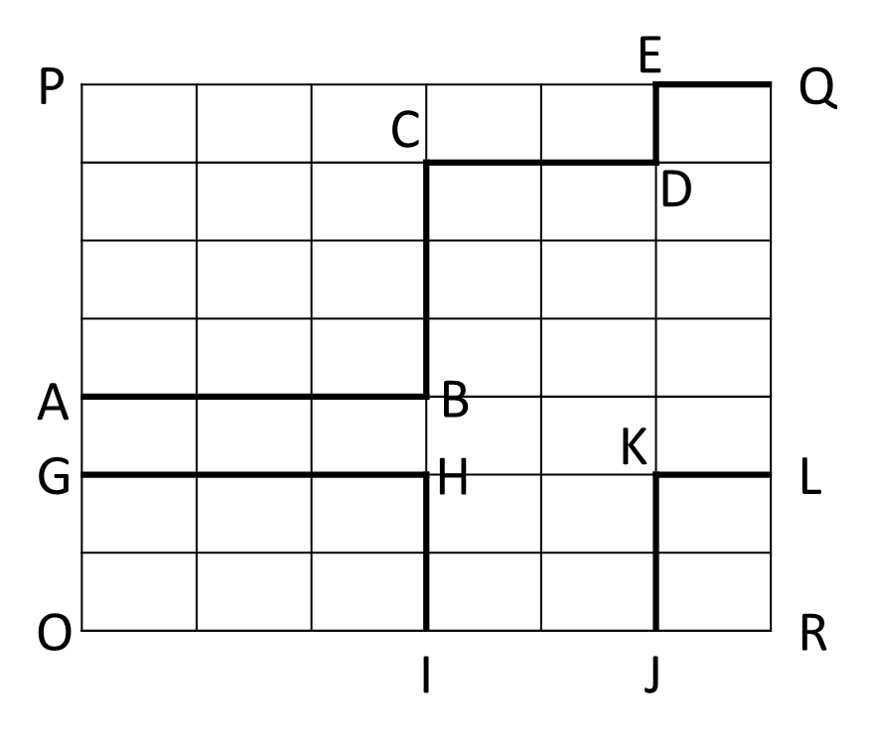
What is the area under the line GHI – JKL in the given quadrilateral OPQR, knowing that all the small spaces are squares of the same area?
- Length ABCDEQ is greater than or equal to 60.
- Area OPQR is less than or equal to 1512.
Answer the following questions based on the information given below:
There were a hundred schools in a town. Of these, the number of schools having a play – ground was 30, and these schools had neither a library nor a laboratory. The number of schools having a laboratory alone was twice the number of those having a library only. The number of schools having a laboratory as well as a library was one fourth the number of those having a laboratory alone. The number of schools having either a laboratory or a library or both was 35.
Each of these items has a question followed by two statements. As the answer,
Type 1, If the question can be answered with the help of statement I alone,
Type 2, If the question can be answered with the help of statement II alone,
Type 3, If both the statement I and statement II are needed to answer the question, and
Type 4, If the question cannot be answered even with the help of both the statements.
What is the radius of the circle?
- Ratio of its area to circumference is > 7.
- Diameter of the circle is ≤ 32.
Answer the following questions based on the information given below:
There were a hundred schools in a town. Of these, the number of schools having a play – ground was 30, and these schools had neither a library nor a laboratory. The number of schools having a laboratory alone was twice the number of those having a library only. The number of schools having a laboratory as well as a library was one fourth the number of those having a laboratory alone. The number of schools having either a laboratory or a library or both was 35.
Each of these items has a question followed by two statements. As the answer,
Type 1, If the question can be answered with the help of statement I alone,
Type 2, If the question can be answered with the help of statement II alone,
Type 3, If both the statement I and statement II are needed to answer the question, and
Type 4, If the question cannot be answered even with the help of both the statements.
What is the time difference between New York and London?
- The departure time at New York is exactly 9:00 a.m. local time and the arrival time at London is at 10:00 a.m. local time.
- The flight time is 5 hours.
Answer the following questions based on the information given below:
There were a hundred schools in a town. Of these, the number of schools having a play – ground was 30, and these schools had neither a library nor a laboratory. The number of schools having a laboratory alone was twice the number of those having a library only. The number of schools having a laboratory as well as a library was one fourth the number of those having a laboratory alone. The number of schools having either a laboratory or a library or both was 35.
Each of these items has a question followed by two statements. As the answer,
Type 1, If the question can be answered with the help of statement I alone,
Type 2, If the question can be answered with the help of statement II alone,
Type 3, If both the statement I and statement II are needed to answer the question, and
Type 4, If the question cannot be answered even with the help of both the statements.
Mr. Murthy takes the morning train to his office from station A to station B, and his colleague Mr.Rahman joins him on the way. There are three stations C, D and E on the way not necessarily in that sequence. What is the sequence of stations?
- Mr. Rahman boards the train at D.
- Mr. Thomas, who travels between C & D has two segments of journey in common with Mr. Murthy but none with Mr. Rahman.