CAT 1995 — DILR Question 32
Direction: Answer the questions based on the following table.
Machine M1 as well as machine M2 can independently produce either product P or product Q. The time taken by machines M1 and M2 (in minutes) to produce one unit of product P and product Q are given in the table below: (Each machine works 8 hour per day).
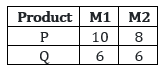
If M1 works at half its normal efficiency, what is the maximum number of units produced, if at least one unit of each must be produced?
Answer & solution
Correct answer: 119
- A
96
- B
89
- C
100
119
If M1 works at half of its normal efficiency, time taken by M1 to manufacture 1 unit of P = 20 min and Q = 12 min. For producing maximum number of units, we have to produce Q on M2 first as it takes only 6 min per piece.
Also since at least one unit of P has to be manufactured and it is more efficient to do so on M2, we would do that. So time taken to manufacture 1 unit of P on M2 = 8 min.
Hence, time remaining on M2 = (480 – 8) = 472. In this remaining time number of units of Q that can be manufactured on M2 = = 78 (only completed units taken). Now since it takes less time to manufacture Q on M1 as well, we will maximize Q on M1. Since 1 unit of number of units that can be produced = = 40.
Hence, the total number of units manufactured = (1 + 78 + 40) = 119 units.
Related Tables questions
- In which year was the tax per rupee of ‘profit before tax’ lowest?…
- In which year was the sales per rupee of share capital highest?…
- In which year was the profit before tax per rupee of sales highest?…
- In which year was the percentage addition to reserves over previous years reserv…
- Amount of the reserves at the end of 1994 is…
- The maximum percentage decrease in market share is…