CAT 1999 — DILR Question 2
Directions: Each question consists of five statements followed by options consisting of three statements put together in a specific order. Choose the option which indicates a valid argument, that is, where the third statement is a conclusion drawn from the preceding two statements.
Example:
A. All cigarettes are hazardous to health.
B. Brand X is a cigarette.
C. Brand X is hazardous to health.
Here, ABC is a valid option, where statement C can be concluded from statements A and B.
A. Traffic congestion increases carbon monoxide in the environment.
B. Increase in carbon monoxide is hazardous to health.
C. Traffic congestion is hazardous to health.
D. Some traffic congestion does not cause increased carbon monoxide.
E. Some traffic congestion is not hazardous to health.
Answer & solution
Correct answer: BAC
- A
CBA
- B
BDE
- C
CDE
BAC
(d) BAC is the correct answer choice, as it forms a valid syllogism.
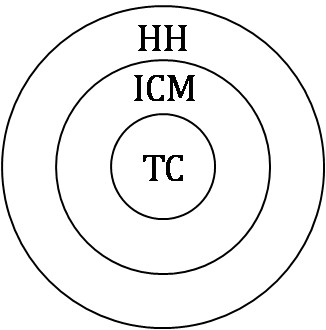
TC = Instances of traffic congestion
ICM = Instances of increase in carbon monoxide in the environment.
HH = Instances that are hazardous to health.
The premises state that increase in carbon monoxide is hazardous to health and traffic congestion increases carbon monoxide in the environment. Therefore, traffic congestion is hazardous to health.
(a) CBA is invalid, because if TC and ICM are both separately hazardous to health (HH), no definite relationship between TC and ICM necessarily follows.
(b) BDE is invalid, because the some TC that are not ICM need not necessarily be free of any hazard to health (HH): they could possibly pollute the environment with other noxious gases.
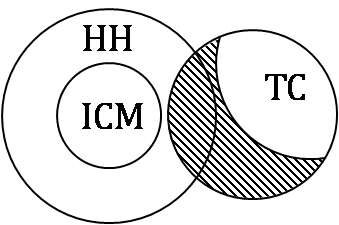
The shaded portion shows those some TC that are not ICM, but could possibly be hazardous to health (HH).
(c) CDE is invalid, because the conclusion E is a negation of one of the premises C. Another check reveals the TC is the middle term, which appears in both the premises C and D, and E, therefore, should not appear in the conclusion E, as per the basic definition of a syllogism.
Related Syllogisms questions
- Directions: Each question consists of five statements followed by options consis…
- Directions: Each question consists of five statements followed by options consis…
- Directions: Each question consists of five statements followed by options consis…
- Directions: Each question consists of five statements followed by options consis…
- Directions: Each question consists of five statements followed by options consis…
- Directions: Each question consists of five statements followed by options consis…