CAT 1999 — DILR
All 54 DILR questions from CAT 1999, with the answer key and detailed solutions. Practise free — check answers as you go, or tap Show solution.
CAT 1999 · DILR
Directions: Each question consists of five statements followed by options consisting of three statements put together in a specific order. Choose the option which indicates a valid argument, that is, where the third statement is a conclusion drawn from the preceding two statements.
Example:
A. All cigarettes are hazardous to health.
B. Brand X is a cigarette.
C. Brand X is hazardous to health.
Here, ABC is a valid option, where statement C can be concluded from statements A and B.
A. All software companies employ knowledge workers.
B. Tara Tech employs knowledge workers.
C. Tara Tech is a software company.
D. Some software companies employ knowledge workers.
E. Tara Tech employs only knowledge workers.
Directions: Each question consists of five statements followed by options consisting of three statements put together in a specific order. Choose the option which indicates a valid argument, that is, where the third statement is a conclusion drawn from the preceding two statements.
Example:
A. All cigarettes are hazardous to health.
B. Brand X is a cigarette.
C. Brand X is hazardous to health.
Here, ABC is a valid option, where statement C can be concluded from statements A and B.
A. Traffic congestion increases carbon monoxide in the environment.
B. Increase in carbon monoxide is hazardous to health.
C. Traffic congestion is hazardous to health.
D. Some traffic congestion does not cause increased carbon monoxide.
E. Some traffic congestion is not hazardous to health.
Directions: Each question consists of five statements followed by options consisting of three statements put together in a specific order. Choose the option which indicates a valid argument, that is, where the third statement is a conclusion drawn from the preceding two statements.
Example:
A. All cigarettes are hazardous to health.
B. Brand X is a cigarette.
C. Brand X is hazardous to health.
Here, ABC is a valid option, where statement C can be concluded from statements A and B.
A. Apples are not sweets.
B. Some apples are sweet.
C. All sweets are tasty.
D. Some apples are not tasty.
E. No apple is tasty.
Directions: Each question consists of five statements followed by options consisting of three statements put together in a specific order. Choose the option which indicates a valid argument, that is, where the third statement is a conclusion drawn from the preceding two statements.
Example:
A. All cigarettes are hazardous to health.
B. Brand X is a cigarette.
C. Brand X is hazardous to health.
Here, ABC is a valid option, where statement C can be concluded from statements A and B.
A. Some towns in India are polluted.
B. All polluted towns should be destroyed.
C. Town Meghana should be destroyed.
D. Town Meghana is polluted.
E. Some towns in India should be destroyed.
Directions: Each question consists of five statements followed by options consisting of three statements put together in a specific order. Choose the option which indicates a valid argument, that is, where the third statement is a conclusion drawn from the preceding two statements.
Example:
A. All cigarettes are hazardous to health.
B. Brand X is a cigarette.
C. Brand X is hazardous to health.
Here, ABC is a valid option, where statement C can be concluded from statements A and B.
A. No patriot is a criminal.
B. Bundledas is not a criminal.
C. Bundledas is a patriot.
D. Bogusdas is not a patriot.
E. Bogusdas is a criminal.
Directions: Each question consists of five statements followed by options consisting of three statements put together in a specific order. Choose the option which indicates a valid argument, that is, where the third statement is a conclusion drawn from the preceding two statements.
Example:
A. All cigarettes are hazardous to health.
B. Brand X is a cigarette.
C. Brand X is hazardous to health.
Here, ABC is a valid option, where statement C can be concluded from statements A and B.
A. Anteaters like ants.
B. Boys are anteaters.
C. Balaram is an anteater.
D. Balaram likes ants.
E. Balaram may eat ants.
Directions: Each question consists of five statements followed by options consisting of three statements put together in a specific order. Choose the option which indicates a valid argument, that is, where the third statement is a conclusion drawn from the preceding two statements.
Example:
A. All cigarettes are hazardous to health.
B. Brand X is a cigarette.
C. Brand X is hazardous to health.
Here, ABC is a valid option, where statement C can be concluded from statements A and B.
A. All actors are handsome.
B. Some actors are popular.
C. Ram is handsome.
D. Ram is a popular actor.
E. Some popular people are handsome.
Directions: Each question consists of five statements followed by options consisting of three statements put together in a specific order. Choose the option which indicates a valid argument, that is, where the third statement is a conclusion drawn from the preceding two statements.
Example:
A. All cigarettes are hazardous to health.
B. Brand X is a cigarette.
C. Brand X is hazardous to health.
Here, ABC is a valid option, where statement C can be concluded from statements A and B.
A. Modern industry is technology-driven.
B. BTI is a modern industry.
C. BTI is technology-driven.
D. BTI may be technology-driven
E. Technology driven industry is modern.
Directions: Each question consists of five statements followed by options consisting of three statements put together in a specific order. Choose the option which indicates a valid argument, that is, where the third statement is a conclusion drawn from the preceding two statements.
Example:
A. All cigarettes are hazardous to health.
B. Brand X is a cigarette.
C. Brand X is hazardous to health.
Here, ABC is a valid option, where statement C can be concluded from statements A and B.
A. All Golmal islanders are blue-coloured people.
B. Some smart people are not blue-coloured people.
C. Some babies are blue-coloured.
D. Some babies are smart.
E. Some smart people are not Golmal islanders.
Directions: Each question consists of five statements followed by options consisting of three statements put together in a specific order. Choose the option which indicates a valid argument, that is, where the third statement is a conclusion drawn from the preceding two statements.
Example:
A. All cigarettes are hazardous to health.
B. Brand X is a cigarette.
C. Brand X is hazardous to health.
Here, ABC is a valid option, where statement C can be concluded from statements A and B.
A. MBAs are in great demand.
B. Ram and Sita are in great demand.
C. Ram is in great demand.
D. Sita is in great demand.
E. Ram and Sita are MBAs.
Directions: Each question has a main statement followed by four statements labelled A, B, C and D. Choose the ordered pair of statements where the first statement implies the second, and the two statements are logically consistent with the main statement.
Either the orangutan is not angry, or he frowns upon the world.
A. The orangutan frowns upon the world.
B. The orangutan is not angry.
C. The orangutan does not frown upon the world.
D. The orangutan is angry.
Directions: Each question has a main statement followed by four statements labelled A, B, C and D. Choose the ordered pair of statements where the first statement implies the second, and the two statements are logically consistent with the main statement.
Either Ravana is a demon, or he is a hero.
A. Ravana is a hero.
B. Ravana is a demon.
C. Ravana is not a demon.
D. Ravana is not a hero.
Directions: Each question has a main statement followed by four statements labelled A, B, C and D. Choose the ordered pair of statements where the first statement implies the second, and the two statements are logically consistent with the main statement.
Whenever Rajeev uses the Internet, he dreams about spiders.
A. Rajeev did not dream about spiders.
B. Rajeev used the Internet.
C. Rajeev dreamt about spiders.
D. Rajeev did not use the Internet.
Directions: Each question has a main statement followed by four statements labelled A, B, C and D. Choose the ordered pair of statements where the first statement implies the second, and the two statements are logically consistent with the main statement.
If I talk to my professors, then I do not need to take a pill for headache.
A. I talked to my professors.
B. I did not need to take a pill for headache.
C. I needed to take a pill for headache.
D. I did not talk to my professors.
Directions: Each question has a set of four statements. Each statement has three segments. Choose the alternative where the third segment in the statement can be logically deduced using both the preceding two, but not just from one of them.
A. No cowboys laugh. Some who laugh are sphinxes. Some sphinxes are not cowboys.
B. All ghosts are florescent. Some ghost do not sing. Some singers are not florescent.
C. Cricketers indulge in swearing. Those who swear are hanged. Some who are hanged are not cricketers.
D. Some crazy people are pianists. All crazy people are whistlers. Some whistlers are pianists.
Directions: Each question has a set of four statements. Each statement has three segments. Choose the alternative where the third segment in the statement can be logically deduced using both the preceding two, but not just from one of them.
A. All good people are knights. All warriors are good people. All knights are warriors.
B. No footballers are ministers. All footballers are tough. Some ministers are players.
C. All pizzas are snacks. Some meals are pizzas. Some meals are snacks.
D. Some barkers are musk deer. All barkers are sloth bears. Some sloth bears are musk deer.
Directions: Each question has a set of four statements. Each statement has three segments. Choose the alternative where the third segment in the statement can be logically deduced using both the preceding two, but not just from one of them.
A. Dinosaurs are prehistoric creatures. Water-buffaloes are not dinosaurs. Water-buffaloes are not
prehistoric creatures.
B. All politicians are frank. No frank people are crocodiles. No crocodiles are politicians.
C. No diamond is quartz. No opal is quartz. Diamonds are opals.
D. All monkeys like bananas. Some GI Joes like bananas. Some GI Joes are monkeys.
Directions: Each question has a set of four statements. Each statement has three segments. Choose the alternative where the third segment in the statement can be logically deduced using both the preceding two, but not just from one of them.
A. All earthquakes cause havoc. Some landslides cause havoc. Some earthquakes cause landslides.
B. All glass things are transparent. Some curios are glass things. Some curios are transparent.
C. All clay objects are brittle. All XY are clay objects. Some XY are brittle.
D. No criminal is a patriot. Ram is not a patriot. Ram is a criminal.
Directions: Each question has a set of four statements. Each statement has three segments. Choose the alternative where the third segment in the statement can be logically deduced using both the preceding two, but not just from one of them.
A. MD is an actor. Some actors are pretty. MD is pretty.
B. Some men are cops. All cops are brave. Some brave people are cops.
C. All cops are brave. Some men are cops. Some men are brave.
D. All actors are pretty ; MD is not an actor ; MD is not pretty.
Directions: Each question has a set of four statements. Each statement has three segments. Choose the alternative where the third segment in the statement can be logically deduced using both the preceding two, but not just from one of them.
A. All IIMs are in India. No BIMs are in India. No IIMs are BIMs.
B. All IIMs are in India. No BIMs are in India. No BIMs are IIMs.
C. Some IIMs are not in India. Some BIMs are not in India. Some IIMs are BIMs.
D. Some IIMs are not in India. Some BIMs are not in India. Some BIMs are IIMs.
Directions: Each question has a set of four statements. Each statement has three segments. Choose the alternative where the third segment in the statement can be logically deduced using both the preceding two, but not just from one of them.
A. Citizens of Yes Islands speak only the truth. Citizens of Yes Islands are young people. Young people speak only the truth.
B. Citizens of Yes Islands speak only the truth. Some Yes Islands are in Atlantic. Some citizens of Yes Islands are in the Atlantic.
C. Citizens of Yes Islands speak only the truth. Some young people are citizens of Yes Islands. Some young people speak only the truth.
D. Some people speak only the truth. Some citizens of Yes Islands speak only the truth. Some people who speak only the truth are citizens of Yes Islands.
Directions: Each question has a set of four statements. Each statement has three segments. Choose the alternative where the third segment in the statement can be logically deduced using both the preceding two, but not just from one of them.
A. All mammals are viviparous. Some fish are viviparous. Some fish are mammals.
B. All birds are oviparous. Some fish are not oviparous. Some fish are birds.
C. No mammal is oviparous. Some creatures are oviparous and some are not. Some creatures are not mammals.
D. Some creatures are mammals. Some creatures are viviparous. Some mammals are viviparous.
Directions: Each question has a set of four statements. Each statement has three segments. Choose the alternative where the third segment in the statement can be logically deduced using both the preceding two, but not just from one of them.
A. Many singers are not writers. All poets are singers. Some poets are not writers.
B. Giants climb beanstalks. Some chicken do not climb beanstalks. Some chicken are not giants.
C. All explorers live in snowdrifts. Some penguins live in snowdrifts. Some penguins are explorers.
D. Amar is taller than Akbar. Anthony is shorter than Amar. Akbar is shorter than Anthony.
Directions: Each question has a set of four statements. Each statement has three segments. Choose the alternative where the third segment in the statement can be logically deduced using both the preceding two, but not just from one of them.
A. A few farmers are rocket scientists. Some rocket scientists catch snakes. A few farmers catch snakes.
B. Poonam is a kangaroo. Some kangaroos are made of teak. Poonam is made of teak.
C. No bulls eat grass. All matadors eat grass. No matadors are bulls.
D. Some skunks drive Cadillacs. All skunks are polar bears. Some polar bears drive Cadillacs.
Passage / Data
Directions: Answer the questions based on the following information.
The figure below represents sales and net profit in Rs. crore of IVP Ltd. for five years from 1994-95 to 1998-99. During this period the sales increased from Rs. 100 crore to Rs. 680 crore. Correspondingly, the net profit increased from Rs. 2.5 crore to Rs. 12 crore. Net profit is defined as the excess of sales over total costs.
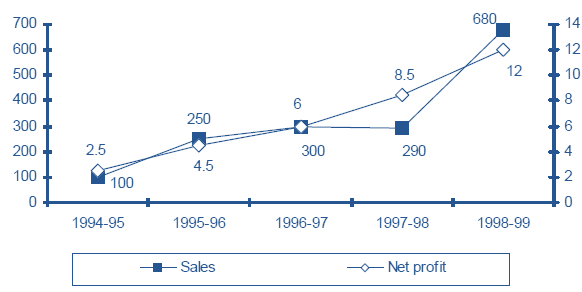
The highest percentage of growth in sales, relative to the previous year, occurred in
Passage / Data
Directions: Answer the questions based on the following information.
The figure below represents sales and net profit in Rs. crore of IVP Ltd. for five years from 1994-95 to 1998-99. During this period the sales increased from Rs. 100 crore to Rs. 680 crore. Correspondingly, the net profit increased from Rs. 2.5 crore to Rs. 12 crore. Net profit is defined as the excess of sales over total costs.
The highest percentage growth in net profit, relative to the previous year, was achieved in
Passage / Data
Directions: Answer the questions based on the following information.
The figure below represents sales and net profit in Rs. crore of IVP Ltd. for five years from 1994-95 to 1998-99. During this period the sales increased from Rs. 100 crore to Rs. 680 crore. Correspondingly, the net profit increased from Rs. 2.5 crore to Rs. 12 crore. Net profit is defined as the excess of sales over total costs.
Defining profitability as the ratio of net profit to sales, IVP Ltd., recorded the highest profitability in
Passage / Data
Directions: Answer the questions based on the following information.
The figure below represents sales and net profit in Rs. crore of IVP Ltd. for five years from 1994-95 to 1998-99. During this period the sales increased from Rs. 100 crore to Rs. 680 crore. Correspondingly, the net profit increased from Rs. 2.5 crore to Rs. 12 crore. Net profit is defined as the excess of sales over total costs.
With profitability as defined in question 137, it can be concluded that
Passage / Data
Directions: Answer the questions based on the following information
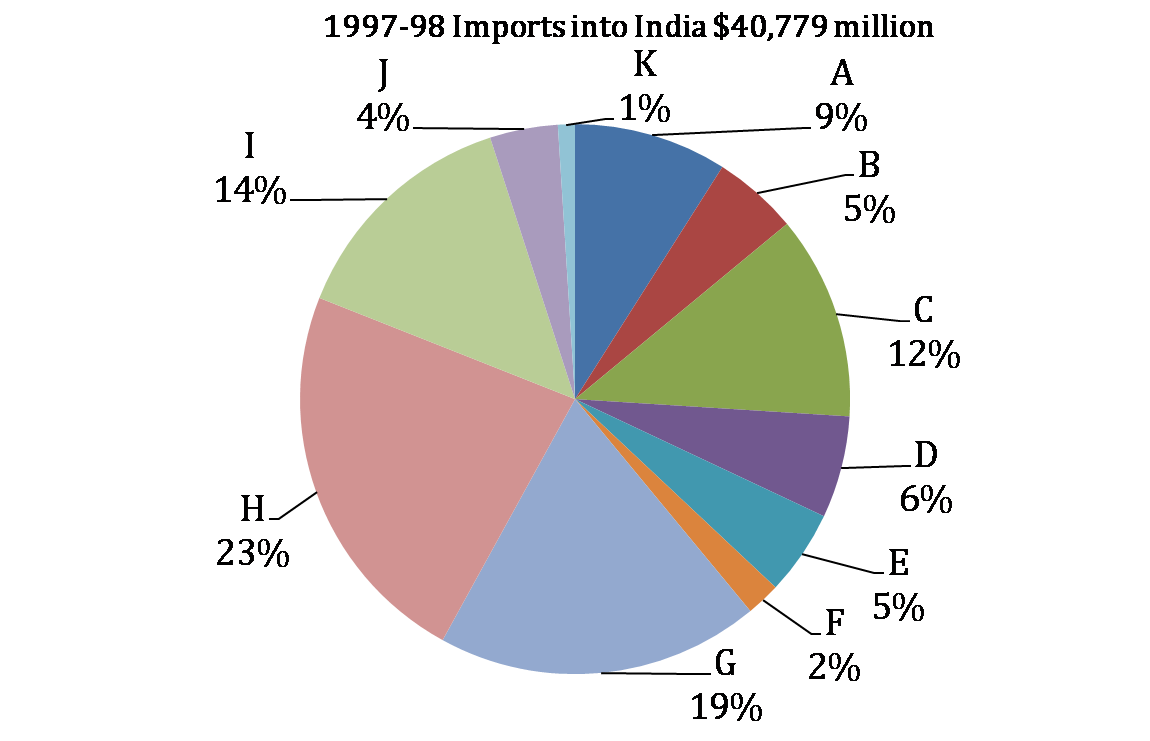
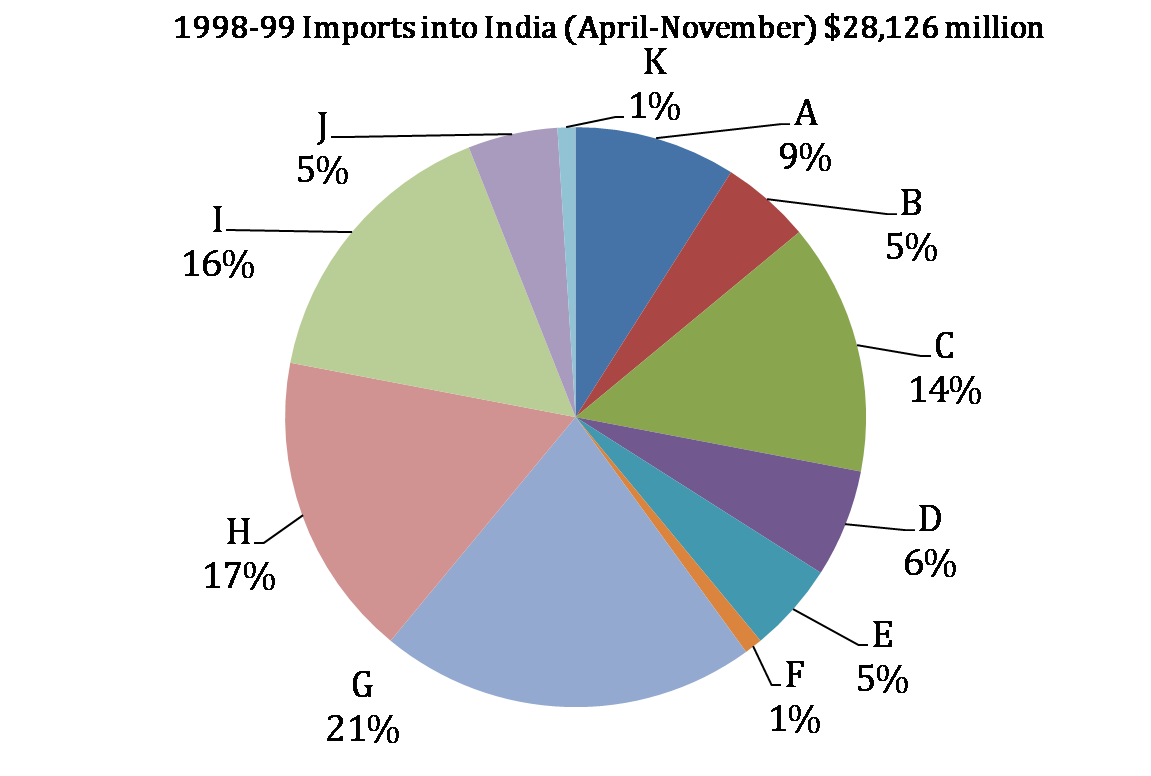
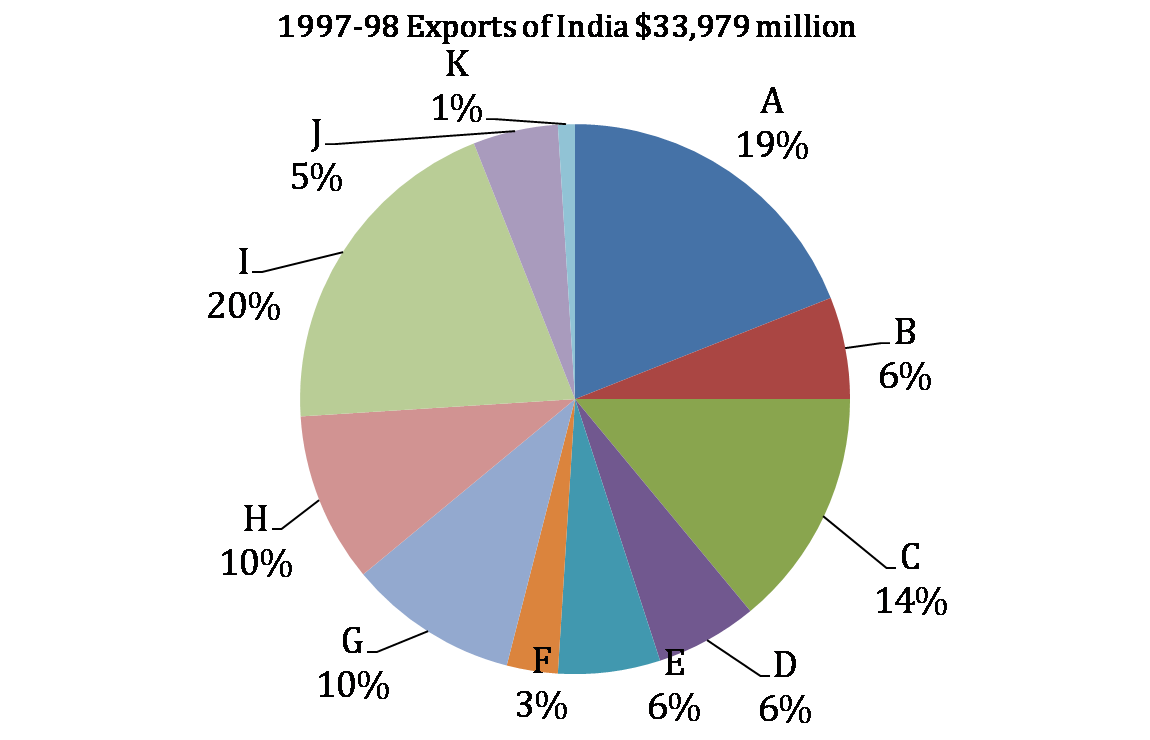
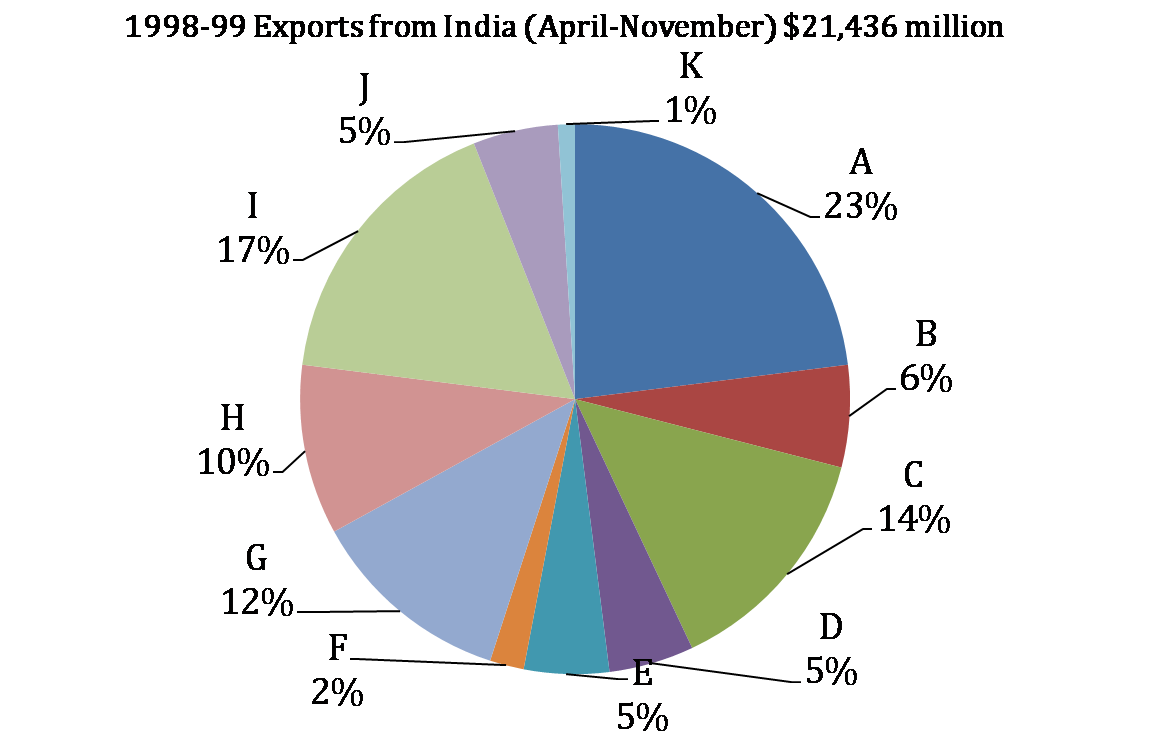
Consider the information provided in the figure below relating to India’s foreign trade in 1997-98 and the first eight months of 1998-99. Total trade with a region is defined as the sum of exports and imports from that region. Trade deficit is defined as the excess of imports over exports. Trade deficit may be negative.
A.USA G. Other East European countries
B. Germany H. OPEC
C. Other EU I. Asia
D.UK J. Other LDCs
E. Japan K. Others
F. Russia
| Source of Imports | |
 |
 |
| Destination of exports | |
 |
 |
What is the region with which India had the highest total trade in 1997-98?
Passage / Data
Directions: Answer the questions based on the following information
Consider the information provided in the figure below relating to India’s foreign trade in 1997-98 and the first eight months of 1998-99. Total trade with a region is defined as the sum of exports and imports from that region. Trade deficit is defined as the excess of imports over exports. Trade deficit may be negative.
A.USA G. Other East European countries
B. Germany H. OPEC
C. Other EU I. Asia
D.UK J. Other LDCs
E. Japan K. Others
F. Russia
| Source of Imports | |
|
|
| Destination of exports | |
|
|
In 1997-98 the amount of Indian exports, million US dollars, to the region with which India had the lowest total trade, is approximately
Passage / Data
Directions: Answer the questions based on the following information
Consider the information provided in the figure below relating to India’s foreign trade in 1997-98 and the first eight months of 1998-99. Total trade with a region is defined as the sum of exports and imports from that region. Trade deficit is defined as the excess of imports over exports. Trade deficit may be negative.
A.USA G. Other East European countries
B. Germany H. OPEC
C. Other EU I. Asia
D.UK J. Other LDCs
E. Japan K. Others
F. Russia
| Source of Imports | |
|
|
| Destination of exports | |
|
|
In 1997-98, the trade deficit with respect to India, billion US dollars, for the region with the highest trade deficit with respect to India, is approximately equal to
Passage / Data
Directions: Answer the questions based on the following information
Consider the information provided in the figure below relating to India’s foreign trade in 1997-98 and the first eight months of 1998-99. Total trade with a region is defined as the sum of exports and imports from that region. Trade deficit is defined as the excess of imports over exports. Trade deficit may be negative.
A.USA G. Other East European countries
B. Germany H. OPEC
C. Other EU I. Asia
D.UK J. Other LDCs
E. Japan K. Others
F. Russia
| Source of Imports | |
|
|
| Destination of exports | |
|
|
What is the region with the lowest trade deficit with India in 1997-98?
Passage / Data
Directions: Answer the questions based on the following information
Consider the information provided in the figure below relating to India’s foreign trade in 1997-98 and the first eight months of 1998-99. Total trade with a region is defined as the sum of exports and imports from that region. Trade deficit is defined as the excess of imports over exports. Trade deficit may be negative.
A.USA G. Other East European countries
B. Germany H. OPEC
C. Other EU I. Asia
D.UK J. Other LDCs
E. Japan K. Others
F. Russia
| Source of Imports | |
|
|
| Destination of exports | |
|
|
Additional directions: Assume that the average monthly exports from India and imports to India during the remaining four months of 1998-99 would be the same as that for the first eight months of the year.
What is the region to which India’s exports registered the highest percentage growth between 1997-98 and 1998-99?
Passage / Data
Directions: Answer the questions based on the following information
Consider the information provided in the figure below relating to India’s foreign trade in 1997-98 and the first eight months of 1998-99. Total trade with a region is defined as the sum of exports and imports from that region. Trade deficit is defined as the excess of imports over exports. Trade deficit may be negative.
A.USA G. Other East European countries
B. Germany H. OPEC
C. Other EU I. Asia
D.UK J. Other LDCs
E. Japan K. Others
F. Russia
| Source of Imports | |
|
|
| Destination of exports | |
|
|
Additional directions: Assume that the average monthly exports from India and imports to India during the remaining four months of 1998-99 would be the same as that for the first eight months of the year.
What is the percentage growth rate in India’s total trade deficit between 1997-98 and 1998-99?
Passage / Data
Directions: Answer the questions based on the following information.
These questions are based on the price fluctuations of four commodities — arhar, pepper, sugar and gold during February-July 1999 as described in the figures below.
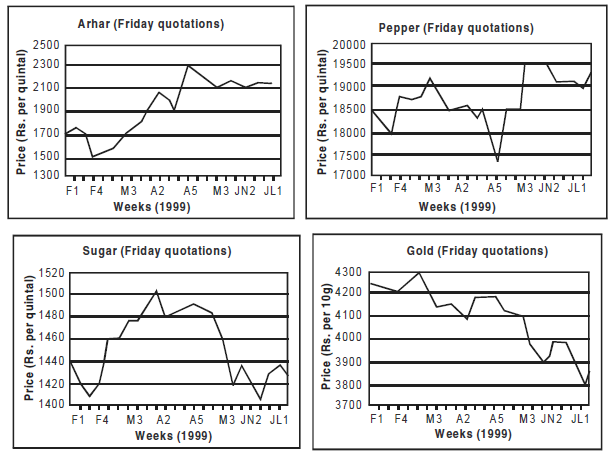
Price change of a commodity is defined as the absolute difference in ending and beginning prices expressed as a percentage of the beginning. What is the commodity with the highest price change?
Passage / Data
Directions: Answer the questions based on the following information.
These questions are based on the price fluctuations of four commodities — arhar, pepper, sugar and gold during February-July 1999 as described in the figures below.
Price volatility (PV) of a commodity is defined as follows:
PV = (Highest price during the period – Lowest price during the period)/Average price during the period. What is the commodity with the lowest price volatility?
Passage / Data
Directions: Answer the questions based on the following information.
These questions are based on the price fluctuations of four commodities — arhar, pepper, sugar and gold during February-July 1999 as described in the figures below.
Mr X, a fund manager with an investment company invested 25% of his funds in each of the four commodities at the beginning of the period. He sold the commodities at the end of the period. His investments in the commodities resulted in
Passage / Data
Directions: Answer the questions based on the following information.
These questions are based on the price fluctuations of four commodities — arhar, pepper, sugar and gold during February-July 1999 as described in the figures below.
The price volatility(PV) of the commodity with the highest PV during the February-July period is approximately equal to
Passage / Data
Directions: Answer the questions based on the following information.
The table below presents data on percentage population covered by drinking water and sanitation facilities in selected Asian countries.
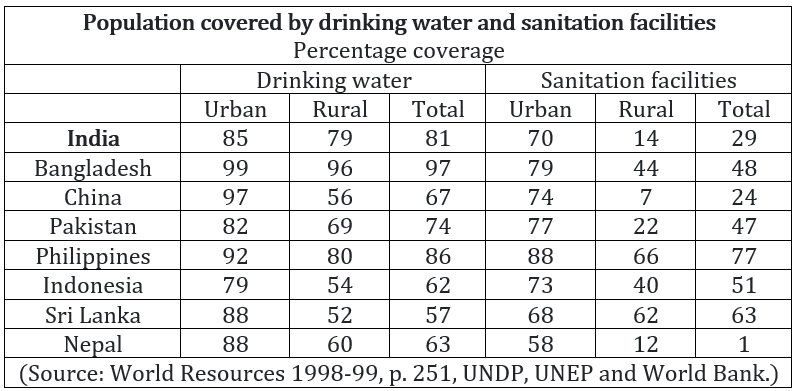
Country A is said to dominate B or A > B if A has higher percentage in total coverage for both drinking water and sanitation facilities, and, B is said to be dominated by A, or B < A.
A country is said to be on the coverage frontier if no other country dominates it. Similarly, a country is not on the coverage frontier if it is dominated by at least one other country.
Which countries are the countries on the coverage frontier?
Passage / Data
Directions: Answer the questions based on the following information.
The table below presents data on percentage population covered by drinking water and sanitation facilities in selected Asian countries.
Country A is said to dominate B or A > B if A has higher percentage in total coverage for both drinking water and sanitation facilities, and, B is said to be dominated by A, or B < A.
A country is said to be on the coverage frontier if no other country dominates it. Similarly, a country is not on the coverage frontier if it is dominated by at least one other country.
Which of the following statements are true?
A. India > Pakistan and India > Indonesia
B. India > China and India > Nepal
C. Sri Lanka > China D. China > Nepal
Passage / Data
Directions: Answer the questions based on the following information.
The table below presents data on percentage population covered by drinking water and sanitation facilities in selected Asian countries.
Country A is said to dominate B or A > B if A has higher percentage in total coverage for both drinking water and sanitation facilities, and, B is said to be dominated by A, or B < A.
A country is said to be on the coverage frontier if no other country dominates it. Similarly, a country is not on the coverage frontier if it is dominated by at least one other country.
Using only the data presented under ‘sanitation facilities’ columns, it can be concluded that rural population in India, as a percentage of its total population is approximately
Passage / Data
Directions: Answer the questions based on the following information.
The table below presents data on percentage population covered by drinking water and sanitation facilities in selected Asian countries.
Country A is said to dominate B or A > B if A has higher percentage in total coverage for both drinking water and sanitation facilities, and, B is said to be dominated by A, or B < A.
A country is said to be on the coverage frontier if no other country dominates it. Similarly, a country is not on the coverage frontier if it is dominated by at least one other country.
Again, using only the data presented under ‘sanitation facilities’ columns, sequence China, Indonesia and Philippines in ascending order of rural population as a percentage of their respective total population. The correct order is
Passage / Data
Directions: Answer the questions based on the following information.
The table below presents data on percentage population covered by drinking water and sanitation facilities in selected Asian countries.
Country A is said to dominate B or A > B if A has higher percentage in total coverage for both drinking water and sanitation facilities, and, B is said to be dominated by A, or B < A.
A country is said to be on the coverage frontier if no other country dominates it. Similarly, a country is not on the coverage frontier if it is dominated by at least one other country.
India is not on the coverage frontier because
A. it is lower than Bangladesh in terms of coverage of drinking water facilities.
B. it is lower than Sri Lanka in terms of coverage of sanitation facilities.
C. it is lower than Pakistan in terms of coverage of sanitation facilities.
D. it is dominated by Indonesia.
Passage / Data
Directions: Answer the questions based on the following information.
The table below presents data on percentage population covered by drinking water and sanitation facilities in selected Asian countries.
Country A is said to dominate B or A > B if A has higher percentage in total coverage for both drinking water and sanitation facilities, and, B is said to be dominated by A, or B < A.
A country is said to be on the coverage frontier if no other country dominates it. Similarly, a country is not on the coverage frontier if it is dominated by at least one other country.
Additional direction: These relate to the above table with the additional provision that the gap between the population coverages of ‘sanitation facilities’ and ‘drinking water facilities’ is a measure of disparity in coverage.
The country with the most disparity in coverage of rural sector is
Passage / Data
Directions: Answer the questions based on the following information.
The table below presents data on percentage population covered by drinking water and sanitation facilities in selected Asian countries.
Country A is said to dominate B or A > B if A has higher percentage in total coverage for both drinking water and sanitation facilities, and, B is said to be dominated by A, or B < A.
A country is said to be on the coverage frontier if no other country dominates it. Similarly, a country is not on the coverage frontier if it is dominated by at least one other country.
Additional direction: These relate to the above table with the additional provision that the gap between the population coverages of ‘sanitation facilities’ and ‘drinking water facilities’ is a measure of disparity in coverage.
The country with the least disparity in coverage of urban sector is
Passage / Data
Directions: Answer the questions based on the following information.
Ten coins are distributed among four people P, Q, R and S such that one of them gets one coin, another gets two coins, the third gets three coins and the fourth gets four coins. It is known that Q gets more coins than P, and S gets fewer coins than R.
If the number of coins distributed to Q is twice the number distributed to P, then which one of the following is necessarily true?
Passage / Data
Directions: Answer the questions based on the following information.
Ten coins are distributed among four people P, Q, R and S such that one of them gets one coin, another gets two coins, the third gets three coins and the fourth gets four coins. It is known that Q gets more coins than P, and S gets fewer coins than R.
If R gets at least two more coins than S, then which one of the following is necessarily true?
Passage / Data
Directions: Answer the questions based on the following information.
Ten coins are distributed among four people P, Q, R and S such that one of them gets one coin, another gets two coins, the third gets three coins and the fourth gets four coins. It is known that Q gets more coins than P, and S gets fewer coins than R.
If Q gets fewer coins than R, then which one of the following is not necessarily true?
Passage / Data
Directions: Answer the questions based on the following information.
A, B, C, D, E and F are a group of friends from a club. There are two housewives, one lecturer, one architect, one accountant and one lawyer in the group. There are two married couples in the group. The lawyer is married to D who is a housewife. No lady in the group is either an architect or an accountant. C, the accountant, is married to F who is a lecturer. A is married to D and E is not a housewife.
What is the profession of E?
Passage / Data
Directions: Answer the questions based on the following information.
A, B, C, D, E and F are a group of friends from a club. There are two housewives, one lecturer, one architect, one accountant and one lawyer in the group. There are two married couples in the group. The lawyer is married to D who is a housewife. No lady in the group is either an architect or an accountant. C, the accountant, is married to F who is a lecturer. A is married to D and E is not a housewife.
How many members of the group are male?
Passage / Data
Direction : Answer the questions based on the following information.
Seven university cricket players are to be honoured at a special luncheon. The players will be seated on the dais along one side of a single rectangular table.
I. A and G have to leave the luncheon early and must be seated at the extreme right end of the table, which is closest to the exit.
II. B will receive the Man of the Match Award and must be in the centre chair.
III. C and D who are bitter rivals for the position of wicketkeeper, dislike one another and should be seated as far apart as possible.
IV. E and F are best friends and want to sit together.
Which of the following may not be seated at either end of the table?
Passage / Data
Direction : Answer the questions based on the following information.
Seven university cricket players are to be honoured at a special luncheon. The players will be seated on the dais along one side of a single rectangular table.
I. A and G have to leave the luncheon early and must be seated at the extreme right end of the table, which is closest to the exit.
II. B will receive the Man of the Match Award and must be in the centre chair.
III. C and D who are bitter rivals for the position of wicketkeeper, dislike one another and should be seated as far apart as possible.
IV. E and F are best friends and want to sit together.
Which of the following pairs may not be seated together?
Passage / Data
Direction : Answer the questions based on the following information.
Seven university cricket players are to be honoured at a special luncheon. The players will be seated on the dais along one side of a single rectangular table.
I. A and G have to leave the luncheon early and must be seated at the extreme right end of the table, which is closest to the exit.
II. B will receive the Man of the Match Award and must be in the centre chair.
III. C and D who are bitter rivals for the position of wicketkeeper, dislike one another and should be seated as far apart as possible.
IV. E and F are best friends and want to sit together.
Which of the following may not be seated at either end of the table?
Passage / Data
Direction : Answer the questions based on the following information.
Seven university cricket players are to be honoured at a special luncheon. The players will be seated on the dais along one side of a single rectangular table.
I. A and G have to leave the luncheon early and must be seated at the extreme right end of the table, which is closest to the exit.
II. B will receive the Man of the Match Award and must be in the centre chair.
III. C and D who are bitter rivals for the position of wicketkeeper, dislike one another and should be seated as far apart as possible.
IV. E and F are best friends and want to sit together.
Abraham, Border, Charlie, Dennis and Elmer, and their respective wives recently dined together and were seated at a circular table. The seats were so arranged that men and women alternated and each woman was three places away from her husband. Mrs Charlie sat to the left of Mr Abraham. Mrs Elmer sat two places to the right of Mrs Border. Who sat to the right of Mr Abraham?