CAT 2000 — DILR Question 22
Answer the following question based on the information given below.
The table shows trends in external transactions of Indian corporate sector during the period 1993-94 to 1997-98. In addition, following definitions hold good.
Salesi , Importsi, and Exportsi respectively denote the sales, imports and exports in year i.
Deficit in year i, Deficiti = Importsi – Exportsi.
Deficit Intensity in year i, DIi = Deficiti / Salesi.
Growth rate of deficit intensity in year i, GDIi = (DIi – DIi-1)/DIi-1
Further, note that all imports are classified as either raw material or capital goods.
Trends in External Transactions of Indian Corporate Sector (All figures in %)
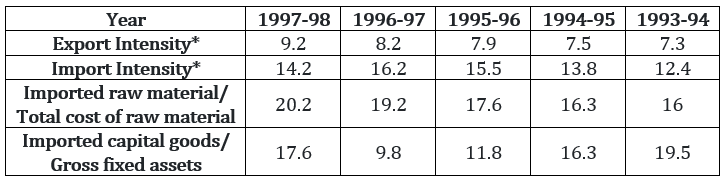
In 1997-98 the total cost of raw materials is estimated as 50% of sales of that year. The turn over of Gross fixed assets, defined as the ratio of sales to Gross fixed assets, in 1997-98 is, approximately
Answer & solution
Correct answer: 4.3
- A
3.3
4.3
- C
0.33
- D
not possible to determine
Total cost of raw material = 0.5 × Sales
∵ Import of raw material = 20.2 × Total cost of raw material
∴ Import of raw material = 10.1 × Sales
∵ Import of Capital Goods = 17.6 × Gross fixed assets (GFA)
∵ Imports = Raw Materials + Capital Goods
∴ Imports = (10.1 × Sales) + (17.6 × GFA)
∵ Imports = 14.2 × Sales
∴ 14.2 × Sales = (10.1 × Sales) + (17.6 × GFA)
Hence, option (b).
Related Tables questions
- Suppose the average employment level is 60 per factory. The average employment i…
- Among the firms in different sectors, value added per employee is highest in…
- Capital productivity is defined as the gross output value per rupee of fixed cap…
- A sector is considered “pareto efficient” if its value added per emp…
- The total value added in all sectors is estimated at Rs. 140,000 crores. Suppose…
- The value of the highest growth rate in deficit intensity is approximately…