CAT 2008 — DILR Question 19
Answer the following questions based on the information given below:
In a sports event, six teams (A, B, C, D, E and F) are competing against each other. Matches are scheduled in two stages. Each team plays three matches in Stage-I and two matches in Stage-II. No team plays against the same team more than once in the event. No ties are permitted in any of the matches. The observations after the completion of Stage-I and Stage-II are as given below.
Stage-I:
- One team won all the three matches.
- Two teams lost all the matches.
- D lost to A but won against C and F.
- E lost to B but won against C and F.
- B lost at least one match.
- F did not play against the top team of Stage-I.
Stage-II:
- The leader of Stage-I lost the next two matches.
- Of the two teams at the bottom after Stage-I, one team won both matches, while the other lost both matches.
- One more team lost both matches in Stage-II.
The team(s) with the most wins in the event is (are):
Answer & solution
Correct answer: B & E
- A
A
- B
A & C
- C
F
- D
E
B & E
Let the bold letters denote the teams that have lost.
From condition 3 of stage I,
D lost to A.
D won against C.
D won against F.
These can be represented as:
D -- A
D -- C
D -- F
Similarly, condition 4 of stage I can be represented as:
E -- B
E -- C
E -- F
Since D and E have participated in three matches in stage I, they would not be involved in any other match in stage I.
From the above representations it is clear that all other teams except A have lost at least one match.
∴ From condition 1, of stage I, only A has won all the three matches in stage I.
Also, A will participate in 2 more matches as every team participates in 3 matches in stage I.
∴ A will win in 2 of the remaining 3 matches.
Also A is the top team as it wins all matches in stage I.
From condition 6 of stage I,
F did not play against A.
∴ A won against B and C which can be represented as:
B -- A
A -- C
The only 2 teams which have not won even a single match so far is C and F.
From statement 6 of stage I, F loses in the remaining match against B, which can be
represented as:
F -- B
Stage I can be represented as:
D -- A B -- A
D -- C A -- C
D -- F F -- B
E -- B
E -- C
E -- F
From condition 1 of stage II,
A lost both matches in stage II.
Also, since no team plays against the same team more than once in the event, A plays matches against E and F.
A -- E
A -- F
Since one of the two teams at the bottom after stage I won both matches in stage II, F is the team which has won both the matches in stage II.
Also C lost both matches in stage II.
F -- C
B -- C
The last condition states that one more team lost both matches in stage II.
∴ D lost both matches in stage II.
D -- B
D -- E
Stage II can be represented as:
A -- E
A -- F
F -- C
B -- C
D -- B
D -- E
Now, we can calculate the number of times each team has won.
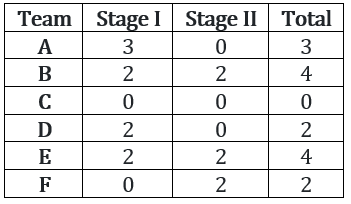
It can be observed from the above table that B and E have most wins in the event.
Hence, option (e).
Related Round Robin Tournament questions
- The two teams that defeated the leader of Stage-I are:…
- The only team(s) that won both the matches in Stage-II is (are):…
- The teams that won exactly two matches in the event are:…