Games & Tournaments — CAT Previous-Year Questions
34 previous-year questions on Games & Tournaments from CAT, with full solutions. Practise free — check answers as you go; sign in to save your progress.
Games & Tournaments · CAT PYQs
Passage / Data
Answer the following questions based on the information given below.
The game of QUIET is played between two teams. Six teams, numbered 1, 2, 3, 4, 5, and 6, play in a QUIET tournament. These teams are divided equally into two groups. In the tournament, each team plays every other team in the same group only once, and each team in the other group exactly twice. The tournament has several rounds, each of which consists of a few games. Every team plays exactly one game in each round.
The following additional facts are known about the schedule of games in the tournament.
1. Each team played against a team from the other group in Round 8.
2. In Round 4 and Round 7, the match-ups, that is the pair of teams playing against each other, were identical. In Round 5 and Round 8, the match-ups were identical.
3. Team 4 played Team 6 in both Round 1 and Round 2.
4. Team 1 played Team 5 ONLY once and that was in Round 2.
5. Team 3 played Team 4 in Round 3. Team 1 played Team 6 in Round 6.
6. In Round 8, Team 3 played Team 6, while Team 2 played Team 5.
How many rounds were there in the tournament?
Passage / Data
Answer the following questions based on the information given below.
The game of QUIET is played between two teams. Six teams, numbered 1, 2, 3, 4, 5, and 6, play in a QUIET tournament. These teams are divided equally into two groups. In the tournament, each team plays every other team in the same group only once, and each team in the other group exactly twice. The tournament has several rounds, each of which consists of a few games. Every team plays exactly one game in each round.
The following additional facts are known about the schedule of games in the tournament.
1. Each team played against a team from the other group in Round 8.
2. In Round 4 and Round 7, the match-ups, that is the pair of teams playing against each other, were identical. In Round 5 and Round 8, the match-ups were identical.
3. Team 4 played Team 6 in both Round 1 and Round 2.
4. Team 1 played Team 5 ONLY once and that was in Round 2.
5. Team 3 played Team 4 in Round 3. Team 1 played Team 6 in Round 6.
6. In Round 8, Team 3 played Team 6, while Team 2 played Team 5.
What is the number of the team that played Team 1 in Round 5?
Passage / Data
Answer the following questions based on the information given below.
The game of QUIET is played between two teams. Six teams, numbered 1, 2, 3, 4, 5, and 6, play in a QUIET tournament. These teams are divided equally into two groups. In the tournament, each team plays every other team in the same group only once, and each team in the other group exactly twice. The tournament has several rounds, each of which consists of a few games. Every team plays exactly one game in each round.
The following additional facts are known about the schedule of games in the tournament.
1. Each team played against a team from the other group in Round 8.
2. In Round 4 and Round 7, the match-ups, that is the pair of teams playing against each other, were identical. In Round 5 and Round 8, the match-ups were identical.
3. Team 4 played Team 6 in both Round 1 and Round 2.
4. Team 1 played Team 5 ONLY once and that was in Round 2.
5. Team 3 played Team 4 in Round 3. Team 1 played Team 6 in Round 6.
6. In Round 8, Team 3 played Team 6, while Team 2 played Team 5.
Which team among the teams numbered 2, 3, 4, and 5 was not part of the same group?
Passage / Data
Answer the following questions based on the information given below.
The game of QUIET is played between two teams. Six teams, numbered 1, 2, 3, 4, 5, and 6, play in a QUIET tournament. These teams are divided equally into two groups. In the tournament, each team plays every other team in the same group only once, and each team in the other group exactly twice. The tournament has several rounds, each of which consists of a few games. Every team plays exactly one game in each round.
The following additional facts are known about the schedule of games in the tournament.
1. Each team played against a team from the other group in Round 8.
2. In Round 4 and Round 7, the match-ups, that is the pair of teams playing against each other, were identical. In Round 5 and Round 8, the match-ups were identical.
3. Team 4 played Team 6 in both Round 1 and Round 2.
4. Team 1 played Team 5 ONLY once and that was in Round 2.
5. Team 3 played Team 4 in Round 3. Team 1 played Team 6 in Round 6.
6. In Round 8, Team 3 played Team 6, while Team 2 played Team 5.
What is the number of the team that played Team 1 in Round 7?
Passage / Data
Answer the following questions based on the information given below.
The game of QUIET is played between two teams. Six teams, numbered 1, 2, 3, 4, 5, and 6, play in a QUIET tournament. These teams are divided equally into two groups. In the tournament, each team plays every other team in the same group only once, and each team in the other group exactly twice. The tournament has several rounds, each of which consists of a few games. Every team plays exactly one game in each round.
The following additional facts are known about the schedule of games in the tournament.
1. Each team played against a team from the other group in Round 8.
2. In Round 4 and Round 7, the match-ups, that is the pair of teams playing against each other, were identical. In Round 5 and Round 8, the match-ups were identical.
3. Team 4 played Team 6 in both Round 1 and Round 2.
4. Team 1 played Team 5 ONLY once and that was in Round 2.
5. Team 3 played Team 4 in Round 3. Team 1 played Team 6 in Round 6.
6. In Round 8, Team 3 played Team 6, while Team 2 played Team 5.
What is the number of the team that played Team 6 in Round 3?
Passage / Data
Answer the next 5 questions based on the information given below:
The management of a university hockey team was evaluating performance of four women players - Amla, Bimla, Harita and Sarita for their possible selection in the university team for next year. For this purpose, the management was looking at the number of goals scored by them in the past 8 matches, numbered 1 through 8. The four players together had scored a total of 12 goals in these matches. In the 8 matches, each of them had scored at least one goal. No two players had scored the same total number of goals.
The following facts are known about the goals scored by these four players only. All the questions refer only to the goals scored by these four players.
1. Only one goal was scored in every even numbered match.
2. Harita scored more goals than Bimla.
3. The highest goal scorer scored goals in exactly 3 matches including Match 4 and Match 8.
4. Bimla scored a goal in Match 1 and one each in three other consecutive matches.
5. An equal number of goals were scored in Match 3 and Match 7, which was different from the number of goals scored in either Match 1 or Match 5.
6. The match in which the highest number of goals was scored was unique and it was not Match 5.
How many goals were scored in Match 7?
Passage / Data
Answer the next 5 questions based on the information given below:
The management of a university hockey team was evaluating performance of four women players - Amla, Bimla, Harita and Sarita for their possible selection in the university team for next year. For this purpose, the management was looking at the number of goals scored by them in the past 8 matches, numbered 1 through 8. The four players together had scored a total of 12 goals in these matches. In the 8 matches, each of them had scored at least one goal. No two players had scored the same total number of goals.
The following facts are known about the goals scored by these four players only. All the questions refer only to the goals scored by these four players.
1. Only one goal was scored in every even numbered match.
2. Harita scored more goals than Bimla.
3. The highest goal scorer scored goals in exactly 3 matches including Match 4 and Match 8.
4. Bimla scored a goal in Match 1 and one each in three other consecutive matches.
5. An equal number of goals were scored in Match 3 and Match 7, which was different from the number of goals scored in either Match 1 or Match 5.
6. The match in which the highest number of goals was scored was unique and it was not Match 5.
Which of the following is the correct sequence of goals scored in matches 1, 3, 5 and 7?
Passage / Data
Answer the next 5 questions based on the information given below:
The management of a university hockey team was evaluating performance of four women players - Amla, Bimla, Harita and Sarita for their possible selection in the university team for next year. For this purpose, the management was looking at the number of goals scored by them in the past 8 matches, numbered 1 through 8. The four players together had scored a total of 12 goals in these matches. In the 8 matches, each of them had scored at least one goal. No two players had scored the same total number of goals.
The following facts are known about the goals scored by these four players only. All the questions refer only to the goals scored by these four players.
1. Only one goal was scored in every even numbered match.
2. Harita scored more goals than Bimla.
3. The highest goal scorer scored goals in exactly 3 matches including Match 4 and Match 8.
4. Bimla scored a goal in Match 1 and one each in three other consecutive matches.
5. An equal number of goals were scored in Match 3 and Match 7, which was different from the number of goals scored in either Match 1 or Match 5.
6. The match in which the highest number of goals was scored was unique and it was not Match 5.
Which of the following statement(s) is/are false?
Statement-1: In every match at least one player scored a goal.
Statement-2: No two players scored goals in the same number of matches.
Passage / Data
Answer the next 5 questions based on the information given below:
The management of a university hockey team was evaluating performance of four women players - Amla, Bimla, Harita and Sarita for their possible selection in the university team for next year. For this purpose, the management was looking at the number of goals scored by them in the past 8 matches, numbered 1 through 8. The four players together had scored a total of 12 goals in these matches. In the 8 matches, each of them had scored at least one goal. No two players had scored the same total number of goals.
The following facts are known about the goals scored by these four players only. All the questions refer only to the goals scored by these four players.
1. Only one goal was scored in every even numbered match.
2. Harita scored more goals than Bimla.
3. The highest goal scorer scored goals in exactly 3 matches including Match 4 and Match 8.
4. Bimla scored a goal in Match 1 and one each in three other consecutive matches.
5. An equal number of goals were scored in Match 3 and Match 7, which was different from the number of goals scored in either Match 1 or Match 5.
6. The match in which the highest number of goals was scored was unique and it was not Match 5.
If Harita scored goals in one more match as compared to Sarita, which of the following statement(s) is/are necessarily true?
Statement-1: Amla scored goals in consecutive matches.
Statement-2: Sarita scored goals in consecutive matches.
Passage / Data
Answer the next 4 questions based on the information given
The game of Chango is a game where two people play against each other; one of them wins and the other loses, i.e., there are no drawn Chango games. 12 players participated in a Chango championship. They were divided into four groups: Group A consisted of Aruna, Azul, and Arif; Group B consisted of Brinda, Brij, and Biju; Group C consisted of Chitra, Chetan, and Chhavi; and Group D consisted of Dipen, Donna, and Deb.
Players within each group had a distinct rank going into the championship. The players have NOT been listed necessarily according to their ranks. In the group stage of the game, the second and third ranked players play against each other, and the winner of that game plays against the first ranked player of the group. The winner of this second game is considered as
the winner of the group and enters a semi-final.
The winners from Groups A and B play against each other in one semi-final, while the winners from Groups C and D play against each other in the other semi-final. The winners of the two semi-finals play against each other in the final to decide the winner of the championship.
It is known that:
- Chitra did not win the championship.
- Aruna did not play against Arif. Brij did not play against Brinda.
- Aruna, Biju, Chitra, and Dipen played three games each, Azul and Chetan played two games each, and the remaining players played one game each.
Who among the following was DEFINITELY NOT ranked first in his/her group?
Passage / Data
Answer the next 4 questions based on the information given
The game of Chango is a game where two people play against each other; one of them wins and the other loses, i.e., there are no drawn Chango games. 12 players participated in a Chango championship. They were divided into four groups: Group A consisted of Aruna, Azul, and Arif; Group B consisted of Brinda, Brij, and Biju; Group C consisted of Chitra, Chetan, and Chhavi; and Group D consisted of Dipen, Donna, and Deb.
Players within each group had a distinct rank going into the championship. The players have NOT been listed necessarily according to their ranks. In the group stage of the game, the second and third ranked players play against each other, and the winner of that game plays against the first ranked player of the group. The winner of this second game is considered as
the winner of the group and enters a semi-final.
The winners from Groups A and B play against each other in one semi-final, while the winners from Groups C and D play against each other in the other semi-final. The winners of the two semi-finals play against each other in the final to decide the winner of the championship.
It is known that:
- Chitra did not win the championship.
- Aruna did not play against Arif. Brij did not play against Brinda.
- Aruna, Biju, Chitra, and Dipen played three games each, Azul and Chetan played two games each, and the remaining players played one game each.
Which of the following pairs must have played against each other in the championship?
Passage / Data
Answer the next 4 questions based on the information given
The game of Chango is a game where two people play against each other; one of them wins and the other loses, i.e., there are no drawn Chango games. 12 players participated in a Chango championship. They were divided into four groups: Group A consisted of Aruna, Azul, and Arif; Group B consisted of Brinda, Brij, and Biju; Group C consisted of Chitra, Chetan, and Chhavi; and Group D consisted of Dipen, Donna, and Deb.
Players within each group had a distinct rank going into the championship. The players have NOT been listed necessarily according to their ranks. In the group stage of the game, the second and third ranked players play against each other, and the winner of that game plays against the first ranked player of the group. The winner of this second game is considered as
the winner of the group and enters a semi-final.
The winners from Groups A and B play against each other in one semi-final, while the winners from Groups C and D play against each other in the other semi-final. The winners of the two semi-finals play against each other in the final to decide the winner of the championship.
It is known that:
- Chitra did not win the championship.
- Aruna did not play against Arif. Brij did not play against Brinda.
- Aruna, Biju, Chitra, and Dipen played three games each, Azul and Chetan played two games each, and the remaining players played one game each.
Who won the championship?
Passage / Data
Answer the next 4 questions based on the information given
The game of Chango is a game where two people play against each other; one of them wins and the other loses, i.e., there are no drawn Chango games. 12 players participated in a Chango championship. They were divided into four groups: Group A consisted of Aruna, Azul, and Arif; Group B consisted of Brinda, Brij, and Biju; Group C consisted of Chitra, Chetan, and Chhavi; and Group D consisted of Dipen, Donna, and Deb.
Players within each group had a distinct rank going into the championship. The players have NOT been listed necessarily according to their ranks. In the group stage of the game, the second and third ranked players play against each other, and the winner of that game plays against the first ranked player of the group. The winner of this second game is considered as
the winner of the group and enters a semi-final.
The winners from Groups A and B play against each other in one semi-final, while the winners from Groups C and D play against each other in the other semi-final. The winners of the two semi-finals play against each other in the final to decide the winner of the championship.
It is known that:
- Chitra did not win the championship.
- Aruna did not play against Arif. Brij did not play against Brinda.
- Aruna, Biju, Chitra, and Dipen played three games each, Azul and Chetan played two games each, and the remaining players played one game each.
Who among the following did NOT play against Chitra in the championship?
Passage / Data
Answer the following question based on the information given below.
Six players – Tanzi, Umeza, Wangdu, Xyla, Yonita and Zeneca competed in an archery tournament. The tournament had three compulsory rounds, Rounds 1 to 3. In each round every player shot an arrow at a target. Hitting the centre of the target (called bull’s eye) fetched the highest score of 5. The only other possible scores that a player could achieve were 4, 3, 2 and 1. Every bull’s eye score in the first three rounds gave a player one additional chance to shoot in the bonus rounds, Rounds 4 to 6. The possible scores in Rounds 4 to 6 were identical to the first three. A player’s total score in the tournament was the sum of his/her scores in all rounds played by him/her. The table below presents partial information on points scored by the players after completion of the tournament. In the table, NP means that the player did not participate in that round, while a hyphen means that the player participated in that round and the score information is missing.
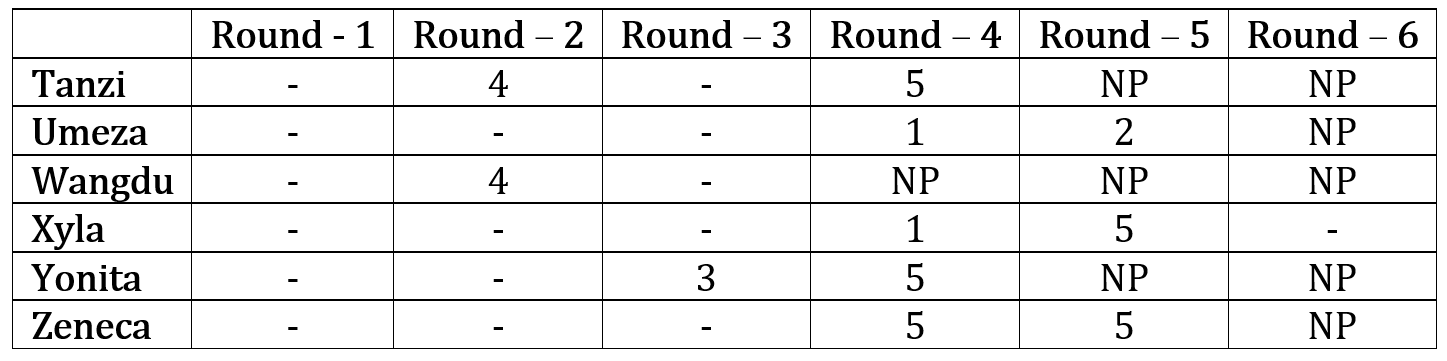
The following facts are also known.
- Tanzi, Umeza and Yonita had the same total score.
- Total scores for all players, except one, were in multiples of three.
- The highest total score was one more than double of the lowest total score.
- The number of players hitting bull’s eye in Round 2 was double of that in Round 3.
- Tanzi and Zeneca had the same score in Round 1 but different scores in Round 3.
What was the highest total score?
Passage / Data
Answer the following question based on the information given below.
Six players – Tanzi, Umeza, Wangdu, Xyla, Yonita and Zeneca competed in an archery tournament. The tournament had three compulsory rounds, Rounds 1 to 3. In each round every player shot an arrow at a target. Hitting the centre of the target (called bull’s eye) fetched the highest score of 5. The only other possible scores that a player could achieve were 4, 3, 2 and 1. Every bull’s eye score in the first three rounds gave a player one additional chance to shoot in the bonus rounds, Rounds 4 to 6. The possible scores in Rounds 4 to 6 were identical to the first three. A player’s total score in the tournament was the sum of his/her scores in all rounds played by him/her. The table below presents partial information on points scored by the players after completion of the tournament. In the table, NP means that the player did not participate in that round, while a hyphen means that the player participated in that round and the score information is missing.
The following facts are also known.
- Tanzi, Umeza and Yonita had the same total score.
- Total scores for all players, except one, were in multiples of three.
- The highest total score was one more than double of the lowest total score.
- The number of players hitting bull’s eye in Round 2 was double of that in Round 3.
- Tanzi and Zeneca had the same score in Round 1 but different scores in Round 3.
What was Zeneca's total score?
Passage / Data
Answer the following question based on the information given below.
Six players – Tanzi, Umeza, Wangdu, Xyla, Yonita and Zeneca competed in an archery tournament. The tournament had three compulsory rounds, Rounds 1 to 3. In each round every player shot an arrow at a target. Hitting the centre of the target (called bull’s eye) fetched the highest score of 5. The only other possible scores that a player could achieve were 4, 3, 2 and 1. Every bull’s eye score in the first three rounds gave a player one additional chance to shoot in the bonus rounds, Rounds 4 to 6. The possible scores in Rounds 4 to 6 were identical to the first three. A player’s total score in the tournament was the sum of his/her scores in all rounds played by him/her. The table below presents partial information on points scored by the players after completion of the tournament. In the table, NP means that the player did not participate in that round, while a hyphen means that the player participated in that round and the score information is missing.
The following facts are also known.
- Tanzi, Umeza and Yonita had the same total score.
- Total scores for all players, except one, were in multiples of three.
- The highest total score was one more than double of the lowest total score.
- The number of players hitting bull’s eye in Round 2 was double of that in Round 3.
- Tanzi and Zeneca had the same score in Round 1 but different scores in Round 3.
Which of the following statements is true?
Passage / Data
Answer the following question based on the information given below.
Six players – Tanzi, Umeza, Wangdu, Xyla, Yonita and Zeneca competed in an archery tournament. The tournament had three compulsory rounds, Rounds 1 to 3. In each round every player shot an arrow at a target. Hitting the centre of the target (called bull’s eye) fetched the highest score of 5. The only other possible scores that a player could achieve were 4, 3, 2 and 1. Every bull’s eye score in the first three rounds gave a player one additional chance to shoot in the bonus rounds, Rounds 4 to 6. The possible scores in Rounds 4 to 6 were identical to the first three. A player’s total score in the tournament was the sum of his/her scores in all rounds played by him/her. The table below presents partial information on points scored by the players after completion of the tournament. In the table, NP means that the player did not participate in that round, while a hyphen means that the player participated in that round and the score information is missing.
The following facts are also known.
- Tanzi, Umeza and Yonita had the same total score.
- Total scores for all players, except one, were in multiples of three.
- The highest total score was one more than double of the lowest total score.
- The number of players hitting bull’s eye in Round 2 was double of that in Round 3.
- Tanzi and Zeneca had the same score in Round 1 but different scores in Round 3.
What was Tanzi's score in Round 3?
Passage / Data
Answer the following questions based on the information given below.
Ten players, as listed in the table below, participated in a rifle shooting competition comprising of 10 rounds. Each round had 6 participants. Players numbered 1 through 6 participated in Round 1, players 2 through 7 in Round 2,..., players 5 through 10 in Round 5, players 6 through 10 and 1 in Round 6, players 7 through 10, 1 and 2 in Round 7 and so on. The top three performances in each round were awarded 7, 3 and 1 points respectively. There were no ties in any of the 10 rounds. The table below gives the total number of points obtained by the 10 players after Round 6 and Round 10.
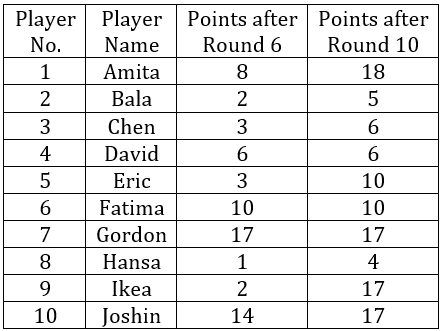
The following information is known about Rounds 1 through 6:
- Gordon did not score consecutively in any two rounds.
- Eric and Fatima both scored in a round.
The following information is known about Rounds 7 through 10:
- Only two players scored in three consecutive rounds. One of them was Chen. No other player scored in any two consecutive rounds.
- Joshin scored in Round 7, while Amita scored in Round 10.
- No player scored in all the four rounds.
What were the scores of Chen, David, and Eric respectively after Round 3?
Passage / Data
Answer the following questions based on the information given below.
Ten players, as listed in the table below, participated in a rifle shooting competition comprising of 10 rounds. Each round had 6 participants. Players numbered 1 through 6 participated in Round 1, players 2 through 7 in Round 2,..., players 5 through 10 in Round 5, players 6 through 10 and 1 in Round 6, players 7 through 10, 1 and 2 in Round 7 and so on. The top three performances in each round were awarded 7, 3 and 1 points respectively. There were no ties in any of the 10 rounds. The table below gives the total number of points obtained by the 10 players after Round 6 and Round 10.
The following information is known about Rounds 1 through 6:
- Gordon did not score consecutively in any two rounds.
- Eric and Fatima both scored in a round.
The following information is known about Rounds 7 through 10:
- Only two players scored in three consecutive rounds. One of them was Chen. No other player scored in any two consecutive rounds.
- Joshin scored in Round 7, while Amita scored in Round 10.
- No player scored in all the four rounds.
Which three players were in the last three positions after Round 4?
Passage / Data
Answer the following questions based on the information given below.
Ten players, as listed in the table below, participated in a rifle shooting competition comprising of 10 rounds. Each round had 6 participants. Players numbered 1 through 6 participated in Round 1, players 2 through 7 in Round 2,..., players 5 through 10 in Round 5, players 6 through 10 and 1 in Round 6, players 7 through 10, 1 and 2 in Round 7 and so on. The top three performances in each round were awarded 7, 3 and 1 points respectively. There were no ties in any of the 10 rounds. The table below gives the total number of points obtained by the 10 players after Round 6 and Round 10.
The following information is known about Rounds 1 through 6:
- Gordon did not score consecutively in any two rounds.
- Eric and Fatima both scored in a round.
The following information is known about Rounds 7 through 10:
- Only two players scored in three consecutive rounds. One of them was Chen. No other player scored in any two consecutive rounds.
- Joshin scored in Round 7, while Amita scored in Round 10.
- No player scored in all the four rounds.
Which player scored points in maximum number of rounds?
Passage / Data
Answer the following questions based on the information given below.
Ten players, as listed in the table below, participated in a rifle shooting competition comprising of 10 rounds. Each round had 6 participants. Players numbered 1 through 6 participated in Round 1, players 2 through 7 in Round 2,..., players 5 through 10 in Round 5, players 6 through 10 and 1 in Round 6, players 7 through 10, 1 and 2 in Round 7 and so on. The top three performances in each round were awarded 7, 3 and 1 points respectively. There were no ties in any of the 10 rounds. The table below gives the total number of points obtained by the 10 players after Round 6 and Round 10.
The following information is known about Rounds 1 through 6:
- Gordon did not score consecutively in any two rounds.
- Eric and Fatima both scored in a round.
The following information is known about Rounds 7 through 10:
- Only two players scored in three consecutive rounds. One of them was Chen. No other player scored in any two consecutive rounds.
- Joshin scored in Round 7, while Amita scored in Round 10.
- No player scored in all the four rounds.
Which players scored points in the last round?
Passage / Data
Answer the following questions based on the information given below:
In a sports event, six teams (A, B, C, D, E and F) are competing against each other. Matches are scheduled in two stages. Each team plays three matches in Stage-I and two matches in Stage-II. No team plays against the same team more than once in the event. No ties are permitted in any of the matches. The observations after the completion of Stage-I and Stage-II are as given below.
Stage-I:
- One team won all the three matches.
- Two teams lost all the matches.
- D lost to A but won against C and F.
- E lost to B but won against C and F.
- B lost at least one match.
- F did not play against the top team of Stage-I.
Stage-II:
- The leader of Stage-I lost the next two matches.
- Of the two teams at the bottom after Stage-I, one team won both matches, while the other lost both matches.
- One more team lost both matches in Stage-II.
The team(s) with the most wins in the event is (are):
Passage / Data
Answer the following questions based on the information given below:
In a sports event, six teams (A, B, C, D, E and F) are competing against each other. Matches are scheduled in two stages. Each team plays three matches in Stage-I and two matches in Stage-II. No team plays against the same team more than once in the event. No ties are permitted in any of the matches. The observations after the completion of Stage-I and Stage-II are as given below.
Stage-I:
- One team won all the three matches.
- Two teams lost all the matches.
- D lost to A but won against C and F.
- E lost to B but won against C and F.
- B lost at least one match.
- F did not play against the top team of Stage-I.
Stage-II:
- The leader of Stage-I lost the next two matches.
- Of the two teams at the bottom after Stage-I, one team won both matches, while the other lost both matches.
- One more team lost both matches in Stage-II.
The two teams that defeated the leader of Stage-I are:
Passage / Data
Answer the following questions based on the information given below:
In a sports event, six teams (A, B, C, D, E and F) are competing against each other. Matches are scheduled in two stages. Each team plays three matches in Stage-I and two matches in Stage-II. No team plays against the same team more than once in the event. No ties are permitted in any of the matches. The observations after the completion of Stage-I and Stage-II are as given below.
Stage-I:
- One team won all the three matches.
- Two teams lost all the matches.
- D lost to A but won against C and F.
- E lost to B but won against C and F.
- B lost at least one match.
- F did not play against the top team of Stage-I.
Stage-II:
- The leader of Stage-I lost the next two matches.
- Of the two teams at the bottom after Stage-I, one team won both matches, while the other lost both matches.
- One more team lost both matches in Stage-II.
The only team(s) that won both the matches in Stage-II is (are):
Passage / Data
Answer the following questions based on the information given below:
In a sports event, six teams (A, B, C, D, E and F) are competing against each other. Matches are scheduled in two stages. Each team plays three matches in Stage-I and two matches in Stage-II. No team plays against the same team more than once in the event. No ties are permitted in any of the matches. The observations after the completion of Stage-I and Stage-II are as given below.
Stage-I:
- One team won all the three matches.
- Two teams lost all the matches.
- D lost to A but won against C and F.
- E lost to B but won against C and F.
- B lost at least one match.
- F did not play against the top team of Stage-I.
Stage-II:
- The leader of Stage-I lost the next two matches.
- Of the two teams at the bottom after Stage-I, one team won both matches, while the other lost both matches.
- One more team lost both matches in Stage-II.
The teams that won exactly two matches in the event are:
Passage / Data
Answer the following question based on the information given below.
In the table below is the listing of players, seeded from highest (#1) to lowest (#32), who are due to play in an Association of Tennis Players (ATP) tournament for women. This tournament has four knockout rounds before the final, i.e., first round, second round, quarterfinals, and semi-finals. In the first round, the highest seeded player plays the lowest seeded player (seed # 32) which is designated match No. 1 of first round; the 2nd seeded player plays the 31st seeded player which is designated match No. 2 of the first round, and so on. Thus, for instance, match No. 16 of first round is to be played between 16th seeded player and the 17th seeded player. In the second round, the winner of match No. 1 of first round plays the winner of match No. 16 of first round and is designated match No. 1 of second round. Similarly, the winner of match No. 2 of first round plays the winner of match No. 15 of first round, and is designated match No. 2 of second round. Thus, for instance, match No. 8 of the second round is to be played between the winner of match No. 8 of first round and the winner of match No. 9 of first round. The same pattern is followed for later rounds as well.
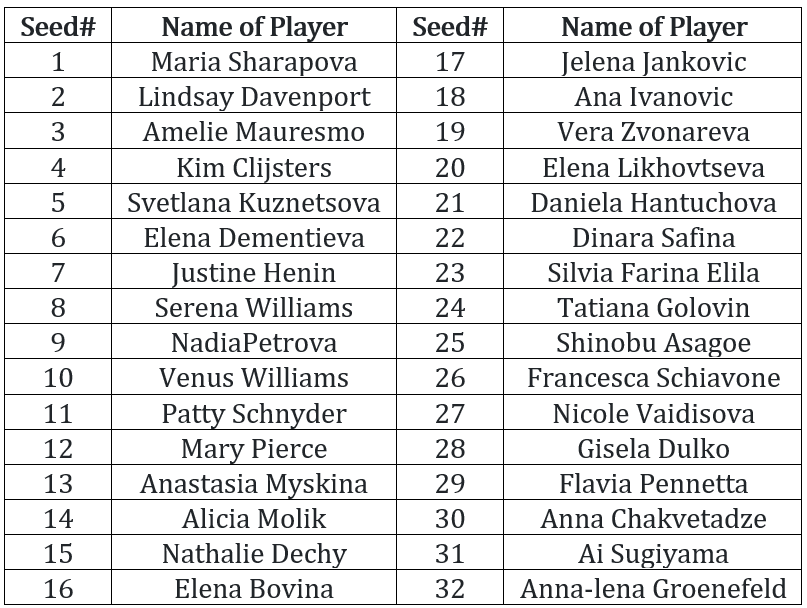
If there are no upsets (a lower seeded player beating a higher seeded player) in the first round, and only match Nos. 6, 7, and 8 of the second round result in upsets, then who would meet Lindsay Davenport in quarter finals, in case Davenport reaches quarter finals?
Passage / Data
Answer the following question based on the information given below.
In the table below is the listing of players, seeded from highest (#1) to lowest (#32), who are due to play in an Association of Tennis Players (ATP) tournament for women. This tournament has four knockout rounds before the final, i.e., first round, second round, quarterfinals, and semi-finals. In the first round, the highest seeded player plays the lowest seeded player (seed # 32) which is designated match No. 1 of first round; the 2nd seeded player plays the 31st seeded player which is designated match No. 2 of the first round, and so on. Thus, for instance, match No. 16 of first round is to be played between 16th seeded player and the 17th seeded player. In the second round, the winner of match No. 1 of first round plays the winner of match No. 16 of first round and is designated match No. 1 of second round. Similarly, the winner of match No. 2 of first round plays the winner of match No. 15 of first round, and is designated match No. 2 of second round. Thus, for instance, match No. 8 of the second round is to be played between the winner of match No. 8 of first round and the winner of match No. 9 of first round. The same pattern is followed for later rounds as well.
If Elena Dementieva and Serena Williams lose in the second round, while Justine Henin and Nadia Petrova make it to the semifinals, then who would play Maria Sharapova in the quarterfinals, in the event Sharapova reaches quarterfinals?
Passage / Data
Answer the following question based on the information given below.
In the table below is the listing of players, seeded from highest (#1) to lowest (#32), who are due to play in an Association of Tennis Players (ATP) tournament for women. This tournament has four knockout rounds before the final, i.e., first round, second round, quarterfinals, and semi-finals. In the first round, the highest seeded player plays the lowest seeded player (seed # 32) which is designated match No. 1 of first round; the 2nd seeded player plays the 31st seeded player which is designated match No. 2 of the first round, and so on. Thus, for instance, match No. 16 of first round is to be played between 16th seeded player and the 17th seeded player. In the second round, the winner of match No. 1 of first round plays the winner of match No. 16 of first round and is designated match No. 1 of second round. Similarly, the winner of match No. 2 of first round plays the winner of match No. 15 of first round, and is designated match No. 2 of second round. Thus, for instance, match No. 8 of the second round is to be played between the winner of match No. 8 of first round and the winner of match No. 9 of first round. The same pattern is followed for later rounds as well.
If, in the first round, all even numbered matches (and none of the odd numbered ones) result in upsets, and there are no upsets in the second round, then who could be the lowest seeded player facing Maria Sharapova in semi-finals?
Passage / Data
Answer the following question based on the information given below.
In the table below is the listing of players, seeded from highest (#1) to lowest (#32), who are due to play in an Association of Tennis Players (ATP) tournament for women. This tournament has four knockout rounds before the final, i.e., first round, second round, quarterfinals, and semi-finals. In the first round, the highest seeded player plays the lowest seeded player (seed # 32) which is designated match No. 1 of first round; the 2nd seeded player plays the 31st seeded player which is designated match No. 2 of the first round, and so on. Thus, for instance, match No. 16 of first round is to be played between 16th seeded player and the 17th seeded player. In the second round, the winner of match No. 1 of first round plays the winner of match No. 16 of first round and is designated match No. 1 of second round. Similarly, the winner of match No. 2 of first round plays the winner of match No. 15 of first round, and is designated match No. 2 of second round. Thus, for instance, match No. 8 of the second round is to be played between the winner of match No. 8 of first round and the winner of match No. 9 of first round. The same pattern is followed for later rounds as well.
If the top eight seeds make it to the quarterfinals, then who, amongst the players listed below, would definitely not play against Maria Sharapova in the final, in case Sharapova reaches the final?
Passage / Data
Answer the following question based on the information given below.
The year was 2006. All six teams in Pool A of World Cup hockey, play each other exactly once. Each win earns a team three points, a draw earns one point and a loss earns zero points. The two teams with the highest points qualify for the semi-finals. In case of a tie, the team with the highest goal difference (Goal For – Goals Against) qualifies.
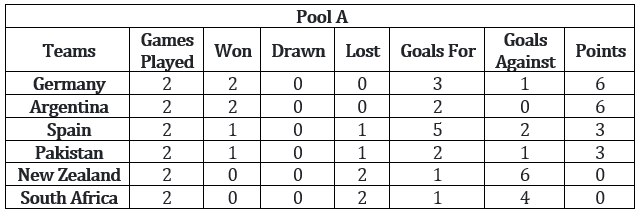
In the opening match, Spain lost to Germany. After the second round (after each team played two matches), the pool table looked as shown below.
In the third round, Spain played Pakistan, Argentina played Germany, and New Zealand played South Africa. All the third round matches were drawn. The following are some results from the fourth and fifth round matches.
a. Spain won both the fourth and fifth round matches.
b. Both Argentina and Germany won their fifth round matches by 3 goals to 0.
c. Pakistan won both the fourth and fifth round matches by 1 goal to 0.
Which one of the following statements is true about matches played in the first two rounds?
Passage / Data
Answer the following question based on the information given below.
The year was 2006. All six teams in Pool A of World Cup hockey, play each other exactly once. Each win earns a team three points, a draw earns one point and a loss earns zero points. The two teams with the highest points qualify for the semi-finals. In case of a tie, the team with the highest goal difference (Goal For – Goals Against) qualifies.
In the opening match, Spain lost to Germany. After the second round (after each team played two matches), the pool table looked as shown below.
In the third round, Spain played Pakistan, Argentina played Germany, and New Zealand played South Africa. All the third round matches were drawn. The following are some results from the fourth and fifth round matches.
a. Spain won both the fourth and fifth round matches.
b. Both Argentina and Germany won their fifth round matches by 3 goals to 0.
c. Pakistan won both the fourth and fifth round matches by 1 goal to 0.
Which one of the following statements is true about matches played in the first two rounds?
Passage / Data
Answer the following question based on the information given below.
The year was 2006. All six teams in Pool A of World Cup hockey, play each other exactly once. Each win earns a team three points, a draw earns one point and a loss earns zero points. The two teams with the highest points qualify for the semi-finals. In case of a tie, the team with the highest goal difference (Goal For – Goals Against) qualifies.
In the opening match, Spain lost to Germany. After the second round (after each team played two matches), the pool table looked as shown below.
In the third round, Spain played Pakistan, Argentina played Germany, and New Zealand played South Africa. All the third round matches were drawn. The following are some results from the fourth and fifth round matches.
a. Spain won both the fourth and fifth round matches.
b. Both Argentina and Germany won their fifth round matches by 3 goals to 0.
c. Pakistan won both the fourth and fifth round matches by 1 goal to 0.
If Pakistan qualified as one of the two teams from Pool A, which was the other team that qualified?
Passage / Data
Answer the following question based on the information given below.
The year was 2006. All six teams in Pool A of World Cup hockey, play each other exactly once. Each win earns a team three points, a draw earns one point and a loss earns zero points. The two teams with the highest points qualify for the semi-finals. In case of a tie, the team with the highest goal difference (Goal For – Goals Against) qualifies.
In the opening match, Spain lost to Germany. After the second round (after each team played two matches), the pool table looked as shown below.
In the third round, Spain played Pakistan, Argentina played Germany, and New Zealand played South Africa. All the third round matches were drawn. The following are some results from the fourth and fifth round matches.
a. Spain won both the fourth and fifth round matches.
b. Both Argentina and Germany won their fifth round matches by 3 goals to 0.
c. Pakistan won both the fourth and fifth round matches by 1 goal to 0.
Which team finished at the top of the pool after five rounds of matches?
Passage / Data
Direction: Answer the questions based on the following information.
Amar, Akbar and Anthony are three friends. Only three colours are available for their shirts, viz. red, green and blue. Amar does not wear red shirt. Akbar does not wear green shirt. Anthony does not wear blue shirt.
A, B, C, D, ..., X, Y, Z are the players who participated in a tournament. Everyone played with every other player exactly once. A win scores 2 points, a draw scores 1 point and a loss scores 0 point. None of the matches ended in a draw. No two players scored the same score. At the end of the tournament, by ranking list is published which is in accordance with the alphabetical order. Then