CAT 2017 Slot 2 — DILR Question 20
Answer the following question based on the information given below.
A tea taster was assigned to rate teas from six different locations – Munnar, Wayanand, Ooty, Darjeeling, Assam and Himachal. These teas were placed in six cups, numbered 1 to 6, not necessarily in the same order. The tea taster was asked to rate these teas on the strength of their flavour on a scale of 1 to 10. He gave a unique integer rating to each tea. Some other information is given below:
- Cup 6 contained tea from Himachal.
- Tea from Ooty got the highest rating, but it was not in Cup 3.
- The rating of tea in Cup 3 was double the rating of the tea in Cup 5.
- Only two cups got ratings in even numbers.
- Cup 2 got the minimum rating and this rating was an even number.
- Tea in Cup 3 got a higher rating than that in Cup 1.
- The rating of tea from Wayanad was more than the rating of tea from Munnar, but less than that from Assam.
If cups containing teas from Wayanad and Ooty had consecutive numbers, which of the following statements may be true?
Answer & solution
Correct answer: Cup 1 contains tea from Darjeeling
- A
Cup 5 contains tea from Assam
Cup 1 contains tea from Darjeeling
- C
Tea from Wayanad has got a rating of 6
- D
Tea from Darjeeling got the minimum rating
Following condition (1) and (2) we can form the table as below

Now rating of Tea in cup 3 is twice the rating of tea in cup 5. So the rating of tea in cup 3 will be an even number. Now following condition. (4) and (5) we know that cup 2 and cup 3 are the only cups that have an even numbered rating. This means that the rating of tea in cup 1, 4, 5 and 6 will be an odd number. Now since the rating of cup 3 is twice the rating of cup 5 which has an odd numbered rating, rating of cup 5 will be 3. The reason for this is that the since the rating of cup 2 is the least and an even number, the rating of cup 5 has to be higher than that of cup 2 (which will be atleast 2) and hence it’s rating cannot be 1. Further, since only the rating of cup 2 and cup 3 are even numbers and neither of them contains the highest rated tea, so then rating of Tea in Ooty (which is not in cup 3) will be less than 10. So this means the only possibility for rating of tea in cup 3 has to be 6, as that is the only even number which is twice that of an odd number. This further implies that the rating of tea in cup 5 is 3. This also means that rating of Tea in cup 2 is 2. We know need to find the ratings of tea in cups 1, 4 and 6. Further, as all these cups will be 5, 7 and 9 (not essentially in that order). Since the rating of tea in cup 3 (which is 6) is higher than the rating of tea in cup 1, the rating of tea in cup 1 has to be 5. Further, tea from Ooty is placed in cup 4 and since the tea from Ooty has the highest rating it’s rating will be 9. This would mean that the rating of tea from Himachal in cup 6 will be 7. The only other information we have is that Tea from Assam has a better rating than Tea from Wayanand which in turn is better than Tea from Munnar.
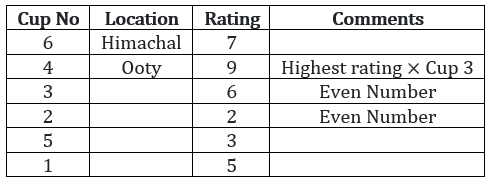
We have no other information about the location of tea in cups 1, 2, 3 and 5. So using the table above let us answer the questions.
Given that cups containing tea from Wayanad and Ooty have consecutive numbers, tea from Wayanad can either be in cup 3 or cup 5. However, as tea in cup 3 has the 3rd highest rating it cannot be from Wayanad. This is because the tea from Assam is better than the tea from Wayanad. So then tea from Wayanad will be in cup no 5 and will have a rating of 3 and tea in cup 2 which has the lowest rating of 2 is from Munnar. This means that in cup 1 and cup 3 we can have tea from Assam and Darjeeling (not essentially in that order). If we now examine the statements in each of the 4 options we will see that statements in options (1), (3) and (4) are not true. However statement in option (2) may be true.
Hence, option (b).
Related Linear Arrangement questions
- What was the second highest rating given?…
- What was the number of the cup that contained tea from Ooty?…
- If the tea from Munnar did not get the minimum rating, what was the rating of th…
- In which row was Manik sitting?…
- How much extra did Jayanta pay for his choice of seat?…
- How much extra did Gargi pay for her choice of seat?…