CAT 2022 Slot 3 — DILR Question 16
Answer the next 5 questions based on the information given below:
All the first-year students in the computer science (CS) department in a university take both the courses (i) AI and (ii) ML. Students from other departments (non-CS students) can also take one of these two courses, but not both. Students who fail in a course get an F grade; others pass and are awarded A or B or C grades depending on their performance. The following are some additional facts about the number of students who took these two courses this year and the grades they obtained.
1. The numbers of non-CS students who took AI and ML were in the ratio 2 : 5.
2. The number of non-CS students who took either AI or ML was equal to the number of CS students.
3. The numbers of non-CS students who failed in the two courses were the same and their total is equal to the number of CS students who got a C grade in ML.
4. In both the courses, 50% of the students who passed got a B grade. But, while the numbers of students who got A and C grades were the same for AI, they were in the ratio 3 : 2 for ML.
5. No CS student failed in AI, while no non-CS student got an A grade in AI.
6. The numbers of CS students who got A, B and C grades respectively in AI were in the ratio 3 : 5 : 2, while in ML the ratio was 4 : 5 : 2.
7. The ratio of the total number of non-CS students failing in one of the two courses to the number of CS students failing in one of the two courses was 3 : 1.
8. 30 students failed in ML.
How many students took AI?
Answer & solution
Correct answer: 270
- A
90
- B
60
- C
210
270
From (1) and (2): Let the number of non-CS students who took AI and ML are 2x and 5x respectively.
⇒ Number of CS students = 2x + 5x = 7x.
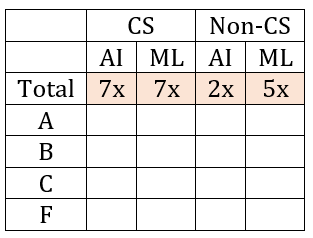
From (3): Let the number of non-CS students failing in two courses is ‘a’ each and CS students who got a C in ML = ‘2a’
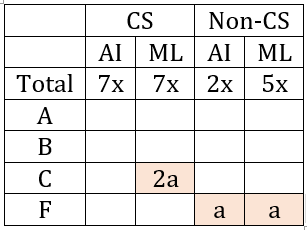
From (6): Let number of CS students who got A, B and C grades respectively in AI are 3y, 5y, 2y.
While number of CS students who got A, B and C grades respectively in ML are 4a, 5a, 2a.
From (5): No CS student failed in AI, while no non-CS student got an A grade in AI.
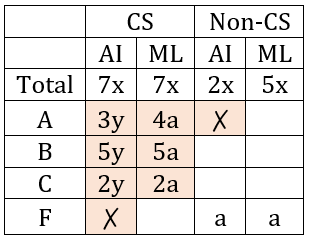
From (4): The numbers of students who got A and C grades were the same for AI
⇒ 3y + 0 = 2y + non-CS students in AI with C grade
⇒ non-CS students in AI with C grade = 3y – 2y = y
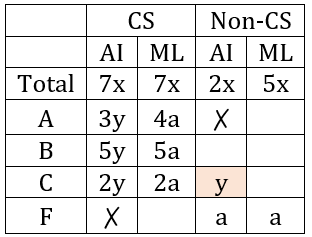
From (8): 30 students failed in ML hence CS students failing in ML = 30 – a.
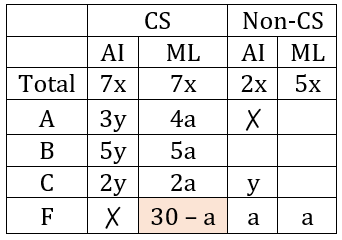
From (7):
⇒ =
⇒ 2a = 90 – 3a
⇒ a = 18
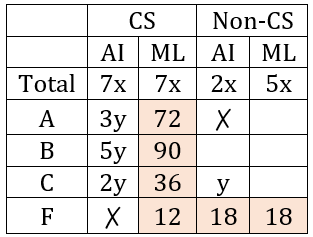
⇒ 7x = 72 + 90 + 36 + 12 = 210
⇒ x = 30
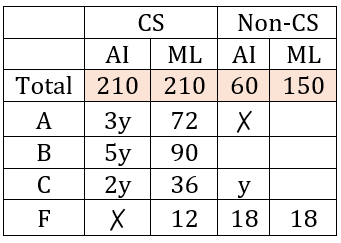
⇒ 210 = 3y + 5y + 2y
⇒ y = 21
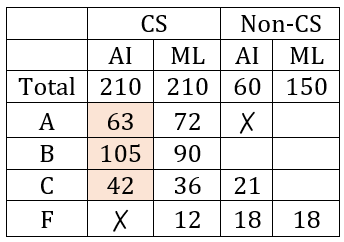
⇒ 60 = 0 + (non-CS student in AI getting B grade) + 21 + 18
∴ non-CS student in AI getting B grade = 60 – 39 = 21
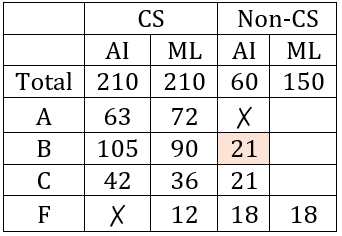
From (4): In both the courses, 50% of the students who passed got a B grade
Number of students passing in ML = 72 + 90 + 36 + (150 - 18) = 330
⇒ Number of students receiving B grade in ML = 330/2 = 165.
⇒ non-CS students with B grade in ML = 165 – 90 = 75
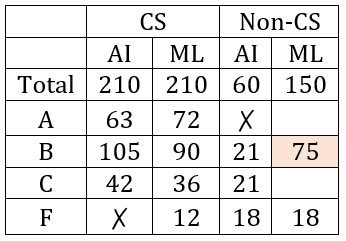
Let number of non-CS students with A grade in ML = c, hence number of non-CS students with C grade in ML = 150 – 75 – 18 – c = 57 – c
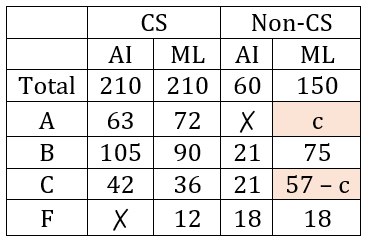
From (4): the numbers of students who got A and C grades were in the ratio 3 : 2 for ML.
⇒ =
⇒ 144 + 2c = 279 – 3c
⇒ 5c = 135
⇒ c = 27
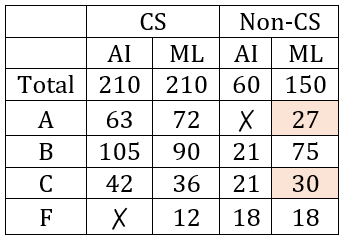
∴ Number of students taking AI = 210 (CS students) + 60 (non-CS students) = 270.
Hence, option (d).
Related Mixed Practice questions
- None of the following statements is implied by the arguments of the passage, EXC…
- The author claims that, “The apparent veil between the organic and the man…
- The author claims that, “Part of this bionic convergence is a matter of wo…
- Which one of the following sets of words/phrases best serves as keywords to the …
- The author notes that, “At the start of the twentieth century, Americans w…
- Which one of the following is not a valid inference from the passage?…