CAT 2023 Slot 1 — DILR Question 11
Answer the following questions based on the information given below:
The schematic diagram below shows 12 rectangular houses in a housing complex. House numbers are mentioned in the rectangles representing the houses. The houses are located in six columns – Column-A through Column-F, and two rows – Row-1 and Row-2. The houses are divided into two blocks - Block XX and Block YY. The diagram also shows two roads, one passing in front of the houses in Row-2 and another between the two blocks.
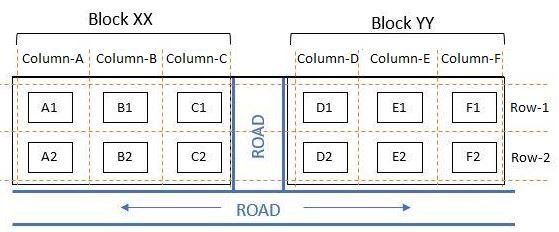
Some of the houses are occupied. The remaining ones are vacant and are the only ones available for sale.
The road adjacency value of a house is the number of its sides adjacent to a road. For example, the road adjacency values of C2, F2, and B1 are 2, 1, and 0, respectively. The neighbour count of a house is the number of sides of that house adjacent to occupied houses in the same block. For example, E1 and C1 can have the maximum possible neighbour counts of 3 and 2, respectively.
The base price of a vacant house is Rs. 10 lakhs if the house does not have a parking space, and Rs. 12 lakhs if it does. The quoted price (in lakhs of Rs.) of a vacant house is calculated as (base price) + 5 × (road adjacency value) + 3 × (neighbour count).
The following information is also known.
1. The maximum quoted price of a house in Block XX is Rs. 24 lakhs. The minimum quoted price of a house in block YY is Rs. 15 lakhs, and one such house is in Column-E.
2. Row-1 has two occupied houses, one in each block.
3. Both houses in Column-E are vacant. Each of Column-D and Column-F has at least one occupied house.
4. There is only one house with parking space in Block YY.
How many houses are vacant in Block XX?
Answer & solution
Correct answer: 3
Answer: 3
Easy
One careful set-up unlocks all five questions. The price formula is the key lever: , with base (no parking) or (parking). Pin down the extreme-price houses first, then propagate the certainties.
The complex has 12 houses in 6 columns (A–F) and 2 rows. Block XX = columns A, B, C; Block YY = columns D, E, F. One road runs in front of Row-2 (the bottom edge) and another runs vertically between the two blocks (between C and D).
Road adjacency (sides touching a road): bottom-row houses touch the front road; D2 and C2 also touch the middle road. So ; in Row-1 only and (middle road), while .
Crack Block XX from its max price 24. The most a house can be worth is base . To reach :
This is the only combination: base , adjacency , neighbour count . A neighbour count of needs a house with three same-block neighbours — only (touching A2, C2, B1) qualifies, and has adjacency . So is vacant, priced 24, and its three neighbours are all occupied.
Fix the rest of XX using Fact 2. Row-1 has exactly two occupied houses, one per block. In XX that occupied Row-1 house is (already known occupied), so and are vacant.
Block YY: locate the parking house via E1. Both column-E houses are vacant (Fact 3). has adjacency and neighbour count (exactly one of occupied, by Fact 2). So its price is or . Since the YY minimum is and is achieved in column E, , forcing base . Hence is the single parking house in YY (Fact 4).
Settle D1 vs F1. Suppose were vacant: it has no parking (only does), adjacency , neighbour count , so price — impossible. So is occupied, making the vacant Row-1 house in YY. By Fact 3 column D still needs an occupant, so is occupied. may be either.
Block XX has exactly the three vacant houses , , .
Related Linear Arrangement questions
- Which of the following houses is definitely occupied? [Two options are correct i…
- Which of the following options best describes the number of vacant houses in Row…
- What is the maximum possible quoted price (in lakhs of Rs.) for a vacant house i…
- Which house in Block YY has parking space?…