CAT 2023 Slot 2 — DILR Question 11
Answer the following questions based on the information given below:
Three participants – Akhil, Bimal and Chatur participate in a random draw competition for five days. Every day, each participant randomly picks up a ball numbered between 1 and 9. The number on the ball determines his score on that day. The total score of a participant is the sum of his scores attained in the five days. The total score of a day is the sum of participants’ scores on that day. The 2-day average on a day, except on Day 1, is the average of the total scores of that day and of the previous day. For example, if the total scores of Day 1 and Day 2 are 25 and 20, then the 2-day average on Day 2 is calculated as 22.5. Table 1 gives the 2-day averages for

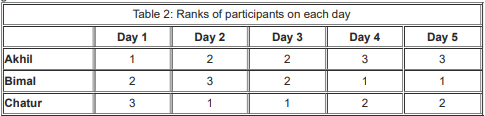
Participants are ranked each day, with the person having the maximum score being awarded the minimum rank (1) on that day. If there is a tie, all participants with the tied score are awarded the best available rank. For example, if on a day Akhil, Bimal, and Chatur score 8, 7 and 7 respectively, then their ranks will be 1, 2 and 2 respectively on that day. These ranks are given in Table 2.
The following information is also known.
- Chatur always scores in multiples of 3. His score on Day 2 is the unique highest score in the competition. His minimum score is observed only on Day 1, and it matches Akhil’s score on Day 4.
- The total score on Day 3 is the same as the total score on Day 4.
- Bimal’s scores are the same on Day 1 and Day 3.
What is Akhil's score on Day 1?
Answer & solution
Correct answer: 7
7
- B
6
- C
5
- D
8
Easy
One grid solves the whole set. Turn the 2-day averages into daily totals, then use the rank table plus the three extra facts to nail every score. We build the grid once and just read answers off it.
Given data (transcribed from the two tables).
Table 1 — 2-day averages. A day's 2-day average , where is that day's total of all three scores.
| Day 2 | Day 3 | Day 4 | Day 5 | |
|---|---|---|---|---|
| 2-day avg | 15 | 15.5 | 16 | 17 |
Table 2 — daily ranks (rank 1 = highest score; ties share the best rank).
| Day 1 | Day 2 | Day 3 | Day 4 | Day 5 | |
|---|---|---|---|---|---|
| Akhil | 1 | 2 | 2 | 3 | 3 |
| Bimal | 2 | 3 | 2 | 1 | 1 |
| Chatur | 3 | 1 | 1 | 2 | 2 |
Extra facts: (1) Chatur always scores a multiple of 3; his Day-2 score is the unique highest score of the whole competition; his minimum occurs only on Day 1 and equals Akhil's Day-4 score. (2) . (3) Bimal's Day-1 and Day-3 scores are equal.
Daily totals from the averages. Doubling each 2-day average gives the sum of two consecutive day-totals:
Fact 2 says , so . Back-substituting: , , .
Chatur's column (multiples of 3). On Day 2 Chatur is rank 1 and his score is the unique highest of the entire competition, so . On Day 3, Chatur (rank 1) beats Akhil = Bimal (both rank 2): with a multiple of 3 forces . His minimum is only on Day 1 and is a multiple of 3 below 6, so .
Day 4 and Akhil's Day-4 score. Fact 1: Akhil's Day-4 score equals Chatur's minimum, so . Day-4 order is with total 16: , a multiple of 3 above 3 .
Day 1 (Bimal link). Fact 3: . Day 1 order is with total 15 and : . So Akhil scores 7 on Day 1.
Day 5 finishes Chatur. Order , total 18, a multiple of 3 above 3. would need (impossible), so . Chatur's total is therefore
The two free cells. Only (Day 2) and (Day 5) remain loose. Day 2 needs with . Day 5 needs i.e. with , and since must stay the unique 9, . The grid:
| Day 1 | Day 2 | Day 3 | Day 4 | Day 5 | |
|---|---|---|---|---|---|
| Akhil | 7 | 5 | 3 | ||
| Bimal | 5 | 5 | 7 | ||
| Chatur | 3 | 9 | 6 | 6 | 6 |
Hence Akhil's total and Bimal's total , with .
Akhil's score on Day 1 is .
Related Mixed Practice questions
- If the author of the passage were to write a book on the Battle of Hastings alon…
- According to this passage, which one of the following statements best describes …
- All of the following, if true, can weaken the passage’s claim that facts d…
- All of the following describe the “common-sense view” of history, EX…
- Based only on information provided in the passage, which one of the following hy…
- The author sees the rise of Netflix in Europe as:…