CAT 2024 Slot 1 — DILR Question 1
Answer the following questions based on the information given.
The chart below shows the price data for seven shares – A, B, C, D, E, F, and G as a candlestick plot for a particular day. The vertical axis shows the price of the share in rupees. A share whose closing price (price at the end of the day) is more than its opening price (price at the start of the day) is called a bullish share; otherwise, it is called a bearish share. All bullish and bearish shares are shown in green and red colour respectively.
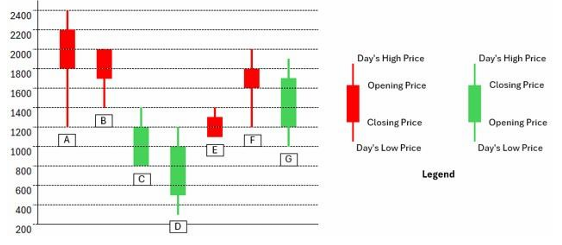
Reading the candles against the gridlines (each gridline = ₹200), the open / close / high / low values are approximately:
| Share | Open | Close | High | Low | Type |
|---|---|---|---|---|---|
| A | 2100 | 1900 | 2400 | 1500 | Bearish (red) |
| B | 2000 | 1750 | 2050 | 1300 | Bearish (red) |
| C | 850 | 1350 | 1400 | 750 | Bullish (green) |
| D | 600 | 1050 | 1150 | 300 | Bullish (green) |
| E | 1300 | 1150 | 1450 | 1100 | Bearish (red) |
| F | 1900 | 1700 | 2150 | 1650 | Bearish (red) |
| G | 1300 | 1750 | 1800 | 1250 | Bullish (green) |
For a red (bearish) candle the body top is the opening and the body bottom is the closing; for a green (bullish) candle the body bottom is the opening and the body top is the closing. The thin wicks mark the day’s high and low.
Daily Share Price Variability (SPV) is defined as (Day’s high price - Day’s low price) / (Average of the opening and closing prices during the day). Which among the shares A, C, D and F had the highest SPV on that day?
Answer & solution
Correct answer: D
- A
F
- B
A
- C
C
D
Easy
SPV is largest when the high–low spread is large compared with the typical price. Read each candle, then compute SPV for the four named shares.
Read of the candles (each gridline = ₹200; red: body top = open, body bottom = close; green: reversed; wicks = high/low):
| Share | Open | Close | High | Low |
|---|---|---|---|---|
| A | 2100 | 1900 | 2400 | 1500 |
| C | 850 | 1350 | 1400 | 750 |
| D | 600 | 1050 | 1150 | 300 |
| F | 1900 | 1700 | 2150 | 1650 |
Write the SPV formula. Per the definition,
Compute SPV for A, C, D, F. Substitute the read values from the Set-up.
Pick the maximum. D has by far the widest spread (its lower wick plunges to ₹300) on a modest average price, so its SPV dominates.
No arithmetic needed for the winner: D’s long lower wick gives the biggest high−low gap while its body sits low — both push SPV up.
Related Bar Graphs questions
- Daily Share Price Variability (SPV) is defined as (Day’s high price - Day&…
- Daily loss for a share is defined as (Opening price – Closing price) / (Op…
- What would have been the percentage wealth gain for a trader, who bought equal n…