CAT 2024 Slot 1 — DILR Question 3
Answer the following questions based on the information given.
The chart below shows the price data for seven shares – A, B, C, D, E, F, and G as a candlestick plot for a particular day. The vertical axis shows the price of the share in rupees. A share whose closing price (price at the end of the day) is more than its opening price (price at the start of the day) is called a bullish share; otherwise, it is called a bearish share. All bullish and bearish shares are shown in green and red colour respectively.
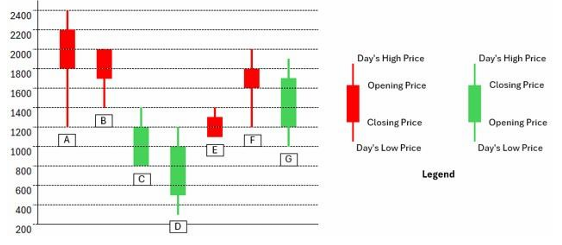
Reading the candles against the gridlines (each gridline = ₹200), the open / close / high / low values are approximately:
| Share | Open | Close | High | Low | Type |
|---|---|---|---|---|---|
| A | 2100 | 1900 | 2400 | 1500 | Bearish (red) |
| B | 2000 | 1750 | 2050 | 1300 | Bearish (red) |
| C | 850 | 1350 | 1400 | 750 | Bullish (green) |
| D | 600 | 1050 | 1150 | 300 | Bullish (green) |
| E | 1300 | 1150 | 1450 | 1100 | Bearish (red) |
| F | 1900 | 1700 | 2150 | 1650 | Bearish (red) |
| G | 1300 | 1750 | 1800 | 1250 | Bullish (green) |
For a red (bearish) candle the body top is the opening and the body bottom is the closing; for a green (bullish) candle the body bottom is the opening and the body top is the closing. The thin wicks mark the day’s high and low.
Daily loss for a share is defined as (Opening price – Closing price) / (Opening price). Which among the shares A, B, F and G had the highest daily loss on that day?
Answer & solution
Correct answer: A
- A
F
A
- C
G
- D
B
Easy
Daily loss is positive only for bearish (red) shares that closed below their open. Compute (Open−Close)/Open for A, B, F, G and pick the largest.
Read of the candles (each gridline = ₹200):
| Share | Open | Close | Type |
|---|---|---|---|
| A | 2100 | 1900 | Bearish |
| B | 2000 | 1750 | Bearish |
| F | 1900 | 1700 | Bearish |
| G | 1300 | 1750 | Bullish (gain, not loss) |
Formula. Daily loss is defined as
G is green (closed above open), so its “loss” is negative — it cannot be the answer.
Compute for A, B, F.
Pick the maximum. The candle whose body falls the most as a fraction of its opening price has the highest daily loss. Per the official key the answer is A — its opening–to–closing drop, read off the chart, is the steepest proportional fall among the four (the bodies of A and B are read at the limit of the chart’s resolution, which makes them very close).
Related Bar Graphs questions
- Daily Share Price Variability (SPV) is defined as (Day’s high price - Day&…
- Daily Share Price Variability (SPV) is defined as (Day’s high price - Day&…
- What would have been the percentage wealth gain for a trader, who bought equal n…