CAT 2024 Slot 1 — DILR Question 8
Answer the following questions based on the information given below.
Six web surfers M, N, O, P, X, and Y each had 30 stars which they distributed among four bloggers A, B, C, and D. The number of stars received by A and B from the six web surfers is shown in the figure below.
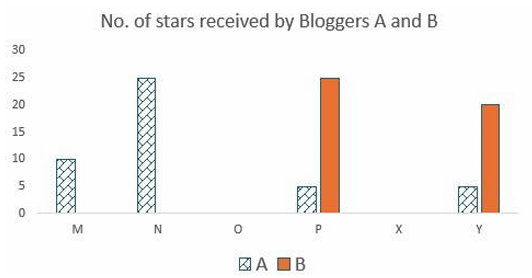
| Surfer | to A | to B |
|---|---|---|
| M | 10 | 0 |
| N | 25 | 0 |
| O | 0 | 0 |
| P | 5 | 25 |
| X | 0 | 0 |
| Y | 5 | 20 |
The following additional facts are known regarding the number of stars received by the bloggers from the surfers.
- The numbers of stars received by the bloggers from the surfers were all multiples of 5 (including 0).
- The total numbers of stars received by the bloggers were the same.
- Each blogger received a different number of stars from M.
- Two surfers gave all their stars to a single blogger.
- D received more stars than C from Y.
Which of the following can be determined with certainty?
I. The number of stars received by C from M
II. The number of stars received by D from O
Answer & solution
Correct answer: Only I
Only I
- B
Neither I nor II
- C
Both I and II
- D
Only II
Hard
Fix each blogger’s total at 45, then use Facts 3–5 to nail down the C and D entries. Statement I (C from M) is forced; Statement II (D from O) is not, because O’s “all-to-one” donation could go to either C or D.
Set-up (C+D per surfer = 30−A−B):
| Surfer | A | B | C+D |
|---|---|---|---|
| M | 10 | 0 | 20 |
| N | 25 | 0 | 5 |
| O | 0 | 0 | 30 |
| P | 5 | 25 | 0 |
| X | 0 | 0 | 30 |
| Y | 5 | 20 | 5 |
Each blogger total = 45 (from Fact 2 and 180/4).
Forced single-blogger rows. P gives C+D=0, so C and D get nothing from P. From Y, C+D=5 with D > C (Fact 5) and multiples of 5, so D gets 5 and C gets 0.
Use Fact 3 on M. M gives A=10, B=0, and C, D the remaining 20, all four amounts distinct multiples of 5. So .
Use Fact 4 on O and X. Only O and X have C+D=30; they are the two surfers who give all 30 to one blogger. They cannot both feed C (that would give C at least 60 > 45) nor both feed D — so one of them gives 30 to C and the other 30 to D.
Close C’s total to find C from M. C gets 0 from P and Y, 30 from one of O/X, and from N (where ). With C total = 45:
So Statement I is fixed: C received 15 stars from M.
Test Statement II (D from O). From step 3 the 30-star gift to D comes from O or X — nothing distinguishes them. So D from O is either 30 or 0; it is not determinable.
Need a hint?
The symmetry between O and X is the whole point: any fact that fixes one of them would fix the other. None does, so D-from-O stays ambiguous while C-from-M is pinned by the totals.
Related Mixed Practice questions
- The author’s overall tone in the first paragraph can be described as…
- The author is unlikely to disagree with any of the following EXCEPT:…
- The contrasting reactions to the Chinese and Israeli “contaminations&rdquo…
- The author mentions all of the following reasons to dismiss concerns about conta…
- The passage below is accompanied by four questions. Based on the passage, choose…
- In the context of the passage we can infer that to succeed in the liquor industr…