Mixed Practice — CAT Previous-Year Questions
126 previous-year questions on Mixed Practice from CAT, with full solutions. Practise free — check answers as you go; sign in to save your progress.
Mixed Practice · CAT PYQs
Passage / Data
Answer the following questions based on the information given below.
Six web surfers M, N, O, P, X, and Y each had 30 stars which they distributed among four bloggers A, B, C, and D. The number of stars received by A and B from the six web surfers is shown in the figure below.
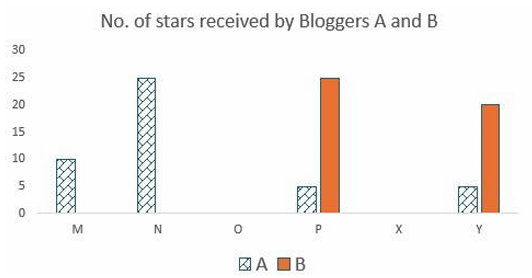
| Surfer | to A | to B |
|---|---|---|
| M | 10 | 0 |
| N | 25 | 0 |
| O | 0 | 0 |
| P | 5 | 25 |
| X | 0 | 0 |
| Y | 5 | 20 |
The following additional facts are known regarding the number of stars received by the bloggers from the surfers.
- The numbers of stars received by the bloggers from the surfers were all multiples of 5 (including 0).
- The total numbers of stars received by the bloggers were the same.
- Each blogger received a different number of stars from M.
- Two surfers gave all their stars to a single blogger.
- D received more stars than C from Y.
What was the total number of stars received by D?
Passage / Data
Answer the following questions based on the information given below.
Six web surfers M, N, O, P, X, and Y each had 30 stars which they distributed among four bloggers A, B, C, and D. The number of stars received by A and B from the six web surfers is shown in the figure below.
| Surfer | to A | to B |
|---|---|---|
| M | 10 | 0 |
| N | 25 | 0 |
| O | 0 | 0 |
| P | 5 | 25 |
| X | 0 | 0 |
| Y | 5 | 20 |
The following additional facts are known regarding the number of stars received by the bloggers from the surfers.
- The numbers of stars received by the bloggers from the surfers were all multiples of 5 (including 0).
- The total numbers of stars received by the bloggers were the same.
- Each blogger received a different number of stars from M.
- Two surfers gave all their stars to a single blogger.
- D received more stars than C from Y.
What was the number of stars received by D from Y?
Passage / Data
Answer the following questions based on the information given below.
Six web surfers M, N, O, P, X, and Y each had 30 stars which they distributed among four bloggers A, B, C, and D. The number of stars received by A and B from the six web surfers is shown in the figure below.
| Surfer | to A | to B |
|---|---|---|
| M | 10 | 0 |
| N | 25 | 0 |
| O | 0 | 0 |
| P | 5 | 25 |
| X | 0 | 0 |
| Y | 5 | 20 |
The following additional facts are known regarding the number of stars received by the bloggers from the surfers.
- The numbers of stars received by the bloggers from the surfers were all multiples of 5 (including 0).
- The total numbers of stars received by the bloggers were the same.
- Each blogger received a different number of stars from M.
- Two surfers gave all their stars to a single blogger.
- D received more stars than C from Y.
How many surfers distributed their stars among exactly 2 bloggers?
Passage / Data
Answer the following questions based on the information given below.
Six web surfers M, N, O, P, X, and Y each had 30 stars which they distributed among four bloggers A, B, C, and D. The number of stars received by A and B from the six web surfers is shown in the figure below.
| Surfer | to A | to B |
|---|---|---|
| M | 10 | 0 |
| N | 25 | 0 |
| O | 0 | 0 |
| P | 5 | 25 |
| X | 0 | 0 |
| Y | 5 | 20 |
The following additional facts are known regarding the number of stars received by the bloggers from the surfers.
- The numbers of stars received by the bloggers from the surfers were all multiples of 5 (including 0).
- The total numbers of stars received by the bloggers were the same.
- Each blogger received a different number of stars from M.
- Two surfers gave all their stars to a single blogger.
- D received more stars than C from Y.
Which of the following can be determined with certainty?
I. The number of stars received by C from M
II. The number of stars received by D from O
Passage / Data
Answer the following questions based on the information given below.
Two students, Amiya and Ramya are the only candidates in an election for the position of class representative. Students will vote based on the intensity level of Amiya’s and Ramya’s campaigns and the type of campaigns they run. Each campaign is said to have a level of 1 if it is a staid campaign and a level of 2 if it is a vigorous campaign. Campaigns can be of two types, they can either focus on issues, or on attacking the other candidate.
If Amiya and Ramya both run campaigns focusing on issues, then
- The percentage of students voting in the election will be 20 times the sum of the levels of campaigning of the two students. For example, if Amiya and Ramya both run vigorous campaigns, then 20 × (2+2)%, that is, 80% of the students will vote in the election.
- Among voting students, the percentage of votes for each candidate will be proportional to the levels of their campaigns. For example, if Amiya runs a staid (i.e., level 1) campaign while Ramya runs a vigorous (i.e., level 2) campaign, then Amiya will receive 1/3 of the votes cast, and Ramya will receive the other 2/3. The above-mentioned percentages change as follows if at least one of them runs a campaign attacking their opponent.
- If Amiya runs a campaign attacking Ramya and Ramya runs a campaign focusing on issues, then 10% of the students who would have otherwise voted for Amiya will vote for Ramya, and another 10% who would have otherwise voted for Amiya, will not vote at all.
- If Ramya runs a campaign attacking Amiya and Amiya runs a campaign focusing on issues, then 20% of the students who would have otherwise voted for Ramya will vote for Amiya, and another 5% who would have otherwise voted for Ramya, will not vote at all.
- If both run campaigns attacking each other, then 10% of the students who would have otherwise voted for them had they run campaigns focusing on issues, will not vote at all.
If both of them run staid campaigns attacking the other, then what percentage of students will vote in the election?
Passage / Data
Answer the following questions based on the information given below.
Two students, Amiya and Ramya are the only candidates in an election for the position of class representative. Students will vote based on the intensity level of Amiya’s and Ramya’s campaigns and the type of campaigns they run. Each campaign is said to have a level of 1 if it is a staid campaign and a level of 2 if it is a vigorous campaign. Campaigns can be of two types, they can either focus on issues, or on attacking the other candidate.
If Amiya and Ramya both run campaigns focusing on issues, then
- The percentage of students voting in the election will be 20 times the sum of the levels of campaigning of the two students. For example, if Amiya and Ramya both run vigorous campaigns, then 20 × (2+2)%, that is, 80% of the students will vote in the election.
- Among voting students, the percentage of votes for each candidate will be proportional to the levels of their campaigns. For example, if Amiya runs a staid (i.e., level 1) campaign while Ramya runs a vigorous (i.e., level 2) campaign, then Amiya will receive 1/3 of the votes cast, and Ramya will receive the other 2/3. The above-mentioned percentages change as follows if at least one of them runs a campaign attacking their opponent.
- If Amiya runs a campaign attacking Ramya and Ramya runs a campaign focusing on issues, then 10% of the students who would have otherwise voted for Amiya will vote for Ramya, and another 10% who would have otherwise voted for Amiya, will not vote at all.
- If Ramya runs a campaign attacking Amiya and Amiya runs a campaign focusing on issues, then 20% of the students who would have otherwise voted for Ramya will vote for Amiya, and another 5% who would have otherwise voted for Ramya, will not vote at all.
- If both run campaigns attacking each other, then 10% of the students who would have otherwise voted for them had they run campaigns focusing on issues, will not vote at all.
What is the minimum percentage of students who will vote in the election?
Passage / Data
Answer the following questions based on the information given below.
Two students, Amiya and Ramya are the only candidates in an election for the position of class representative. Students will vote based on the intensity level of Amiya’s and Ramya’s campaigns and the type of campaigns they run. Each campaign is said to have a level of 1 if it is a staid campaign and a level of 2 if it is a vigorous campaign. Campaigns can be of two types, they can either focus on issues, or on attacking the other candidate.
If Amiya and Ramya both run campaigns focusing on issues, then
- The percentage of students voting in the election will be 20 times the sum of the levels of campaigning of the two students. For example, if Amiya and Ramya both run vigorous campaigns, then 20 × (2+2)%, that is, 80% of the students will vote in the election.
- Among voting students, the percentage of votes for each candidate will be proportional to the levels of their campaigns. For example, if Amiya runs a staid (i.e., level 1) campaign while Ramya runs a vigorous (i.e., level 2) campaign, then Amiya will receive 1/3 of the votes cast, and Ramya will receive the other 2/3. The above-mentioned percentages change as follows if at least one of them runs a campaign attacking their opponent.
- If Amiya runs a campaign attacking Ramya and Ramya runs a campaign focusing on issues, then 10% of the students who would have otherwise voted for Amiya will vote for Ramya, and another 10% who would have otherwise voted for Amiya, will not vote at all.
- If Ramya runs a campaign attacking Amiya and Amiya runs a campaign focusing on issues, then 20% of the students who would have otherwise voted for Ramya will vote for Amiya, and another 5% who would have otherwise voted for Ramya, will not vote at all.
- If both run campaigns attacking each other, then 10% of the students who would have otherwise voted for them had they run campaigns focusing on issues, will not vote at all.
If Amiya runs a campaign focusing on issues, then what is the maximum percentage of votes that she can get?
Passage / Data
Answer the following questions based on the information given below.
Two students, Amiya and Ramya are the only candidates in an election for the position of class representative. Students will vote based on the intensity level of Amiya’s and Ramya’s campaigns and the type of campaigns they run. Each campaign is said to have a level of 1 if it is a staid campaign and a level of 2 if it is a vigorous campaign. Campaigns can be of two types, they can either focus on issues, or on attacking the other candidate.
If Amiya and Ramya both run campaigns focusing on issues, then
- The percentage of students voting in the election will be 20 times the sum of the levels of campaigning of the two students. For example, if Amiya and Ramya both run vigorous campaigns, then 20 × (2+2)%, that is, 80% of the students will vote in the election.
- Among voting students, the percentage of votes for each candidate will be proportional to the levels of their campaigns. For example, if Amiya runs a staid (i.e., level 1) campaign while Ramya runs a vigorous (i.e., level 2) campaign, then Amiya will receive 1/3 of the votes cast, and Ramya will receive the other 2/3. The above-mentioned percentages change as follows if at least one of them runs a campaign attacking their opponent.
- If Amiya runs a campaign attacking Ramya and Ramya runs a campaign focusing on issues, then 10% of the students who would have otherwise voted for Amiya will vote for Ramya, and another 10% who would have otherwise voted for Amiya, will not vote at all.
- If Ramya runs a campaign attacking Amiya and Amiya runs a campaign focusing on issues, then 20% of the students who would have otherwise voted for Ramya will vote for Amiya, and another 5% who would have otherwise voted for Ramya, will not vote at all.
- If both run campaigns attacking each other, then 10% of the students who would have otherwise voted for them had they run campaigns focusing on issues, will not vote at all.
If Ramya runs a campaign attacking Amiya, then what is the minimum percentage of votes that she is guaranteed to get?
Passage / Data
Answer the following questions based on the information given below.
The numbers 1, 2, 3, 4, 5, 6, 7, 8, 9, and 10 are placed in ten slots of the following grid based on the conditions below.
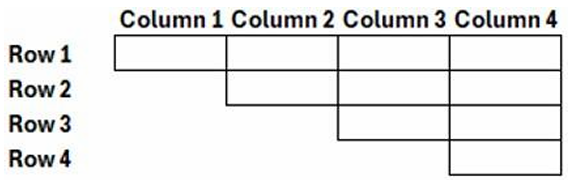
| Column 1 | Column 2 | Column 3 | Column 4 | |
|---|---|---|---|---|
| Row 1 | □ | □ | □ | □ |
| Row 2 | □ | □ | □ | |
| Row 3 | □ | □ | ||
| Row 4 | □ |
(Row 1 has 4 slots in Columns 1–4; Row 2 has 3 slots in Columns 2–4; Row 3 has 2 slots in Columns 3–4; Row 4 has 1 slot in Column 4 — ten slots in all.)
1. Numbers in any row appear in an increasing order from left to right.
2. Numbers in any column appear in a decreasing order from top to bottom.
3. 1 is placed either in the same row or in the same column as 10.
4. Neither 2 nor 3 is placed in the same row or in the same column as 10.
5. Neither 7 nor 8 is placed in the same row or in the same column as 9.
6. 4 and 6 are placed in the same row.
What is the row number which has the least sum of numbers placed in that row?
Passage / Data
Answer the following questions based on the information given below.
The numbers 1, 2, 3, 4, 5, 6, 7, 8, 9, and 10 are placed in ten slots of the following grid based on the conditions below.
| Column 1 | Column 2 | Column 3 | Column 4 | |
|---|---|---|---|---|
| Row 1 | □ | □ | □ | □ |
| Row 2 | □ | □ | □ | |
| Row 3 | □ | □ | ||
| Row 4 | □ |
(Row 1 has 4 slots in Columns 1–4; Row 2 has 3 slots in Columns 2–4; Row 3 has 2 slots in Columns 3–4; Row 4 has 1 slot in Column 4 — ten slots in all.)
1. Numbers in any row appear in an increasing order from left to right.
2. Numbers in any column appear in a decreasing order from top to bottom.
3. 1 is placed either in the same row or in the same column as 10.
4. Neither 2 nor 3 is placed in the same row or in the same column as 10.
5. Neither 7 nor 8 is placed in the same row or in the same column as 9.
6. 4 and 6 are placed in the same row.
Which of the following statements MUST be true?
I. 10 is placed in a slot in Row 1.
II. 1 is placed in a slot in Row 4.
Passage / Data
Answer the following questions based on the information given below.
The numbers 1, 2, 3, 4, 5, 6, 7, 8, 9, and 10 are placed in ten slots of the following grid based on the conditions below.
| Column 1 | Column 2 | Column 3 | Column 4 | |
|---|---|---|---|---|
| Row 1 | □ | □ | □ | □ |
| Row 2 | □ | □ | □ | |
| Row 3 | □ | □ | ||
| Row 4 | □ |
(Row 1 has 4 slots in Columns 1–4; Row 2 has 3 slots in Columns 2–4; Row 3 has 2 slots in Columns 3–4; Row 4 has 1 slot in Column 4 — ten slots in all.)
1. Numbers in any row appear in an increasing order from left to right.
2. Numbers in any column appear in a decreasing order from top to bottom.
3. 1 is placed either in the same row or in the same column as 10.
4. Neither 2 nor 3 is placed in the same row or in the same column as 10.
5. Neither 7 nor 8 is placed in the same row or in the same column as 9.
6. 4 and 6 are placed in the same row.
Which of the following statements MUST be true?
I. 2 is placed in a slot in Column 2.
II. 3 is placed in a slot in Column 3.
Passage / Data
Answer the following questions based on the information given below.
The numbers 1, 2, 3, 4, 5, 6, 7, 8, 9, and 10 are placed in ten slots of the following grid based on the conditions below.
| Column 1 | Column 2 | Column 3 | Column 4 | |
|---|---|---|---|---|
| Row 1 | □ | □ | □ | □ |
| Row 2 | □ | □ | □ | |
| Row 3 | □ | □ | ||
| Row 4 | □ |
(Row 1 has 4 slots in Columns 1–4; Row 2 has 3 slots in Columns 2–4; Row 3 has 2 slots in Columns 3–4; Row 4 has 1 slot in Column 4 — ten slots in all.)
1. Numbers in any row appear in an increasing order from left to right.
2. Numbers in any column appear in a decreasing order from top to bottom.
3. 1 is placed either in the same row or in the same column as 10.
4. Neither 2 nor 3 is placed in the same row or in the same column as 10.
5. Neither 7 nor 8 is placed in the same row or in the same column as 9.
6. 4 and 6 are placed in the same row.
For how many slots in the grid, placement of numbers CANNOT be determined with certainty?
Passage / Data
Answer the following questions based on the information given below.
The numbers 1, 2, 3, 4, 5, 6, 7, 8, 9, and 10 are placed in ten slots of the following grid based on the conditions below.
| Column 1 | Column 2 | Column 3 | Column 4 | |
|---|---|---|---|---|
| Row 1 | □ | □ | □ | □ |
| Row 2 | □ | □ | □ | |
| Row 3 | □ | □ | ||
| Row 4 | □ |
(Row 1 has 4 slots in Columns 1–4; Row 2 has 3 slots in Columns 2–4; Row 3 has 2 slots in Columns 3–4; Row 4 has 1 slot in Column 4 — ten slots in all.)
1. Numbers in any row appear in an increasing order from left to right.
2. Numbers in any column appear in a decreasing order from top to bottom.
3. 1 is placed either in the same row or in the same column as 10.
4. Neither 2 nor 3 is placed in the same row or in the same column as 10.
5. Neither 7 nor 8 is placed in the same row or in the same column as 9.
6. 4 and 6 are placed in the same row.
What is the sum of the numbers placed in Column 4?
Passage / Data
Answer the following questions based on the information given below.
An online e-commerce firm receives daily integer product ratings from 1 through 5 given by buyers. The daily average is the average of the ratings given on that day. The cumulative average is the average of all ratings given on or before that day. The rating system began on Day 1, and the cumulative averages were 3 and 3.1 at the end of Day 1 and Day 2, respectively. The distribution of ratings on Day 2 is given in the figure below.
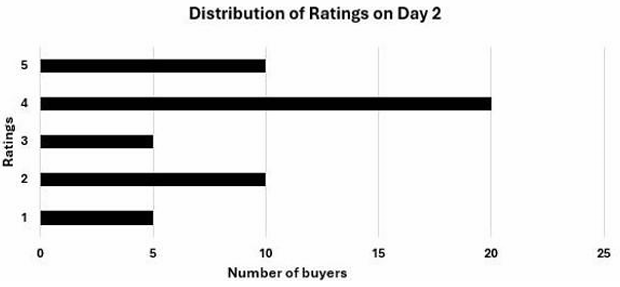
| Rating (Day 2) | 1 | 2 | 3 | 4 | 5 |
|---|---|---|---|---|---|
| Number of buyers | 5 | 10 | 5 | 20 | 10 |
The following information is known about ratings on Day 3.
1. 100 buyers gave product ratings on Day 3.
2. The modes of the product ratings were 4 and 5.
3. The numbers of buyers giving each product rating are non-zero multiples of 10.
4. The same number of buyers gave product ratings of 1 and 2, and that number is half the number of buyers who gave a rating of 3.
How many buyers gave ratings on Day 1?
Passage / Data
Answer the following questions based on the information given below.
An online e-commerce firm receives daily integer product ratings from 1 through 5 given by buyers. The daily average is the average of the ratings given on that day. The cumulative average is the average of all ratings given on or before that day. The rating system began on Day 1, and the cumulative averages were 3 and 3.1 at the end of Day 1 and Day 2, respectively. The distribution of ratings on Day 2 is given in the figure below.
| Rating (Day 2) | 1 | 2 | 3 | 4 | 5 |
|---|---|---|---|---|---|
| Number of buyers | 5 | 10 | 5 | 20 | 10 |
The following information is known about ratings on Day 3.
1. 100 buyers gave product ratings on Day 3.
2. The modes of the product ratings were 4 and 5.
3. The numbers of buyers giving each product rating are non-zero multiples of 10.
4. The same number of buyers gave product ratings of 1 and 2, and that number is half the number of buyers who gave a rating of 3.
What is the daily average rating of Day 3?
Passage / Data
Answer the following questions based on the information given below.
An online e-commerce firm receives daily integer product ratings from 1 through 5 given by buyers. The daily average is the average of the ratings given on that day. The cumulative average is the average of all ratings given on or before that day. The rating system began on Day 1, and the cumulative averages were 3 and 3.1 at the end of Day 1 and Day 2, respectively. The distribution of ratings on Day 2 is given in the figure below.
| Rating (Day 2) | 1 | 2 | 3 | 4 | 5 |
|---|---|---|---|---|---|
| Number of buyers | 5 | 10 | 5 | 20 | 10 |
The following information is known about ratings on Day 3.
1. 100 buyers gave product ratings on Day 3.
2. The modes of the product ratings were 4 and 5.
3. The numbers of buyers giving each product rating are non-zero multiples of 10.
4. The same number of buyers gave product ratings of 1 and 2, and that number is half the number of buyers who gave a rating of 3.
What is the median of all ratings given on Day 3?
Passage / Data
Answer the following questions based on the information given below.
An online e-commerce firm receives daily integer product ratings from 1 through 5 given by buyers. The daily average is the average of the ratings given on that day. The cumulative average is the average of all ratings given on or before that day. The rating system began on Day 1, and the cumulative averages were 3 and 3.1 at the end of Day 1 and Day 2, respectively. The distribution of ratings on Day 2 is given in the figure below.
| Rating (Day 2) | 1 | 2 | 3 | 4 | 5 |
|---|---|---|---|---|---|
| Number of buyers | 5 | 10 | 5 | 20 | 10 |
The following information is known about ratings on Day 3.
1. 100 buyers gave product ratings on Day 3.
2. The modes of the product ratings were 4 and 5.
3. The numbers of buyers giving each product rating are non-zero multiples of 10.
4. The same number of buyers gave product ratings of 1 and 2, and that number is half the number of buyers who gave a rating of 3.
Which of the following is true about the cumulative average ratings of Day 2 and Day 3?
Passage / Data
Answer the following questions based on the information given below.
Two students, Amiya and Ramya are the only candidates in an election for the position of class representative. Students will vote based on the intensity level of Amiya’s and Ramya’s campaigns and the type of campaigns they run. Each campaign is said to have a level of 1 if it is a staid campaign and a level of 2 if it is a vigorous campaign. Campaigns can be of two types, they can either focus on issues, or on attacking the other candidate.
If Amiya and Ramya both run campaigns focusing on issues, then
- The percentage of students voting in the election will be 20 times the sum of the levels of campaigning of the two students. For example, if Amiya and Ramya both run vigorous campaigns, then 20 × (2+2)%, that is, 80% of the students will vote in the election.
- Among voting students, the percentage of votes for each candidate will be proportional to the levels of their campaigns. For example, if Amiya runs a staid (i.e., level 1) campaign while Ramya runs a vigorous (i.e., level 2) campaign, then Amiya will receive 1/3 of the votes cast, and Ramya will receive the other 2/3. The above-mentioned percentages change as follows if at least one of them runs a campaign attacking their opponent.
- If Amiya runs a campaign attacking Ramya and Ramya runs a campaign focusing on issues, then 10% of the students who would have otherwise voted for Amiya will vote for Ramya, and another 10% who would have otherwise voted for Amiya, will not vote at all.
- If Ramya runs a campaign attacking Amiya and Amiya runs a campaign focusing on issues, then 20% of the students who would have otherwise voted for Ramya will vote for Amiya, and another 5% who would have otherwise voted for Ramya, will not vote at all.
- If both run campaigns attacking each other, then 10% of the students who would have otherwise voted for them had they run campaigns focusing on issues, will not vote at all.
What is the maximum possible voting margin with which one of the candidates can win?
Passage / Data
Answer the following questions based on the information given below:
Five restaurants, coded R1, R2, R3, R4 and R5 gave integer ratings to five gig workers – Ullas, Vasu, Waman, Xavier and Yusuf, on a scale of 1 to 5.
The means of the ratings given by R1, R2, R3, R4 and R5 were 3.4, 2.2, 3.8, 2.8 and 3.4 respectively.
The summary statistics of these ratings for the five workers is given below.
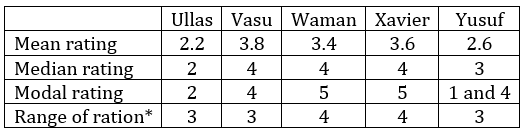
* Range of ratings is defined as the difference between the maximum and minimum ratings awarded to a worker.
The following is partial information about ratings of 1 and 5 awarded by the restaurants to the workers.
(a) R1 awarded a rating of 5 to Waman, as did R2 to Xavier, R3 to Waman and Xavier, and R5 to Vasu.
(b) R1 awarded a rating of 1 to Ullas, as did R2 to Waman and Yusuf, and R3 to Yusuf.
How many individual ratings cannot be determined from the above information?
Passage / Data
Answer the following questions based on the information given below:
Five restaurants, coded R1, R2, R3, R4 and R5 gave integer ratings to five gig workers – Ullas, Vasu, Waman, Xavier and Yusuf, on a scale of 1 to 5.
The means of the ratings given by R1, R2, R3, R4 and R5 were 3.4, 2.2, 3.8, 2.8 and 3.4 respectively.
The summary statistics of these ratings for the five workers is given below.
* Range of ratings is defined as the difference between the maximum and minimum ratings awarded to a worker.
The following is partial information about ratings of 1 and 5 awarded by the restaurants to the workers.
(a) R1 awarded a rating of 5 to Waman, as did R2 to Xavier, R3 to Waman and Xavier, and R5 to Vasu.
(b) R1 awarded a rating of 1 to Ullas, as did R2 to Waman and Yusuf, and R3 to Yusuf.
To how many workers did R2 give a rating of 4?
Passage / Data
Answer the following questions based on the information given below:
Five restaurants, coded R1, R2, R3, R4 and R5 gave integer ratings to five gig workers – Ullas, Vasu, Waman, Xavier and Yusuf, on a scale of 1 to 5.
The means of the ratings given by R1, R2, R3, R4 and R5 were 3.4, 2.2, 3.8, 2.8 and 3.4 respectively.
The summary statistics of these ratings for the five workers is given below.
* Range of ratings is defined as the difference between the maximum and minimum ratings awarded to a worker.
The following is partial information about ratings of 1 and 5 awarded by the restaurants to the workers.
(a) R1 awarded a rating of 5 to Waman, as did R2 to Xavier, R3 to Waman and Xavier, and R5 to Vasu.
(b) R1 awarded a rating of 1 to Ullas, as did R2 to Waman and Yusuf, and R3 to Yusuf.
What rating did R1 give to Xavier?
Passage / Data
Answer the following questions based on the information given below:
Five restaurants, coded R1, R2, R3, R4 and R5 gave integer ratings to five gig workers – Ullas, Vasu, Waman, Xavier and Yusuf, on a scale of 1 to 5.
The means of the ratings given by R1, R2, R3, R4 and R5 were 3.4, 2.2, 3.8, 2.8 and 3.4 respectively.
The summary statistics of these ratings for the five workers is given below.
* Range of ratings is defined as the difference between the maximum and minimum ratings awarded to a worker.
The following is partial information about ratings of 1 and 5 awarded by the restaurants to the workers.
(a) R1 awarded a rating of 5 to Waman, as did R2 to Xavier, R3 to Waman and Xavier, and R5 to Vasu.
(b) R1 awarded a rating of 1 to Ullas, as did R2 to Waman and Yusuf, and R3 to Yusuf.
What is the median of the ratings given by R3 to the five workers?
Passage / Data
Answer the following questions based on the information given below:
Five restaurants, coded R1, R2, R3, R4 and R5 gave integer ratings to five gig workers – Ullas, Vasu, Waman, Xavier and Yusuf, on a scale of 1 to 5.
The means of the ratings given by R1, R2, R3, R4 and R5 were 3.4, 2.2, 3.8, 2.8 and 3.4 respectively.
The summary statistics of these ratings for the five workers is given below.
* Range of ratings is defined as the difference between the maximum and minimum ratings awarded to a worker.
The following is partial information about ratings of 1 and 5 awarded by the restaurants to the workers.
(a) R1 awarded a rating of 5 to Waman, as did R2 to Xavier, R3 to Waman and Xavier, and R5 to Vasu.
(b) R1 awarded a rating of 1 to Ullas, as did R2 to Waman and Yusuf, and R3 to Yusuf.
Which among the following restaurants gave its median rating to exactly one of the workers?
Passage / Data
Answer the following questions based on the information given below:
Odsville has five firms – Alfloo, Bzygoo, Czechy, Drjbna and Elavalaki. Each of these firms was founded in some year and also closed down a few years later.
Each firm raised Rs. 1 crore in its first and last year of existence. The amount each firm raised every year increased until it reached a maximum, and then decreased until the firm closed down. No firm raised the same amount of money in two consecutive years. Each annual increase and decrease was either by Rs. 1 crore or by Rs. 2 crores.
The table below provides partial information about the five firms.
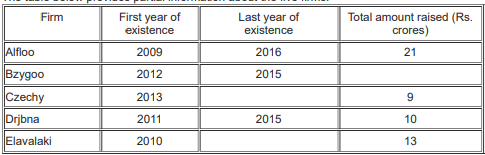
For which firm(s) can the amounts raised by them be concluded with certainty in each year?
Passage / Data
Answer the following questions based on the information given below:
Odsville has five firms – Alfloo, Bzygoo, Czechy, Drjbna and Elavalaki. Each of these firms was founded in some year and also closed down a few years later.
Each firm raised Rs. 1 crore in its first and last year of existence. The amount each firm raised every year increased until it reached a maximum, and then decreased until the firm closed down. No firm raised the same amount of money in two consecutive years. Each annual increase and decrease was either by Rs. 1 crore or by Rs. 2 crores.
The table below provides partial information about the five firms.
What best can be concluded about the total amount of money raised in 2015?
Passage / Data
Answer the following questions based on the information given below:
Odsville has five firms – Alfloo, Bzygoo, Czechy, Drjbna and Elavalaki. Each of these firms was founded in some year and also closed down a few years later.
Each firm raised Rs. 1 crore in its first and last year of existence. The amount each firm raised every year increased until it reached a maximum, and then decreased until the firm closed down. No firm raised the same amount of money in two consecutive years. Each annual increase and decrease was either by Rs. 1 crore or by Rs. 2 crores.
The table below provides partial information about the five firms.
What is the largest possible total amount of money (in Rs. crores) that could have been raised in 2013?
Passage / Data
Answer the following questions based on the information given below:
Odsville has five firms – Alfloo, Bzygoo, Czechy, Drjbna and Elavalaki. Each of these firms was founded in some year and also closed down a few years later.
Each firm raised Rs. 1 crore in its first and last year of existence. The amount each firm raised every year increased until it reached a maximum, and then decreased until the firm closed down. No firm raised the same amount of money in two consecutive years. Each annual increase and decrease was either by Rs. 1 crore or by Rs. 2 crores.
The table below provides partial information about the five firms.
If Elavalaki raised Rs. 3 crores in 2013, then what is the smallest possible total amount of money (in Rs. crores) that could have been raised by all the companies in 2012?
Passage / Data
Answer the following questions based on the information given below:
Odsville has five firms – Alfloo, Bzygoo, Czechy, Drjbna and Elavalaki. Each of these firms was founded in some year and also closed down a few years later.
Each firm raised Rs. 1 crore in its first and last year of existence. The amount each firm raised every year increased until it reached a maximum, and then decreased until the firm closed down. No firm raised the same amount of money in two consecutive years. Each annual increase and decrease was either by Rs. 1 crore or by Rs. 2 crores.
The table below provides partial information about the five firms.
If the total amount of money raised in 2014 is Rs. 12 crores, then which of the following is not possible?
Passage / Data
Answer the following questions based on the information given below:
Three participants – Akhil, Bimal and Chatur participate in a random draw competition for five days. Every day, each participant randomly picks up a ball numbered between 1 and 9. The number on the ball determines his score on that day. The total score of a participant is the sum of his scores attained in the five days. The total score of a day is the sum of participants’ scores on that day. The 2-day average on a day, except on Day 1, is the average of the total scores of that day and of the previous day. For example, if the total scores of Day 1 and Day 2 are 25 and 20, then the 2-day average on Day 2 is calculated as 22.5. Table 1 gives the 2-day averages for

Participants are ranked each day, with the person having the maximum score being awarded the minimum rank (1) on that day. If there is a tie, all participants with the tied score are awarded the best available rank. For example, if on a day Akhil, Bimal, and Chatur score 8, 7 and 7 respectively, then their ranks will be 1, 2 and 2 respectively on that day. These ranks are given in Table 2.
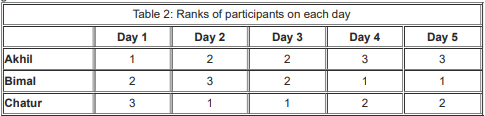
The following information is also known.
- Chatur always scores in multiples of 3. His score on Day 2 is the unique highest score in the competition. His minimum score is observed only on Day 1, and it matches Akhil’s score on Day 4.
- The total score on Day 3 is the same as the total score on Day 4.
- Bimal’s scores are the same on Day 1 and Day 3.
What is Akhil's score on Day 1?
Passage / Data
Answer the following questions based on the information given below:
Three participants – Akhil, Bimal and Chatur participate in a random draw competition for five days. Every day, each participant randomly picks up a ball numbered between 1 and 9. The number on the ball determines his score on that day. The total score of a participant is the sum of his scores attained in the five days. The total score of a day is the sum of participants’ scores on that day. The 2-day average on a day, except on Day 1, is the average of the total scores of that day and of the previous day. For example, if the total scores of Day 1 and Day 2 are 25 and 20, then the 2-day average on Day 2 is calculated as 22.5. Table 1 gives the 2-day averages for
Participants are ranked each day, with the person having the maximum score being awarded the minimum rank (1) on that day. If there is a tie, all participants with the tied score are awarded the best available rank. For example, if on a day Akhil, Bimal, and Chatur score 8, 7 and 7 respectively, then their ranks will be 1, 2 and 2 respectively on that day. These ranks are given in Table 2.
The following information is also known.
- Chatur always scores in multiples of 3. His score on Day 2 is the unique highest score in the competition. His minimum score is observed only on Day 1, and it matches Akhil’s score on Day 4.
- The total score on Day 3 is the same as the total score on Day 4.
- Bimal’s scores are the same on Day 1 and Day 3.
Who attains the maximum total score?
Passage / Data
Answer the following questions based on the information given below:
Three participants – Akhil, Bimal and Chatur participate in a random draw competition for five days. Every day, each participant randomly picks up a ball numbered between 1 and 9. The number on the ball determines his score on that day. The total score of a participant is the sum of his scores attained in the five days. The total score of a day is the sum of participants’ scores on that day. The 2-day average on a day, except on Day 1, is the average of the total scores of that day and of the previous day. For example, if the total scores of Day 1 and Day 2 are 25 and 20, then the 2-day average on Day 2 is calculated as 22.5. Table 1 gives the 2-day averages for
Participants are ranked each day, with the person having the maximum score being awarded the minimum rank (1) on that day. If there is a tie, all participants with the tied score are awarded the best available rank. For example, if on a day Akhil, Bimal, and Chatur score 8, 7 and 7 respectively, then their ranks will be 1, 2 and 2 respectively on that day. These ranks are given in Table 2.
The following information is also known.
- Chatur always scores in multiples of 3. His score on Day 2 is the unique highest score in the competition. His minimum score is observed only on Day 1, and it matches Akhil’s score on Day 4.
- The total score on Day 3 is the same as the total score on Day 4.
- Bimal’s scores are the same on Day 1 and Day 3.
What is the minimum possible total score of Bimal?
Passage / Data
Answer the following questions based on the information given below:
Three participants – Akhil, Bimal and Chatur participate in a random draw competition for five days. Every day, each participant randomly picks up a ball numbered between 1 and 9. The number on the ball determines his score on that day. The total score of a participant is the sum of his scores attained in the five days. The total score of a day is the sum of participants’ scores on that day. The 2-day average on a day, except on Day 1, is the average of the total scores of that day and of the previous day. For example, if the total scores of Day 1 and Day 2 are 25 and 20, then the 2-day average on Day 2 is calculated as 22.5. Table 1 gives the 2-day averages for
Participants are ranked each day, with the person having the maximum score being awarded the minimum rank (1) on that day. If there is a tie, all participants with the tied score are awarded the best available rank. For example, if on a day Akhil, Bimal, and Chatur score 8, 7 and 7 respectively, then their ranks will be 1, 2 and 2 respectively on that day. These ranks are given in Table 2.
The following information is also known.
- Chatur always scores in multiples of 3. His score on Day 2 is the unique highest score in the competition. His minimum score is observed only on Day 1, and it matches Akhil’s score on Day 4.
- The total score on Day 3 is the same as the total score on Day 4.
- Bimal’s scores are the same on Day 1 and Day 3.
If Akhil attains a total score of 24, then what is the total score of Bimal?
Passage / Data
Answer the following questions based on the information given below:
In a coaching class, some students register online, and some others register offline. No student registers both online and offline; hence the total registration number is the sum of online and offline registrations. The following facts and table pertain to these registration numbers for the five months – January to May of 2023. The table shows the minimum, maximum, median registration numbers of these five months, separately for online, offline and total number of registrations. The following additional facts are known.
1. In every month, both online and offline registration numbers were multiples of 10.
2. In January, the number of offline registrations was twice that of online registrations.
3. In April, the number of online registrations was twice that of offline registrations.
4. The number of online registrations in March was the same as the number of offline registrations in February.
5. The number of online registrations was the largest in May.
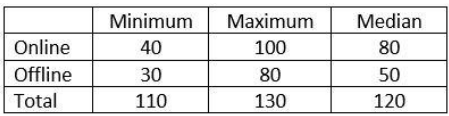
What was the total number of registrations in April?
Passage / Data
Answer the following questions based on the information given below:
In a coaching class, some students register online, and some others register offline. No student registers both online and offline; hence the total registration number is the sum of online and offline registrations. The following facts and table pertain to these registration numbers for the five months – January to May of 2023. The table shows the minimum, maximum, median registration numbers of these five months, separately for online, offline and total number of registrations. The following additional facts are known.
1. In every month, both online and offline registration numbers were multiples of 10.
2. In January, the number of offline registrations was twice that of online registrations.
3. In April, the number of online registrations was twice that of offline registrations.
4. The number of online registrations in March was the same as the number of offline registrations in February.
5. The number of online registrations was the largest in May.
What was the number of online registrations in January?
Passage / Data
Answer the following questions based on the information given below:
In a coaching class, some students register online, and some others register offline. No student registers both online and offline; hence the total registration number is the sum of online and offline registrations. The following facts and table pertain to these registration numbers for the five months – January to May of 2023. The table shows the minimum, maximum, median registration numbers of these five months, separately for online, offline and total number of registrations. The following additional facts are known.
1. In every month, both online and offline registration numbers were multiples of 10.
2. In January, the number of offline registrations was twice that of online registrations.
3. In April, the number of online registrations was twice that of offline registrations.
4. The number of online registrations in March was the same as the number of offline registrations in February.
5. The number of online registrations was the largest in May.
Which of the following statements can be true?
I. The number of offline registrations was the smallest in May.
II. The total number of registrations was the smallest in February.
Passage / Data
Answer the following questions based on the information given below:
In a coaching class, some students register online, and some others register offline. No student registers both online and offline; hence the total registration number is the sum of online and offline registrations. The following facts and table pertain to these registration numbers for the five months – January to May of 2023. The table shows the minimum, maximum, median registration numbers of these five months, separately for online, offline and total number of registrations. The following additional facts are known.
1. In every month, both online and offline registration numbers were multiples of 10.
2. In January, the number of offline registrations was twice that of online registrations.
3. In April, the number of online registrations was twice that of offline registrations.
4. The number of online registrations in March was the same as the number of offline registrations in February.
5. The number of online registrations was the largest in May.
What best can be concluded about the number of offline registrations in February?
Passage / Data
Answer the following questions based on the information given below:
In a coaching class, some students register online, and some others register offline. No student registers both online and offline; hence the total registration number is the sum of online and offline registrations. The following facts and table pertain to these registration numbers for the five months – January to May of 2023. The table shows the minimum, maximum, median registration numbers of these five months, separately for online, offline and total number of registrations. The following additional facts are known.
1. In every month, both online and offline registration numbers were multiples of 10.
2. In January, the number of offline registrations was twice that of online registrations.
3. In April, the number of online registrations was twice that of offline registrations.
4. The number of online registrations in March was the same as the number of offline registrations in February.
5. The number of online registrations was the largest in May.
Which pair of months definitely had the same total number of registrations?
I. January and April
II. February and May
Passage / Data
Answer the following questions based on the information given below:
There are only three female students – Amala, Koli and Rini – and only three male students – Biman, Mathew and Shyamal – in a course. The course has two evaluation components, a project and a test. The aggregate score in the course is a weighted average of the two components, with the weights being positive and adding to 1.
The projects are done in groups of two, with each group consisting of a female and a male student. Both the group members obtain the same score in the project.
The following additional facts are known about the scores in the project and the test.
1. The minimum, maximum and the average of both project and test scores were identical – 40, 80 and 60, respectively.
2. The test scores of the students were all multiples of 10; four of them were distinct and the remaining two were equal to the average test scores.
3. Amala’s score in the project was double that of Koli in the same, but Koli scored 20 more than Amala in the test. Yet Amala had the highest aggregate score.
4. Shyamal scored the second highest in the test. He scored two more than Koli, but two less than Amala in the aggregate.
5. Biman scored the second lowest in the test and the lowest in the aggregate.
6. Mathew scored more than Rini in the project, but less than her in the test.
What was Rini’s score in the project?
Passage / Data
Answer the following questions based on the information given below:
There are only three female students – Amala, Koli and Rini – and only three male students – Biman, Mathew and Shyamal – in a course. The course has two evaluation components, a project and a test. The aggregate score in the course is a weighted average of the two components, with the weights being positive and adding to 1.
The projects are done in groups of two, with each group consisting of a female and a male student. Both the group members obtain the same score in the project.
The following additional facts are known about the scores in the project and the test.
1. The minimum, maximum and the average of both project and test scores were identical – 40, 80 and 60, respectively.
2. The test scores of the students were all multiples of 10; four of them were distinct and the remaining two were equal to the average test scores.
3. Amala’s score in the project was double that of Koli in the same, but Koli scored 20 more than Amala in the test. Yet Amala had the highest aggregate score.
4. Shyamal scored the second highest in the test. He scored two more than Koli, but two less than Amala in the aggregate.
5. Biman scored the second lowest in the test and the lowest in the aggregate.
6. Mathew scored more than Rini in the project, but less than her in the test.
What was the weight of the test component?
Passage / Data
Answer the following questions based on the information given below:
There are only three female students – Amala, Koli and Rini – and only three male students – Biman, Mathew and Shyamal – in a course. The course has two evaluation components, a project and a test. The aggregate score in the course is a weighted average of the two components, with the weights being positive and adding to 1.
The projects are done in groups of two, with each group consisting of a female and a male student. Both the group members obtain the same score in the project.
The following additional facts are known about the scores in the project and the test.
1. The minimum, maximum and the average of both project and test scores were identical – 40, 80 and 60, respectively.
2. The test scores of the students were all multiples of 10; four of them were distinct and the remaining two were equal to the average test scores.
3. Amala’s score in the project was double that of Koli in the same, but Koli scored 20 more than Amala in the test. Yet Amala had the highest aggregate score.
4. Shyamal scored the second highest in the test. He scored two more than Koli, but two less than Amala in the aggregate.
5. Biman scored the second lowest in the test and the lowest in the aggregate.
6. Mathew scored more than Rini in the project, but less than her in the test.
What was the maximum aggregate score obtained by the students?
Passage / Data
Answer the following questions based on the information given below:
There are only three female students – Amala, Koli and Rini – and only three male students – Biman, Mathew and Shyamal – in a course. The course has two evaluation components, a project and a test. The aggregate score in the course is a weighted average of the two components, with the weights being positive and adding to 1.
The projects are done in groups of two, with each group consisting of a female and a male student. Both the group members obtain the same score in the project.
The following additional facts are known about the scores in the project and the test.
1. The minimum, maximum and the average of both project and test scores were identical – 40, 80 and 60, respectively.
2. The test scores of the students were all multiples of 10; four of them were distinct and the remaining two were equal to the average test scores.
3. Amala’s score in the project was double that of Koli in the same, but Koli scored 20 more than Amala in the test. Yet Amala had the highest aggregate score.
4. Shyamal scored the second highest in the test. He scored two more than Koli, but two less than Amala in the aggregate.
5. Biman scored the second lowest in the test and the lowest in the aggregate.
6. Mathew scored more than Rini in the project, but less than her in the test.
What was Mathew’s score in the test?
Passage / Data
Answer the following questions based on the information given below:
There are only three female students – Amala, Koli and Rini – and only three male students – Biman, Mathew and Shyamal – in a course. The course has two evaluation components, a project and a test. The aggregate score in the course is a weighted average of the two components, with the weights being positive and adding to 1.
The projects are done in groups of two, with each group consisting of a female and a male student. Both the group members obtain the same score in the project.
The following additional facts are known about the scores in the project and the test.
1. The minimum, maximum and the average of both project and test scores were identical – 40, 80 and 60, respectively.
2. The test scores of the students were all multiples of 10; four of them were distinct and the remaining two were equal to the average test scores.
3. Amala’s score in the project was double that of Koli in the same, but Koli scored 20 more than Amala in the test. Yet Amala had the highest aggregate score.
4. Shyamal scored the second highest in the test. He scored two more than Koli, but two less than Amala in the aggregate.
5. Biman scored the second lowest in the test and the lowest in the aggregate.
6. Mathew scored more than Rini in the project, but less than her in the test.
Which of the following pairs of students were part of the same project team?
i) Amala and Biman
ii) Koli and Mathew
Passage / Data
Answer the next 5 questions based on the information given below:
Adhara, Bithi, Chhaya, Dhanavi, Esther, and Fathima are the interviewers in a process that awards funding for new initiatives. Every interviewer individually interviews each of the candidates individually and awards a token only if she recommends funding. A token has a face value of 2, 3, 5, 7, 11, or 13. Each interviewer awards tokens of a single face value only.
Once all six interviews are over for a candidate, the candidate receives a funding that is Rs.1000 times the product of the face values of all the tokens. For example, if a candidate has tokens with face values 2, 5, and 7, then they get a funding of Rs.1000 × (2 × 5 × 7) = Rs.70,000.
Pragnyaa, Qahira, Rasheeda, Smera, and Tantra were five candidates who received funding. The funds they received, in descending order, were Rs.390,000, Rs.210,000, Rs.165,000, Rs.77,000, and Rs.66,000.
The following additional facts are known:
1. Fathima awarded tokens to everyone except Qahira, while Adhara awarded tokens to no one except Pragnyaa.
2. Rashida received the highest number of tokens that anyone received, but she did not receive one from Esther.
3. Bithi awarded a token to Smera but not to Qahira, while Dhanavi awarded a token to Qahira but not to Smera.
How many tokens did Qahira receive?
Passage / Data
Answer the next 5 questions based on the information given below:
Adhara, Bithi, Chhaya, Dhanavi, Esther, and Fathima are the interviewers in a process that awards funding for new initiatives. Every interviewer individually interviews each of the candidates individually and awards a token only if she recommends funding. A token has a face value of 2, 3, 5, 7, 11, or 13. Each interviewer awards tokens of a single face value only.
Once all six interviews are over for a candidate, the candidate receives a funding that is Rs.1000 times the product of the face values of all the tokens. For example, if a candidate has tokens with face values 2, 5, and 7, then they get a funding of Rs.1000 × (2 × 5 × 7) = Rs.70,000.
Pragnyaa, Qahira, Rasheeda, Smera, and Tantra were five candidates who received funding. The funds they received, in descending order, were Rs.390,000, Rs.210,000, Rs.165,000, Rs.77,000, and Rs.66,000.
The following additional facts are known:
1. Fathima awarded tokens to everyone except Qahira, while Adhara awarded tokens to no one except Pragnyaa.
2. Rashida received the highest number of tokens that anyone received, but she did not receive one from Esther.
3. Bithi awarded a token to Smera but not to Qahira, while Dhanavi awarded a token to Qahira but not to Smera.
Who among the following definitely received a token from Bithi but not from Dhanavi?
Passage / Data
Answer the next 5 questions based on the information given below:
Adhara, Bithi, Chhaya, Dhanavi, Esther, and Fathima are the interviewers in a process that awards funding for new initiatives. Every interviewer individually interviews each of the candidates individually and awards a token only if she recommends funding. A token has a face value of 2, 3, 5, 7, 11, or 13. Each interviewer awards tokens of a single face value only.
Once all six interviews are over for a candidate, the candidate receives a funding that is Rs.1000 times the product of the face values of all the tokens. For example, if a candidate has tokens with face values 2, 5, and 7, then they get a funding of Rs.1000 × (2 × 5 × 7) = Rs.70,000.
Pragnyaa, Qahira, Rasheeda, Smera, and Tantra were five candidates who received funding. The funds they received, in descending order, were Rs.390,000, Rs.210,000, Rs.165,000, Rs.77,000, and Rs.66,000.
The following additional facts are known:
1. Fathima awarded tokens to everyone except Qahira, while Adhara awarded tokens to no one except Pragnyaa.
2. Rashida received the highest number of tokens that anyone received, but she did not receive one from Esther.
3. Bithi awarded a token to Smera but not to Qahira, while Dhanavi awarded a token to Qahira but not to Smera.
How many tokens did Chhaya award?
Passage / Data
Answer the next 5 questions based on the information given below:
Adhara, Bithi, Chhaya, Dhanavi, Esther, and Fathima are the interviewers in a process that awards funding for new initiatives. Every interviewer individually interviews each of the candidates individually and awards a token only if she recommends funding. A token has a face value of 2, 3, 5, 7, 11, or 13. Each interviewer awards tokens of a single face value only.
Once all six interviews are over for a candidate, the candidate receives a funding that is Rs.1000 times the product of the face values of all the tokens. For example, if a candidate has tokens with face values 2, 5, and 7, then they get a funding of Rs.1000 × (2 × 5 × 7) = Rs.70,000.
Pragnyaa, Qahira, Rasheeda, Smera, and Tantra were five candidates who received funding. The funds they received, in descending order, were Rs.390,000, Rs.210,000, Rs.165,000, Rs.77,000, and Rs.66,000.
The following additional facts are known:
1. Fathima awarded tokens to everyone except Qahira, while Adhara awarded tokens to no one except Pragnyaa.
2. Rashida received the highest number of tokens that anyone received, but she did not receive one from Esther.
3. Bithi awarded a token to Smera but not to Qahira, while Dhanavi awarded a token to Qahira but not to Smera.
How many tokens did Smera receive?
Passage / Data
Answer the next 5 questions based on the information given below:
Adhara, Bithi, Chhaya, Dhanavi, Esther, and Fathima are the interviewers in a process that awards funding for new initiatives. Every interviewer individually interviews each of the candidates individually and awards a token only if she recommends funding. A token has a face value of 2, 3, 5, 7, 11, or 13. Each interviewer awards tokens of a single face value only.
Once all six interviews are over for a candidate, the candidate receives a funding that is Rs.1000 times the product of the face values of all the tokens. For example, if a candidate has tokens with face values 2, 5, and 7, then they get a funding of Rs.1000 × (2 × 5 × 7) = Rs.70,000.
Pragnyaa, Qahira, Rasheeda, Smera, and Tantra were five candidates who received funding. The funds they received, in descending order, were Rs.390,000, Rs.210,000, Rs.165,000, Rs.77,000, and Rs.66,000.
The following additional facts are known:
1. Fathima awarded tokens to everyone except Qahira, while Adhara awarded tokens to no one except Pragnyaa.
2. Rashida received the highest number of tokens that anyone received, but she did not receive one from Esther.
3. Bithi awarded a token to Smera but not to Qahira, while Dhanavi awarded a token to Qahira but not to Smera.
Which of the following could be the amount of funding that Tantra received?
(a) Rs. 66,000
(b) Rs. 165,000
Passage / Data
Answer the next 4 questions based on the information given
Each of the bottles mentioned in this question contains 50 ml of liquid. The liquid in any bottle can be 100% pure content (P) or can have certain amount of impurity (I). Visually it is not possible to distinguish between P and I. There is a testing device which detects impurity, as long as the percentage of impurity in the content tested is 10% or more.
For example, suppose bottle 1 contains only P, and bottle 2 contains 80% P and 20% I. If content from bottle 1 is tested, it will be found out that it contains only P. If content of bottle 2 is tested, the test will reveal that it contains some amount of I. If 10 ml of content from bottle 1 is mixed with 20 ml content from bottle 2, the test will show that the mixture has impurity, and hence we can conclude that at least one of the two bottles has I. However, if 10 ml of content from bottle 1 is mixed with 5 ml of content from bottle 2. the test will not detect any impurity in the resultant mixture.
5 ml of content from bottle A is mixed with 5 ml of content from bottle B. The resultant mixture, when tested, detects the presence of I. If it is known that bottle A contains only P, what BEST can be concluded about the volume of I in bottle B?
Passage / Data
Answer the next 4 questions based on the information given
Each of the bottles mentioned in this question contains 50 ml of liquid. The liquid in any bottle can be 100% pure content (P) or can have certain amount of impurity (I). Visually it is not possible to distinguish between P and I. There is a testing device which detects impurity, as long as the percentage of impurity in the content tested is 10% or more.
For example, suppose bottle 1 contains only P, and bottle 2 contains 80% P and 20% I. If content from bottle 1 is tested, it will be found out that it contains only P. If content of bottle 2 is tested, the test will reveal that it contains some amount of I. If 10 ml of content from bottle 1 is mixed with 20 ml content from bottle 2, the test will show that the mixture has impurity, and hence we can conclude that at least one of the two bottles has I. However, if 10 ml of content from bottle 1 is mixed with 5 ml of content from bottle 2. the test will not detect any impurity in the resultant mixture.
There are four bottles. Each bottle is known to contain only P or only I. They will be considered to be “collectively ready for despatch” if all of them contain only P. In minimum how many tests, is it possible to ascertain whether these four bottles are “collectively ready for despatch”?
Passage / Data
Answer the next 4 questions based on the information given
Each of the bottles mentioned in this question contains 50 ml of liquid. The liquid in any bottle can be 100% pure content (P) or can have certain amount of impurity (I). Visually it is not possible to distinguish between P and I. There is a testing device which detects impurity, as long as the percentage of impurity in the content tested is 10% or more.
For example, suppose bottle 1 contains only P, and bottle 2 contains 80% P and 20% I. If content from bottle 1 is tested, it will be found out that it contains only P. If content of bottle 2 is tested, the test will reveal that it contains some amount of I. If 10 ml of content from bottle 1 is mixed with 20 ml content from bottle 2, the test will show that the mixture has impurity, and hence we can conclude that at least one of the two bottles has I. However, if 10 ml of content from bottle 1 is mixed with 5 ml of content from bottle 2. the test will not detect any impurity in the resultant mixture.
There are four bottles. It is known that three of these bottles contain only P, while the remaining one contains 80% P and 20% I. What is the minimum number of tests required to definitely identify the bottle containing some amount of I?
Passage / Data
Answer the next 4 questions based on the information given
Each of the bottles mentioned in this question contains 50 ml of liquid. The liquid in any bottle can be 100% pure content (P) or can have certain amount of impurity (I). Visually it is not possible to distinguish between P and I. There is a testing device which detects impurity, as long as the percentage of impurity in the content tested is 10% or more.
For example, suppose bottle 1 contains only P, and bottle 2 contains 80% P and 20% I. If content from bottle 1 is tested, it will be found out that it contains only P. If content of bottle 2 is tested, the test will reveal that it contains some amount of I. If 10 ml of content from bottle 1 is mixed with 20 ml content from bottle 2, the test will show that the mixture has impurity, and hence we can conclude that at least one of the two bottles has I. However, if 10 ml of content from bottle 1 is mixed with 5 ml of content from bottle 2. the test will not detect any impurity in the resultant mixture.
There are four bottles. It is known that either one or two of these bottles contain(s) only P, while the remaining ones contain 85% P and 15% I. What is the minimum number of tests required to ascertain the exact number of bottles containing only P?
Passage / Data
Answer the following question based on the information given below.
A new game show on TV has 100 boxes numbered 1, 2, . . . , 100 in a row, each containing a mystery prize. The prizes are items of different types, a, b, c, . . . , in decreasing order of value. The most expensive item is of type a, a diamond ring, and there is exactly one of these. You are told that the number of items at least doubles as you move to the next type. For example, there would be at least twice as many items of type b as of type a, at least twice as many items of type c as of type b and so on. There is no particular order in which the prizes are placed in the boxes.
What is the minimum possible number of different types of prizes?
Passage / Data
Answer the following question based on the information given below.
A new game show on TV has 100 boxes numbered 1, 2, . . . , 100 in a row, each containing a mystery prize. The prizes are items of different types, a, b, c, . . . , in decreasing order of value. The most expensive item is of type a, a diamond ring, and there is exactly one of these. You are told that the number of items at least doubles as you move to the next type. For example, there would be at least twice as many items of type b as of type a, at least twice as many items of type c as of type b and so on. There is no particular order in which the prizes are placed in the boxes.
What is the maximum possible number of different types of prizes?
Passage / Data
Answer the following question based on the information given below.
A new game show on TV has 100 boxes numbered 1, 2, . . . , 100 in a row, each containing a mystery prize. The prizes are items of different types, a, b, c, . . . , in decreasing order of value. The most expensive item is of type a, a diamond ring, and there is exactly one of these. You are told that the number of items at least doubles as you move to the next type. For example, there would be at least twice as many items of type b as of type a, at least twice as many items of type c as of type b and so on. There is no particular order in which the prizes are placed in the boxes.
Which of the following is not possible?
Passage / Data
Answer the following question based on the information given below.
A new game show on TV has 100 boxes numbered 1, 2, . . . , 100 in a row, each containing a mystery prize. The prizes are items of different types, a, b, c, . . . , in decreasing order of value. The most expensive item is of type a, a diamond ring, and there is exactly one of these. You are told that the number of items at least doubles as you move to the next type. For example, there would be at least twice as many items of type b as of type a, at least twice as many items of type c as of type b and so on. There is no particular order in which the prizes are placed in the boxes.
You ask for the type of item in box 45. Instead of being given a direct answer, you are told that there are 31 items of the same type as box 45 in boxes 1 to 44 and 43 items of the same type as box 45 in boxes 46 to 100.
What is the maximum possible number of different types of items?
Passage / Data
Answer the following question based on the information given below.
A company administers a written test comprising of three sections of 20 marks each – Data Interpretation (DI), Written English (WE) and General Awareness (GA), for recruitment. A composite score for a candidate (out of 80) is calculated by doubling her marks in DI and adding it to the sum of her marks in the other two sections. Candidates who score less than 70% marks in two or more sections are disqualified. From among the rest, the four with the highest composite scores are recruited. If four or less candidates qualify, all who qualify are recruited.
Ten candidates appeared for the written test. Their marks in the test are given in the table below. Some marks in the table are missing, but the following facts are known:
- No two candidates had the same composite score.
- Ajay was the unique highest scorer in WE.
- Among the four recruited, Geeta had the lowest composite score.
- Indu was recruited.
- Danish, Harini, and Indu had scored the same marks the in GA.
- Indu and Jatin both scored 100% in exactly one section and Jatin’s composite score was 10 more than Indu’s.
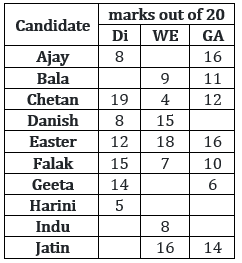
Which of the following statements MUST be true?
- Jatin's composite score was more than that of Danish.
- Indu scored less than Chetna in DI.
- Jatin scored more than Indu in GA.
Passage / Data
Answer the following question based on the information given below.
A company administers a written test comprising of three sections of 20 marks each – Data Interpretation (DI), Written English (WE) and General Awareness (GA), for recruitment. A composite score for a candidate (out of 80) is calculated by doubling her marks in DI and adding it to the sum of her marks in the other two sections. Candidates who score less than 70% marks in two or more sections are disqualified. From among the rest, the four with the highest composite scores are recruited. If four or less candidates qualify, all who qualify are recruited.
Ten candidates appeared for the written test. Their marks in the test are given in the table below. Some marks in the table are missing, but the following facts are known:
- No two candidates had the same composite score.
- Ajay was the unique highest scorer in WE.
- Among the four recruited, Geeta had the lowest composite score.
- Indu was recruited.
- Danish, Harini, and Indu had scored the same marks the in GA.
- Indu and Jatin both scored 100% in exactly one section and Jatin’s composite score was 10 more than Indu’s.
Which of the following statements MUST be FALSE?
Passage / Data
Answer the following question based on the information given below.
A company administers a written test comprising of three sections of 20 marks each – Data Interpretation (DI), Written English (WE) and General Awareness (GA), for recruitment. A composite score for a candidate (out of 80) is calculated by doubling her marks in DI and adding it to the sum of her marks in the other two sections. Candidates who score less than 70% marks in two or more sections are disqualified. From among the rest, the four with the highest composite scores are recruited. If four or less candidates qualify, all who qualify are recruited.
Ten candidates appeared for the written test. Their marks in the test are given in the table below. Some marks in the table are missing, but the following facts are known:
- No two candidates had the same composite score.
- Ajay was the unique highest scorer in WE.
- Among the four recruited, Geeta had the lowest composite score.
- Indu was recruited.
- Danish, Harini, and Indu had scored the same marks the in GA.
- Indu and Jatin both scored 100% in exactly one section and Jatin’s composite score was 10 more than Indu’s.
If all the candidates except Ajay and Danish had different marks in DI, and Bala's composite score was less than Chetna's composite score, then what is the maximum marks that Bala could have scored in DI?
Passage / Data
Answer the following question based on the information given below.
A company administers a written test comprising of three sections of 20 marks each – Data Interpretation (DI), Written English (WE) and General Awareness (GA), for recruitment. A composite score for a candidate (out of 80) is calculated by doubling her marks in DI and adding it to the sum of her marks in the other two sections. Candidates who score less than 70% marks in two or more sections are disqualified. From among the rest, the four with the highest composite scores are recruited. If four or less candidates qualify, all who qualify are recruited.
Ten candidates appeared for the written test. Their marks in the test are given in the table below. Some marks in the table are missing, but the following facts are known:
- No two candidates had the same composite score.
- Ajay was the unique highest scorer in WE.
- Among the four recruited, Geeta had the lowest composite score.
- Indu was recruited.
- Danish, Harini, and Indu had scored the same marks the in GA.
- Indu and Jatin both scored 100% in exactly one section and Jatin’s composite score was 10 more than Indu’s.
If all the candidates scored different marks in WE then what is the maximum marks that Harini could have scored in WE?
Passage / Data
Answer the following question based on the information given below.
An ATM dispenses exactly Rs. 5000 per withdrawal using 100, 200 and 500 rupee notes. The ATM requires every customer to give her preference for one of the three denominations of notes. It then dispenses notes such that the number of notes of the customer’s preferred denomination exceeds the total number of notes of other denominations dispensed to her.
In how many different ways can the ATM serve a customer who gives 500 rupee notes as her preference?
Passage / Data
Answer the following question based on the information given below.
An ATM dispenses exactly Rs. 5000 per withdrawal using 100, 200 and 500 rupee notes. The ATM requires every customer to give her preference for one of the three denominations of notes. It then dispenses notes such that the number of notes of the customer’s preferred denomination exceeds the total number of notes of other denominations dispensed to her.
If the ATM could serve only 10 customers with a stock of fifty 500 rupee notes and a sufficient number of notes of other denominations, what is the maximum number of customers among these 10 who could have given 500 rupee notes as their preferences?
Passage / Data
Answer the following question based on the information given below.
An ATM dispenses exactly Rs. 5000 per withdrawal using 100, 200 and 500 rupee notes. The ATM requires every customer to give her preference for one of the three denominations of notes. It then dispenses notes such that the number of notes of the customer’s preferred denomination exceeds the total number of notes of other denominations dispensed to her.
What is the maximum number of customers that the ATM can serve with a stock of fifty 500 rupee notes and a sufficient number of notes of other denominations, if all the customers are to be served with at most 20 notes per withdrawal?
Passage / Data
Answer the following question based on the information given below.
An ATM dispenses exactly Rs. 5000 per withdrawal using 100, 200 and 500 rupee notes. The ATM requires every customer to give her preference for one of the three denominations of notes. It then dispenses notes such that the number of notes of the customer’s preferred denomination exceeds the total number of notes of other denominations dispensed to her.
What is the number of 500 rupee notes required to serve 50 customers with 500 rupee notes as their preferences and another 50 customers with 100 rupee notes as their preferences, if the total number of notes to be dispensed is the smallest possible?
Passage / Data
Answer the following question based on the information given below.
The base exchange rate of a currency X with respect to a currency Y is the number of units of currency Y which is equivalent in value to one unit of currency X. Currency exchange outlets buy currency at buying exchange rates that are lower than base exchange rates, and sell currency at selling exchange rates that are higher than base exchange rates.
A currency exchange outlet uses the local currency L to buy and sell three international currencies A, B, and C, but does not exchange one international currency directly withanother. The base exchange rates of A, B and C with respect to L are in the ratio 100:120:1. The buying exchange rates of each of A, B, and C with respect to L are 5% below the corresponding base exchange rates, and their selling exchange rates are 10% above their corresponding base exchange rates.
The following facts are known about the outlet on a particular day:
- The amount of L used by the outlet to buy C equals the amount of L it received by selling C.
- The amounts of L used by the outlet to buy A and B are in the ratio 5 : 3.
- The amounts of L the outlet received from the sales of A and B are in the ratio 5 : 9.
- The outlet received 88000 units of L by selling A during the day.
- The outlet started the day with some amount of L, 2500 units of A, 4800 units of B, and 48000 units of C.
- The outlet ended the day with some amount of L, 3300 units of A, 4800 units of B, and 51000 units of C.
How many units of currency A did the outlet buy on that day?
Passage / Data
Answer the following question based on the information given below.
The base exchange rate of a currency X with respect to a currency Y is the number of units of currency Y which is equivalent in value to one unit of currency X. Currency exchange outlets buy currency at buying exchange rates that are lower than base exchange rates, and sell currency at selling exchange rates that are higher than base exchange rates.
A currency exchange outlet uses the local currency L to buy and sell three international currencies A, B, and C, but does not exchange one international currency directly withanother. The base exchange rates of A, B and C with respect to L are in the ratio 100:120:1. The buying exchange rates of each of A, B, and C with respect to L are 5% below the corresponding base exchange rates, and their selling exchange rates are 10% above their corresponding base exchange rates.
The following facts are known about the outlet on a particular day:
- The amount of L used by the outlet to buy C equals the amount of L it received by selling C.
- The amounts of L used by the outlet to buy A and B are in the ratio 5 : 3.
- The amounts of L the outlet received from the sales of A and B are in the ratio 5 : 9.
- The outlet received 88000 units of L by selling A during the day.
- The outlet started the day with some amount of L, 2500 units of A, 4800 units of B, and 48000 units of C.
- The outlet ended the day with some amount of L, 3300 units of A, 4800 units of B, and 51000 units of C.
How many units of currency C did the outlet sell on that day?
Passage / Data
Answer the following question based on the information given below.
The base exchange rate of a currency X with respect to a currency Y is the number of units of currency Y which is equivalent in value to one unit of currency X. Currency exchange outlets buy currency at buying exchange rates that are lower than base exchange rates, and sell currency at selling exchange rates that are higher than base exchange rates.
A currency exchange outlet uses the local currency L to buy and sell three international currencies A, B, and C, but does not exchange one international currency directly withanother. The base exchange rates of A, B and C with respect to L are in the ratio 100:120:1. The buying exchange rates of each of A, B, and C with respect to L are 5% below the corresponding base exchange rates, and their selling exchange rates are 10% above their corresponding base exchange rates.
The following facts are known about the outlet on a particular day:
- The amount of L used by the outlet to buy C equals the amount of L it received by selling C.
- The amounts of L used by the outlet to buy A and B are in the ratio 5 : 3.
- The amounts of L the outlet received from the sales of A and B are in the ratio 5 : 9.
- The outlet received 88000 units of L by selling A during the day.
- The outlet started the day with some amount of L, 2500 units of A, 4800 units of B, and 48000 units of C.
- The outlet ended the day with some amount of L, 3300 units of A, 4800 units of B, and 51000 units of C.
What was the base exchange rate of currency B with respect to currency L on that day?
Passage / Data
Answer the following question based on the information given below.
The base exchange rate of a currency X with respect to a currency Y is the number of units of currency Y which is equivalent in value to one unit of currency X. Currency exchange outlets buy currency at buying exchange rates that are lower than base exchange rates, and sell currency at selling exchange rates that are higher than base exchange rates.
A currency exchange outlet uses the local currency L to buy and sell three international currencies A, B, and C, but does not exchange one international currency directly withanother. The base exchange rates of A, B and C with respect to L are in the ratio 100:120:1. The buying exchange rates of each of A, B, and C with respect to L are 5% below the corresponding base exchange rates, and their selling exchange rates are 10% above their corresponding base exchange rates.
The following facts are known about the outlet on a particular day:
- The amount of L used by the outlet to buy C equals the amount of L it received by selling C.
- The amounts of L used by the outlet to buy A and B are in the ratio 5 : 3.
- The amounts of L the outlet received from the sales of A and B are in the ratio 5 : 9.
- The outlet received 88000 units of L by selling A during the day.
- The outlet started the day with some amount of L, 2500 units of A, 4800 units of B, and 48000 units of C.
- The outlet ended the day with some amount of L, 3300 units of A, 4800 units of B, and 51000 units of C.
What was the buying exchange rate of currency C with respect to currency L on that day?
Passage / Data
Answer the following question based on the information given below.
Each visitor to an amusement park needs to buy a ticket. Tickets can be Platinum, Gold, or Economy. Visitors are classified as Old, Middle-aged, or Young. The following facts are known about visitors and ticket sales on particular day:
- 140 tickets were sold.
- The number of Middle-aged visitors was twice the number of Old visitors, while the number of Young visitors was twice the number of Middle-aged visitors.
- Young visitors bought 38 of the 55 Economy tickets that were sold, and they bought half the total number of Platinum tickets that were sold.
- The number of Gold tickets bought by Old visitors was equal to the number of Economy tickets bought by Old visitors.
If the number of Old visitors buying Platinum tickets was equal to the number of Middle-aged visitors buying Platinum tickets, then which among the following could be the total number of Platinum tickets sold?
Passage / Data
Answer the following question based on the information given below.
Each visitor to an amusement park needs to buy a ticket. Tickets can be Platinum, Gold, or Economy. Visitors are classified as Old, Middle-aged, or Young. The following facts are known about visitors and ticket sales on particular day:
- 140 tickets were sold.
- The number of Middle-aged visitors was twice the number of Old visitors, while the number of Young visitors was twice the number of Middle-aged visitors.
- Young visitors bought 38 of the 55 Economy tickets that were sold, and they bought half the total number of Platinum tickets that were sold.
- The number of Gold tickets bought by Old visitors was equal to the number of Economy tickets bought by Old visitors.
If the number of Old visitors buying Platinum tickets was equal to the number of Middleaged visitors buying Economy tickets, then the number of Old visitors buying Gold tickets was
Passage / Data
Answer the following question based on the information given below.
Each visitor to an amusement park needs to buy a ticket. Tickets can be Platinum, Gold, or Economy. Visitors are classified as Old, Middle-aged, or Young. The following facts are known about visitors and ticket sales on particular day:
- 140 tickets were sold.
- The number of Middle-aged visitors was twice the number of Old visitors, while the number of Young visitors was twice the number of Middle-aged visitors.
- Young visitors bought 38 of the 55 Economy tickets that were sold, and they bought half the total number of Platinum tickets that were sold.
- The number of Gold tickets bought by Old visitors was equal to the number of Economy tickets bought by Old visitors.
If the number of Old visitors buying Gold tickets was strictly greater than the number of Young visitors buying Gold tickets, then the number of Middle-aged visitors buying Gold tickets was
Passage / Data
Answer the following question based on the information given below.
Each visitor to an amusement park needs to buy a ticket. Tickets can be Platinum, Gold, or Economy. Visitors are classified as Old, Middle-aged, or Young. The following facts are known about visitors and ticket sales on particular day:
- 140 tickets were sold.
- The number of Middle-aged visitors was twice the number of Old visitors, while the number of Young visitors was twice the number of Middle-aged visitors.
- Young visitors bought 38 of the 55 Economy tickets that were sold, and they bought half the total number of Platinum tickets that were sold.
- The number of Gold tickets bought by Old visitors was equal to the number of Economy tickets bought by Old visitors.
Which of the following statements MUST be FALSE?
Passage / Data
Answer the following question based on the information given below.
An old woman had the following assets:
(a) Rs. 70 lakh in bank deposits
(b) 1 house worth Rs. 50 lakh
(c). 3 flats, each worth Rs. 30 lakh
(d) Certain number of gold coins, each worth Rs. 1 lakh
She wanted to distribute her assets among her three children; Neeta, Seeta and Geeta.
The house, any of the flats or any of the coins were not to be split. That is, the house went entirely to one child; a flat went to one child and similarly, a gold coin went to one child.
Among the three, Neeta received the least amount in bank deposits, while Geeta received the highest. The value of the assets was distributed equally among the children, as were the gold coins.How much did Seeta receive in bank deposits (in lakhs of rupees)?
Passage / Data
Answer the following question based on the information given below.
An old woman had the following assets:
(a) Rs. 70 lakh in bank deposits
(b) 1 house worth Rs. 50 lakh
(c). 3 flats, each worth Rs. 30 lakh
(d) Certain number of gold coins, each worth Rs. 1 lakh
She wanted to distribute her assets among her three children; Neeta, Seeta and Geeta.
The house, any of the flats or any of the coins were not to be split. That is, the house went entirely to one child; a flat went to one child and similarly, a gold coin went to one child.
Among the three, Neeta received the least amount in bank deposits, while Geeta received the highest. The value of the assets was distributed equally among the children, as were the gold coins. How many flats did Neeta receive?
Passage / Data
Answer the following question based on the information given below.
An old woman had the following assets:
(a) Rs. 70 lakh in bank deposits
(b) 1 house worth Rs. 50 lakh
(c). 3 flats, each worth Rs. 30 lakh
(d) Certain number of gold coins, each worth Rs. 1 lakh
She wanted to distribute her assets among her three children; Neeta, Seeta and Geeta.
The house, any of the flats or any of the coins were not to be split. That is, the house went entirely to one child; a flat went to one child and similarly, a gold coin went to one child.
The value of the assets distributed among Neeta, Seeta and Geeta was in the ratio of 1 : 2 : 3, while the gold coins were distributed among them in the ratio of 2 : 3 : 4. One child got all three flats and she did not get the house. One child, other than Geeta, got Rs. 30 lakh in bank deposits.
How many gold coins did the old woman have?
Passage / Data
Answer the following question based on the information given below.
An old woman had the following assets:
(a) Rs. 70 lakh in bank deposits
(b) 1 house worth Rs. 50 lakh
(c). 3 flats, each worth Rs. 30 lakh
(d) Certain number of gold coins, each worth Rs. 1 lakh
She wanted to distribute her assets among her three children; Neeta, Seeta and Geeta.
The house, any of the flats or any of the coins were not to be split. That is, the house went entirely to one child; a flat went to one child and similarly, a gold coin went to one child.
The value of the assets distributed among Neeta, Seeta and Geeta was in the ratio of 1 : 2 : 3, while the gold coins were distributed among them in the ratio of 2 : 3 : 4. One child got all three flats and she did not get the house. One child, other than Geeta, got Rs. 30 lakh in bank deposits.
How much did Geeta get in bank deposits (in lakhs of rupees)?
Passage / Data
Answer the following question based on the information given below.
For admission to various affiliated colleges, a university conducts a written test with four different sections, each with a maximum of 50 marks. The following table gives the aggregate as well as the sectional cut-off marks fixed by six different colleges affiliated to the university. A student will get admission only if he/she gets marks greater than or equal to the cut-off marks in each of the sections and his/her aggregate marks are at least equal to the aggregate cut-off marks as specified by the college.
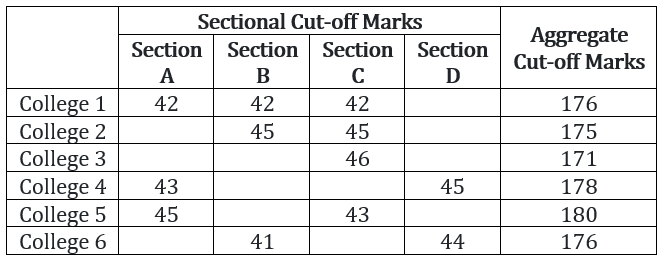
Aditya did not get a call from even a single college. What could be the maximum aggregate marks obtained by him?
Passage / Data
Answer the following question based on the information given below.
For admission to various affiliated colleges, a university conducts a written test with four different sections, each with a maximum of 50 marks. The following table gives the aggregate as well as the sectional cut-off marks fixed by six different colleges affiliated to the university. A student will get admission only if he/she gets marks greater than or equal to the cut-off marks in each of the sections and his/her aggregate marks are at least equal to the aggregate cut-off marks as specified by the college.
Bhama got calls from all colleges. What could be the minimum aggregate marks obtained by her?
Passage / Data
Answer the following question based on the information given below.
For admission to various affiliated colleges, a university conducts a written test with four different sections, each with a maximum of 50 marks. The following table gives the aggregate as well as the sectional cut-off marks fixed by six different colleges affiliated to the university. A student will get admission only if he/she gets marks greater than or equal to the cut-off marks in each of the sections and his/her aggregate marks are at least equal to the aggregate cut-off marks as specified by the college.
Charlie got calls from two colleges. What could be the minimum marks obtained by him in a section?
Passage / Data
Answer the following question based on the information given below.
There are 100 employees in an organization across five departments. The following table gives the departement-wise distribution of average age, average basic pay and allowances. The gross pay of an employee is the sum of his/her basic pay and allowances.
There are limited numbers of employees considered for transfer/promotion across departments. Whenever a person is transferred/promoted from a department of lower average age to a department of higher average age, he/she will get an additional allowance of 10% of basic pay over and above his/her current allowance. There will not be any change in pay structure if a person is transferred/promoted from a department with higher average age to a department with lower average age.
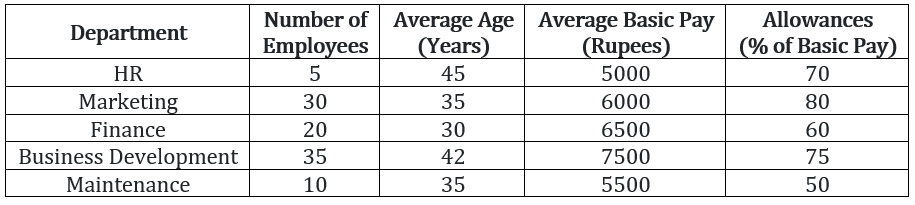
There was a mutual transfer of an employee between Marketing and Finance departments and transfer of one employee from Marketing to HR. As a result, the average age of Finance department increased by one year and that of Marketing department remained the same. What is the new average age of HR department?
Passage / Data
Answer the following question based on the information given below.
There are 100 employees in an organization across five departments. The following table gives the departement-wise distribution of average age, average basic pay and allowances. The gross pay of an employee is the sum of his/her basic pay and allowances.
There are limited numbers of employees considered for transfer/promotion across departments. Whenever a person is transferred/promoted from a department of lower average age to a department of higher average age, he/she will get an additional allowance of 10% of basic pay over and above his/her current allowance. There will not be any change in pay structure if a person is transferred/promoted from a department with higher average age to a department with lower average age.
What is the approximate percentage change in the average gross pay of the HR department due to transfer of a 40-yr old person with basic pay of Rs. 8000 from the Marketing department?
Passage / Data
Answer the following question based on the information given below.
There are 100 employees in an organization across five departments. The following table gives the departement-wise distribution of average age, average basic pay and allowances. The gross pay of an employee is the sum of his/her basic pay and allowances.
There are limited numbers of employees considered for transfer/promotion across departments. Whenever a person is transferred/promoted from a department of lower average age to a department of higher average age, he/she will get an additional allowance of 10% of basic pay over and above his/her current allowance. There will not be any change in pay structure if a person is transferred/promoted from a department with higher average age to a department with lower average age.
If two employees (each with a basic pay of Rs. 6000) are transferred from Maintenance department to HR department and one person (with a basic pay of Rs. 8000) was transferred from Marketing department to HR department, what will be the percentage change in average basic pay of HR department?
Passage / Data
Answer the following question based on the information given below.
Abdul, Bikram and Chetan are three professional traders who trade in shares of a company XYZ Ltd. Abdul follows the strategy of buying at the opening of the day at 10 am and selling the whole lot at the close of the day at 3 pm. Bikram follows the strategy of buying at hourly intervals: 10 am , 11 am, 12 noon, 1 pm and 2 pm, and selling the whole lot at the close of the day. Further, he buys an equal number of shares in each purchase. Chetan follows a similar pattern as Bikram but his strategy is somewhat different. Chetan’s total investment amount is divided equally among his purchases. The profit or loss made by each investor is the difference between the sale value at the close of the day less the investment in purchase. The “return” for each investor is defined as the ratio of the profit or loss to the investment amount expressed as a percentage.
On a “boom” day the price of XYZ Ltd. keeps rising throughout the day and peaks at the close of the day. Which trader got the minimum return on that day?
Passage / Data
Answer the following question based on the information given below.
Abdul, Bikram and Chetan are three professional traders who trade in shares of a company XYZ Ltd. Abdul follows the strategy of buying at the opening of the day at 10 am and selling the whole lot at the close of the day at 3 pm. Bikram follows the strategy of buying at hourly intervals: 10 am , 11 am, 12 noon, 1 pm and 2 pm, and selling the whole lot at the close of the day. Further, he buys an equal number of shares in each purchase. Chetan follows a similar pattern as Bikram but his strategy is somewhat different. Chetan’s total investment amount is divided equally among his purchases. The profit or loss made by each investor is the difference between the sale value at the close of the day less the investment in purchase. The “return” for each investor is defined as the ratio of the profit or loss to the investment amount expressed as a percentage.
On a day of fluctuating market prices, the share price of XYZ Ltd. ends with a gain, i.e., it is higher at the close of the day compared to the opening value. Which trader got the maximum return on that day?
Passage / Data
Answer the following question based on the information given below.
Abdul, Bikram and Chetan are three professional traders who trade in shares of a company XYZ Ltd. Abdul follows the strategy of buying at the opening of the day at 10 am and selling the whole lot at the close of the day at 3 pm. Bikram follows the strategy of buying at hourly intervals: 10 am , 11 am, 12 noon, 1 pm and 2 pm, and selling the whole lot at the close of the day. Further, he buys an equal number of shares in each purchase. Chetan follows a similar pattern as Bikram but his strategy is somewhat different. Chetan’s total investment amount is divided equally among his purchases. The profit or loss made by each investor is the difference between the sale value at the close of the day less the investment in purchase. The “return” for each investor is defined as the ratio of the profit or loss to the investment amount expressed as a percentage.
Which one of the following statements is always true?
Passage / Data
Answer the following question based on the information given below.
Abdul, Bikram and Chetan are three professional traders who trade in shares of a company XYZ Ltd. Abdul follows the strategy of buying at the opening of the day at 10 am and selling the whole lot at the close of the day at 3 pm. Bikram follows the strategy of buying at hourly intervals: 10 am , 11 am, 12 noon, 1 pm and 2 pm, and selling the whole lot at the close of the day. Further, he buys an equal number of shares in each purchase. Chetan follows a similar pattern as Bikram but his strategy is somewhat different. Chetan’s total investment amount is divided equally among his purchases. The profit or loss made by each investor is the difference between the sale value at the close of the day less the investment in purchase. The “return” for each investor is defined as the ratio of the profit or loss to the investment amount expressed as a percentage.
One day, two other traders, Dane and Emily joined Abdul, Bikram and Chetan for trading in the shares of XYZ Ltd. Dane followed a strategy of buying equal numbers of shares at 10 am, 11 am and 12 noon, and selling the same numbers at 1 pm, 2 pm and 3 pm. Emily, on the other hand, followed the strategy of buying shares using all her money at 10 am and selling all of them at 12 noon and again buying the shares for all the money at 1 pm and again selling all of them at the close of the day at 3 pm. At the close of the day the following was observed:
i. Abdul lost money in the transactions.
ii. Both Dane and Emily made profits.
iii. There was an increase in share price during the closing hour compared to the price at 2 pm.
iv. Share price at 12 noon was lower than the opening price.
Which of the following is necessarily false?
Passage / Data
Answer the following question based on the information given below.
Abdul, Bikram and Chetan are three professional traders who trade in shares of a company XYZ Ltd. Abdul follows the strategy of buying at the opening of the day at 10 am and selling the whole lot at the close of the day at 3 pm. Bikram follows the strategy of buying at hourly intervals: 10 am , 11 am, 12 noon, 1 pm and 2 pm, and selling the whole lot at the close of the day. Further, he buys an equal number of shares in each purchase. Chetan follows a similar pattern as Bikram but his strategy is somewhat different. Chetan’s total investment amount is divided equally among his purchases. The profit or loss made by each investor is the difference between the sale value at the close of the day less the investment in purchase. The “return” for each investor is defined as the ratio of the profit or loss to the investment amount expressed as a percentage.
Share price was at its highest at
Note: Use data from the previous question.
Passage / Data
Answer the following question based on the information given below.
Mathematicians are assigned a number called Erdös number, (named after the famous mathematician, Paul Erdös). Only Paul Erdös himself has an Erdös number of zero. Any mathematician who has written a research paper with Erdös has an Erdös number of 1. For other mathematicians, the calculation of his/her Erdös number is illustrated below:
Suppose that a mathematician X has co-authored papers with several other mathematicians. From among them, mathematician Y has the smallest Erdös number. Let the Erdös number of Y be y. Then X has an Erdös number of y + 1. Hence any mathematician with no co-authorship chain connected to Erdös has an Erdös number of infinity.
- In a seven day long mini-conference organized in memory of Paul Erdös, a close group of eight mathematicians, call them A, B, C, D, E, F, G and H, discussed some research problems. At the beginning of the conference, A was the only participant who had an infinite Erdös number. Nobody had an Erdös number less than that of F.
- On the third day of the conference F co-authored a paper jointly with A and C. This reduced the average Erdös number of the group of eight mathematicians to 3. The Erdös numbers of B, D, E, G and H remained unchanged with the writing of this paper. Further, no other co-authorship among any three members would have reduced the average Erdös number of the group of eight to as low as 3.
- At the end of the third day, five members of this group had identical Erdös numbers while the other three had Erdös numbers distinct from each other.
- On the fifth day, E co-authored a paper with F which reduced the group‘s average Erdös number by 0.5. The Erdös numbers of the remaining six were unchanged with the writing of this paper.
- No other paper was written during the conference.
The person having the largest Erdös number at the end of the conference must have had Erdös number (at that time):
Passage / Data
Answer the following question based on the information given below.
Mathematicians are assigned a number called Erdös number, (named after the famous mathematician, Paul Erdös). Only Paul Erdös himself has an Erdös number of zero. Any mathematician who has written a research paper with Erdös has an Erdös number of 1. For other mathematicians, the calculation of his/her Erdös number is illustrated below:
Suppose that a mathematician X has co-authored papers with several other mathematicians. From among them, mathematician Y has the smallest Erdös number. Let the Erdös number of Y be y. Then X has an Erdös number of y + 1. Hence any mathematician with no co-authorship chain connected to Erdös has an Erdös number of infinity.
- In a seven day long mini-conference organized in memory of Paul Erdös, a close group of eight mathematicians, call them A, B, C, D, E, F, G and H, discussed some research problems. At the beginning of the conference, A was the only participant who had an infinite Erdös number. Nobody had an Erdös number less than that of F.
- On the third day of the conference F co-authored a paper jointly with A and C. This reduced the average Erdös number of the group of eight mathematicians to 3. The Erdös numbers of B, D, E, G and H remained unchanged with the writing of this paper. Further, no other co-authorship among any three members would have reduced the average Erdös number of the group of eight to as low as 3.
- At the end of the third day, five members of this group had identical Erdös numbers while the other three had Erdös numbers distinct from each other.
- On the fifth day, E co-authored a paper with F which reduced the group‘s average Erdös number by 0.5. The Erdös numbers of the remaining six were unchanged with the writing of this paper.
- No other paper was written during the conference.
How many participants in the conference did not change their Erdös number during the conference?
Passage / Data
Answer the following question based on the information given below.
Mathematicians are assigned a number called Erdös number, (named after the famous mathematician, Paul Erdös). Only Paul Erdös himself has an Erdös number of zero. Any mathematician who has written a research paper with Erdös has an Erdös number of 1. For other mathematicians, the calculation of his/her Erdös number is illustrated below:
Suppose that a mathematician X has co-authored papers with several other mathematicians. From among them, mathematician Y has the smallest Erdös number. Let the Erdös number of Y be y. Then X has an Erdös number of y + 1. Hence any mathematician with no co-authorship chain connected to Erdös has an Erdös number of infinity.
- In a seven day long mini-conference organized in memory of Paul Erdös, a close group of eight mathematicians, call them A, B, C, D, E, F, G and H, discussed some research problems. At the beginning of the conference, A was the only participant who had an infinite Erdös number. Nobody had an Erdös number less than that of F.
- On the third day of the conference F co-authored a paper jointly with A and C. This reduced the average Erdös number of the group of eight mathematicians to 3. The Erdös numbers of B, D, E, G and H remained unchanged with the writing of this paper. Further, no other co-authorship among any three members would have reduced the average Erdös number of the group of eight to as low as 3.
- At the end of the third day, five members of this group had identical Erdös numbers while the other three had Erdös numbers distinct from each other.
- On the fifth day, E co-authored a paper with F which reduced the group‘s average Erdös number by 0.5. The Erdös numbers of the remaining six were unchanged with the writing of this paper.
- No other paper was written during the conference.
The Erdös number of C at the end of the conference was:
Passage / Data
Answer the following question based on the information given below.
Mathematicians are assigned a number called Erdös number, (named after the famous mathematician, Paul Erdös). Only Paul Erdös himself has an Erdös number of zero. Any mathematician who has written a research paper with Erdös has an Erdös number of 1. For other mathematicians, the calculation of his/her Erdös number is illustrated below:
Suppose that a mathematician X has co-authored papers with several other mathematicians. From among them, mathematician Y has the smallest Erdös number. Let the Erdös number of Y be y. Then X has an Erdös number of y + 1. Hence any mathematician with no co-authorship chain connected to Erdös has an Erdös number of infinity.
- In a seven day long mini-conference organized in memory of Paul Erdös, a close group of eight mathematicians, call them A, B, C, D, E, F, G and H, discussed some research problems. At the beginning of the conference, A was the only participant who had an infinite Erdös number. Nobody had an Erdös number less than that of F.
- On the third day of the conference F co-authored a paper jointly with A and C. This reduced the average Erdös number of the group of eight mathematicians to 3. The Erdös numbers of B, D, E, G and H remained unchanged with the writing of this paper. Further, no other co-authorship among any three members would have reduced the average Erdös number of the group of eight to as low as 3.
- At the end of the third day, five members of this group had identical Erdös numbers while the other three had Erdös numbers distinct from each other.
- On the fifth day, E co-authored a paper with F which reduced the group‘s average Erdös number by 0.5. The Erdös numbers of the remaining six were unchanged with the writing of this paper.
- No other paper was written during the conference.
The Erdös number of E at the beginning of the conference was:
Passage / Data
Answer the following question based on the information given below.
Mathematicians are assigned a number called Erdös number, (named after the famous mathematician, Paul Erdös). Only Paul Erdös himself has an Erdös number of zero. Any mathematician who has written a research paper with Erdös has an Erdös number of 1. For other mathematicians, the calculation of his/her Erdös number is illustrated below:
Suppose that a mathematician X has co-authored papers with several other mathematicians. From among them, mathematician Y has the smallest Erdös number. Let the Erdös number of Y be y. Then X has an Erdös number of y + 1. Hence any mathematician with no co-authorship chain connected to Erdös has an Erdös number of infinity.
- In a seven day long mini-conference organized in memory of Paul Erdös, a close group of eight mathematicians, call them A, B, C, D, E, F, G and H, discussed some research problems. At the beginning of the conference, A was the only participant who had an infinite Erdös number. Nobody had an Erdös number less than that of F.
- On the third day of the conference F co-authored a paper jointly with A and C. This reduced the average Erdös number of the group of eight mathematicians to 3. The Erdös numbers of B, D, E, G and H remained unchanged with the writing of this paper. Further, no other co-authorship among any three members would have reduced the average Erdös number of the group of eight to as low as 3.
- At the end of the third day, five members of this group had identical Erdös numbers while the other three had Erdös numbers distinct from each other.
- On the fifth day, E co-authored a paper with F which reduced the group‘s average Erdös number by 0.5. The Erdös numbers of the remaining six were unchanged with the writing of this paper.
- No other paper was written during the conference.
How many participants had the same Erdös number at the beginning of the conference?
Passage / Data
Answer the following question based on the information given below.
Two traders, Chetan and Michael, were involved in the buying and selling of MCS shares over five trading days. At the beginning of the first day, the MCS share was priced at Rs. 100, while at the end of the fifth day it was priced at Rs. 110. At the end of each day, the MCS share price either went up by Rs. 10, or else, it came down by Rs. 10. Both Chetan and Michael took buying and selling decisions at the end of each trading day.
The beginning price of MCS share on a given day was the same as the ending price of the previous day.
Chetan and Michael started with the same number of shares and amount of cash, and had enough of both. Below are some additional facts about how Chetan and Michael traded over the five trading days.
- Each day if the price went up, Chetan sold 10 shares of MCS at the closing price. On the other hand, each day if the price went down, he bought 10 shares at the closing price.
- If on any day, the closing price was above Rs. 110, then Michael sold 10 shares of MCS, while if it was below Rs. 90, he bought 10 shares, all at the closing price.
If Chetan sold 10 shares of MCS on three consecutive days, while Michael sold 10 shares only once during the five days, what was the price of MCS at the end of day 3?
Passage / Data
Answer the following question based on the information given below.
Two traders, Chetan and Michael, were involved in the buying and selling of MCS shares over five trading days. At the beginning of the first day, the MCS share was priced at Rs. 100, while at the end of the fifth day it was priced at Rs. 110. At the end of each day, the MCS share price either went up by Rs. 10, or else, it came down by Rs. 10. Both Chetan and Michael took buying and selling decisions at the end of each trading day.
The beginning price of MCS share on a given day was the same as the ending price of the previous day.
Chetan and Michael started with the same number of shares and amount of cash, and had enough of both. Below are some additional facts about how Chetan and Michael traded over the five trading days.
- Each day if the price went up, Chetan sold 10 shares of MCS at the closing price. On the other hand, each day if the price went down, he bought 10 shares at the closing price.
- If on any day, the closing price was above Rs. 110, then Michael sold 10 shares of MCS, while if it was below Rs. 90, he bought 10 shares, all at the closing price.
If Michael ended up with Rs. 100 less cash than Chetan at the end of day 5, what was the difference in the number of shares possessed by Michael and Chetan (at the end of day 5)?
Passage / Data
Answer the following question based on the information given below.
Two traders, Chetan and Michael, were involved in the buying and selling of MCS shares over five trading days. At the beginning of the first day, the MCS share was priced at Rs. 100, while at the end of the fifth day it was priced at Rs. 110. At the end of each day, the MCS share price either went up by Rs. 10, or else, it came down by Rs. 10. Both Chetan and Michael took buying and selling decisions at the end of each trading day.
The beginning price of MCS share on a given day was the same as the ending price of the previous day.
Chetan and Michael started with the same number of shares and amount of cash, and had enough of both. Below are some additional facts about how Chetan and Michael traded over the five trading days.
- Each day if the price went up, Chetan sold 10 shares of MCS at the closing price. On the other hand, each day if the price went down, he bought 10 shares at the closing price.
- If on any day, the closing price was above Rs. 110, then Michael sold 10 shares of MCS, while if it was below Rs. 90, he bought 10 shares, all at the closing price.
If Chetan ended up with Rs. 1300 more cash than Michael at the end of day 5, what was the price of MCS share at the end of day 4?
Passage / Data
Answer the following question based on the information given below.
Two traders, Chetan and Michael, were involved in the buying and selling of MCS shares over five trading days. At the beginning of the first day, the MCS share was priced at Rs. 100, while at the end of the fifth day it was priced at Rs. 110. At the end of each day, the MCS share price either went up by Rs. 10, or else, it came down by Rs. 10. Both Chetan and Michael took buying and selling decisions at the end of each trading day.
The beginning price of MCS share on a given day was the same as the ending price of the previous day.
Chetan and Michael started with the same number of shares and amount of cash, and had enough of both. Below are some additional facts about how Chetan and Michael traded over the five trading days.
- Each day if the price went up, Chetan sold 10 shares of MCS at the closing price. On the other hand, each day if the price went down, he bought 10 shares at the closing price.
- If on any day, the closing price was above Rs. 110, then Michael sold 10 shares of MCS, while if it was below Rs. 90, he bought 10 shares, all at the closing price.
What could have been the maximum possible increase in combined cash balance of Chetan and Michael at the end of the fifth day?
Passage / Data
Answer the following question based on the information given below.
Two traders, Chetan and Michael, were involved in the buying and selling of MCS shares over five trading days. At the beginning of the first day, the MCS share was priced at Rs. 100, while at the end of the fifth day it was priced at Rs. 110. At the end of each day, the MCS share price either went up by Rs. 10, or else, it came down by Rs. 10. Both Chetan and Michael took buying and selling decisions at the end of each trading day.
The beginning price of MCS share on a given day was the same as the ending price of the previous day.
Chetan and Michael started with the same number of shares and amount of cash, and had enough of both. Below are some additional facts about how Chetan and Michael traded over the five trading days.
- Each day if the price went up, Chetan sold 10 shares of MCS at the closing price. On the other hand, each day if the price went down, he bought 10 shares at the closing price.
- If on any day, the closing price was above Rs. 110, then Michael sold 10 shares of MCS, while if it was below Rs. 90, he bought 10 shares, all at the closing price.
If Michael ended up with 20 more shares than Chetan at the end of day 5, what was the price of the share at the end of day 3?
Passage / Data
Answer the following question based on the information given below.
Venkat, a stockbroker, invested a part of his money in the stock of four companies - A, B, C and D. Each of these companies belonged to different industries, viz., Cement, Information Technology (IT), Auto, and Steel, in no particular order. At the time of investment, the price of each stock was Rs.100. Venkat purchased only one stock of each of these companies. He was expecting returns of 20%, 10%, 30%, and 40% from the stock of companies A, B, C and D, respectively. Returns are defined as the change in the value of the stock after one year, expressed as a percentage of the initial value. During the year, two of these companies announced extraordinarily good results. One of these two companies belonged to the Cement or the IT industry, while the other one belonged to either the Steel or the Auto industry. As a result, the returns on the stocks of these two companies were higher than the initially expected returns. For the company belonging to the Cement or the IT industry with extraordinarily good results, the returns were twice that of the initially expected returns. For the company belonging to the Steel or the Auto industry, the returns on announcement of extraordinarily good results were only one and a half times that of the initially expected returns. For the remaining two companies, which did not announce extraordinarily good results, the returns realized during the year were the same as initially expected.
What is the minimum average return Venkat would have earned during the year?
Passage / Data
Answer the following question based on the information given below.
Venkat, a stockbroker, invested a part of his money in the stock of four companies - A, B, C and D. Each of these companies belonged to different industries, viz., Cement, Information Technology (IT), Auto, and Steel, in no particular order. At the time of investment, the price of each stock was Rs.100. Venkat purchased only one stock of each of these companies. He was expecting returns of 20%, 10%, 30%, and 40% from the stock of companies A, B, C and D, respectively. Returns are defined as the change in the value of the stock after one year, expressed as a percentage of the initial value. During the year, two of these companies announced extraordinarily good results. One of these two companies belonged to the Cement or the IT industry, while the other one belonged to either the Steel or the Auto industry. As a result, the returns on the stocks of these two companies were higher than the initially expected returns. For the company belonging to the Cement or the IT industry with extraordinarily good results, the returns were twice that of the initially expected returns. For the company belonging to the Steel or the Auto industry, the returns on announcement of extraordinarily good results were only one and a half times that of the initially expected returns. For the remaining two companies, which did not announce extraordinarily good results, the returns realized during the year were the same as initially expected.
If Venkat earned a 35% return on average during the year, then which of these statements would necessarily be true?
I . Company A belonged either to Auto or to Steel Industry.
II. Company B did not announce extraordinarily good results.
III. Company A announced extraordinarily good results.IV. Company D did not announce extraordinarily good results.
Passage / Data
Answer the following question based on the information given below.
Venkat, a stockbroker, invested a part of his money in the stock of four companies - A, B, C and D. Each of these companies belonged to different industries, viz., Cement, Information Technology (IT), Auto, and Steel, in no particular order. At the time of investment, the price of each stock was Rs.100. Venkat purchased only one stock of each of these companies. He was expecting returns of 20%, 10%, 30%, and 40% from the stock of companies A, B, C and D, respectively. Returns are defined as the change in the value of the stock after one year, expressed as a percentage of the initial value. During the year, two of these companies announced extraordinarily good results. One of these two companies belonged to the Cement or the IT industry, while the other one belonged to either the Steel or the Auto industry. As a result, the returns on the stocks of these two companies were higher than the initially expected returns. For the company belonging to the Cement or the IT industry with extraordinarily good results, the returns were twice that of the initially expected returns. For the company belonging to the Steel or the Auto industry, the returns on announcement of extraordinarily good results were only one and a half times that of the initially expected returns. For the remaining two companies, which did not announce extraordinarily good results, the returns realized during the year were the same as initially expected.
If Venkat earned a 38.75% return on average during the year, then which of these statement(s) would necessarily be true?
I . Company C belonged either to Auto or to Steel Industry.
II. Company D belonged either to Auto or to Steel Industry.
III. Company A announced extraordinarily good results.IV. Company B did not announce extraordinarily good results.
Passage / Data
Answer the following question based on the information given below.
Venkat, a stockbroker, invested a part of his money in the stock of four companies - A, B, C and D. Each of these companies belonged to different industries, viz., Cement, Information Technology (IT), Auto, and Steel, in no particular order. At the time of investment, the price of each stock was Rs.100. Venkat purchased only one stock of each of these companies. He was expecting returns of 20%, 10%, 30%, and 40% from the stock of companies A, B, C and D, respectively. Returns are defined as the change in the value of the stock after one year, expressed as a percentage of the initial value. During the year, two of these companies announced extraordinarily good results. One of these two companies belonged to the Cement or the IT industry, while the other one belonged to either the Steel or the Auto industry. As a result, the returns on the stocks of these two companies were higher than the initially expected returns. For the company belonging to the Cement or the IT industry with extraordinarily good results, the returns were twice that of the initially expected returns. For the company belonging to the Steel or the Auto industry, the returns on announcement of extraordinarily good results were only one and a half times that of the initially expected returns. For the remaining two companies, which did not announce extraordinarily good results, the returns realized during the year were the same as initially expected.
If Company C belonged to the Cement or the IT industry and did announce extraordinarily good results, then which of these statement(s) would necessarily be true?
I . Venkat earned not more than 36.25% return on average.
II. Venkat earned not less than 33.75% return on average.
III. If Venkat earned 33.75% return on average, Company A announced extraordinarily good results.IV. If Venkat earned 33.75% return on average, Company B belonged either to Auto or to Steel Industry.
Passage / Data
Answer the following question based on the information given below.
Coach John sat with the score cards of Indian players from the 3 games in a one-day cricket tournament where the same set of players played for India and all the major batsmen got out. John summarized the batting performance through three diagrams, one for each game. In each diagram, the three outer triangles communicate the number of runs scored by the three top scorers from India, where K, R, S, V, and Y represent Kaif, Rahul, Saurav, Virender, and Yuvraj respectively. The middle triangle in each diagram denotes the percentage of total score that was scored by the top three Indian scorers in that game. No two players score the same number of runs in the same game. John also calculated two batting indices for each player based on his scores in the tournament; the R-index of a batsman is the difference between his highest and lowest scores in the 3 games while the M-index is the middle number, if his scores are arranged in a non-increasing order
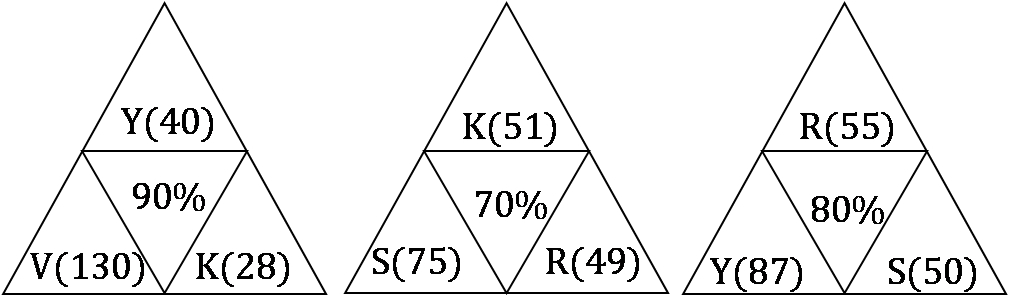
Which of the players had the best M-index from the tournament?
Passage / Data
Answer the following question based on the information given below.
Coach John sat with the score cards of Indian players from the 3 games in a one-day cricket tournament where the same set of players played for India and all the major batsmen got out. John summarized the batting performance through three diagrams, one for each game. In each diagram, the three outer triangles communicate the number of runs scored by the three top scorers from India, where K, R, S, V, and Y represent Kaif, Rahul, Saurav, Virender, and Yuvraj respectively. The middle triangle in each diagram denotes the percentage of total score that was scored by the top three Indian scorers in that game. No two players score the same number of runs in the same game. John also calculated two batting indices for each player based on his scores in the tournament; the R-index of a batsman is the difference between his highest and lowest scores in the 3 games while the M-index is the middle number, if his scores are arranged in a non-increasing order
Among the players mentioned, who can have the lowest R-index from the tournament?
Passage / Data
Answer the following question based on the information given below.
Coach John sat with the score cards of Indian players from the 3 games in a one-day cricket tournament where the same set of players played for India and all the major batsmen got out. John summarized the batting performance through three diagrams, one for each game. In each diagram, the three outer triangles communicate the number of runs scored by the three top scorers from India, where K, R, S, V, and Y represent Kaif, Rahul, Saurav, Virender, and Yuvraj respectively. The middle triangle in each diagram denotes the percentage of total score that was scored by the top three Indian scorers in that game. No two players score the same number of runs in the same game. John also calculated two batting indices for each player based on his scores in the tournament; the R-index of a batsman is the difference between his highest and lowest scores in the 3 games while the M-index is the middle number, if his scores are arranged in a non-increasing order
For how many Indian players is it possible to calculate the exact M-index?
Passage / Data
Answer the following question based on the information given below.
Coach John sat with the score cards of Indian players from the 3 games in a one-day cricket tournament where the same set of players played for India and all the major batsmen got out. John summarized the batting performance through three diagrams, one for each game. In each diagram, the three outer triangles communicate the number of runs scored by the three top scorers from India, where K, R, S, V, and Y represent Kaif, Rahul, Saurav, Virender, and Yuvraj respectively. The middle triangle in each diagram denotes the percentage of total score that was scored by the top three Indian scorers in that game. No two players score the same number of runs in the same game. John also calculated two batting indices for each player based on his scores in the tournament; the R-index of a batsman is the difference between his highest and lowest scores in the 3 games while the M-index is the middle number, if his scores are arranged in a non-increasing order
How many players among those listed definitely scored less than Yuvraj in the tournament?
Passage / Data
Answer the following question based on the information given below.
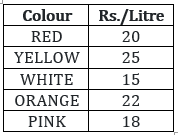
Rang Barsey Paint Company (RBPC) is in the business of manufacturing paints. RBPC buys RED, YELLOW, WHITE, ORANGE, and PINK paints. ORANGE paint can be also produced by mixing RED and YELLOW paints in equal proportions. Similarly, PINK paint can also be produced by mixing equal amounts of RED and WHITE paints. Among other paints, RBPC sells CREAM paint, (formed by mixing WHITE and YELLOW in the ratio 70 : 30) AVOCADO paint (formed by mixing equal amounts of ORANGE and PINK paint) and WASHEDORANGE paint (formed by mixing equal amounts of ORANGE and WHITE paint). The following table provides the price at which RBPC buys paints.
The cheapest way to manufacture AVOCADO paint would cost:
Passage / Data
Answer the following question based on the information given below.
Rang Barsey Paint Company (RBPC) is in the business of manufacturing paints. RBPC buys RED, YELLOW, WHITE, ORANGE, and PINK paints. ORANGE paint can be also produced by mixing RED and YELLOW paints in equal proportions. Similarly, PINK paint can also be produced by mixing equal amounts of RED and WHITE paints. Among other paints, RBPC sells CREAM paint, (formed by mixing WHITE and YELLOW in the ratio 70 : 30) AVOCADO paint (formed by mixing equal amounts of ORANGE and PINK paint) and WASHEDORANGE paint (formed by mixing equal amounts of ORANGE and WHITE paint). The following table provides the price at which RBPC buys paints.
WASHEDORANGE can be manufactured by mixing
Passage / Data
Answer the following question based on the information given below.
Rang Barsey Paint Company (RBPC) is in the business of manufacturing paints. RBPC buys RED, YELLOW, WHITE, ORANGE, and PINK paints. ORANGE paint can be also produced by mixing RED and YELLOW paints in equal proportions. Similarly, PINK paint can also be produced by mixing equal amounts of RED and WHITE paints. Among other paints, RBPC sells CREAM paint, (formed by mixing WHITE and YELLOW in the ratio 70 : 30) AVOCADO paint (formed by mixing equal amounts of ORANGE and PINK paint) and WASHEDORANGE paint (formed by mixing equal amounts of ORANGE and WHITE paint). The following table provides the price at which RBPC buys paints.
Assume that AVOCADO, CREAM, and WASHEDORANGE each sells for the same price. Which of the three is the most profitable to manufacture?
Passage / Data
Answer the following question based on the information given below.
Some children were taking free throws at the basketball court in school during lunch break. Below are some facts about how many baskets these children shot.
i. Ganesh shot 8 baskets less than Ashish.
ii. Dhanraj and Ramesh together shot 37 baskets.
iii. Jugraj shot 8 baskets more than Dhanraj.
iv. Ashish shot 5 baskets more than Dhanraj.
v. Ashish and Ganesh together shot 40 baskets.
Which of the following statements is true?
Passage / Data
Answer the following question based on the information given below.
Some children were taking free throws at the basketball court in school during lunch break. Below are some facts about how many baskets these children shot.
i. Ganesh shot 8 baskets less than Ashish.
ii. Dhanraj and Ramesh together shot 37 baskets.
iii. Jugraj shot 8 baskets more than Dhanraj.
iv. Ashish shot 5 baskets more than Dhanraj.
v. Ashish and Ganesh together shot 40 baskets.
Which of the following statements is true?
Passage / Data
Answer the following question based on the information given below.
In a Decathlon, the events are 100m, 400m, 100m hurdles, 1500m, High jump, Pole vault, Long jump, Discus, Shot put and Javelin. The performance in the first four of these events is consolidated into Score 1, the next three into Score 2, and the last three into Score 3. Each such consolidation is obtained by giving appropriate positive weights to individual events. The final score is simply the total of these three scores. The athletes with the highest, second highest and the third highest final scores receive the gold, silver and bronze medals, respectively. The table given below gives the scores and performance of nineteen top athletes in this event.
The athletes from FRG and USA decided to run a 4 × 100 m relay race for their respective countries with the country having three athletes borrowing the athlete from CZE. Assume that all the athletes ran their stretch of the relay race at the same speed as in Decathlon event. How much more time did the FRG relay team take as compared to the USA team?
Passage / Data
Answer the following question based on the information given below.
In a Decathlon, the events are 100m, 400m, 100m hurdles, 1500m, High jump, Pole vault, Long jump, Discus, Shot put and Javelin. The performance in the first four of these events is consolidated into Score 1, the next three into Score 2, and the last three into Score 3. Each such consolidation is obtained by giving appropriate positive weights to individual events. The final score is simply the total of these three scores. The athletes with the highest, second highest and the third highest final scores receive the gold, silver and bronze medals, respectively. The table given below gives the scores and performance of nineteen top athletes in this event.
What is the least that Daley Thompson must get in Score 2 that ensures him a bronze medal?
Passage / Data
Answer the following question based on the information given below.
In a Decathlon, the events are 100m, 400m, 100m hurdles, 1500m, High jump, Pole vault, Long jump, Discus, Shot put and Javelin. The performance in the first four of these events is consolidated into Score 1, the next three into Score 2, and the last three into Score 3. Each such consolidation is obtained by giving appropriate positive weights to individual events. The final score is simply the total of these three scores. The athletes with the highest, second highest and the third highest final scores receive the gold, silver and bronze medals, respectively. The table given below gives the scores and performance of nineteen top athletes in this event.
At least how many competitors (excluding Daley Thompson) must Michael Smith have out-jumped in the long jump event?
Passage / Data
Answer the following question based on the information given below.
There are 6 refineries, 7 depots, 9 districts. The refineries are BB, BC, BD, BE, BF, BG. The depots are AA, AB, AC, AD, AE, AF and AG and the districts are AAA, AAB, AAC, AAD, AAE, AAF, AAG, AAH, AAI.
Table A shows the cost of transporting one unit from refinery to depot.
Table B shows the cost of transporting one unit from depot to districts.
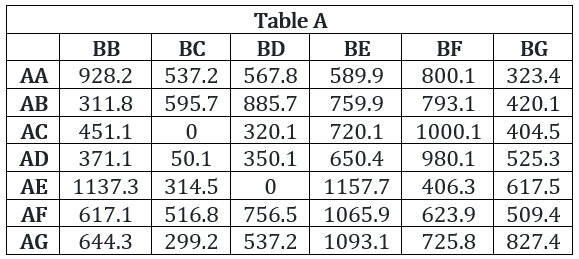
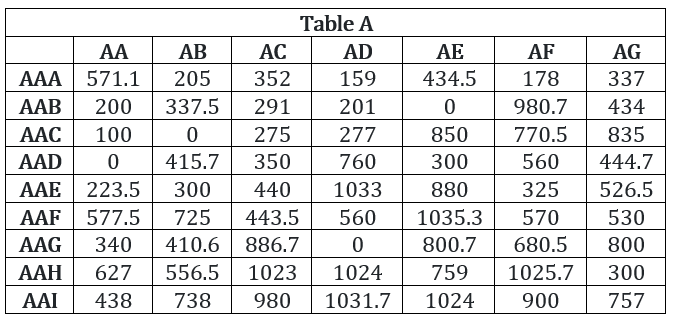
The minimum cost of sending one unit from any refinery to any district is:
Passage / Data
Answer the following question based on the information given below.
There are 6 refineries, 7 depots, 9 districts. The refineries are BB, BC, BD, BE, BF, BG. The depots are AA, AB, AC, AD, AE, AF and AG and the districts are AAA, AAB, AAC, AAD, AAE, AAF, AAG, AAH, AAI.
Table A shows the cost of transporting one unit from refinery to depot.
Table B shows the cost of transporting one unit from depot to districts.
How many possible ways are there for sending one unit from any refinery to any district?
Passage / Data
Answer the following question based on the information given below.
There are 6 refineries, 7 depots, 9 districts. The refineries are BB, BC, BD, BE, BF, BG. The depots are AA, AB, AC, AD, AE, AF and AG and the districts are AAA, AAB, AAC, AAD, AAE, AAF, AAG, AAH, AAI.
Table A shows the cost of transporting one unit from refinery to depot.
Table B shows the cost of transporting one unit from depot to districts.
The largest cost of sending one unit from any refinery to district is:
Passage / Data
Answer the following question based on the information given below.
There are 6 refineries, 7 depots, 9 districts. The refineries are BB, BC, BD, BE, BF, BG. The depots are AA, AB, AC, AD, AE, AF and AG and the districts are AAA, AAB, AAC, AAD, AAE, AAF, AAG, AAH, AAI.
Table A shows the cost of transporting one unit from refinery to depot.
Table B shows the cost of transporting one unit from depot to districts.
The minimum cost of transportation of one unit from refinery BD to any district is:
Passage / Data
Answer the following question based on the information given below.
There are 6 refineries, 7 depots, 9 districts. The refineries are BB, BC, BD, BE, BF, BG. The depots are AA, AB, AC, AD, AE, AF and AG and the districts are AAA, AAB, AAC, AAD, AAE, AAF, AAG, AAH, AAI.
Table A shows the cost of transporting one unit from refinery to depot.
Table B shows the cost of transporting one unit from depot to districts.
The minimum cost of transportation from any refinery to AAG district is:
Passage / Data
Answer the following question based on the information given below.
There are 6 refineries, 7 depots, 9 districts. The refineries are BB, BC, BD, BE, BF, BG. The depots are AA, AB, AC, AD, AE, AF and AG and the districts are AAA, AAB, AAC, AAD, AAE, AAF, AAG, AAH, AAI.
Table A shows the cost of transporting one unit from refinery to depot.
Table B shows the cost of transporting one unit from depot to districts.
The minimum cost of transportation from refinery BE to district AAA is:
Passage / Data
Answer the following question based on the information given below.
A group of three or four has to be selected from seven persons. Among are two women: Fiza and Kavita, and five men: Ram, Shyam, David, Peter and Rahim. Ram would not like to be in the group if Shyam is also selected. Shyam and Rahim want to be selected together in the group. Kavita would like to be in the group only if David is also there. David, if selected, would not like Peter in the group. Ram would like to be in the group only if Peter is also there. David insists that Fiza be selected in case he is there in the group.
I have a total of Rs. 1,000. Item A costs Rs. 110, item B costs Rs. 90, item C costs Rs. 70, item D costs Rs. 40 and item E costs Rs. 45. For every item D that I purchase, I must also buy two of item B. For every item A, I must buy one of item C. For every item E, I must also buy two of item D and one of item B. For every item purchased I earn 1000 points and for every rupee not spent I earn a penalty of 1500 points. My objective is to maximise to points I earn. What is the number of items that I must purchase to maximise my points?
Passage / Data
Answer the following question based on the information given below.
A group of three or four has to be selected from seven persons. Among are two women: Fiza and Kavita, and five men: Ram, Shyam, David, Peter and Rahim. Ram would not like to be in the group if Shyam is also selected. Shyam and Rahim want to be selected together in the group. Kavita would like to be in the group only if David is also there. David, if selected, would not like Peter in the group. Ram would like to be in the group only if Peter is also there. David insists that Fiza be selected in case he is there in the group.
Four friends Ashok, Bashir, Chirag and Deepak are out shopping. Ashok has less money than three times the amount that Bashir has. Chirag has more money than Bashir. Deepak has an amount equal to the difference of amounts with Bashir and Chirag. Ashok has three times the money with Deepak. They each have to buy at least one shirt, or one shawl, or one sweater, or one jacket that are priced Rs. 200, Rs. 400, Rs. 600, and Rs. 1,000 a piece, respectively. Chirag borrows Rs. 300 from Ashok and buys a jacket. Bashir buys a sweater after borrowing Rs. 100 from Ashok and is left with no money. Ashok buys three shirts. What is the costliest item the Deepak could buy with his own money?
My bag can carry no more than ten books. I must carry at least one book each of management, mathematics, physics and fiction. Also, for every management book I carry I must carry two or more fiction books, and for every mathematics book I carry I must carry two or more physics books. I earn 4, 3, 2 and 1 points for each management, mathematics, physics and fiction book, respectively, I carry in my bag. I want to maximise the points I can earn by carrying the most appropriate combination of books in my bag. The maximum points that I can earn are
Eighty kilograms (kg) of store material is to be transported to a location 10 km away. Any number of couriers can be used to transport the material can be packed in any number of units of 10, 20 or 40 kg. Courier charges are Rs. 10 per hour. Couriers travel at the speed of 10 km/hr if they are not carrying any load, at 5 km/hr if carrying 10 kg, at 2 km/hr if carrying 20 kg and at 1 km/hr if carrying 40 kg. A courier cannot carry more than 40 kg of load. The minimum cost at which 80 kg of store material can be transported will be
Passage / Data
Use the following information:
Swetha, Swarna, Sneha and Soumya are four sisters who have an agreement that they share all snacks equally among themselves. One day, uncle Prem gave a box of cookies to Swetha. Since the other sisters were not around, Swetha divided the cookies into four parts, ate her share and put the rest into the box. As she was closing the box, Swarna came in, She took all the cookies from the box and divided them into four equal parts. Swetha and Swarna ate one part each and put the rest into the box. Just then Sneha walked in. She took all the cookies from the box, divided them into four equal parts. The three of them ate their respective shares and put the rest into the box. Later, when Soumya came, she divided all the cookies into four equal parts and all the four sisters ate their respective shares. In total, Soumya ate 3 cookies.
How many cookies, in total, did Sneha eat?
Passage / Data
Use the following information:
Swetha, Swarna, Sneha and Soumya are four sisters who have an agreement that they share all snacks equally among themselves. One day, uncle Prem gave a box of cookies to Swetha. Since the other sisters were not around, Swetha divided the cookies into four parts, ate her share and put the rest into the box. As she was closing the box, Swarna came in, She took all the cookies from the box and divided them into four equal parts. Swetha and Swarna ate one part each and put the rest into the box. Just then Sneha walked in. She took all the cookies from the box, divided them into four equal parts. The three of them ate their respective shares and put the rest into the box. Later, when Soumya came, she divided all the cookies into four equal parts and all the four sisters ate their respective shares. In total, Soumya ate 3 cookies.
How many cookies did uncle Prem give to Swetha?
Passage / Data
Use the following information:
Swetha, Swarna, Sneha and Soumya are four sisters who have an agreement that they share all snacks equally among themselves. One day, uncle Prem gave a box of cookies to Swetha. Since the other sisters were not around, Swetha divided the cookies into four parts, ate her share and put the rest into the box. As she was closing the box, Swarna came in, She took all the cookies from the box and divided them into four equal parts. Swetha and Swarna ate one part each and put the rest into the box. Just then Sneha walked in. She took all the cookies from the box, divided them into four equal parts. The three of them ate their respective shares and put the rest into the box. Later, when Soumya came, she divided all the cookies into four equal parts and all the four sisters ate their respective shares. In total, Soumya ate 3 cookies.
How many cookies, in total, did Swetha eat?
Passage / Data
Use the following information:
Swetha, Swarna, Sneha and Soumya are four sisters who have an agreement that they share all snacks equally among themselves. One day, uncle Prem gave a box of cookies to Swetha. Since the other sisters were not around, Swetha divided the cookies into four parts, ate her share and put the rest into the box. As she was closing the box, Swarna came in, She took all the cookies from the box and divided them into four equal parts. Swetha and Swarna ate one part each and put the rest into the box. Just then Sneha walked in. She took all the cookies from the box, divided them into four equal parts. The three of them ate their respective shares and put the rest into the box. Later, when Soumya came, she divided all the cookies into four equal parts and all the four sisters ate their respective shares. In total, Soumya ate 3 cookies.
How many cookies, in total, did Swarna eat?