CAT 2004 — Question Paper with Solutions
The complete CAT 2004 previous-year paper with the answer key and detailed solutions for all 122 questions across 3 sections. Attempt each question and check it, or tap Show solution — free, and your progress saves when you sign in.
CAT 2004 — practice
Passage / Data
Fill up the blanks A, B, C ... F, in the two passages below with the most appropriate word from the options given for each blank.
At that time the White House was as serene as a resort hotel out of season. The corridors were _______A______. In the various offices, _____B______ gray men in waistcoats talked to one another in low-pitched voices. The only colour, or choler, curiously enough, was provided by President Eisenhower himself. Apparently, his _____C_______ was easily set off; he scowled when he ______D_______ the corridors.
For Blank A-
Passage / Data
Fill up the blanks A, B, C ... F, in the two passages below with the most appropriate word from the options given for each blank.
At that time the White House was as serene as a resort hotel out of season. The corridors were _______A______. In the various offices, _____B______ gray men in waistcoats talked to one another in low-pitched voices. The only colour, or choler, curiously enough, was provided by President Eisenhower himself. Apparently, his _____C_______ was easily set off; he scowled when he ______D_______ the corridors.
For Blank B-
Passage / Data
Fill up the blanks A, B, C ... F, in the two passages below with the most appropriate word from the options given for each blank.
At that time the White House was as serene as a resort hotel out of season. The corridors were _______A______. In the various offices, _____B______ gray men in waistcoats talked to one another in low-pitched voices. The only colour, or choler, curiously enough, was provided by President Eisenhower himself. Apparently, his _____C_______ was easily set off; he scowled when he ______D_______ the corridors.
For Blank C-
Passage / Data
Fill up the blanks A, B, C ... F, in the two passages below with the most appropriate word from the options given for each blank.
At that time the White House was as serene as a resort hotel out of season. The corridors were _______A______. In the various offices, _____B______ gray men in waistcoats talked to one another in low-pitched voices. The only colour, or choler, curiously enough, was provided by President Eisenhower himself. Apparently, his _____C_______ was easily set off; he scowled when he ______D_______ the corridors.
For Blank D-
Passage / Data
Fill up the blanks A, B, C ... F, in the two passages below with the most appropriate word from the options given for each blank.
"Between the year 1946 and the year 1955, I did not file any income tax returns". With that ______A______ statement, Ramesh embarked on an account of his encounter with the Income Tax Department. "I originally owed Rs. 20,000 in unpaid taxes. With _____B________ and _______C______, the 20,000 became 60,000. The Income Tax Department then went into action, and I learned firsthand just how much power the Tax Department wields. Royalties and trust funds can be ______D_______; automobiles may be _______E______, and auctioned off. Nothing belongs to the ______F_______ until the case is settled."
For Blank A-
Passage / Data
Fill up the blanks A, B, C ... F, in the two passages below with the most appropriate word from the options given for each blank.
"Between the year 1946 and the year 1955, I did not file any income tax returns". With that ______A______ statement, Ramesh embarked on an account of his encounter with the Income Tax Department. "I originally owed Rs. 20,000 in unpaid taxes. With _____B________ and _______C______, the 20,000 became 60,000. The Income Tax Department then went into action, and I learned firsthand just how much power the Tax Department wields. Royalties and trust funds can be ______D_______; automobiles may be _______E______, and auctioned off. Nothing belongs to the ______F_______ until the case is settled."
For Blank B-
Passage / Data
Fill up the blanks A, B, C ... F, in the two passages below with the most appropriate word from the options given for each blank.
"Between the year 1946 and the year 1955, I did not file any income tax returns". With that ______A______ statement, Ramesh embarked on an account of his encounter with the Income Tax Department. "I originally owed Rs. 20,000 in unpaid taxes. With _____B________ and _______C______, the 20,000 became 60,000. The Income Tax Department then went into action, and I learned firsthand just how much power the Tax Department wields. Royalties and trust funds can be ______D_______; automobiles may be _______E______, and auctioned off. Nothing belongs to the ______F_______ until the case is settled."
For Blank C-
Passage / Data
Fill up the blanks A, B, C ... F, in the two passages below with the most appropriate word from the options given for each blank.
"Between the year 1946 and the year 1955, I did not file any income tax returns". With that ______A______ statement, Ramesh embarked on an account of his encounter with the Income Tax Department. "I originally owed Rs. 20,000 in unpaid taxes. With _____B________ and _______C______, the 20,000 became 60,000. The Income Tax Department then went into action, and I learned firsthand just how much power the Tax Department wields. Royalties and trust funds can be ______D_______; automobiles may be _______E______, and auctioned off. Nothing belongs to the ______F_______ until the case is settled."
For Blank D-
Passage / Data
Fill up the blanks A, B, C ... F, in the two passages below with the most appropriate word from the options given for each blank.
"Between the year 1946 and the year 1955, I did not file any income tax returns". With that ______A______ statement, Ramesh embarked on an account of his encounter with the Income Tax Department. "I originally owed Rs. 20,000 in unpaid taxes. With _____B________ and _______C______, the 20,000 became 60,000. The Income Tax Department then went into action, and I learned firsthand just how much power the Tax Department wields. Royalties and trust funds can be ______D_______; automobiles may be _______E______, and auctioned off. Nothing belongs to the ______F_______ until the case is settled."
For Blank E-
Passage / Data
Fill up the blanks A, B, C ... F, in the two passages below with the most appropriate word from the options given for each blank.
"Between the year 1946 and the year 1955, I did not file any income tax returns". With that ______A______ statement, Ramesh embarked on an account of his encounter with the Income Tax Department. "I originally owed Rs. 20,000 in unpaid taxes. With _____B________ and _______C______, the 20,000 became 60,000. The Income Tax Department then went into action, and I learned firsthand just how much power the Tax Department wields. Royalties and trust funds can be ______D_______; automobiles may be _______E______, and auctioned off. Nothing belongs to the ______F_______ until the case is settled."
For Blank F-
Passage / Data
Fill up the blanks A, B, C ... F, in the two passages below with the most appropriate word from the options given for each blank.
"Between the year 1946 and the year 1955, I did not file any income tax returns". With that ______A______ statement, Ramesh embarked on an account of his encounter with the Income Tax Department. "I originally owed Rs. 20,000 in unpaid taxes. With _____B________ and _______C______, the 20,000 became 60,000. The Income Tax Department then went into action, and I learned firsthand just how much power the Tax Department wields. Royalties and trust funds can be ______D_______; automobiles may be _______E______, and auctioned off. Nothing belongs to the ______F_______ until the case is settled."
Identify the INCORRECT sentence or sentences.
- Harish told Raj to plead guilty.
- Raj pleaded guilty of stealing money from the shop.
- The court found Raj guilty of all the crimes he was charged with.
- He was sentenced for three years in jail.
Passage / Data
Fill up the blanks A, B, C ... F, in the two passages below with the most appropriate word from the options given for each blank.
"Between the year 1946 and the year 1955, I did not file any income tax returns". With that ______A______ statement, Ramesh embarked on an account of his encounter with the Income Tax Department. "I originally owed Rs. 20,000 in unpaid taxes. With _____B________ and _______C______, the 20,000 became 60,000. The Income Tax Department then went into action, and I learned firsthand just how much power the Tax Department wields. Royalties and trust funds can be ______D_______; automobiles may be _______E______, and auctioned off. Nothing belongs to the ______F_______ until the case is settled."
Identify the INCORRECT sentence or sentences.
- Last Sunday, Archana had nothing to do.
- After waking up, she lay on the bed thinking of what to do.
- At 11 o'clock she took shower and got ready.
- She spent most of the day shopping.
Passage / Data
Fill up the blanks A, B, C ... F, in the two passages below with the most appropriate word from the options given for each blank.
"Between the year 1946 and the year 1955, I did not file any income tax returns". With that ______A______ statement, Ramesh embarked on an account of his encounter with the Income Tax Department. "I originally owed Rs. 20,000 in unpaid taxes. With _____B________ and _______C______, the 20,000 became 60,000. The Income Tax Department then went into action, and I learned firsthand just how much power the Tax Department wields. Royalties and trust funds can be ______D_______; automobiles may be _______E______, and auctioned off. Nothing belongs to the ______F_______ until the case is settled."
Identify the INCORRECT sentence or sentences.
- It was a tough situation and Manasi was taking pains to make it better.
- Slowly her efforts gave fruit and things started improving.
- Everyone complemented her for her good work.
- She was very happy and thanked everyone for their help.
Passage / Data
Fill up the blanks A, B, C ... F, in the two passages below with the most appropriate word from the options given for each blank.
"Between the year 1946 and the year 1955, I did not file any income tax returns". With that ______A______ statement, Ramesh embarked on an account of his encounter with the Income Tax Department. "I originally owed Rs. 20,000 in unpaid taxes. With _____B________ and _______C______, the 20,000 became 60,000. The Income Tax Department then went into action, and I learned firsthand just how much power the Tax Department wields. Royalties and trust funds can be ______D_______; automobiles may be _______E______, and auctioned off. Nothing belongs to the ______F_______ until the case is settled."
Each statement has a part missing. Choose the best option from the options given below the statement to make up the missing part.
The ancient Egyptians believed ________ so that when these objects were magically reanimated through the correct rituals, they would be able to function effectively.
Passage / Data
Fill up the blanks A, B, C ... F, in the two passages below with the most appropriate word from the options given for each blank.
"Between the year 1946 and the year 1955, I did not file any income tax returns". With that ______A______ statement, Ramesh embarked on an account of his encounter with the Income Tax Department. "I originally owed Rs. 20,000 in unpaid taxes. With _____B________ and _______C______, the 20,000 became 60,000. The Income Tax Department then went into action, and I learned firsthand just how much power the Tax Department wields. Royalties and trust funds can be ______D_______; automobiles may be _______E______, and auctioned off. Nothing belongs to the ______F_______ until the case is settled."
Each statement has a part missing. Choose the best option from the options given below the statement to make up the missing part.
Archaeologists believe that the pieces of red-ware pottery excavated recently near Bhavnagar and __________ shed light on a hitherto dark 600-year period in the Harappan history of Gujarat.
Passage / Data
Fill up the blanks A, B, C ... F, in the two passages below with the most appropriate word from the options given for each blank.
"Between the year 1946 and the year 1955, I did not file any income tax returns". With that ______A______ statement, Ramesh embarked on an account of his encounter with the Income Tax Department. "I originally owed Rs. 20,000 in unpaid taxes. With _____B________ and _______C______, the 20,000 became 60,000. The Income Tax Department then went into action, and I learned firsthand just how much power the Tax Department wields. Royalties and trust funds can be ______D_______; automobiles may be _______E______, and auctioned off. Nothing belongs to the ______F_______ until the case is settled."
Each statement has a part missing. Choose the best option from the options given below the statement to make up the missing part.
Many people suggest ___________ and still others would like to convince people not to buy pirated cassettes.
Passage / Data
Fill up the blanks A, B, C ... F, in the two passages below with the most appropriate word from the options given for each blank.
"Between the year 1946 and the year 1955, I did not file any income tax returns". With that ______A______ statement, Ramesh embarked on an account of his encounter with the Income Tax Department. "I originally owed Rs. 20,000 in unpaid taxes. With _____B________ and _______C______, the 20,000 became 60,000. The Income Tax Department then went into action, and I learned firsthand just how much power the Tax Department wields. Royalties and trust funds can be ______D_______; automobiles may be _______E______, and auctioned off. Nothing belongs to the ______F_______ until the case is settled."
Each question has a base word that is used in the options given below. Choose the option in which the usage of the word is inappropriate.
BOLT
Passage / Data
Fill up the blanks A, B, C ... F, in the two passages below with the most appropriate word from the options given for each blank.
"Between the year 1946 and the year 1955, I did not file any income tax returns". With that ______A______ statement, Ramesh embarked on an account of his encounter with the Income Tax Department. "I originally owed Rs. 20,000 in unpaid taxes. With _____B________ and _______C______, the 20,000 became 60,000. The Income Tax Department then went into action, and I learned firsthand just how much power the Tax Department wields. Royalties and trust funds can be ______D_______; automobiles may be _______E______, and auctioned off. Nothing belongs to the ______F_______ until the case is settled."
Each question has a base word that is used in the options given below. Choose the option in which the usage of the word is inappropriate.
PASSING
Passage / Data
Fill up the blanks A, B, C ... F, in the two passages below with the most appropriate word from the options given for each blank.
"Between the year 1946 and the year 1955, I did not file any income tax returns". With that ______A______ statement, Ramesh embarked on an account of his encounter with the Income Tax Department. "I originally owed Rs. 20,000 in unpaid taxes. With _____B________ and _______C______, the 20,000 became 60,000. The Income Tax Department then went into action, and I learned firsthand just how much power the Tax Department wields. Royalties and trust funds can be ______D_______; automobiles may be _______E______, and auctioned off. Nothing belongs to the ______F_______ until the case is settled."
Each question has a base word that is used in the options given below. Choose the option in which the usage of the word is inappropriate.
FALLOUT
Passage / Data
Fill up the blanks A, B, C ... F, in the two passages below with the most appropriate word from the options given for each blank.
"Between the year 1946 and the year 1955, I did not file any income tax returns". With that ______A______ statement, Ramesh embarked on an account of his encounter with the Income Tax Department. "I originally owed Rs. 20,000 in unpaid taxes. With _____B________ and _______C______, the 20,000 became 60,000. The Income Tax Department then went into action, and I learned firsthand just how much power the Tax Department wields. Royalties and trust funds can be ______D_______; automobiles may be _______E______, and auctioned off. Nothing belongs to the ______F_______ until the case is settled."
Each of the questions below consists of a set of labelled sentences. These sentences, when properly sequenced, form a coherent paragraph. Choose the most logical order of sentences from the options.
- The two neighbours never fought each other.
- Fights involving three male fiddler crabs have been recorded, but the status of the participants was unknown.
- They pushed or grappled only with the intruder.
- We recorded 17 cases in which a resident that was fighting an intruder was joined by an immediate neighbour, an ally.
- We therefore tracked 268 intruder males until we saw them fighting a resident male.
Passage / Data
Fill up the blanks A, B, C ... F, in the two passages below with the most appropriate word from the options given for each blank.
"Between the year 1946 and the year 1955, I did not file any income tax returns". With that ______A______ statement, Ramesh embarked on an account of his encounter with the Income Tax Department. "I originally owed Rs. 20,000 in unpaid taxes. With _____B________ and _______C______, the 20,000 became 60,000. The Income Tax Department then went into action, and I learned firsthand just how much power the Tax Department wields. Royalties and trust funds can be ______D_______; automobiles may be _______E______, and auctioned off. Nothing belongs to the ______F_______ until the case is settled."
Each of the questions below consists of a set of labelled sentences. These sentences, when properly sequenced, form a coherent paragraph. Choose the most logical order of sentences from the options.
- He felt justified in bypassing Congress altogether on a variety of moves.
- At times he was fighting the entire Congress.
- Bush felt he had a mission to restore power to the presidency.
- Bush was not fighting just the democrats.
- Representative democracy is a messy business, and a CEO of the White House does not like a legislature of second guessers and time wasters.
Passage / Data
Fill up the blanks A, B, C ... F, in the two passages below with the most appropriate word from the options given for each blank.
"Between the year 1946 and the year 1955, I did not file any income tax returns". With that ______A______ statement, Ramesh embarked on an account of his encounter with the Income Tax Department. "I originally owed Rs. 20,000 in unpaid taxes. With _____B________ and _______C______, the 20,000 became 60,000. The Income Tax Department then went into action, and I learned firsthand just how much power the Tax Department wields. Royalties and trust funds can be ______D_______; automobiles may be _______E______, and auctioned off. Nothing belongs to the ______F_______ until the case is settled."
Each of the questions below consists of a set of labelled sentences. These sentences, when properly sequenced, form a coherent paragraph. Choose the most logical order of sentences from the options.
- In the west, Allied Forces had fought their way through southern Italy as far as Rome.
- In June 1944 Germany's military position in World War Two appeared hopeless.
- In Britain, the task of amassing the men and materials for the liberation of northern Europe had been completed.
- The Red Army was poised to drive the Nazis back through Poland.
- The situation on the eastern front was catastrophic.
Passage / Data
Fill up the blanks A, B, C ... F, in the two passages below with the most appropriate word from the options given for each blank.
"Between the year 1946 and the year 1955, I did not file any income tax returns". With that ______A______ statement, Ramesh embarked on an account of his encounter with the Income Tax Department. "I originally owed Rs. 20,000 in unpaid taxes. With _____B________ and _______C______, the 20,000 became 60,000. The Income Tax Department then went into action, and I learned firsthand just how much power the Tax Department wields. Royalties and trust funds can be ______D_______; automobiles may be _______E______, and auctioned off. Nothing belongs to the ______F_______ until the case is settled."
Each of the questions below contains a paragraph followed by alternative summaries. Choose the option that best captures the essence of the paragraph.
You seemed at first to take no notice of your school-fellows, or rather to set yourself against them because they were strangers to you. They knew as little of you as you did of them; this would have been the reason for their keeping aloof from you as well, which you would have felt as a hardship. Learn never to conceive a prejudice against others because you know nothing of them. It is bad reasoning, and makes enemies of half the world. Do not think ill of them till they behave ill to you; and then strive to avoid the faults which you see in them. This will disarm their hostility sooner than pique or resentment or complaint.
Passage / Data
Fill up the blanks A, B, C ... F, in the two passages below with the most appropriate word from the options given for each blank.
"Between the year 1946 and the year 1955, I did not file any income tax returns". With that ______A______ statement, Ramesh embarked on an account of his encounter with the Income Tax Department. "I originally owed Rs. 20,000 in unpaid taxes. With _____B________ and _______C______, the 20,000 became 60,000. The Income Tax Department then went into action, and I learned firsthand just how much power the Tax Department wields. Royalties and trust funds can be ______D_______; automobiles may be _______E______, and auctioned off. Nothing belongs to the ______F_______ until the case is settled."
Each of the questions below contains a paragraph followed by alternative summaries. Choose the option that best captures the essence of the paragraph.
The human race is spread all over the world, from the polar regions to the tropics. The people of whom it is made up eat different kinds of food, partly according to the climate in which they live, and partly according to the kind of food which their country produces. In hot climates, meat and fat are not much needed; but in the Arctic regions they seem to be very necessary for keeping up the heat of the body. Thus, in India, people live chiefly on different kinds of grains, eggs, milk, or sometimes fish and meat. In Europe, people eat more meat and less grain. In the Arctic regions, where no grains and fruits are produced, the Eskimo and other races live almost entirely on meat and fish.
Passage / Data
The passage given below is followed by a set of questions. Choose the most appropriate answer to each question.
Recently I spent several hours sitting under a tree in my garden with the social anthropologist William Ury, a Harvard University professor who specializes in the art of negotiation and wrote the bestselling book, Getting to Yes. He captivated me with his theory that tribalism protects people from their fear of rapid change. He explained that the pillars of tribalism that humans rely on for security would always counter any significant cultural or social change. In this way, he said, change is never allowed to happen too fast. Technology, for example, is a pillar of society. Ury believes that every time technology moves in a new or radical direction, another pillar such as religion or nationalism will grow stronger - in effect, the traditional and familiar will assume greater importance to compensate for the new and untested. In this manner, human tribes avoid rapid change that leaves people insecure and frightened.
But we have all heard that nothing is as permanent as change. Nothing is guaranteed. Pithy expressions, to be sure, but no more than clichés. As Ury says, people don’t live that way from day-to-day. On the contrary, they actively seek certainty and stability. They want to know they will be safe.
Evert so; we scare ourselves constantly with the idea of change. An IBM CEO once said: ‘We only re-structure for a good reason, and if we haven’t re-structured in a while, that’s a good reason.’ We are scared that competitors, technology and the consumer will put us out of business – so we have to change all the time just to stay alive. But if we asked our fathers and grandfathers, would they have said that they lived in a period of little change? Structure may not have changed much. It may just be the speed with which we do things.
Change is over-rated, anyway. Consider the automobile. It’s an especially valuable example, because the auto industry has spent tens of billions of dollars on research and product development in the last 100 years. Henry Ford’s first car had a metal chassis with an internal combustion, gasoline-powered engine, four wheels with rubber tyres, a foot operated clutch assembly and brake system, a steering wheel, and four seats, and it could safely do 18 miles per hour. A hundred years and tens of thousands of research hours later, we drive cars with a metal chassis with an internal combustion, gasoline-powered engine, four wheels with rubber tyres, a foot operated clutch assembly and brake system, a steering wheel, four seats – and the average speed in London in 2001 was 17.5 miles per hour!
That’s not a hell of a lot of return for the money. Ford evidently doesn’t have much to teach us about change. The fact that they’re still manufacturing cars is not proof that Ford Motor Co. is a sound organization, just proof that it takes very large companies to make cars in great quantities – making for an almost impregnable entry barrier. Fifty years after the development of the jet engine, planes are also little changed. They've grown bigger, wider and can carry more people. But those are incremental, largely cosmetic changes.
Taken together, this lack of real change has come to mean that in travel – whether driving or flying – time and technology have not combined to make things much better. The safety and design have of course accompanied the times and the new volume of cars and flights, but nothing of any significance has changed in the basic assumptions of the final product.
At the same time, moving around in cars or aeroplanes becomes less and less efficient all the time. Not only has there been no great change, but also both forms of transport have deteriorated as more people clamour to use them. The same is true for telephones, which took over hundred years to become mobile, or photographic film, which also required an entire century to change.
The only explanation for this is anthropological. Once established in calcified organizations, humans do two things: sabotage changes that might render people dispensable, and ensure industry-wide emulation. In the 1960s, German auto companies developed plans to scrap the entire combustion engine for an electrical design. (The same existed in the 1970s in Japan, and in the 1980s in France.) So for 40 years we might have been free of the wasteful and ludicrous dependence on fossil fuels. Why didn't it go anywhere? Because auto executives understood pistons and carburettors, and would be loath to cannibalize their expertise, along with most of their factories.
According to the passage, which of the following statements is true?
Passage / Data
The passage given below is followed by a set of questions. Choose the most appropriate answer to each question.
Recently I spent several hours sitting under a tree in my garden with the social anthropologist William Ury, a Harvard University professor who specializes in the art of negotiation and wrote the bestselling book, Getting to Yes. He captivated me with his theory that tribalism protects people from their fear of rapid change. He explained that the pillars of tribalism that humans rely on for security would always counter any significant cultural or social change. In this way, he said, change is never allowed to happen too fast. Technology, for example, is a pillar of society. Ury believes that every time technology moves in a new or radical direction, another pillar such as religion or nationalism will grow stronger - in effect, the traditional and familiar will assume greater importance to compensate for the new and untested. In this manner, human tribes avoid rapid change that leaves people insecure and frightened.
But we have all heard that nothing is as permanent as change. Nothing is guaranteed. Pithy expressions, to be sure, but no more than clichés. As Ury says, people don’t live that way from day-to-day. On the contrary, they actively seek certainty and stability. They want to know they will be safe.
Evert so; we scare ourselves constantly with the idea of change. An IBM CEO once said: ‘We only re-structure for a good reason, and if we haven’t re-structured in a while, that’s a good reason.’ We are scared that competitors, technology and the consumer will put us out of business – so we have to change all the time just to stay alive. But if we asked our fathers and grandfathers, would they have said that they lived in a period of little change? Structure may not have changed much. It may just be the speed with which we do things.
Change is over-rated, anyway. Consider the automobile. It’s an especially valuable example, because the auto industry has spent tens of billions of dollars on research and product development in the last 100 years. Henry Ford’s first car had a metal chassis with an internal combustion, gasoline-powered engine, four wheels with rubber tyres, a foot operated clutch assembly and brake system, a steering wheel, and four seats, and it could safely do 18 miles per hour. A hundred years and tens of thousands of research hours later, we drive cars with a metal chassis with an internal combustion, gasoline-powered engine, four wheels with rubber tyres, a foot operated clutch assembly and brake system, a steering wheel, four seats – and the average speed in London in 2001 was 17.5 miles per hour!
That’s not a hell of a lot of return for the money. Ford evidently doesn’t have much to teach us about change. The fact that they’re still manufacturing cars is not proof that Ford Motor Co. is a sound organization, just proof that it takes very large companies to make cars in great quantities – making for an almost impregnable entry barrier. Fifty years after the development of the jet engine, planes are also little changed. They've grown bigger, wider and can carry more people. But those are incremental, largely cosmetic changes.
Taken together, this lack of real change has come to mean that in travel – whether driving or flying – time and technology have not combined to make things much better. The safety and design have of course accompanied the times and the new volume of cars and flights, but nothing of any significance has changed in the basic assumptions of the final product.
At the same time, moving around in cars or aeroplanes becomes less and less efficient all the time. Not only has there been no great change, but also both forms of transport have deteriorated as more people clamour to use them. The same is true for telephones, which took over hundred years to become mobile, or photographic film, which also required an entire century to change.
The only explanation for this is anthropological. Once established in calcified organizations, humans do two things: sabotage changes that might render people dispensable, and ensure industry-wide emulation. In the 1960s, German auto companies developed plans to scrap the entire combustion engine for an electrical design. (The same existed in the 1970s in Japan, and in the 1980s in France.) So for 40 years we might have been free of the wasteful and ludicrous dependence on fossil fuels. Why didn't it go anywhere? Because auto executives understood pistons and carburettors, and would be loath to cannibalize their expertise, along with most of their factories.
Which of the following views does the author fully support in the passage?
Passage / Data
The passage given below is followed by a set of questions. Choose the most appropriate answer to each question.
Recently I spent several hours sitting under a tree in my garden with the social anthropologist William Ury, a Harvard University professor who specializes in the art of negotiation and wrote the bestselling book, Getting to Yes. He captivated me with his theory that tribalism protects people from their fear of rapid change. He explained that the pillars of tribalism that humans rely on for security would always counter any significant cultural or social change. In this way, he said, change is never allowed to happen too fast. Technology, for example, is a pillar of society. Ury believes that every time technology moves in a new or radical direction, another pillar such as religion or nationalism will grow stronger - in effect, the traditional and familiar will assume greater importance to compensate for the new and untested. In this manner, human tribes avoid rapid change that leaves people insecure and frightened.
But we have all heard that nothing is as permanent as change. Nothing is guaranteed. Pithy expressions, to be sure, but no more than clichés. As Ury says, people don’t live that way from day-to-day. On the contrary, they actively seek certainty and stability. They want to know they will be safe.
Evert so; we scare ourselves constantly with the idea of change. An IBM CEO once said: ‘We only re-structure for a good reason, and if we haven’t re-structured in a while, that’s a good reason.’ We are scared that competitors, technology and the consumer will put us out of business – so we have to change all the time just to stay alive. But if we asked our fathers and grandfathers, would they have said that they lived in a period of little change? Structure may not have changed much. It may just be the speed with which we do things.
Change is over-rated, anyway. Consider the automobile. It’s an especially valuable example, because the auto industry has spent tens of billions of dollars on research and product development in the last 100 years. Henry Ford’s first car had a metal chassis with an internal combustion, gasoline-powered engine, four wheels with rubber tyres, a foot operated clutch assembly and brake system, a steering wheel, and four seats, and it could safely do 18 miles per hour. A hundred years and tens of thousands of research hours later, we drive cars with a metal chassis with an internal combustion, gasoline-powered engine, four wheels with rubber tyres, a foot operated clutch assembly and brake system, a steering wheel, four seats – and the average speed in London in 2001 was 17.5 miles per hour!
That’s not a hell of a lot of return for the money. Ford evidently doesn’t have much to teach us about change. The fact that they’re still manufacturing cars is not proof that Ford Motor Co. is a sound organization, just proof that it takes very large companies to make cars in great quantities – making for an almost impregnable entry barrier. Fifty years after the development of the jet engine, planes are also little changed. They've grown bigger, wider and can carry more people. But those are incremental, largely cosmetic changes.
Taken together, this lack of real change has come to mean that in travel – whether driving or flying – time and technology have not combined to make things much better. The safety and design have of course accompanied the times and the new volume of cars and flights, but nothing of any significance has changed in the basic assumptions of the final product.
At the same time, moving around in cars or aeroplanes becomes less and less efficient all the time. Not only has there been no great change, but also both forms of transport have deteriorated as more people clamour to use them. The same is true for telephones, which took over hundred years to become mobile, or photographic film, which also required an entire century to change.
The only explanation for this is anthropological. Once established in calcified organizations, humans do two things: sabotage changes that might render people dispensable, and ensure industry-wide emulation. In the 1960s, German auto companies developed plans to scrap the entire combustion engine for an electrical design. (The same existed in the 1970s in Japan, and in the 1980s in France.) So for 40 years we might have been free of the wasteful and ludicrous dependence on fossil fuels. Why didn't it go anywhere? Because auto executives understood pistons and carburettors, and would be loath to cannibalize their expertise, along with most of their factories.
Which of the following best describes one of the main ideas discussed in the passage?
Passage / Data
The passage given below is followed by a set of questions. Choose the most appropriate answer to each question.
Recently I spent several hours sitting under a tree in my garden with the social anthropologist William Ury, a Harvard University professor who specializes in the art of negotiation and wrote the bestselling book, Getting to Yes. He captivated me with his theory that tribalism protects people from their fear of rapid change. He explained that the pillars of tribalism that humans rely on for security would always counter any significant cultural or social change. In this way, he said, change is never allowed to happen too fast. Technology, for example, is a pillar of society. Ury believes that every time technology moves in a new or radical direction, another pillar such as religion or nationalism will grow stronger - in effect, the traditional and familiar will assume greater importance to compensate for the new and untested. In this manner, human tribes avoid rapid change that leaves people insecure and frightened.
But we have all heard that nothing is as permanent as change. Nothing is guaranteed. Pithy expressions, to be sure, but no more than clichés. As Ury says, people don’t live that way from day-to-day. On the contrary, they actively seek certainty and stability. They want to know they will be safe.
Evert so; we scare ourselves constantly with the idea of change. An IBM CEO once said: ‘We only re-structure for a good reason, and if we haven’t re-structured in a while, that’s a good reason.’ We are scared that competitors, technology and the consumer will put us out of business – so we have to change all the time just to stay alive. But if we asked our fathers and grandfathers, would they have said that they lived in a period of little change? Structure may not have changed much. It may just be the speed with which we do things.
Change is over-rated, anyway. Consider the automobile. It’s an especially valuable example, because the auto industry has spent tens of billions of dollars on research and product development in the last 100 years. Henry Ford’s first car had a metal chassis with an internal combustion, gasoline-powered engine, four wheels with rubber tyres, a foot operated clutch assembly and brake system, a steering wheel, and four seats, and it could safely do 18 miles per hour. A hundred years and tens of thousands of research hours later, we drive cars with a metal chassis with an internal combustion, gasoline-powered engine, four wheels with rubber tyres, a foot operated clutch assembly and brake system, a steering wheel, four seats – and the average speed in London in 2001 was 17.5 miles per hour!
That’s not a hell of a lot of return for the money. Ford evidently doesn’t have much to teach us about change. The fact that they’re still manufacturing cars is not proof that Ford Motor Co. is a sound organization, just proof that it takes very large companies to make cars in great quantities – making for an almost impregnable entry barrier. Fifty years after the development of the jet engine, planes are also little changed. They've grown bigger, wider and can carry more people. But those are incremental, largely cosmetic changes.
Taken together, this lack of real change has come to mean that in travel – whether driving or flying – time and technology have not combined to make things much better. The safety and design have of course accompanied the times and the new volume of cars and flights, but nothing of any significance has changed in the basic assumptions of the final product.
At the same time, moving around in cars or aeroplanes becomes less and less efficient all the time. Not only has there been no great change, but also both forms of transport have deteriorated as more people clamour to use them. The same is true for telephones, which took over hundred years to become mobile, or photographic film, which also required an entire century to change.
The only explanation for this is anthropological. Once established in calcified organizations, humans do two things: sabotage changes that might render people dispensable, and ensure industry-wide emulation. In the 1960s, German auto companies developed plans to scrap the entire combustion engine for an electrical design. (The same existed in the 1970s in Japan, and in the 1980s in France.) So for 40 years we might have been free of the wasteful and ludicrous dependence on fossil fuels. Why didn't it go anywhere? Because auto executives understood pistons and carburettors, and would be loath to cannibalize their expertise, along with most of their factories.
According to the passage, the reason why we continued to be dependent on fossil fuels is that:
Passage / Data
The passage given below is followed by a set of questions. Choose the most appropriate answer to each question.
The painter is now free to paint anything he chooses. There are scarcely any forbidden subjects, and today everybody is prepared to admit that a painting of some fruit can be as important as a painting of a hero dying. The Impressionists did as much as anybody to win this previously unheard-of freedom for the artist. Yet, by the next generation, painters began to abandon the subject altogether, and began to paint abstract pictures. Today the majority of pictures painted are abstract.
Is there a connection between these two developments? Has art gone abstract because the artist is embarrassed by his freedom? Is it that, because he is free to paint anything, he doesn't know what to paint? Apologists for abstract art often talk of it as the art of maximum freedom. But could this be the freedom of the desert island? It would take too long to answer these questions properly. I believe there is a connection. Many things have encouraged the development of abstract art. Among them has been the artists' wish to avoid the difficulties of finding subjects when all subjects are equally possible.
I raise the matter now because I want to draw attention to the fact that the painter's choice of a subject is a far more complicated question than it would at first seem. A subject does not start with what is put in front of the easel or with something which the painter happens to remember. A subject starts with the painter deciding he would like to paint such-and-such because for some reason or other he finds it meaningful. A subject begins when the artist selects something for special mention. (What makes it special or meaningful may seem to the artist to be purely visual—its colours or its form.) When the subject has been selected, the function of the painting itself is to communicate and justify the significance of that selection.
It is often said today that subject matter is unimportant. But this is only a reaction against the excessively literary and moralistic interpretation of subject matter in the nineteenth century. In truth the subject is literally the beginning and end of a painting. The painting begins with a selection (I will paint this and not everything else in the world); it is finished when that selection is justified (now you can see all that I saw and felt in this and how it is more than merely itself).
Thus, for a painting to succeed it is essential that the painter and his public agree about what is significant. The subject may have a personal meaning for the painter or individual spectator; but there must also be the possibility of their agreement on its general meaning. It is at this point that the culture of the society and period in question precedes the artist and his art. Renaissance art would have meant nothing to the Aztecs—and vice versa. If, to some extent, a few intellectuals can appreciate them both today it is because their culture is an historical one: its inspiration is history and therefore it can include within itself, in principle if not in every particular, all known developments to date.
When a culture is secure and certain of its values, it presents its artists with subjects. The general agreement about what is significant is so well established that the significance of a particular subject accrues and becomes traditional. This is true, for instance, of reeds and water in China, of the nude body in Renaissance, of the animal in Africa. Furthermore, in such cultures the artist is unlikely to be a free agent: he will be employed for the sake of particular subjects, and the problem, as we have just described it, will not occur to him.
When a culture is in a state of disintegration or transition the freedom of the artist increases—but the question of subject matter becomes problematic for him: he, himself, has to choose for society. This was at the basis of all the increasing crises in European art during the nineteenth century. It is too often forgotten how many of the art scandals of that time were provoked by the choice of subject (Gericault, Courbet, Daumier, Degas, Lautrec, Van Gogh, etc.).
By the end of the nineteenth century there were, roughly speaking, two ways in which the painter could meet this challenge of deciding what to paint and so choosing for society. Either he identified himself with the people and so allowed their lives to dictate his subjects to him; or he had to find his subjects within himself as painter. By people I mean everybody except the bourgeoisie. Many painters did of course work for the bourgeoisie according to their copy-book of approved subjects, but all of them, filling the Salon and the Royal Academy year after year, are now forgotten, buried under the hypocrisy of those they served so sincerely.
When a culture is insecure, the painter chooses his subject on the basis of:
Passage / Data
The passage given below is followed by a set of questions. Choose the most appropriate answer to each question.
The painter is now free to paint anything he chooses. There are scarcely any forbidden subjects, and today everybody is prepared to admit that a painting of some fruit can be as important as a painting of a hero dying. The Impressionists did as much as anybody to win this previously unheard-of freedom for the artist. Yet, by the next generation, painters began to abandon the subject altogether, and began to paint abstract pictures. Today the majority of pictures painted are abstract.
Is there a connection between these two developments? Has art gone abstract because the artist is embarrassed by his freedom? Is it that, because he is free to paint anything, he doesn't know what to paint? Apologists for abstract art often talk of it as the art of maximum freedom. But could this be the freedom of the desert island? It would take too long to answer these questions properly. I believe there is a connection. Many things have encouraged the development of abstract art. Among them has been the artists' wish to avoid the difficulties of finding subjects when all subjects are equally possible.
I raise the matter now because I want to draw attention to the fact that the painter's choice of a subject is a far more complicated question than it would at first seem. A subject does not start with what is put in front of the easel or with something which the painter happens to remember. A subject starts with the painter deciding he would like to paint such-and-such because for some reason or other he finds it meaningful. A subject begins when the artist selects something for special mention. (What makes it special or meaningful may seem to the artist to be purely visual—its colours or its form.) When the subject has been selected, the function of the painting itself is to communicate and justify the significance of that selection.
It is often said today that subject matter is unimportant. But this is only a reaction against the excessively literary and moralistic interpretation of subject matter in the nineteenth century. In truth the subject is literally the beginning and end of a painting. The painting begins with a selection (I will paint this and not everything else in the world); it is finished when that selection is justified (now you can see all that I saw and felt in this and how it is more than merely itself).
Thus, for a painting to succeed it is essential that the painter and his public agree about what is significant. The subject may have a personal meaning for the painter or individual spectator; but there must also be the possibility of their agreement on its general meaning. It is at this point that the culture of the society and period in question precedes the artist and his art. Renaissance art would have meant nothing to the Aztecs—and vice versa. If, to some extent, a few intellectuals can appreciate them both today it is because their culture is an historical one: its inspiration is history and therefore it can include within itself, in principle if not in every particular, all known developments to date.
When a culture is secure and certain of its values, it presents its artists with subjects. The general agreement about what is significant is so well established that the significance of a particular subject accrues and becomes traditional. This is true, for instance, of reeds and water in China, of the nude body in Renaissance, of the animal in Africa. Furthermore, in such cultures the artist is unlikely to be a free agent: he will be employed for the sake of particular subjects, and the problem, as we have just described it, will not occur to him.
When a culture is in a state of disintegration or transition the freedom of the artist increases—but the question of subject matter becomes problematic for him: he, himself, has to choose for society. This was at the basis of all the increasing crises in European art during the nineteenth century. It is too often forgotten how many of the art scandals of that time were provoked by the choice of subject (Gericault, Courbet, Daumier, Degas, Lautrec, Van Gogh, etc.).
By the end of the nineteenth century there were, roughly speaking, two ways in which the painter could meet this challenge of deciding what to paint and so choosing for society. Either he identified himself with the people and so allowed their lives to dictate his subjects to him; or he had to find his subjects within himself as painter. By people I mean everybody except the bourgeoisie. Many painters did of course work for the bourgeoisie according to their copy-book of approved subjects, but all of them, filling the Salon and the Royal Academy year after year, are now forgotten, buried under the hypocrisy of those they served so sincerely.
In the sentence, "I believe there is a connection" (second paragraph), what two developments is the author referring to?
Passage / Data
The passage given below is followed by a set of questions. Choose the most appropriate answer to each question.
The painter is now free to paint anything he chooses. There are scarcely any forbidden subjects, and today everybody is prepared to admit that a painting of some fruit can be as important as a painting of a hero dying. The Impressionists did as much as anybody to win this previously unheard-of freedom for the artist. Yet, by the next generation, painters began to abandon the subject altogether, and began to paint abstract pictures. Today the majority of pictures painted are abstract.
Is there a connection between these two developments? Has art gone abstract because the artist is embarrassed by his freedom? Is it that, because he is free to paint anything, he doesn't know what to paint? Apologists for abstract art often talk of it as the art of maximum freedom. But could this be the freedom of the desert island? It would take too long to answer these questions properly. I believe there is a connection. Many things have encouraged the development of abstract art. Among them has been the artists' wish to avoid the difficulties of finding subjects when all subjects are equally possible.
I raise the matter now because I want to draw attention to the fact that the painter's choice of a subject is a far more complicated question than it would at first seem. A subject does not start with what is put in front of the easel or with something which the painter happens to remember. A subject starts with the painter deciding he would like to paint such-and-such because for some reason or other he finds it meaningful. A subject begins when the artist selects something for special mention. (What makes it special or meaningful may seem to the artist to be purely visual—its colours or its form.) When the subject has been selected, the function of the painting itself is to communicate and justify the significance of that selection.
It is often said today that subject matter is unimportant. But this is only a reaction against the excessively literary and moralistic interpretation of subject matter in the nineteenth century. In truth the subject is literally the beginning and end of a painting. The painting begins with a selection (I will paint this and not everything else in the world); it is finished when that selection is justified (now you can see all that I saw and felt in this and how it is more than merely itself).
Thus, for a painting to succeed it is essential that the painter and his public agree about what is significant. The subject may have a personal meaning for the painter or individual spectator; but there must also be the possibility of their agreement on its general meaning. It is at this point that the culture of the society and period in question precedes the artist and his art. Renaissance art would have meant nothing to the Aztecs—and vice versa. If, to some extent, a few intellectuals can appreciate them both today it is because their culture is an historical one: its inspiration is history and therefore it can include within itself, in principle if not in every particular, all known developments to date.
When a culture is secure and certain of its values, it presents its artists with subjects. The general agreement about what is significant is so well established that the significance of a particular subject accrues and becomes traditional. This is true, for instance, of reeds and water in China, of the nude body in Renaissance, of the animal in Africa. Furthermore, in such cultures the artist is unlikely to be a free agent: he will be employed for the sake of particular subjects, and the problem, as we have just described it, will not occur to him.
When a culture is in a state of disintegration or transition the freedom of the artist increases—but the question of subject matter becomes problematic for him: he, himself, has to choose for society. This was at the basis of all the increasing crises in European art during the nineteenth century. It is too often forgotten how many of the art scandals of that time were provoked by the choice of subject (Gericault, Courbet, Daumier, Degas, Lautrec, Van Gogh, etc.).
By the end of the nineteenth century there were, roughly speaking, two ways in which the painter could meet this challenge of deciding what to paint and so choosing for society. Either he identified himself with the people and so allowed their lives to dictate his subjects to him; or he had to find his subjects within himself as painter. By people I mean everybody except the bourgeoisie. Many painters did of course work for the bourgeoisie according to their copy-book of approved subjects, but all of them, filling the Salon and the Royal Academy year after year, are now forgotten, buried under the hypocrisy of those they served so sincerely.
Which of the following is NOT necessarily among the attributes needed for a painter to succeed:
Passage / Data
The passage given below is followed by a set of questions. Choose the most appropriate answer to each question.
The painter is now free to paint anything he chooses. There are scarcely any forbidden subjects, and today everybody is prepared to admit that a painting of some fruit can be as important as a painting of a hero dying. The Impressionists did as much as anybody to win this previously unheard-of freedom for the artist. Yet, by the next generation, painters began to abandon the subject altogether, and began to paint abstract pictures. Today the majority of pictures painted are abstract.
Is there a connection between these two developments? Has art gone abstract because the artist is embarrassed by his freedom? Is it that, because he is free to paint anything, he doesn't know what to paint? Apologists for abstract art often talk of it as the art of maximum freedom. But could this be the freedom of the desert island? It would take too long to answer these questions properly. I believe there is a connection. Many things have encouraged the development of abstract art. Among them has been the artists' wish to avoid the difficulties of finding subjects when all subjects are equally possible.
I raise the matter now because I want to draw attention to the fact that the painter's choice of a subject is a far more complicated question than it would at first seem. A subject does not start with what is put in front of the easel or with something which the painter happens to remember. A subject starts with the painter deciding he would like to paint such-and-such because for some reason or other he finds it meaningful. A subject begins when the artist selects something for special mention. (What makes it special or meaningful may seem to the artist to be purely visual—its colours or its form.) When the subject has been selected, the function of the painting itself is to communicate and justify the significance of that selection.
It is often said today that subject matter is unimportant. But this is only a reaction against the excessively literary and moralistic interpretation of subject matter in the nineteenth century. In truth the subject is literally the beginning and end of a painting. The painting begins with a selection (I will paint this and not everything else in the world); it is finished when that selection is justified (now you can see all that I saw and felt in this and how it is more than merely itself).
Thus, for a painting to succeed it is essential that the painter and his public agree about what is significant. The subject may have a personal meaning for the painter or individual spectator; but there must also be the possibility of their agreement on its general meaning. It is at this point that the culture of the society and period in question precedes the artist and his art. Renaissance art would have meant nothing to the Aztecs—and vice versa. If, to some extent, a few intellectuals can appreciate them both today it is because their culture is an historical one: its inspiration is history and therefore it can include within itself, in principle if not in every particular, all known developments to date.
When a culture is secure and certain of its values, it presents its artists with subjects. The general agreement about what is significant is so well established that the significance of a particular subject accrues and becomes traditional. This is true, for instance, of reeds and water in China, of the nude body in Renaissance, of the animal in Africa. Furthermore, in such cultures the artist is unlikely to be a free agent: he will be employed for the sake of particular subjects, and the problem, as we have just described it, will not occur to him.
When a culture is in a state of disintegration or transition the freedom of the artist increases—but the question of subject matter becomes problematic for him: he, himself, has to choose for society. This was at the basis of all the increasing crises in European art during the nineteenth century. It is too often forgotten how many of the art scandals of that time were provoked by the choice of subject (Gericault, Courbet, Daumier, Degas, Lautrec, Van Gogh, etc.).
By the end of the nineteenth century there were, roughly speaking, two ways in which the painter could meet this challenge of deciding what to paint and so choosing for society. Either he identified himself with the people and so allowed their lives to dictate his subjects to him; or he had to find his subjects within himself as painter. By people I mean everybody except the bourgeoisie. Many painters did of course work for the bourgeoisie according to their copy-book of approved subjects, but all of them, filling the Salon and the Royal Academy year after year, are now forgotten, buried under the hypocrisy of those they served so sincerely.
In the context of the passage, which of the following statements would NOT be true?
Passage / Data
The passage given below is followed by a set of questions. Choose the most appropriate answer to each question.
The painter is now free to paint anything he chooses. There are scarcely any forbidden subjects, and today everybody is prepared to admit that a painting of some fruit can be as important as a painting of a hero dying. The Impressionists did as much as anybody to win this previously unheard-of freedom for the artist. Yet, by the next generation, painters began to abandon the subject altogether, and began to paint abstract pictures. Today the majority of pictures painted are abstract.
Is there a connection between these two developments? Has art gone abstract because the artist is embarrassed by his freedom? Is it that, because he is free to paint anything, he doesn't know what to paint? Apologists for abstract art often talk of it as the art of maximum freedom. But could this be the freedom of the desert island? It would take too long to answer these questions properly. I believe there is a connection. Many things have encouraged the development of abstract art. Among them has been the artists' wish to avoid the difficulties of finding subjects when all subjects are equally possible.
I raise the matter now because I want to draw attention to the fact that the painter's choice of a subject is a far more complicated question than it would at first seem. A subject does not start with what is put in front of the easel or with something which the painter happens to remember. A subject starts with the painter deciding he would like to paint such-and-such because for some reason or other he finds it meaningful. A subject begins when the artist selects something for special mention. (What makes it special or meaningful may seem to the artist to be purely visual—its colours or its form.) When the subject has been selected, the function of the painting itself is to communicate and justify the significance of that selection.
It is often said today that subject matter is unimportant. But this is only a reaction against the excessively literary and moralistic interpretation of subject matter in the nineteenth century. In truth the subject is literally the beginning and end of a painting. The painting begins with a selection (I will paint this and not everything else in the world); it is finished when that selection is justified (now you can see all that I saw and felt in this and how it is more than merely itself).
Thus, for a painting to succeed it is essential that the painter and his public agree about what is significant. The subject may have a personal meaning for the painter or individual spectator; but there must also be the possibility of their agreement on its general meaning. It is at this point that the culture of the society and period in question precedes the artist and his art. Renaissance art would have meant nothing to the Aztecs—and vice versa. If, to some extent, a few intellectuals can appreciate them both today it is because their culture is an historical one: its inspiration is history and therefore it can include within itself, in principle if not in every particular, all known developments to date.
When a culture is secure and certain of its values, it presents its artists with subjects. The general agreement about what is significant is so well established that the significance of a particular subject accrues and becomes traditional. This is true, for instance, of reeds and water in China, of the nude body in Renaissance, of the animal in Africa. Furthermore, in such cultures the artist is unlikely to be a free agent: he will be employed for the sake of particular subjects, and the problem, as we have just described it, will not occur to him.
When a culture is in a state of disintegration or transition the freedom of the artist increases—but the question of subject matter becomes problematic for him: he, himself, has to choose for society. This was at the basis of all the increasing crises in European art during the nineteenth century. It is too often forgotten how many of the art scandals of that time were provoked by the choice of subject (Gericault, Courbet, Daumier, Degas, Lautrec, Van Gogh, etc.).
By the end of the nineteenth century there were, roughly speaking, two ways in which the painter could meet this challenge of deciding what to paint and so choosing for society. Either he identified himself with the people and so allowed their lives to dictate his subjects to him; or he had to find his subjects within himself as painter. By people I mean everybody except the bourgeoisie. Many painters did of course work for the bourgeoisie according to their copy-book of approved subjects, but all of them, filling the Salon and the Royal Academy year after year, are now forgotten, buried under the hypocrisy of those they served so sincerely.
Which of the following views is taken by the author?
Passage / Data
The passage given below is followed by a set of questions. Choose the most appropriate answer to each question.
The viability of the multinational corporate system depends upon the degree to which people will tolerate the unevenness it creates. It is well to remember that the 'New Imperialism' which began after 1870 in a spirit of Capitalism Triumphant, soon became seriously troubled and after 1914 was characterized by war, depression, breakdown of the international economic system and war again, rather than Free Trade, Pax Britannica and Material Improvement. A major reason was Britain's inability to cope with the by-products of its own rapid accumulation of capital; i.e., a class-conscious labour force at home; a middle class in the hinterland; and rival centres of capital on the Continent and in America. Britain's policy tended to be atavistic and defensive rather than progressive— more concerned with warding off new threats than creating new areas of expansion. Ironically, Edwardian England revived the paraphernalia of the landed aristocracy it had just destroyed. Instead of embarking on a 'big push' to develop the vast hinterland of the Empire, colonial administrators often adopted policies to arrest the development of either a native capitalist class or a native proletariat which could overthrow them.
As time went on, the centre had to devote an increasing share of government activity to military and other unproductive expenditures; they had to rely on alliances with an inefficient class of landlords, officials and soldiers in the hinterland to maintain stability at the cost of development. A great part of the surplus extracted from the population was thus wasted locally.
The New Mercantilism (as the Multinational Corporate System of special alliances and privileges, aid and tariff concessions is sometimes called) faces similar problems of internal and external division. The centre is troubled: excluded groups revolt and even some of the affluent are dissatisfied with the roles. Nationalistic rivalry between major capitalist countries remains an important divisive factor. Finally, there is the threat presented by the middle classes and the excluded groups of the underdeveloped countries. The national middle classes in the underdeveloped countries came to power when the centre weakened but could not, through their policy of import substitution manufacturing, establish a viable basis for sustained growth. They now face a foreign exchange crisis and an unemployment (or population) crisis—the first indicating their inability to function in the international economy and the second indicating their alienation from the people they are supposed to lead. In the immediate future, these national middle classes will gain a new lease of life as they take advantage of the spaces created by the rivalry between American and non-American oligopolists striving to establish global market positions.
The native capitalists will again become the champions of national independence as they bargain with multinational corporations. But the conflict at this level is more apparent than real, for in the end the fervent nationalism of the middle class asks only for promotion within the corporate structure and not for a break with that structure. In the last analysis their power derives from the metropolis and they cannot easily afford to challenge the international system. They do not command the loyalty of their own population and cannot really compete with the large, powerful, aggregate capitals from the centre. They are prisoners of the taste patterns and consumption standards set at the centre.
The main threat comes from the excluded groups. It is not unusual in underdeveloped countries for the top 5 per cent to obtain between 30 and 40 per cent of the total national income, and for the top one-third to obtain anywhere from 60 to 70 per cent. At most, one-third of the population can be said to benefit in some sense from the dualistic growth that characterizes development in the hinterland. The remaining two-thirds, who together get only one-third of the income, are outsiders, not because they do not contribute to the economy, but because they do not share in the benefits. They provide a source of cheap labour which helps keep exports-to the developed world at a low price and which has financed the urban-biased growth of recent years. In fact, it is difficult to see how the system in most underdeveloped countries could survive without cheap labour since removing it (e.g. diverting it to public works projects as is done in socialist countries) would raise consumption costs to capitalists and professional elites.
The author is in a position to draw parallels between New Imperialism and New Mercantilism because
Passage / Data
The passage given below is followed by a set of questions. Choose the most appropriate answer to each question.
The viability of the multinational corporate system depends upon the degree to which people will tolerate the unevenness it creates. It is well to remember that the 'New Imperialism' which began after 1870 in a spirit of Capitalism Triumphant, soon became seriously troubled and after 1914 was characterized by war, depression, breakdown of the international economic system and war again, rather than Free Trade, Pax Britannica and Material Improvement. A major reason was Britain's inability to cope with the by-products of its own rapid accumulation of capital; i.e., a class-conscious labour force at home; a middle class in the hinterland; and rival centres of capital on the Continent and in America. Britain's policy tended to be atavistic and defensive rather than progressive— more concerned with warding off new threats than creating new areas of expansion. Ironically, Edwardian England revived the paraphernalia of the landed aristocracy it had just destroyed. Instead of embarking on a 'big push' to develop the vast hinterland of the Empire, colonial administrators often adopted policies to arrest the development of either a native capitalist class or a native proletariat which could overthrow them.
As time went on, the centre had to devote an increasing share of government activity to military and other unproductive expenditures; they had to rely on alliances with an inefficient class of landlords, officials and soldiers in the hinterland to maintain stability at the cost of development. A great part of the surplus extracted from the population was thus wasted locally.
The New Mercantilism (as the Multinational Corporate System of special alliances and privileges, aid and tariff concessions is sometimes called) faces similar problems of internal and external division. The centre is troubled: excluded groups revolt and even some of the affluent are dissatisfied with the roles. Nationalistic rivalry between major capitalist countries remains an important divisive factor. Finally, there is the threat presented by the middle classes and the excluded groups of the underdeveloped countries. The national middle classes in the underdeveloped countries came to power when the centre weakened but could not, through their policy of import substitution manufacturing, establish a viable basis for sustained growth. They now face a foreign exchange crisis and an unemployment (or population) crisis—the first indicating their inability to function in the international economy and the second indicating their alienation from the people they are supposed to lead. In the immediate future, these national middle classes will gain a new lease of life as they take advantage of the spaces created by the rivalry between American and non-American oligopolists striving to establish global market positions.
The native capitalists will again become the champions of national independence as they bargain with multinational corporations. But the conflict at this level is more apparent than real, for in the end the fervent nationalism of the middle class asks only for promotion within the corporate structure and not for a break with that structure. In the last analysis their power derives from the metropolis and they cannot easily afford to challenge the international system. They do not command the loyalty of their own population and cannot really compete with the large, powerful, aggregate capitals from the centre. They are prisoners of the taste patterns and consumption standards set at the centre.
The main threat comes from the excluded groups. It is not unusual in underdeveloped countries for the top 5 per cent to obtain between 30 and 40 per cent of the total national income, and for the top one-third to obtain anywhere from 60 to 70 per cent. At most, one-third of the population can be said to benefit in some sense from the dualistic growth that characterizes development in the hinterland. The remaining two-thirds, who together get only one-third of the income, are outsiders, not because they do not contribute to the economy, but because they do not share in the benefits. They provide a source of cheap labour which helps keep exports-to the developed world at a low price and which has financed the urban-biased growth of recent years. In fact, it is difficult to see how the system in most underdeveloped countries could survive without cheap labour since removing it (e.g. diverting it to public works projects as is done in socialist countries) would raise consumption costs to capitalists and professional elites.
According to the author, the British policy during the 'New Imperialism' period tended to be defensive because
Passage / Data
The passage given below is followed by a set of questions. Choose the most appropriate answer to each question.
The viability of the multinational corporate system depends upon the degree to which people will tolerate the unevenness it creates. It is well to remember that the 'New Imperialism' which began after 1870 in a spirit of Capitalism Triumphant, soon became seriously troubled and after 1914 was characterized by war, depression, breakdown of the international economic system and war again, rather than Free Trade, Pax Britannica and Material Improvement. A major reason was Britain's inability to cope with the by-products of its own rapid accumulation of capital; i.e., a class-conscious labour force at home; a middle class in the hinterland; and rival centres of capital on the Continent and in America. Britain's policy tended to be atavistic and defensive rather than progressive— more concerned with warding off new threats than creating new areas of expansion. Ironically, Edwardian England revived the paraphernalia of the landed aristocracy it had just destroyed. Instead of embarking on a 'big push' to develop the vast hinterland of the Empire, colonial administrators often adopted policies to arrest the development of either a native capitalist class or a native proletariat which could overthrow them.
As time went on, the centre had to devote an increasing share of government activity to military and other unproductive expenditures; they had to rely on alliances with an inefficient class of landlords, officials and soldiers in the hinterland to maintain stability at the cost of development. A great part of the surplus extracted from the population was thus wasted locally.
The New Mercantilism (as the Multinational Corporate System of special alliances and privileges, aid and tariff concessions is sometimes called) faces similar problems of internal and external division. The centre is troubled: excluded groups revolt and even some of the affluent are dissatisfied with the roles. Nationalistic rivalry between major capitalist countries remains an important divisive factor. Finally, there is the threat presented by the middle classes and the excluded groups of the underdeveloped countries. The national middle classes in the underdeveloped countries came to power when the centre weakened but could not, through their policy of import substitution manufacturing, establish a viable basis for sustained growth. They now face a foreign exchange crisis and an unemployment (or population) crisis—the first indicating their inability to function in the international economy and the second indicating their alienation from the people they are supposed to lead. In the immediate future, these national middle classes will gain a new lease of life as they take advantage of the spaces created by the rivalry between American and non-American oligopolists striving to establish global market positions.
The native capitalists will again become the champions of national independence as they bargain with multinational corporations. But the conflict at this level is more apparent than real, for in the end the fervent nationalism of the middle class asks only for promotion within the corporate structure and not for a break with that structure. In the last analysis their power derives from the metropolis and they cannot easily afford to challenge the international system. They do not command the loyalty of their own population and cannot really compete with the large, powerful, aggregate capitals from the centre. They are prisoners of the taste patterns and consumption standards set at the centre.
The main threat comes from the excluded groups. It is not unusual in underdeveloped countries for the top 5 per cent to obtain between 30 and 40 per cent of the total national income, and for the top one-third to obtain anywhere from 60 to 70 per cent. At most, one-third of the population can be said to benefit in some sense from the dualistic growth that characterizes development in the hinterland. The remaining two-thirds, who together get only one-third of the income, are outsiders, not because they do not contribute to the economy, but because they do not share in the benefits. They provide a source of cheap labour which helps keep exports-to the developed world at a low price and which has financed the urban-biased growth of recent years. In fact, it is difficult to see how the system in most underdeveloped countries could survive without cheap labour since removing it (e.g. diverting it to public works projects as is done in socialist countries) would raise consumption costs to capitalists and professional elites.
In the sentence, "They are prisoners of the taste patterns and consumption standards set at the centre."(fourth paragraph), what is the meaning of 'centre'?
Passage / Data
The passage given below is followed by a set of questions. Choose the most appropriate answer to each question.
The viability of the multinational corporate system depends upon the degree to which people will tolerate the unevenness it creates. It is well to remember that the 'New Imperialism' which began after 1870 in a spirit of Capitalism Triumphant, soon became seriously troubled and after 1914 was characterized by war, depression, breakdown of the international economic system and war again, rather than Free Trade, Pax Britannica and Material Improvement. A major reason was Britain's inability to cope with the by-products of its own rapid accumulation of capital; i.e., a class-conscious labour force at home; a middle class in the hinterland; and rival centres of capital on the Continent and in America. Britain's policy tended to be atavistic and defensive rather than progressive— more concerned with warding off new threats than creating new areas of expansion. Ironically, Edwardian England revived the paraphernalia of the landed aristocracy it had just destroyed. Instead of embarking on a 'big push' to develop the vast hinterland of the Empire, colonial administrators often adopted policies to arrest the development of either a native capitalist class or a native proletariat which could overthrow them.
As time went on, the centre had to devote an increasing share of government activity to military and other unproductive expenditures; they had to rely on alliances with an inefficient class of landlords, officials and soldiers in the hinterland to maintain stability at the cost of development. A great part of the surplus extracted from the population was thus wasted locally.
The New Mercantilism (as the Multinational Corporate System of special alliances and privileges, aid and tariff concessions is sometimes called) faces similar problems of internal and external division. The centre is troubled: excluded groups revolt and even some of the affluent are dissatisfied with the roles. Nationalistic rivalry between major capitalist countries remains an important divisive factor. Finally, there is the threat presented by the middle classes and the excluded groups of the underdeveloped countries. The national middle classes in the underdeveloped countries came to power when the centre weakened but could not, through their policy of import substitution manufacturing, establish a viable basis for sustained growth. They now face a foreign exchange crisis and an unemployment (or population) crisis—the first indicating their inability to function in the international economy and the second indicating their alienation from the people they are supposed to lead. In the immediate future, these national middle classes will gain a new lease of life as they take advantage of the spaces created by the rivalry between American and non-American oligopolists striving to establish global market positions.
The native capitalists will again become the champions of national independence as they bargain with multinational corporations. But the conflict at this level is more apparent than real, for in the end the fervent nationalism of the middle class asks only for promotion within the corporate structure and not for a break with that structure. In the last analysis their power derives from the metropolis and they cannot easily afford to challenge the international system. They do not command the loyalty of their own population and cannot really compete with the large, powerful, aggregate capitals from the centre. They are prisoners of the taste patterns and consumption standards set at the centre.
The main threat comes from the excluded groups. It is not unusual in underdeveloped countries for the top 5 per cent to obtain between 30 and 40 per cent of the total national income, and for the top one-third to obtain anywhere from 60 to 70 per cent. At most, one-third of the population can be said to benefit in some sense from the dualistic growth that characterizes development in the hinterland. The remaining two-thirds, who together get only one-third of the income, are outsiders, not because they do not contribute to the economy, but because they do not share in the benefits. They provide a source of cheap labour which helps keep exports-to the developed world at a low price and which has financed the urban-biased growth of recent years. In fact, it is difficult to see how the system in most underdeveloped countries could survive without cheap labour since removing it (e.g. diverting it to public works projects as is done in socialist countries) would raise consumption costs to capitalists and professional elites.
Under New Mercantilism, the fervent nationalism of the native middle classes does not create conflict with the multinational corporations because they (the middle classes)
Passage / Data
The passage given below is followed by a set of questions. Choose the most appropriate answer to each question.
Throughout human history the leading causes of death have been infection and trauma. Modern medicine has scored significant victories against both, and the major causes of ill health and death are now the chronic degenerative diseases, such as coronary artery disease, arthritis, osteoporosis, Alzheimer's, macular degeneration, cataract and cancer. These have a long latency period before symptoms appear and a diagnosis is made. It follows that the majority of apparently healthy people are pre-ill.
But are these conditions inevitably degenerative? A truly preventive medicine that focused on the pre-ill, analysing the metabolic errors which lead to clinical illness, might be able to correct them before the first symptom. Genetic risk factors are known for all the chronic degenerative diseases, and are important to the individuals who possess them. At the population level, however, migration studies confirm that these illnesses are linked for the most part to lifestyle factors—exercise, smoking and nutrition. Nutrition is the easiest of these to change, and the most versatile tool for affecting the metabolic changes needed to tilt the balance away from disease.
Many national surveys reveal that malnutrition is common in developed countries. This is not the calorie and/or micronutrient deficiency associated with developing nations (Type A malnutrition); but multiple micronutrient depletion, usually combined with calorific balance or excess (Type B malnutrition). The incidence and severity of Type B malnutrition will be shown to be worse if newer micronutrient groups such as the essential fatty acids, xanthophylls and flavonoids are included in the surveys. Commonly ingested levels of these micronutrients seem to be far too low in many developed countries.
There is now considerable evidence that Type B malnutrition is a major cause of chronic degenerative diseases. If this is the case, then it is logical to treat such diseases not with drugs but with multiple micronutrient repletion, or "pharmaco-nutrition'. This can take the form of pills and capsules—'nutraceuticals', or food formats known as 'functional foods'. This approach has been neglected hitherto because it is relatively unprofitable for drug companies—the products are hard to patent—and it is a strategy which does not sit easily with modern medical interventionism. Over the last 100 years, the drug industry has invested huge sums in developing a range of subtle and powerful drugs to treat the many diseases we are subject to. Medical training is couched in pharmaceutical terms and this approach has provided us with an exceptional range of therapeutic tools in the treatment of disease and in acute medical emergencies. However, the pharmaceutical model has also created an unhealthy dependency culture, in which relatively few of us accept responsibility for maintaining our own health. Instead, we have handed over this responsibility to health professionals who know very little about health maintenance, or disease prevention.
One problem for supporters of this argument is lack of the right kind of hard evidence. We have a wealth of epidemiological data linking dietary factors to health profiles / disease risks, and a great deal of information on mechanism: how food factors interact with our biochemistry. But almost all intervention studies with micronutrients, with the notable exception of the omega 3 fatty acids, have so far produced conflicting or negative results. In other words, our science appears to have no predictive value. Does this invalidate the science? Or are we simply asking the wrong questions?
Based on pharmaceutical thinking, most intervention studies have attempted to measure the impact of a single micronutrient on the incidence of disease. The classical approach says that if you give a compound formula to test subjects and obtain positive results, you cannot know which ingredient is exerting the benefit, so you must test each ingredient individually. But in the field of nutrition, this does not work. Each intervention on its own will hardly make enough difference to be measured. The best therapeutic response must therefore combine micronutrients to normalise our internal physiology. So do we need to analyse each individual's nutritional status and then tailor a formula specifically for him or her? While we do not have the resources to analyse millions of individual cases, there is no need to do so. The vast majority of people are consuming suboptimal amounts of most micronutrients, and most of the micronutrients concerned are very safe. Accordingly, a comprehensive and universal program of micronutrient support is probably the most cost-effective and safest way of improving the general health of the nation.
Type-B malnutrition is a serious concern in developed countries because
Passage / Data
The passage given below is followed by a set of questions. Choose the most appropriate answer to each question.
Throughout human history the leading causes of death have been infection and trauma. Modern medicine has scored significant victories against both, and the major causes of ill health and death are now the chronic degenerative diseases, such as coronary artery disease, arthritis, osteoporosis, Alzheimer's, macular degeneration, cataract and cancer. These have a long latency period before symptoms appear and a diagnosis is made. It follows that the majority of apparently healthy people are pre-ill.
But are these conditions inevitably degenerative? A truly preventive medicine that focused on the pre-ill, analysing the metabolic errors which lead to clinical illness, might be able to correct them before the first symptom. Genetic risk factors are known for all the chronic degenerative diseases, and are important to the individuals who possess them. At the population level, however, migration studies confirm that these illnesses are linked for the most part to lifestyle factors—exercise, smoking and nutrition. Nutrition is the easiest of these to change, and the most versatile tool for affecting the metabolic changes needed to tilt the balance away from disease.
Many national surveys reveal that malnutrition is common in developed countries. This is not the calorie and/or micronutrient deficiency associated with developing nations (Type A malnutrition); but multiple micronutrient depletion, usually combined with calorific balance or excess (Type B malnutrition). The incidence and severity of Type B malnutrition will be shown to be worse if newer micronutrient groups such as the essential fatty acids, xanthophylls and flavonoids are included in the surveys. Commonly ingested levels of these micronutrients seem to be far too low in many developed countries.
There is now considerable evidence that Type B malnutrition is a major cause of chronic degenerative diseases. If this is the case, then it is logical to treat such diseases not with drugs but with multiple micronutrient repletion, or "pharmaco-nutrition'. This can take the form of pills and capsules—'nutraceuticals', or food formats known as 'functional foods'. This approach has been neglected hitherto because it is relatively unprofitable for drug companies—the products are hard to patent—and it is a strategy which does not sit easily with modern medical interventionism. Over the last 100 years, the drug industry has invested huge sums in developing a range of subtle and powerful drugs to treat the many diseases we are subject to. Medical training is couched in pharmaceutical terms and this approach has provided us with an exceptional range of therapeutic tools in the treatment of disease and in acute medical emergencies. However, the pharmaceutical model has also created an unhealthy dependency culture, in which relatively few of us accept responsibility for maintaining our own health. Instead, we have handed over this responsibility to health professionals who know very little about health maintenance, or disease prevention.
One problem for supporters of this argument is lack of the right kind of hard evidence. We have a wealth of epidemiological data linking dietary factors to health profiles / disease risks, and a great deal of information on mechanism: how food factors interact with our biochemistry. But almost all intervention studies with micronutrients, with the notable exception of the omega 3 fatty acids, have so far produced conflicting or negative results. In other words, our science appears to have no predictive value. Does this invalidate the science? Or are we simply asking the wrong questions?
Based on pharmaceutical thinking, most intervention studies have attempted to measure the impact of a single micronutrient on the incidence of disease. The classical approach says that if you give a compound formula to test subjects and obtain positive results, you cannot know which ingredient is exerting the benefit, so you must test each ingredient individually. But in the field of nutrition, this does not work. Each intervention on its own will hardly make enough difference to be measured. The best therapeutic response must therefore combine micronutrients to normalise our internal physiology. So do we need to analyse each individual's nutritional status and then tailor a formula specifically for him or her? While we do not have the resources to analyse millions of individual cases, there is no need to do so. The vast majority of people are consuming suboptimal amounts of most micronutrients, and most of the micronutrients concerned are very safe. Accordingly, a comprehensive and universal program of micronutrient support is probably the most cost-effective and safest way of improving the general health of the nation.
Why are a large number of apparently healthy people deemed pre-ill?
Passage / Data
The passage given below is followed by a set of questions. Choose the most appropriate answer to each question.
Throughout human history the leading causes of death have been infection and trauma. Modern medicine has scored significant victories against both, and the major causes of ill health and death are now the chronic degenerative diseases, such as coronary artery disease, arthritis, osteoporosis, Alzheimer's, macular degeneration, cataract and cancer. These have a long latency period before symptoms appear and a diagnosis is made. It follows that the majority of apparently healthy people are pre-ill.
But are these conditions inevitably degenerative? A truly preventive medicine that focused on the pre-ill, analysing the metabolic errors which lead to clinical illness, might be able to correct them before the first symptom. Genetic risk factors are known for all the chronic degenerative diseases, and are important to the individuals who possess them. At the population level, however, migration studies confirm that these illnesses are linked for the most part to lifestyle factors—exercise, smoking and nutrition. Nutrition is the easiest of these to change, and the most versatile tool for affecting the metabolic changes needed to tilt the balance away from disease.
Many national surveys reveal that malnutrition is common in developed countries. This is not the calorie and/or micronutrient deficiency associated with developing nations (Type A malnutrition); but multiple micronutrient depletion, usually combined with calorific balance or excess (Type B malnutrition). The incidence and severity of Type B malnutrition will be shown to be worse if newer micronutrient groups such as the essential fatty acids, xanthophylls and flavonoids are included in the surveys. Commonly ingested levels of these micronutrients seem to be far too low in many developed countries.
There is now considerable evidence that Type B malnutrition is a major cause of chronic degenerative diseases. If this is the case, then it is logical to treat such diseases not with drugs but with multiple micronutrient repletion, or "pharmaco-nutrition'. This can take the form of pills and capsules—'nutraceuticals', or food formats known as 'functional foods'. This approach has been neglected hitherto because it is relatively unprofitable for drug companies—the products are hard to patent—and it is a strategy which does not sit easily with modern medical interventionism. Over the last 100 years, the drug industry has invested huge sums in developing a range of subtle and powerful drugs to treat the many diseases we are subject to. Medical training is couched in pharmaceutical terms and this approach has provided us with an exceptional range of therapeutic tools in the treatment of disease and in acute medical emergencies. However, the pharmaceutical model has also created an unhealthy dependency culture, in which relatively few of us accept responsibility for maintaining our own health. Instead, we have handed over this responsibility to health professionals who know very little about health maintenance, or disease prevention.
One problem for supporters of this argument is lack of the right kind of hard evidence. We have a wealth of epidemiological data linking dietary factors to health profiles / disease risks, and a great deal of information on mechanism: how food factors interact with our biochemistry. But almost all intervention studies with micronutrients, with the notable exception of the omega 3 fatty acids, have so far produced conflicting or negative results. In other words, our science appears to have no predictive value. Does this invalidate the science? Or are we simply asking the wrong questions?
Based on pharmaceutical thinking, most intervention studies have attempted to measure the impact of a single micronutrient on the incidence of disease. The classical approach says that if you give a compound formula to test subjects and obtain positive results, you cannot know which ingredient is exerting the benefit, so you must test each ingredient individually. But in the field of nutrition, this does not work. Each intervention on its own will hardly make enough difference to be measured. The best therapeutic response must therefore combine micronutrients to normalise our internal physiology. So do we need to analyse each individual's nutritional status and then tailor a formula specifically for him or her? While we do not have the resources to analyse millions of individual cases, there is no need to do so. The vast majority of people are consuming suboptimal amounts of most micronutrients, and most of the micronutrients concerned are very safe. Accordingly, a comprehensive and universal program of micronutrient support is probably the most cost-effective and safest way of improving the general health of the nation.
The author recommends micronutrient-repletion for large-scale treatment of chronic degenerative diseases because
Passage / Data
The passage given below is followed by a set of questions. Choose the most appropriate answer to each question.
Throughout human history the leading causes of death have been infection and trauma. Modern medicine has scored significant victories against both, and the major causes of ill health and death are now the chronic degenerative diseases, such as coronary artery disease, arthritis, osteoporosis, Alzheimer's, macular degeneration, cataract and cancer. These have a long latency period before symptoms appear and a diagnosis is made. It follows that the majority of apparently healthy people are pre-ill.
But are these conditions inevitably degenerative? A truly preventive medicine that focused on the pre-ill, analysing the metabolic errors which lead to clinical illness, might be able to correct them before the first symptom. Genetic risk factors are known for all the chronic degenerative diseases, and are important to the individuals who possess them. At the population level, however, migration studies confirm that these illnesses are linked for the most part to lifestyle factors—exercise, smoking and nutrition. Nutrition is the easiest of these to change, and the most versatile tool for affecting the metabolic changes needed to tilt the balance away from disease.
Many national surveys reveal that malnutrition is common in developed countries. This is not the calorie and/or micronutrient deficiency associated with developing nations (Type A malnutrition); but multiple micronutrient depletion, usually combined with calorific balance or excess (Type B malnutrition). The incidence and severity of Type B malnutrition will be shown to be worse if newer micronutrient groups such as the essential fatty acids, xanthophylls and flavonoids are included in the surveys. Commonly ingested levels of these micronutrients seem to be far too low in many developed countries.
There is now considerable evidence that Type B malnutrition is a major cause of chronic degenerative diseases. If this is the case, then it is logical to treat such diseases not with drugs but with multiple micronutrient repletion, or "pharmaco-nutrition'. This can take the form of pills and capsules—'nutraceuticals', or food formats known as 'functional foods'. This approach has been neglected hitherto because it is relatively unprofitable for drug companies—the products are hard to patent—and it is a strategy which does not sit easily with modern medical interventionism. Over the last 100 years, the drug industry has invested huge sums in developing a range of subtle and powerful drugs to treat the many diseases we are subject to. Medical training is couched in pharmaceutical terms and this approach has provided us with an exceptional range of therapeutic tools in the treatment of disease and in acute medical emergencies. However, the pharmaceutical model has also created an unhealthy dependency culture, in which relatively few of us accept responsibility for maintaining our own health. Instead, we have handed over this responsibility to health professionals who know very little about health maintenance, or disease prevention.
One problem for supporters of this argument is lack of the right kind of hard evidence. We have a wealth of epidemiological data linking dietary factors to health profiles / disease risks, and a great deal of information on mechanism: how food factors interact with our biochemistry. But almost all intervention studies with micronutrients, with the notable exception of the omega 3 fatty acids, have so far produced conflicting or negative results. In other words, our science appears to have no predictive value. Does this invalidate the science? Or are we simply asking the wrong questions?
Based on pharmaceutical thinking, most intervention studies have attempted to measure the impact of a single micronutrient on the incidence of disease. The classical approach says that if you give a compound formula to test subjects and obtain positive results, you cannot know which ingredient is exerting the benefit, so you must test each ingredient individually. But in the field of nutrition, this does not work. Each intervention on its own will hardly make enough difference to be measured. The best therapeutic response must therefore combine micronutrients to normalise our internal physiology. So do we need to analyse each individual's nutritional status and then tailor a formula specifically for him or her? While we do not have the resources to analyse millions of individual cases, there is no need to do so. The vast majority of people are consuming suboptimal amounts of most micronutrients, and most of the micronutrients concerned are very safe. Accordingly, a comprehensive and universal program of micronutrient support is probably the most cost-effective and safest way of improving the general health of the nation.
Tailoring micronutrient-based treatment plans to suit individual deficiency profiles is not necessary because
Passage / Data
The passage given below is followed by a set of questions. Choose the most appropriate answer to each question.
Fifty feet away three male lions lay by the road. They didn't appear to have a hair on their heads. Noting the colour of their noses (leonine noses darken as they age, from pink to black), Craig estimated that they were six years old—young adults. "This is wonderful!" he said, after staring at them for several moments. "This is what we came to see. They really are mane less." Craig, a professor at the University of Minnesota, is arguably the leading expert on the majestic Serengeti lion, whose head is mantled in long, thick hair. He and Peyton West, a doctoral student who has been working with him in Tanzania, had never seen the Tsavo lions that live some 200 miles east of the Serengeti. The scientists had partly suspected that the mane less males were adolescents mistaken for adults by amateur observers. Now they knew better.
The Tsavo research expedition was mostly Peyton's show. She had spent several years in Tanzania, compiling the data she needed to answer a question that ought to have been answered long ago: Why do lions have manes? It's the only cat, wild or domestic, that displays such ornamentation. In Tsavo she was attacking the riddle from the opposite angle. Why do its lions not have manes? (Some "mane less" lions in Tsavo East do have partial manes, but they rarely attain the regal glory of the Serengeti lions'.) Does environmental adaptation account for the trait? Are the lions of Tsavo, as some people believe, a distinct subspecies of their Serengeti cousins?
The Serengeti lions have been under continuous observation for more than 35 years, beginning with George Schaller's pioneering work in the 1960s. But the lions in Tsavo, Kenya's oldest and largest protected ecosystem, have hardly been studied. Consequently, legends have grown up around them. Not only do they look different, according to the myths, they behave differently, displaying greater cunning and aggressiveness. "Remember too," Kenya: The Rough Guide warns, "Tsavo's lions have a reputation of ferocity." Their fearsome image became well-known in 1898, when two males stalled construction of what is now Kenya railways by allegedly killing and eating 135 Indian and African labourers. A British Army officer in charge of building a railroad bridge over the Tsavo River, Lt. Col. J. H. Patterson, spent nine months pursuing the pair before he brought them to bay and killed them. Stuffed and mounted, they now glare at visitors to the Field Museum in Chicago. Patterson's account of the leonine reign of terror, The Man-Eaters of Tsavo, was an international best-seller when published in 1907. Still in print, the book has made Tsavo's lions notorious. That annoys some scientists. "People don't want to give up on mythology,” Dennis King told me one day. The zoologist has been working in Tsavo off and on for four years. "I am so sick of this man-eater business. Patterson made a helluva lot of money off that story, but Tsavo's lions are no more likely to turn man-eater than lions from elsewhere."
But tales of their savagery and wiliness don't all come from sensationalist authors looking to make a buck. Tsavo lions are generally larger than lions elsewhere, enabling them to take down the predominant prey animal in Tsavo, the Cape buffalo, one of the strongest, most aggressive animals of Earth. The buffalo don't give up easily: They often kill or severely injure an attacking lion, and a wounded lion might be more likely to turn to cattle and humans for food.
And other prey is less abundant in Tsavo than in other traditional lion haunts. A hungry lion is more likely to attack humans. Safari guides and Kenya Wildlife Service rangers tell of lions attacking Land Rovers, raiding camps, stalking tourists. Tsavo is a tough neighbourhood, they say, and it breeds tougher lions.
But are they really tougher? And if so, is there any connection between their mane lessness and their ferocity? An intriguing hypothesis was advanced two years ago by Gnoske and Peterhans: Tsavo lions may be similar to the unmanned cave lions of the Pleistocene. The Serengeti variety is among the most evolved of the species—the latest model, so to speak—while certain morphological differences in Tsavo lions (bigger bodies, smaller skulls, and maybe even lack of a mane) suggest that they are closer to the primitive ancestor of all lions. Craig and Peyton had serious doubts about this idea, but admitted that Tsavo lions pose a mystery to science.
The book Man-Eaters of Tsavo annoys some scientists because
Passage / Data
The passage given below is followed by a set of questions. Choose the most appropriate answer to each question.
Fifty feet away three male lions lay by the road. They didn't appear to have a hair on their heads. Noting the colour of their noses (leonine noses darken as they age, from pink to black), Craig estimated that they were six years old—young adults. "This is wonderful!" he said, after staring at them for several moments. "This is what we came to see. They really are mane less." Craig, a professor at the University of Minnesota, is arguably the leading expert on the majestic Serengeti lion, whose head is mantled in long, thick hair. He and Peyton West, a doctoral student who has been working with him in Tanzania, had never seen the Tsavo lions that live some 200 miles east of the Serengeti. The scientists had partly suspected that the mane less males were adolescents mistaken for adults by amateur observers. Now they knew better.
The Tsavo research expedition was mostly Peyton's show. She had spent several years in Tanzania, compiling the data she needed to answer a question that ought to have been answered long ago: Why do lions have manes? It's the only cat, wild or domestic, that displays such ornamentation. In Tsavo she was attacking the riddle from the opposite angle. Why do its lions not have manes? (Some "mane less" lions in Tsavo East do have partial manes, but they rarely attain the regal glory of the Serengeti lions'.) Does environmental adaptation account for the trait? Are the lions of Tsavo, as some people believe, a distinct subspecies of their Serengeti cousins?
The Serengeti lions have been under continuous observation for more than 35 years, beginning with George Schaller's pioneering work in the 1960s. But the lions in Tsavo, Kenya's oldest and largest protected ecosystem, have hardly been studied. Consequently, legends have grown up around them. Not only do they look different, according to the myths, they behave differently, displaying greater cunning and aggressiveness. "Remember too," Kenya: The Rough Guide warns, "Tsavo's lions have a reputation of ferocity." Their fearsome image became well-known in 1898, when two males stalled construction of what is now Kenya railways by allegedly killing and eating 135 Indian and African labourers. A British Army officer in charge of building a railroad bridge over the Tsavo River, Lt. Col. J. H. Patterson, spent nine months pursuing the pair before he brought them to bay and killed them. Stuffed and mounted, they now glare at visitors to the Field Museum in Chicago. Patterson's account of the leonine reign of terror, The Man-Eaters of Tsavo, was an international best-seller when published in 1907. Still in print, the book has made Tsavo's lions notorious. That annoys some scientists. "People don't want to give up on mythology,” Dennis King told me one day. The zoologist has been working in Tsavo off and on for four years. "I am so sick of this man-eater business. Patterson made a helluva lot of money off that story, but Tsavo's lions are no more likely to turn man-eater than lions from elsewhere."
But tales of their savagery and wiliness don't all come from sensationalist authors looking to make a buck. Tsavo lions are generally larger than lions elsewhere, enabling them to take down the predominant prey animal in Tsavo, the Cape buffalo, one of the strongest, most aggressive animals of Earth. The buffalo don't give up easily: They often kill or severely injure an attacking lion, and a wounded lion might be more likely to turn to cattle and humans for food.
And other prey is less abundant in Tsavo than in other traditional lion haunts. A hungry lion is more likely to attack humans. Safari guides and Kenya Wildlife Service rangers tell of lions attacking Land Rovers, raiding camps, stalking tourists. Tsavo is a tough neighbourhood, they say, and it breeds tougher lions.
But are they really tougher? And if so, is there any connection between their mane lessness and their ferocity? An intriguing hypothesis was advanced two years ago by Gnoske and Peterhans: Tsavo lions may be similar to the unmanned cave lions of the Pleistocene. The Serengeti variety is among the most evolved of the species—the latest model, so to speak—while certain morphological differences in Tsavo lions (bigger bodies, smaller skulls, and maybe even lack of a mane) suggest that they are closer to the primitive ancestor of all lions. Craig and Peyton had serious doubts about this idea, but admitted that Tsavo lions pose a mystery to science.
According to the passage, which of the following has NOT contributed to the popular image of Tsavo lions as savage creatures?
Passage / Data
The passage given below is followed by a set of questions. Choose the most appropriate answer to each question.
Fifty feet away three male lions lay by the road. They didn't appear to have a hair on their heads. Noting the colour of their noses (leonine noses darken as they age, from pink to black), Craig estimated that they were six years old—young adults. "This is wonderful!" he said, after staring at them for several moments. "This is what we came to see. They really are mane less." Craig, a professor at the University of Minnesota, is arguably the leading expert on the majestic Serengeti lion, whose head is mantled in long, thick hair. He and Peyton West, a doctoral student who has been working with him in Tanzania, had never seen the Tsavo lions that live some 200 miles east of the Serengeti. The scientists had partly suspected that the mane less males were adolescents mistaken for adults by amateur observers. Now they knew better.
The Tsavo research expedition was mostly Peyton's show. She had spent several years in Tanzania, compiling the data she needed to answer a question that ought to have been answered long ago: Why do lions have manes? It's the only cat, wild or domestic, that displays such ornamentation. In Tsavo she was attacking the riddle from the opposite angle. Why do its lions not have manes? (Some "mane less" lions in Tsavo East do have partial manes, but they rarely attain the regal glory of the Serengeti lions'.) Does environmental adaptation account for the trait? Are the lions of Tsavo, as some people believe, a distinct subspecies of their Serengeti cousins?
The Serengeti lions have been under continuous observation for more than 35 years, beginning with George Schaller's pioneering work in the 1960s. But the lions in Tsavo, Kenya's oldest and largest protected ecosystem, have hardly been studied. Consequently, legends have grown up around them. Not only do they look different, according to the myths, they behave differently, displaying greater cunning and aggressiveness. "Remember too," Kenya: The Rough Guide warns, "Tsavo's lions have a reputation of ferocity." Their fearsome image became well-known in 1898, when two males stalled construction of what is now Kenya railways by allegedly killing and eating 135 Indian and African labourers. A British Army officer in charge of building a railroad bridge over the Tsavo River, Lt. Col. J. H. Patterson, spent nine months pursuing the pair before he brought them to bay and killed them. Stuffed and mounted, they now glare at visitors to the Field Museum in Chicago. Patterson's account of the leonine reign of terror, The Man-Eaters of Tsavo, was an international best-seller when published in 1907. Still in print, the book has made Tsavo's lions notorious. That annoys some scientists. "People don't want to give up on mythology,” Dennis King told me one day. The zoologist has been working in Tsavo off and on for four years. "I am so sick of this man-eater business. Patterson made a helluva lot of money off that story, but Tsavo's lions are no more likely to turn man-eater than lions from elsewhere."
But tales of their savagery and wiliness don't all come from sensationalist authors looking to make a buck. Tsavo lions are generally larger than lions elsewhere, enabling them to take down the predominant prey animal in Tsavo, the Cape buffalo, one of the strongest, most aggressive animals of Earth. The buffalo don't give up easily: They often kill or severely injure an attacking lion, and a wounded lion might be more likely to turn to cattle and humans for food.
And other prey is less abundant in Tsavo than in other traditional lion haunts. A hungry lion is more likely to attack humans. Safari guides and Kenya Wildlife Service rangers tell of lions attacking Land Rovers, raiding camps, stalking tourists. Tsavo is a tough neighbourhood, they say, and it breeds tougher lions.
But are they really tougher? And if so, is there any connection between their mane lessness and their ferocity? An intriguing hypothesis was advanced two years ago by Gnoske and Peterhans: Tsavo lions may be similar to the unmanned cave lions of the Pleistocene. The Serengeti variety is among the most evolved of the species—the latest model, so to speak—while certain morphological differences in Tsavo lions (bigger bodies, smaller skulls, and maybe even lack of a mane) suggest that they are closer to the primitive ancestor of all lions. Craig and Peyton had serious doubts about this idea, but admitted that Tsavo lions pose a mystery to science.
The sentence which concludes the first paragraph, "Now they knew better", implies that:
Passage / Data
The passage given below is followed by a set of questions. Choose the most appropriate answer to each question.
Fifty feet away three male lions lay by the road. They didn't appear to have a hair on their heads. Noting the colour of their noses (leonine noses darken as they age, from pink to black), Craig estimated that they were six years old—young adults. "This is wonderful!" he said, after staring at them for several moments. "This is what we came to see. They really are mane less." Craig, a professor at the University of Minnesota, is arguably the leading expert on the majestic Serengeti lion, whose head is mantled in long, thick hair. He and Peyton West, a doctoral student who has been working with him in Tanzania, had never seen the Tsavo lions that live some 200 miles east of the Serengeti. The scientists had partly suspected that the mane less males were adolescents mistaken for adults by amateur observers. Now they knew better.
The Tsavo research expedition was mostly Peyton's show. She had spent several years in Tanzania, compiling the data she needed to answer a question that ought to have been answered long ago: Why do lions have manes? It's the only cat, wild or domestic, that displays such ornamentation. In Tsavo she was attacking the riddle from the opposite angle. Why do its lions not have manes? (Some "mane less" lions in Tsavo East do have partial manes, but they rarely attain the regal glory of the Serengeti lions'.) Does environmental adaptation account for the trait? Are the lions of Tsavo, as some people believe, a distinct subspecies of their Serengeti cousins?
The Serengeti lions have been under continuous observation for more than 35 years, beginning with George Schaller's pioneering work in the 1960s. But the lions in Tsavo, Kenya's oldest and largest protected ecosystem, have hardly been studied. Consequently, legends have grown up around them. Not only do they look different, according to the myths, they behave differently, displaying greater cunning and aggressiveness. "Remember too," Kenya: The Rough Guide warns, "Tsavo's lions have a reputation of ferocity." Their fearsome image became well-known in 1898, when two males stalled construction of what is now Kenya railways by allegedly killing and eating 135 Indian and African labourers. A British Army officer in charge of building a railroad bridge over the Tsavo River, Lt. Col. J. H. Patterson, spent nine months pursuing the pair before he brought them to bay and killed them. Stuffed and mounted, they now glare at visitors to the Field Museum in Chicago. Patterson's account of the leonine reign of terror, The Man-Eaters of Tsavo, was an international best-seller when published in 1907. Still in print, the book has made Tsavo's lions notorious. That annoys some scientists. "People don't want to give up on mythology,” Dennis King told me one day. The zoologist has been working in Tsavo off and on for four years. "I am so sick of this man-eater business. Patterson made a helluva lot of money off that story, but Tsavo's lions are no more likely to turn man-eater than lions from elsewhere."
But tales of their savagery and wiliness don't all come from sensationalist authors looking to make a buck. Tsavo lions are generally larger than lions elsewhere, enabling them to take down the predominant prey animal in Tsavo, the Cape buffalo, one of the strongest, most aggressive animals of Earth. The buffalo don't give up easily: They often kill or severely injure an attacking lion, and a wounded lion might be more likely to turn to cattle and humans for food.
And other prey is less abundant in Tsavo than in other traditional lion haunts. A hungry lion is more likely to attack humans. Safari guides and Kenya Wildlife Service rangers tell of lions attacking Land Rovers, raiding camps, stalking tourists. Tsavo is a tough neighbourhood, they say, and it breeds tougher lions.
But are they really tougher? And if so, is there any connection between their mane lessness and their ferocity? An intriguing hypothesis was advanced two years ago by Gnoske and Peterhans: Tsavo lions may be similar to the unmanned cave lions of the Pleistocene. The Serengeti variety is among the most evolved of the species—the latest model, so to speak—while certain morphological differences in Tsavo lions (bigger bodies, smaller skulls, and maybe even lack of a mane) suggest that they are closer to the primitive ancestor of all lions. Craig and Peyton had serious doubts about this idea, but admitted that Tsavo lions pose a mystery to science.
Which of the following, if true, would weaken the hypothesis advanced by Gnoske and Peterhans most?
Passage / Data
The passage given below is followed by a set of questions. Choose the most appropriate answer to each question.
Fifty feet away three male lions lay by the road. They didn't appear to have a hair on their heads. Noting the colour of their noses (leonine noses darken as they age, from pink to black), Craig estimated that they were six years old—young adults. "This is wonderful!" he said, after staring at them for several moments. "This is what we came to see. They really are mane less." Craig, a professor at the University of Minnesota, is arguably the leading expert on the majestic Serengeti lion, whose head is mantled in long, thick hair. He and Peyton West, a doctoral student who has been working with him in Tanzania, had never seen the Tsavo lions that live some 200 miles east of the Serengeti. The scientists had partly suspected that the mane less males were adolescents mistaken for adults by amateur observers. Now they knew better.
The Tsavo research expedition was mostly Peyton's show. She had spent several years in Tanzania, compiling the data she needed to answer a question that ought to have been answered long ago: Why do lions have manes? It's the only cat, wild or domestic, that displays such ornamentation. In Tsavo she was attacking the riddle from the opposite angle. Why do its lions not have manes? (Some "mane less" lions in Tsavo East do have partial manes, but they rarely attain the regal glory of the Serengeti lions'.) Does environmental adaptation account for the trait? Are the lions of Tsavo, as some people believe, a distinct subspecies of their Serengeti cousins?
The Serengeti lions have been under continuous observation for more than 35 years, beginning with George Schaller's pioneering work in the 1960s. But the lions in Tsavo, Kenya's oldest and largest protected ecosystem, have hardly been studied. Consequently, legends have grown up around them. Not only do they look different, according to the myths, they behave differently, displaying greater cunning and aggressiveness. "Remember too," Kenya: The Rough Guide warns, "Tsavo's lions have a reputation of ferocity." Their fearsome image became well-known in 1898, when two males stalled construction of what is now Kenya railways by allegedly killing and eating 135 Indian and African labourers. A British Army officer in charge of building a railroad bridge over the Tsavo River, Lt. Col. J. H. Patterson, spent nine months pursuing the pair before he brought them to bay and killed them. Stuffed and mounted, they now glare at visitors to the Field Museum in Chicago. Patterson's account of the leonine reign of terror, The Man-Eaters of Tsavo, was an international best-seller when published in 1907. Still in print, the book has made Tsavo's lions notorious. That annoys some scientists. "People don't want to give up on mythology,” Dennis King told me one day. The zoologist has been working in Tsavo off and on for four years. "I am so sick of this man-eater business. Patterson made a helluva lot of money off that story, but Tsavo's lions are no more likely to turn man-eater than lions from elsewhere."
But tales of their savagery and wiliness don't all come from sensationalist authors looking to make a buck. Tsavo lions are generally larger than lions elsewhere, enabling them to take down the predominant prey animal in Tsavo, the Cape buffalo, one of the strongest, most aggressive animals of Earth. The buffalo don't give up easily: They often kill or severely injure an attacking lion, and a wounded lion might be more likely to turn to cattle and humans for food.
And other prey is less abundant in Tsavo than in other traditional lion haunts. A hungry lion is more likely to attack humans. Safari guides and Kenya Wildlife Service rangers tell of lions attacking Land Rovers, raiding camps, stalking tourists. Tsavo is a tough neighbourhood, they say, and it breeds tougher lions.
But are they really tougher? And if so, is there any connection between their mane lessness and their ferocity? An intriguing hypothesis was advanced two years ago by Gnoske and Peterhans: Tsavo lions may be similar to the unmanned cave lions of the Pleistocene. The Serengeti variety is among the most evolved of the species—the latest model, so to speak—while certain morphological differences in Tsavo lions (bigger bodies, smaller skulls, and maybe even lack of a mane) suggest that they are closer to the primitive ancestor of all lions. Craig and Peyton had serious doubts about this idea, but admitted that Tsavo lions pose a mystery to science.
Each of the questions below consists of a set of labelled sentences. These sentences, when properly sequenced, form a coherent paragraph. Choose the most logical order of sentences from the options.
- Experts such as Larry Burns, head of research at GM, reckon that only such a full hearted leap will allow the world to cope with the mass motorisation that will one day come to China or India.
- But once hydrogen is being produced from biomass or extracted from underground coal or made from water, using nuclear or renewable electricity, the way will be open for a huge reduction in carbon emissions from the whole system.
- In theory, once all the bugs have been sorted out, fuel cells should deliver better total fuel economy than any existing engines.
- That is twice as good as the internal combustion engine, but only five percentage points better than a diesel hybrid.
- Allowing for the resources needed to extract hydrogen from hydrocarbon, oil, coal or gas, the fuel cell has an efficiency of 30%.
Passage / Data
The passage given below is followed by a set of questions. Choose the most appropriate answer to each question.
Fifty feet away three male lions lay by the road. They didn't appear to have a hair on their heads. Noting the colour of their noses (leonine noses darken as they age, from pink to black), Craig estimated that they were six years old—young adults. "This is wonderful!" he said, after staring at them for several moments. "This is what we came to see. They really are mane less." Craig, a professor at the University of Minnesota, is arguably the leading expert on the majestic Serengeti lion, whose head is mantled in long, thick hair. He and Peyton West, a doctoral student who has been working with him in Tanzania, had never seen the Tsavo lions that live some 200 miles east of the Serengeti. The scientists had partly suspected that the mane less males were adolescents mistaken for adults by amateur observers. Now they knew better.
The Tsavo research expedition was mostly Peyton's show. She had spent several years in Tanzania, compiling the data she needed to answer a question that ought to have been answered long ago: Why do lions have manes? It's the only cat, wild or domestic, that displays such ornamentation. In Tsavo she was attacking the riddle from the opposite angle. Why do its lions not have manes? (Some "mane less" lions in Tsavo East do have partial manes, but they rarely attain the regal glory of the Serengeti lions'.) Does environmental adaptation account for the trait? Are the lions of Tsavo, as some people believe, a distinct subspecies of their Serengeti cousins?
The Serengeti lions have been under continuous observation for more than 35 years, beginning with George Schaller's pioneering work in the 1960s. But the lions in Tsavo, Kenya's oldest and largest protected ecosystem, have hardly been studied. Consequently, legends have grown up around them. Not only do they look different, according to the myths, they behave differently, displaying greater cunning and aggressiveness. "Remember too," Kenya: The Rough Guide warns, "Tsavo's lions have a reputation of ferocity." Their fearsome image became well-known in 1898, when two males stalled construction of what is now Kenya railways by allegedly killing and eating 135 Indian and African labourers. A British Army officer in charge of building a railroad bridge over the Tsavo River, Lt. Col. J. H. Patterson, spent nine months pursuing the pair before he brought them to bay and killed them. Stuffed and mounted, they now glare at visitors to the Field Museum in Chicago. Patterson's account of the leonine reign of terror, The Man-Eaters of Tsavo, was an international best-seller when published in 1907. Still in print, the book has made Tsavo's lions notorious. That annoys some scientists. "People don't want to give up on mythology,” Dennis King told me one day. The zoologist has been working in Tsavo off and on for four years. "I am so sick of this man-eater business. Patterson made a helluva lot of money off that story, but Tsavo's lions are no more likely to turn man-eater than lions from elsewhere."
But tales of their savagery and wiliness don't all come from sensationalist authors looking to make a buck. Tsavo lions are generally larger than lions elsewhere, enabling them to take down the predominant prey animal in Tsavo, the Cape buffalo, one of the strongest, most aggressive animals of Earth. The buffalo don't give up easily: They often kill or severely injure an attacking lion, and a wounded lion might be more likely to turn to cattle and humans for food.
And other prey is less abundant in Tsavo than in other traditional lion haunts. A hungry lion is more likely to attack humans. Safari guides and Kenya Wildlife Service rangers tell of lions attacking Land Rovers, raiding camps, stalking tourists. Tsavo is a tough neighbourhood, they say, and it breeds tougher lions.
But are they really tougher? And if so, is there any connection between their mane lessness and their ferocity? An intriguing hypothesis was advanced two years ago by Gnoske and Peterhans: Tsavo lions may be similar to the unmanned cave lions of the Pleistocene. The Serengeti variety is among the most evolved of the species—the latest model, so to speak—while certain morphological differences in Tsavo lions (bigger bodies, smaller skulls, and maybe even lack of a mane) suggest that they are closer to the primitive ancestor of all lions. Craig and Peyton had serious doubts about this idea, but admitted that Tsavo lions pose a mystery to science.
Each of the questions below consists of a set of labelled sentences. These sentences, when properly sequenced, form a coherent paragraph. Choose the most logical order of sentences from the options.
- But this does not mean that death was the Egyptians' only preoccupation.
- Even papyri come mainly from pyramid temples.
- Most of our traditional sources of information about the Old Kingdom are monuments of the rich like pyramids and tombs.
- Houses in which ordinary Egyptians lived have not been preserved, and when most people died they were buried in simple graves.
- We know infinitely more about the wealthy people of Egypt than we do about the ordinary people, as most monuments were made for the rich.
Passage / Data
The passage given below is followed by a set of questions. Choose the most appropriate answer to each question.
Fifty feet away three male lions lay by the road. They didn't appear to have a hair on their heads. Noting the colour of their noses (leonine noses darken as they age, from pink to black), Craig estimated that they were six years old—young adults. "This is wonderful!" he said, after staring at them for several moments. "This is what we came to see. They really are mane less." Craig, a professor at the University of Minnesota, is arguably the leading expert on the majestic Serengeti lion, whose head is mantled in long, thick hair. He and Peyton West, a doctoral student who has been working with him in Tanzania, had never seen the Tsavo lions that live some 200 miles east of the Serengeti. The scientists had partly suspected that the mane less males were adolescents mistaken for adults by amateur observers. Now they knew better.
The Tsavo research expedition was mostly Peyton's show. She had spent several years in Tanzania, compiling the data she needed to answer a question that ought to have been answered long ago: Why do lions have manes? It's the only cat, wild or domestic, that displays such ornamentation. In Tsavo she was attacking the riddle from the opposite angle. Why do its lions not have manes? (Some "mane less" lions in Tsavo East do have partial manes, but they rarely attain the regal glory of the Serengeti lions'.) Does environmental adaptation account for the trait? Are the lions of Tsavo, as some people believe, a distinct subspecies of their Serengeti cousins?
The Serengeti lions have been under continuous observation for more than 35 years, beginning with George Schaller's pioneering work in the 1960s. But the lions in Tsavo, Kenya's oldest and largest protected ecosystem, have hardly been studied. Consequently, legends have grown up around them. Not only do they look different, according to the myths, they behave differently, displaying greater cunning and aggressiveness. "Remember too," Kenya: The Rough Guide warns, "Tsavo's lions have a reputation of ferocity." Their fearsome image became well-known in 1898, when two males stalled construction of what is now Kenya railways by allegedly killing and eating 135 Indian and African labourers. A British Army officer in charge of building a railroad bridge over the Tsavo River, Lt. Col. J. H. Patterson, spent nine months pursuing the pair before he brought them to bay and killed them. Stuffed and mounted, they now glare at visitors to the Field Museum in Chicago. Patterson's account of the leonine reign of terror, The Man-Eaters of Tsavo, was an international best-seller when published in 1907. Still in print, the book has made Tsavo's lions notorious. That annoys some scientists. "People don't want to give up on mythology,” Dennis King told me one day. The zoologist has been working in Tsavo off and on for four years. "I am so sick of this man-eater business. Patterson made a helluva lot of money off that story, but Tsavo's lions are no more likely to turn man-eater than lions from elsewhere."
But tales of their savagery and wiliness don't all come from sensationalist authors looking to make a buck. Tsavo lions are generally larger than lions elsewhere, enabling them to take down the predominant prey animal in Tsavo, the Cape buffalo, one of the strongest, most aggressive animals of Earth. The buffalo don't give up easily: They often kill or severely injure an attacking lion, and a wounded lion might be more likely to turn to cattle and humans for food.
And other prey is less abundant in Tsavo than in other traditional lion haunts. A hungry lion is more likely to attack humans. Safari guides and Kenya Wildlife Service rangers tell of lions attacking Land Rovers, raiding camps, stalking tourists. Tsavo is a tough neighbourhood, they say, and it breeds tougher lions.
But are they really tougher? And if so, is there any connection between their mane lessness and their ferocity? An intriguing hypothesis was advanced two years ago by Gnoske and Peterhans: Tsavo lions may be similar to the unmanned cave lions of the Pleistocene. The Serengeti variety is among the most evolved of the species—the latest model, so to speak—while certain morphological differences in Tsavo lions (bigger bodies, smaller skulls, and maybe even lack of a mane) suggest that they are closer to the primitive ancestor of all lions. Craig and Peyton had serious doubts about this idea, but admitted that Tsavo lions pose a mystery to science.
Each of the questions below contains a paragraph followed by alternative summaries. Choose the option that best captures the essence of the paragraph.
Although almost all climate scientists agree that the Earth is gradually warming, they have long been of two minds about the process of rapid climate shifts within larger periods of change. Some have speculated that the process works like a giant oven or freezer, warming or cooling the whole planet at the same time. Others think that shifts occur on opposing schedules in the Northern and Southern Hemispheres, like exaggerated seasons. Recent research in Germany examining climate patterns in the Southern Hemisphere at the end of the last Ice Age strengthens the idea that warming and cooling occurs at alternate times in the two hemispheres. A more definitive answer to this debate will allow scientists to better predict when and how quickly the next climate shift will happen.
Passage / Data
The passage given below is followed by a set of questions. Choose the most appropriate answer to each question.
Fifty feet away three male lions lay by the road. They didn't appear to have a hair on their heads. Noting the colour of their noses (leonine noses darken as they age, from pink to black), Craig estimated that they were six years old—young adults. "This is wonderful!" he said, after staring at them for several moments. "This is what we came to see. They really are mane less." Craig, a professor at the University of Minnesota, is arguably the leading expert on the majestic Serengeti lion, whose head is mantled in long, thick hair. He and Peyton West, a doctoral student who has been working with him in Tanzania, had never seen the Tsavo lions that live some 200 miles east of the Serengeti. The scientists had partly suspected that the mane less males were adolescents mistaken for adults by amateur observers. Now they knew better.
The Tsavo research expedition was mostly Peyton's show. She had spent several years in Tanzania, compiling the data she needed to answer a question that ought to have been answered long ago: Why do lions have manes? It's the only cat, wild or domestic, that displays such ornamentation. In Tsavo she was attacking the riddle from the opposite angle. Why do its lions not have manes? (Some "mane less" lions in Tsavo East do have partial manes, but they rarely attain the regal glory of the Serengeti lions'.) Does environmental adaptation account for the trait? Are the lions of Tsavo, as some people believe, a distinct subspecies of their Serengeti cousins?
The Serengeti lions have been under continuous observation for more than 35 years, beginning with George Schaller's pioneering work in the 1960s. But the lions in Tsavo, Kenya's oldest and largest protected ecosystem, have hardly been studied. Consequently, legends have grown up around them. Not only do they look different, according to the myths, they behave differently, displaying greater cunning and aggressiveness. "Remember too," Kenya: The Rough Guide warns, "Tsavo's lions have a reputation of ferocity." Their fearsome image became well-known in 1898, when two males stalled construction of what is now Kenya railways by allegedly killing and eating 135 Indian and African labourers. A British Army officer in charge of building a railroad bridge over the Tsavo River, Lt. Col. J. H. Patterson, spent nine months pursuing the pair before he brought them to bay and killed them. Stuffed and mounted, they now glare at visitors to the Field Museum in Chicago. Patterson's account of the leonine reign of terror, The Man-Eaters of Tsavo, was an international best-seller when published in 1907. Still in print, the book has made Tsavo's lions notorious. That annoys some scientists. "People don't want to give up on mythology,” Dennis King told me one day. The zoologist has been working in Tsavo off and on for four years. "I am so sick of this man-eater business. Patterson made a helluva lot of money off that story, but Tsavo's lions are no more likely to turn man-eater than lions from elsewhere."
But tales of their savagery and wiliness don't all come from sensationalist authors looking to make a buck. Tsavo lions are generally larger than lions elsewhere, enabling them to take down the predominant prey animal in Tsavo, the Cape buffalo, one of the strongest, most aggressive animals of Earth. The buffalo don't give up easily: They often kill or severely injure an attacking lion, and a wounded lion might be more likely to turn to cattle and humans for food.
And other prey is less abundant in Tsavo than in other traditional lion haunts. A hungry lion is more likely to attack humans. Safari guides and Kenya Wildlife Service rangers tell of lions attacking Land Rovers, raiding camps, stalking tourists. Tsavo is a tough neighbourhood, they say, and it breeds tougher lions.
But are they really tougher? And if so, is there any connection between their mane lessness and their ferocity? An intriguing hypothesis was advanced two years ago by Gnoske and Peterhans: Tsavo lions may be similar to the unmanned cave lions of the Pleistocene. The Serengeti variety is among the most evolved of the species—the latest model, so to speak—while certain morphological differences in Tsavo lions (bigger bodies, smaller skulls, and maybe even lack of a mane) suggest that they are closer to the primitive ancestor of all lions. Craig and Peyton had serious doubts about this idea, but admitted that Tsavo lions pose a mystery to science.
Each of the questions below contains a paragraph followed by alternative summaries. Choose the option that best captures the essence of the paragraph.
Modern bourgeois society, said Nietzsche, was decadent and enfeebled - a victim of the excessive development of the rational faculties at the expense of will and instinct. Against the liberal-rationalist stress on the intellect, Nietzsche urged recognition of the dark mysterious world of instinctual desires -the true forces of life. Smother the will with excessive intellectualizing and you destroy the spontaneity that sparks cultural creativity and ignites a zest for living. The critical and theoretical outlook destroyed the creative instincts. For man's manifold potential to be realized, he must forego relying on the intellect and nurture again the instinctual roots of human existence.
Passage / Data
The passage given below is followed by a set of questions. Choose the most appropriate answer to each question.
Fifty feet away three male lions lay by the road. They didn't appear to have a hair on their heads. Noting the colour of their noses (leonine noses darken as they age, from pink to black), Craig estimated that they were six years old—young adults. "This is wonderful!" he said, after staring at them for several moments. "This is what we came to see. They really are mane less." Craig, a professor at the University of Minnesota, is arguably the leading expert on the majestic Serengeti lion, whose head is mantled in long, thick hair. He and Peyton West, a doctoral student who has been working with him in Tanzania, had never seen the Tsavo lions that live some 200 miles east of the Serengeti. The scientists had partly suspected that the mane less males were adolescents mistaken for adults by amateur observers. Now they knew better.
The Tsavo research expedition was mostly Peyton's show. She had spent several years in Tanzania, compiling the data she needed to answer a question that ought to have been answered long ago: Why do lions have manes? It's the only cat, wild or domestic, that displays such ornamentation. In Tsavo she was attacking the riddle from the opposite angle. Why do its lions not have manes? (Some "mane less" lions in Tsavo East do have partial manes, but they rarely attain the regal glory of the Serengeti lions'.) Does environmental adaptation account for the trait? Are the lions of Tsavo, as some people believe, a distinct subspecies of their Serengeti cousins?
The Serengeti lions have been under continuous observation for more than 35 years, beginning with George Schaller's pioneering work in the 1960s. But the lions in Tsavo, Kenya's oldest and largest protected ecosystem, have hardly been studied. Consequently, legends have grown up around them. Not only do they look different, according to the myths, they behave differently, displaying greater cunning and aggressiveness. "Remember too," Kenya: The Rough Guide warns, "Tsavo's lions have a reputation of ferocity." Their fearsome image became well-known in 1898, when two males stalled construction of what is now Kenya railways by allegedly killing and eating 135 Indian and African labourers. A British Army officer in charge of building a railroad bridge over the Tsavo River, Lt. Col. J. H. Patterson, spent nine months pursuing the pair before he brought them to bay and killed them. Stuffed and mounted, they now glare at visitors to the Field Museum in Chicago. Patterson's account of the leonine reign of terror, The Man-Eaters of Tsavo, was an international best-seller when published in 1907. Still in print, the book has made Tsavo's lions notorious. That annoys some scientists. "People don't want to give up on mythology,” Dennis King told me one day. The zoologist has been working in Tsavo off and on for four years. "I am so sick of this man-eater business. Patterson made a helluva lot of money off that story, but Tsavo's lions are no more likely to turn man-eater than lions from elsewhere."
But tales of their savagery and wiliness don't all come from sensationalist authors looking to make a buck. Tsavo lions are generally larger than lions elsewhere, enabling them to take down the predominant prey animal in Tsavo, the Cape buffalo, one of the strongest, most aggressive animals of Earth. The buffalo don't give up easily: They often kill or severely injure an attacking lion, and a wounded lion might be more likely to turn to cattle and humans for food.
And other prey is less abundant in Tsavo than in other traditional lion haunts. A hungry lion is more likely to attack humans. Safari guides and Kenya Wildlife Service rangers tell of lions attacking Land Rovers, raiding camps, stalking tourists. Tsavo is a tough neighbourhood, they say, and it breeds tougher lions.
But are they really tougher? And if so, is there any connection between their mane lessness and their ferocity? An intriguing hypothesis was advanced two years ago by Gnoske and Peterhans: Tsavo lions may be similar to the unmanned cave lions of the Pleistocene. The Serengeti variety is among the most evolved of the species—the latest model, so to speak—while certain morphological differences in Tsavo lions (bigger bodies, smaller skulls, and maybe even lack of a mane) suggest that they are closer to the primitive ancestor of all lions. Craig and Peyton had serious doubts about this idea, but admitted that Tsavo lions pose a mystery to science.
Each of the questions below contains a paragraph followed by alternative summaries. Choose the option that best captures the essence of the paragraph.
Local communities have often come in conflict with agents trying to exploit resources, at a faster pace, for an expanding commercial-industrial economy. More often than not, such agents of resource-intensification are given preferential treatment by the state, through the grant of generous long leases over mineral or fish stocks, for example, or the provision of raw material at an enormously subsidized price. With the injustice so compounded, local communities at the receiving end of this process have no recourse except direct action, resisting both the state and outside exploiters through a variety of protest techniques. These struggles might perhaps be seen as a manifestation of a new kind of class conflict.
Passage / Data
Answer the following question based on the information given below.
Prof. Singh has been tracking the number of visitors to his homepage. His service provider has provided him with the following data on the country of origin of the visitors and the university they belong to:
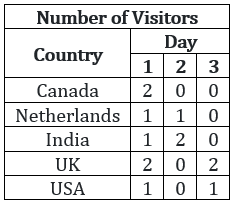
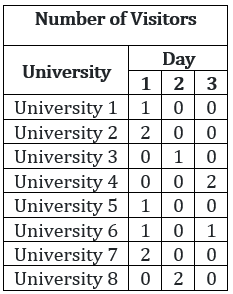
University 1 can belong to ______.
Passage / Data
Answer the following question based on the information given below.
Prof. Singh has been tracking the number of visitors to his homepage. His service provider has provided him with the following data on the country of origin of the visitors and the university they belong to:
To which country does University 5 belong?
Passage / Data
Answer the following question based on the information given below.
Prof. Singh has been tracking the number of visitors to his homepage. His service provider has provided him with the following data on the country of origin of the visitors and the university they belong to:
Visitors from how many universities from UK visited Prof. Singh’s homepage in the three days?
Passage / Data
Answer the following question based on the information given below.
Prof. Singh has been tracking the number of visitors to his homepage. His service provider has provided him with the following data on the country of origin of the visitors and the university they belong to:
Which among the listed countries can possibly host three of the eight listed universities?
Passage / Data
Answer the following question based on the information given below.
A study was conducted to ascertain the relative importance that employees in five different countries assigned to five different traits in their Chief Executive Officers. The traits were compassion (C), decisiveness (D), negotiation skills (N), public visibility (P), and vision (V). The level of dissimilarity between two countries is the maximum difference in the ranks allotted by the two countries to any of the five traits. The following table indicates the rank order of the five traits for each country.
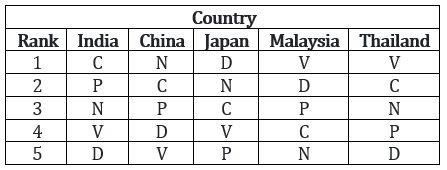
Three of the following four pairs of countries have identical levels of dissimilarity. Which pair is the odd one out?
Passage / Data
Answer the following question based on the information given below.
A study was conducted to ascertain the relative importance that employees in five different countries assigned to five different traits in their Chief Executive Officers. The traits were compassion (C), decisiveness (D), negotiation skills (N), public visibility (P), and vision (V). The level of dissimilarity between two countries is the maximum difference in the ranks allotted by the two countries to any of the five traits. The following table indicates the rank order of the five traits for each country.
Which amongst the following countries is most dissimilar to India?
Passage / Data
Answer the following question based on the information given below.
A study was conducted to ascertain the relative importance that employees in five different countries assigned to five different traits in their Chief Executive Officers. The traits were compassion (C), decisiveness (D), negotiation skills (N), public visibility (P), and vision (V). The level of dissimilarity between two countries is the maximum difference in the ranks allotted by the two countries to any of the five traits. The following table indicates the rank order of the five traits for each country.
Which of the following countries is least dissimilar to India?
Passage / Data
Answer the following question based on the information given below.
A study was conducted to ascertain the relative importance that employees in five different countries assigned to five different traits in their Chief Executive Officers. The traits were compassion (C), decisiveness (D), negotiation skills (N), public visibility (P), and vision (V). The level of dissimilarity between two countries is the maximum difference in the ranks allotted by the two countries to any of the five traits. The following table indicates the rank order of the five traits for each country.
Which of the following pairs of countries are most dissimilar?
Passage / Data
Answer the following question based on the information given below.
The data points in the figure below represent monthly income and expenditure data of individual members of the Ahuja family , the Bose family , the Coomar family , and the Dubey family . For these questions, savings is defined as
Savings = Income − Expenditure
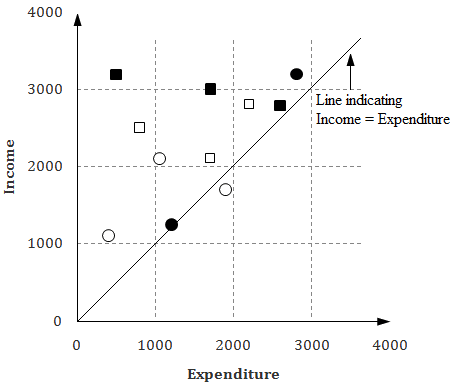
Which family has the highest average expenditure?
Passage / Data
Answer the following question based on the information given below.
The data points in the figure below represent monthly income and expenditure data of individual members of the Ahuja family , the Bose family , the Coomar family , and the Dubey family . For these questions, savings is defined as
Savings = Income − Expenditure
Which family has the lowest average income?
Passage / Data
Answer the following question based on the information given below.
The data points in the figure below represent monthly income and expenditure data of individual members of the Ahuja family , the Bose family , the Coomar family , and the Dubey family . For these questions, savings is defined as
Savings = Income − Expenditure
The highest amount of savings accrues to a member of which family?
Passage / Data
Answer the following question based on the information given below.
The data points in the figure below represent monthly income and expenditure data of individual members of the Ahuja family , the Bose family , the Coomar family , and the Dubey family . For these questions, savings is defined as
Savings = Income − Expenditure
Which family has the lowest average savings?
Passage / Data
Answer the following question based on the information given below.
The Dean’s office recently scanned student results into the central computer system. When their character reading software cannot read something, it leaves the space blank. The scanner output reads as follows:
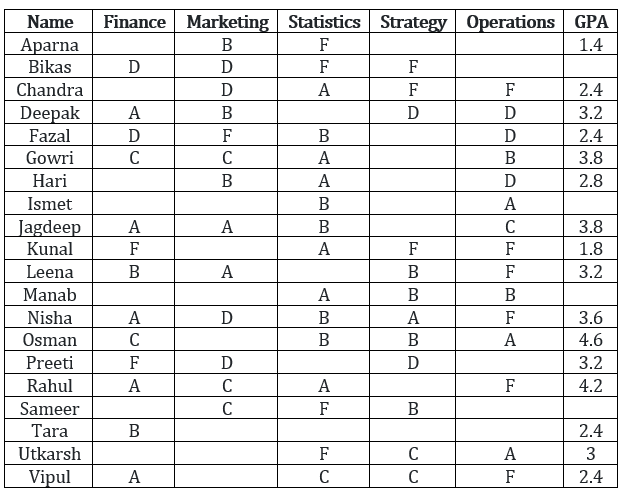
In the grading system, A, B, C, D, and F grades fetch 6, 4, 3, 2, and 0 grade points respectively. The Grade Point Average (GPA) is the arithmetic mean of the grade points obtained in the five subjects.
For example Nisha's GPA is 3.6
Some additional facts are also known about the students’ grades. These are:
a. Vipul obtained the same grade in Marketing as Aparna obtained in Finance and Strategy.
b. Fazal obtained the same grade in Strategy as Utkarsh did in Marketing.
c. Tara received the same grade in exactly three courses.
In Operations, Tara could have received the same grade as ____________.
Passage / Data
Answer the following question based on the information given below.
The Dean’s office recently scanned student results into the central computer system. When their character reading software cannot read something, it leaves the space blank. The scanner output reads as follows:
In the grading system, A, B, C, D, and F grades fetch 6, 4, 3, 2, and 0 grade points respectively. The Grade Point Average (GPA) is the arithmetic mean of the grade points obtained in the five subjects.
For example Nisha's GPA is 3.6
Some additional facts are also known about the students’ grades. These are:
a. Vipul obtained the same grade in Marketing as Aparna obtained in Finance and Strategy.
b. Fazal obtained the same grade in Strategy as Utkarsh did in Marketing.
c. Tara received the same grade in exactly three courses.
What grade did Preeti obtain in Statistics?
Passage / Data
Answer the following question based on the information given below.
The Dean’s office recently scanned student results into the central computer system. When their character reading software cannot read something, it leaves the space blank. The scanner output reads as follows:
In the grading system, A, B, C, D, and F grades fetch 6, 4, 3, 2, and 0 grade points respectively. The Grade Point Average (GPA) is the arithmetic mean of the grade points obtained in the five subjects.
For example Nisha's GPA is 3.6
Some additional facts are also known about the students’ grades. These are:
a. Vipul obtained the same grade in Marketing as Aparna obtained in Finance and Strategy.
b. Fazal obtained the same grade in Strategy as Utkarsh did in Marketing.
c. Tara received the same grade in exactly three courses.
What grade did Utkarsh obtain in Finance?
Passage / Data
Answer the following question based on the information given below.
The Dean’s office recently scanned student results into the central computer system. When their character reading software cannot read something, it leaves the space blank. The scanner output reads as follows:
In the grading system, A, B, C, D, and F grades fetch 6, 4, 3, 2, and 0 grade points respectively. The Grade Point Average (GPA) is the arithmetic mean of the grade points obtained in the five subjects.
For example Nisha's GPA is 3.6
Some additional facts are also known about the students’ grades. These are:
a. Vipul obtained the same grade in Marketing as Aparna obtained in Finance and Strategy.
b. Fazal obtained the same grade in Strategy as Utkarsh did in Marketing.
c. Tara received the same grade in exactly three courses.
In Strategy, Gowri’s grade point was higher than that obtained by _________.
Passage / Data
Answer the following question based on the information given below.
Purana and Naya are two brands of kitchen mixer-grinders available in the local market. Purana is an old brand that was introduced in 1990, while Naya was introduced in 1997. For both these brands, 20% of the mixer-grinders bought in a particular year are disposed off as junk exactly two years later. It is known that 10 Purana mixer-grinders were disposed off in 1997. The following figures show the number of Purana and Naya mixer-grinders in operation from 1995 to 2000, as at the end of the year.
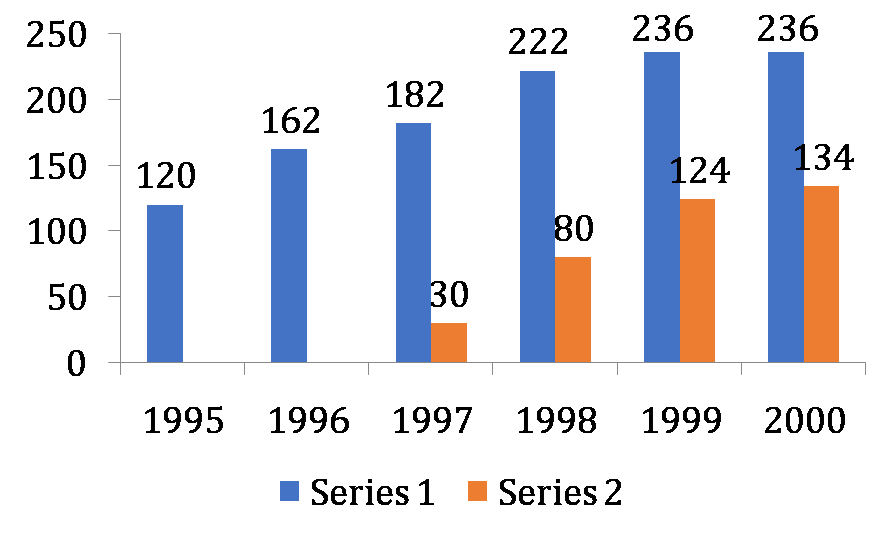
How many Naya mixer-grinders were disposed of by the end of 2000?
Passage / Data
Answer the following question based on the information given below.
Purana and Naya are two brands of kitchen mixer-grinders available in the local market. Purana is an old brand that was introduced in 1990, while Naya was introduced in 1997. For both these brands, 20% of the mixer-grinders bought in a particular year are disposed off as junk exactly two years later. It is known that 10 Purana mixer-grinders were disposed off in 1997. The following figures show the number of Purana and Naya mixer-grinders in operation from 1995 to 2000, as at the end of the year.
How many Naya mixer-grinders were purchased in 1999?
Passage / Data
Answer the following question based on the information given below.
Purana and Naya are two brands of kitchen mixer-grinders available in the local market. Purana is an old brand that was introduced in 1990, while Naya was introduced in 1997. For both these brands, 20% of the mixer-grinders bought in a particular year are disposed off as junk exactly two years later. It is known that 10 Purana mixer-grinders were disposed off in 1997. The following figures show the number of Purana and Naya mixer-grinders in operation from 1995 to 2000, as at the end of the year.
How many Purana mixer-grinders were purchased in 1999?
Passage / Data
Answer the following question based on the information given below.
Purana and Naya are two brands of kitchen mixer-grinders available in the local market. Purana is an old brand that was introduced in 1990, while Naya was introduced in 1997. For both these brands, 20% of the mixer-grinders bought in a particular year are disposed off as junk exactly two years later. It is known that 10 Purana mixer-grinders were disposed off in 1997. The following figures show the number of Purana and Naya mixer-grinders in operation from 1995 to 2000, as at the end of the year.
How many Purana mixer-grinders were disposed of in 2000?
Passage / Data
Answer the following question based on the information given below.
Coach John sat with the score cards of Indian players from the 3 games in a one-day cricket tournament where the same set of players played for India and all the major batsmen got out. John summarized the batting performance through three diagrams, one for each game. In each diagram, the three outer triangles communicate the number of runs scored by the three top scorers from India, where K, R, S, V, and Y represent Kaif, Rahul, Saurav, Virender, and Yuvraj respectively. The middle triangle in each diagram denotes the percentage of total score that was scored by the top three Indian scorers in that game. No two players score the same number of runs in the same game. John also calculated two batting indices for each player based on his scores in the tournament; the R-index of a batsman is the difference between his highest and lowest scores in the 3 games while the M-index is the middle number, if his scores are arranged in a non-increasing order
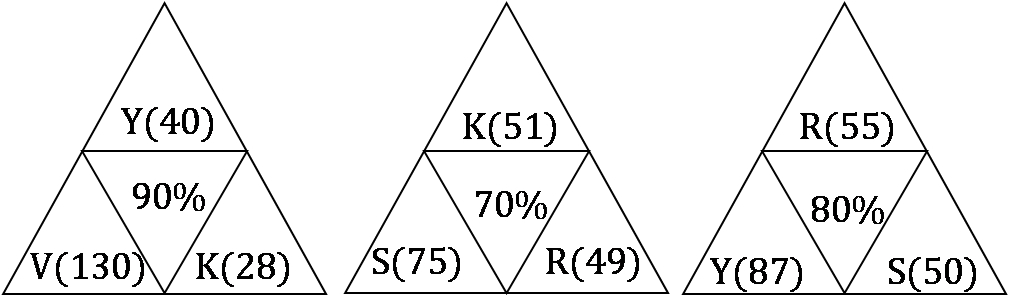
Which of the players had the best M-index from the tournament?
Passage / Data
Answer the following question based on the information given below.
Coach John sat with the score cards of Indian players from the 3 games in a one-day cricket tournament where the same set of players played for India and all the major batsmen got out. John summarized the batting performance through three diagrams, one for each game. In each diagram, the three outer triangles communicate the number of runs scored by the three top scorers from India, where K, R, S, V, and Y represent Kaif, Rahul, Saurav, Virender, and Yuvraj respectively. The middle triangle in each diagram denotes the percentage of total score that was scored by the top three Indian scorers in that game. No two players score the same number of runs in the same game. John also calculated two batting indices for each player based on his scores in the tournament; the R-index of a batsman is the difference between his highest and lowest scores in the 3 games while the M-index is the middle number, if his scores are arranged in a non-increasing order
Among the players mentioned, who can have the lowest R-index from the tournament?
Passage / Data
Answer the following question based on the information given below.
Coach John sat with the score cards of Indian players from the 3 games in a one-day cricket tournament where the same set of players played for India and all the major batsmen got out. John summarized the batting performance through three diagrams, one for each game. In each diagram, the three outer triangles communicate the number of runs scored by the three top scorers from India, where K, R, S, V, and Y represent Kaif, Rahul, Saurav, Virender, and Yuvraj respectively. The middle triangle in each diagram denotes the percentage of total score that was scored by the top three Indian scorers in that game. No two players score the same number of runs in the same game. John also calculated two batting indices for each player based on his scores in the tournament; the R-index of a batsman is the difference between his highest and lowest scores in the 3 games while the M-index is the middle number, if his scores are arranged in a non-increasing order
For how many Indian players is it possible to calculate the exact M-index?
Passage / Data
Answer the following question based on the information given below.
Coach John sat with the score cards of Indian players from the 3 games in a one-day cricket tournament where the same set of players played for India and all the major batsmen got out. John summarized the batting performance through three diagrams, one for each game. In each diagram, the three outer triangles communicate the number of runs scored by the three top scorers from India, where K, R, S, V, and Y represent Kaif, Rahul, Saurav, Virender, and Yuvraj respectively. The middle triangle in each diagram denotes the percentage of total score that was scored by the top three Indian scorers in that game. No two players score the same number of runs in the same game. John also calculated two batting indices for each player based on his scores in the tournament; the R-index of a batsman is the difference between his highest and lowest scores in the 3 games while the M-index is the middle number, if his scores are arranged in a non-increasing order
How many players among those listed definitely scored less than Yuvraj in the tournament?
Passage / Data
Answer the following question based on the information given below.
Twenty one participants from four continents (Africa, Americas, Australasia, and Europe) attended a United Nations conference. Each participant was an expert in one of four fields, labour, health, population studies, and refugee relocation. The following five facts about the participants are given.
a. The number of labour experts in the camp was exactly half the number of experts in each of the three other categories.
b. Africa did not send any labour expert. Otherwise, every continent, including Africa, sent at least one expert for each category.
c. None of the continents sent more than three experts in any category.
d. If there had been one less Australasian expert, then the Americas would have had twice as many experts as each of the other continents.
e. Mike and Alfanso are leading experts of population studies who attended the conference. They are from Australasia.
Which of the following numbers cannot be determined from the information given?
Passage / Data
Answer the following question based on the information given below.
Twenty one participants from four continents (Africa, Americas, Australasia, and Europe) attended a United Nations conference. Each participant was an expert in one of four fields, labour, health, population studies, and refugee relocation. The following five facts about the participants are given.
a. The number of labour experts in the camp was exactly half the number of experts in each of the three other categories.
b. Africa did not send any labour expert. Otherwise, every continent, including Africa, sent at least one expert for each category.
c. None of the continents sent more than three experts in any category.
d. If there had been one less Australasian expert, then the Americas would have had twice as many experts as each of the other continents.
e. Mike and Alfanso are leading experts of population studies who attended the conference. They are from Australasia.
Which of the following combinations is NOT possible?
Passage / Data
Answer the following question based on the information given below.
Twenty one participants from four continents (Africa, Americas, Australasia, and Europe) attended a United Nations conference. Each participant was an expert in one of four fields, labour, health, population studies, and refugee relocation. The following five facts about the participants are given.
a. The number of labour experts in the camp was exactly half the number of experts in each of the three other categories.
b. Africa did not send any labour expert. Otherwise, every continent, including Africa, sent at least one expert for each category.
c. None of the continents sent more than three experts in any category.
d. If there had been one less Australasian expert, then the Americas would have had twice as many experts as each of the other continents.
e. Mike and Alfanso are leading experts of population studies who attended the conference. They are from Australasia.
If Ramos is the lone American expert in population studies, which of the following is NOT true about the numbers of experts in the conference from the four continents?
Passage / Data
Answer the following question based on the information given below.
Twenty one participants from four continents (Africa, Americas, Australasia, and Europe) attended a United Nations conference. Each participant was an expert in one of four fields, labour, health, population studies, and refugee relocation. The following five facts about the participants are given.
a. The number of labour experts in the camp was exactly half the number of experts in each of the three other categories.
b. Africa did not send any labour expert. Otherwise, every continent, including Africa, sent at least one expert for each category.
c. None of the continents sent more than three experts in any category.
d. If there had been one less Australasian expert, then the Americas would have had twice as many experts as each of the other continents.
e. Mike and Alfanso are leading experts of population studies who attended the conference. They are from Australasia.
Alex, an American expert in refugee relocation, was the first keynote speaker in the conference. What can be inferred about the number of American experts in refugee relocation in the conference, excluding Alex?
i. At least one
ii. At most two
Passage / Data
Answer the following question based on the information given below.
The year was 2006. All six teams in Pool A of World Cup hockey, play each other exactly once. Each win earns a team three points, a draw earns one point and a loss earns zero points. The two teams with the highest points qualify for the semi-finals. In case of a tie, the team with the highest goal difference (Goal For – Goals Against) qualifies.
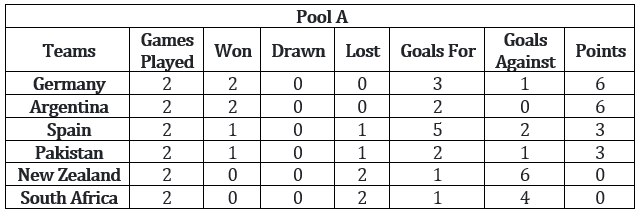
In the opening match, Spain lost to Germany. After the second round (after each team played two matches), the pool table looked as shown below.
In the third round, Spain played Pakistan, Argentina played Germany, and New Zealand played South Africa. All the third round matches were drawn. The following are some results from the fourth and fifth round matches.
a. Spain won both the fourth and fifth round matches.
b. Both Argentina and Germany won their fifth round matches by 3 goals to 0.
c. Pakistan won both the fourth and fifth round matches by 1 goal to 0.
Which one of the following statements is true about matches played in the first two rounds?
Passage / Data
Answer the following question based on the information given below.
The year was 2006. All six teams in Pool A of World Cup hockey, play each other exactly once. Each win earns a team three points, a draw earns one point and a loss earns zero points. The two teams with the highest points qualify for the semi-finals. In case of a tie, the team with the highest goal difference (Goal For – Goals Against) qualifies.
In the opening match, Spain lost to Germany. After the second round (after each team played two matches), the pool table looked as shown below.
In the third round, Spain played Pakistan, Argentina played Germany, and New Zealand played South Africa. All the third round matches were drawn. The following are some results from the fourth and fifth round matches.
a. Spain won both the fourth and fifth round matches.
b. Both Argentina and Germany won their fifth round matches by 3 goals to 0.
c. Pakistan won both the fourth and fifth round matches by 1 goal to 0.
Which one of the following statements is true about matches played in the first two rounds?
Passage / Data
Answer the following question based on the information given below.
The year was 2006. All six teams in Pool A of World Cup hockey, play each other exactly once. Each win earns a team three points, a draw earns one point and a loss earns zero points. The two teams with the highest points qualify for the semi-finals. In case of a tie, the team with the highest goal difference (Goal For – Goals Against) qualifies.
In the opening match, Spain lost to Germany. After the second round (after each team played two matches), the pool table looked as shown below.
In the third round, Spain played Pakistan, Argentina played Germany, and New Zealand played South Africa. All the third round matches were drawn. The following are some results from the fourth and fifth round matches.
a. Spain won both the fourth and fifth round matches.
b. Both Argentina and Germany won their fifth round matches by 3 goals to 0.
c. Pakistan won both the fourth and fifth round matches by 1 goal to 0.
If Pakistan qualified as one of the two teams from Pool A, which was the other team that qualified?
Passage / Data
Answer the following question based on the information given below.
The year was 2006. All six teams in Pool A of World Cup hockey, play each other exactly once. Each win earns a team three points, a draw earns one point and a loss earns zero points. The two teams with the highest points qualify for the semi-finals. In case of a tie, the team with the highest goal difference (Goal For – Goals Against) qualifies.
In the opening match, Spain lost to Germany. After the second round (after each team played two matches), the pool table looked as shown below.
In the third round, Spain played Pakistan, Argentina played Germany, and New Zealand played South Africa. All the third round matches were drawn. The following are some results from the fourth and fifth round matches.
a. Spain won both the fourth and fifth round matches.
b. Both Argentina and Germany won their fifth round matches by 3 goals to 0.
c. Pakistan won both the fourth and fifth round matches by 1 goal to 0.
Which team finished at the top of the pool after five rounds of matches?
A father and his son are waiting at a bus stop in the evening. There is a lamp post behind them. The lamp post, the father and his son stand on the same straight line. The father observes that the shadows of his head and his son's head are incident at the same point on the ground. If the heights of the lamp post, the father and his son are 6 metres, 1.8 metres and 0.9 metres respectively, and the father is standing 2.1 metres away from the post, then how far (in metres) is the son standing from his father?
A milkman mixes 20 litres of water with 80 litres of milk. After selling one-fourth of this mixture, he adds water to replenish the quantity that he has sold. What is the current proportion of water to milk?
Karan and Arjun run a 100 metre race, where Karan beats Arjun by 10 metres. To do a favour to Arjun, Karan starts 10 metres behind the starting line in a second 100 metre race. They both run at their earlier speeds. Which of the following is true in connection with the second race?
N persons stand on the circumference of a circle at distinct points. Each possible pair of persons, not standing next to each other, sings a two-minute song one pair after the other. If the total time taken for singing is 28 minutes, what is N?
If the sum of the first 11 terms of an arithmetic progression equals that of the first 19 terms, then what is the sum of the first 30 terms?
If a man cycles at 10 km/hr, then he arrives at a certain place at 1 p.m. If he cycles at 15 km/hr, he will arrive at the same place at 11 a.m. At what speed must he cycle to get there at noon?
On January 1, 2004 two new societies, S1, and S2, are formed, each with n members. On the first day of each subsequent month, S1 adds b members while S2 multiplies its current number of members by a constant factor r. Both the societies have the same number of members on July 2, 2004. If b = 10.5n, what is the value of r?
If f(x) = x3 – 4x + p, and f(0) and f(1) are of opposite signs, then which of the following is necessarily true?
Suppose n is an integer such that the sum of the digits of n is 2, and 1010 < n < 1011. The number of different values for n is
If then r cannot take any value except _________.
Let
What is the value of y?
Let f(x) = ax2 – b|x|, where a and b are constants. Then at x = 0, f(x) is
Two boats, travelling at 5 and 10 kms per hour, head directly towards each other. They begin at a distance of 20 kms from each other. How far apart are they (in kms) one minute before they collide?
Each family in a locality has at most two adults, and no family has fewer than 3 children. Considering all the families together, there are more adults than boys, more boys than girls, and more girls than families. Then the minimum possible number of families in the locality is:
In Nuts And Bolts factory, one machine produces only nuts at the rate of 100 nuts per minute and needs to be cleaned for 5 minutes after production of every 1000 nuts. Another machine produces only bolts at the rate of 75 bolts per minute and needs to be cleaned for 10 minutes after production of every 1500 bolts. If both the machines start production at the same time, what is the minimum duration required for producing 9000 pairs of nuts and bolts?
A rectangular sheet of paper, when halved by folding it at the mid-point of its longer side, results in a rectangle, whose longer and shorter sides are in the same proportion as the longer and shorter sides of the original rectangle. If the shorter side of the original rectangle is 2, what is the area of the smaller rectangle?
Passage / Data
Answer the following question based on the information given below.
In the adjoining figure, I and II are circles with centres P and Q respectively. The two circles touch each other and have a common tangent that touches them at points R and S respectively. This common tangent meets the line joining P and Q at O. The diameters of I and II are in the ratio 4 : 3. It is also known that the length of PO is 28 cm.
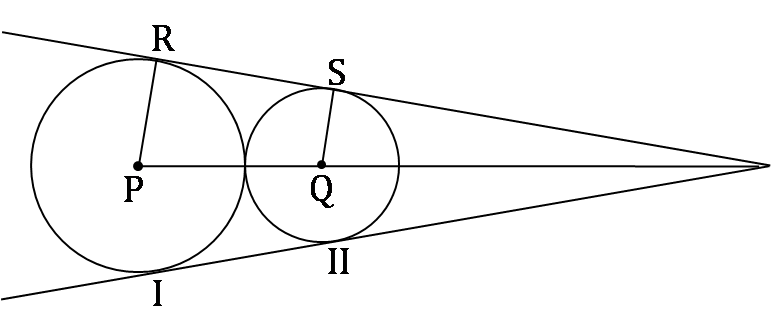
What is the ratio of the length of PQ to that of QO?
Passage / Data
Answer the following question based on the information given below.
In the adjoining figure, I and II are circles with centres P and Q respectively. The two circles touch each other and have a common tangent that touches them at points R and S respectively. This common tangent meets the line joining P and Q at O. The diameters of I and II are in the ratio 4 : 3. It is also known that the length of PO is 28 cm.
What is the radius of the circle II?
Passage / Data
Answer the following question based on the information given below.
In the adjoining figure, I and II are circles with centres P and Q respectively. The two circles touch each other and have a common tangent that touches them at points R and S respectively. This common tangent meets the line joining P and Q at O. The diameters of I and II are in the ratio 4 : 3. It is also known that the length of PO is 28 cm.
The length of SO is ________.
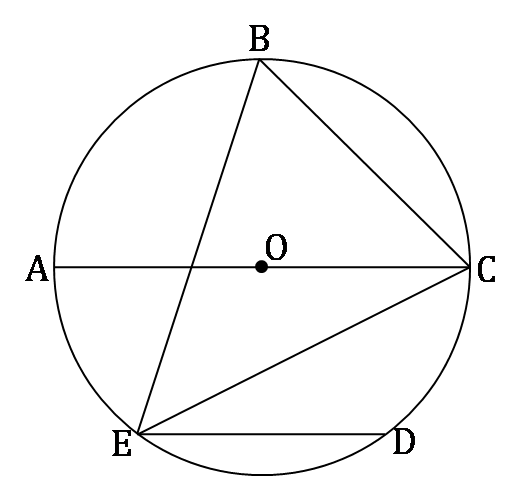
In the adjoining figure, chord ED is parallel to the diameter AC of the circle. If ∠CBE = 65°, then what is the value of ∠DEC?
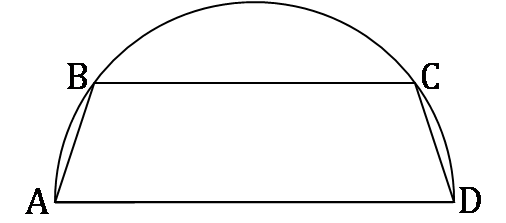
On a semicircle with diameter AD, chord BC is parallel to the diameter. Further, each of the chords AB and CD has length 2, while AD has length 8. What is the length of BC?
Passage / Data
Answer the following question based on the information given below.
f1(x) = x 0 ≤ x ≤ 1
= 1 x ≥ 1
= 0 otherwise
f2(x) = f1(–x) for all x
f3(x) = –f2(x) for all x
f4(x) = f3(–x) for all x
How many of the following products are necessarily zero for every x
f1(x)f2(x), f2(x)f3(x), f2(x)f4(x)?
Passage / Data
Answer the following question based on the information given below.
f1(x) = x 0 ≤ x ≤ 1
= 1 x ≥ 1
= 0 otherwise
f2(x) = f1(–x) for all x
f3(x) = –f2(x) for all x
f4(x) = f3(–x) for all x
Which of the following is necessarily true?
Passage / Data
Answer the following question based on the information given below.
In an examination, there are 100 questions divided into three groups A, B and C such that each group contains at least one question. Each question in group A carries 1 mark, each question in group B carries 2 marks and each question in group C carries 3 marks. It is known that the questions in group A together carry at least 60% of the total marks.
If group B contains 23 questions, then how many questions are there in group C?
Passage / Data
Answer the following question based on the information given below.
In an examination, there are 100 questions divided into three groups A, B and C such that each group contains at least one question. Each question in group A carries 1 mark, each question in group B carries 2 marks and each question in group C carries 3 marks. It is known that the questions in group A together carry at least 60% of the total marks.
If group C contains 8 questions and group B carries at least 20% of the total marks, which of the following best describes the number of questions in group B?
A sprinter starts running on a circular path of radius r metres. Her average speed (in metres/minute) is πr during the first 30 seconds, πr/2 during next one minute, πr/4 during next 2 minutes, πr/8 during next 4 minutes, and so on. What is the ratio of the time taken for the nth round to that for the previous round?
Consider the sequence of numbers a1, a2, a3, ... to infinity where a1 = 81.33 and a2 = –19 and aj = aj–1 – aj–2 for j ≥ 3. What is the sum of the first 6002 terms of this sequence?
The remainder, when (1523 + 2323) is divided by 19, is:
In the adjoining figure, the lines represent one-way roads allowing travel only northwards or only westwards. Along how many distinct routes can a car reach point B from point A?
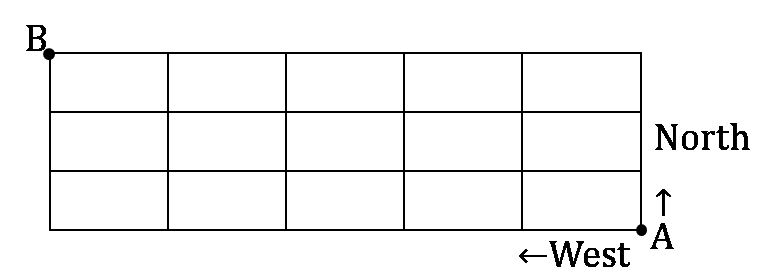
Let C be a circle with centre P0 and AB be a diameter of C. Suppose P1 is the mid-point of the line segment P0B, P2 is the mid-point of the line segment P1B and so on. Let C1, C2, C3, ... be circles with diameters P0P1, P1P2, P2P3 ... respectively. Suppose the circles C1,C2, C3, ... are all shaded. The ratio of the area of the unshaded portion of C to that of the original circle C is:
Let u = (log2 x)2 – 6 log2 x + 12 where x is a real number. Then the equation xu = 256, has
A new flag is to be designed with six vertical stripes using some or all of the colours yellow, green, blue and red. Then, the number of ways this can be done such that no two adjacent stripes have the same colour is:
If the lengths of diagonals DF, AG and CE of the cube shown in the adjoining figure are equal to the three sides of a triangle, then the radius of the circle circumscribing that triangle will be _______.
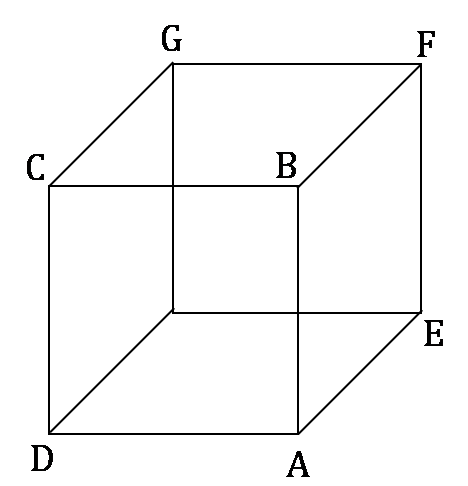
A circle with radius 2 is placed against a right angle. Another smaller circle is also placed as shown in the adjoining figure. What is the radius of the smaller circle?

Each question is followed by two statements, A and B. Answer each question using the following instructions
Choose 1 if the question can be answered by using one of the statements alone but not by using the other statement alone.
Choose 2 if the question can be answered by using either of the statements alone.
Choose 3 if the question can be answered by using both statements together but not by either statement alone.
Choose 4 if the question cannot be answered on the basis of the two statements.
Ravi spent less than Rs.75 to buy one kilogram each of potato, onion, and gourd. Which one of the three vegetables bought was the costliest?
A. 2 kg potato and 1 kg gourd cost less than 1 kg potato and 2 kg gourd.
B. 1 kg potato and 2 kg onion together cost the same as 1 kg onion and 2 kg gourd.
Each question is followed by two statements, A and B. Answer each question using the following instructions
Choose 1 if the question can be answered by using one of the statements alone but not by using the other statement alone.
Choose 2 if the question can be answered by using either of the statements alone.
Choose 3 if the question can be answered by using both statements together but not by either statement alone.
Choose 4 if the question cannot be answered on the basis of the two statements.
Tarak is standing 2 steps to the left of a red mark and 3 steps to the right of a blue mark. He tosses a coin. If it comes up heads, he moves one step to the right; otherwise he moves one step to the left. He keeps doing this until he reaches one of the two marks, and then he stops. At which mark does he stop?
A. He stops after 21 coin tosses.
B. He obtains three more tails than heads.
Each question is followed by two statements, A and B. Answer each question using the following instructions
Choose 1 if the question can be answered by using one of the statements alone but not by using the other statement alone.
Choose 2 if the question can be answered by using either of the statements alone.
Choose 3 if the question can be answered by using both statements together but not by either statement alone.
Choose 4 if the question cannot be answered on the basis of the two statements.
Nandini paid for an article using currency notes of denominations Re. l, Rs. 2, Rs. 5, and Rs. 10 using at least one note of each denomination. The total number of five and ten rupee notes used was one more than the total number of one and two rupee notes used. What was the price of the article?
A. Nandini used a total of 13 currency notes.
B. The price of the article was a multiple of Rs. 10.
Each question is followed by two statements, A and B. Answer each question using the following instructions
Choose 1 if the question can be answered by using one of the statements alone but not by using the other statement alone.
Choose 2 if the question can be answered by using either of the statements alone.
Choose 3 if the question can be answered by using both statements together but not by either statement alone.
Choose 4 if the question cannot be answered on the basis of the two statements.
Four candidates for an award obtain distinct scores in a test. Each of the four casts a vote to choose the winner of the award. The candidate who gets the largest number of votes wins the award. In case of a tie in the voting process, the candidate with the highest score wins the award. Who wins the award?
A. The candidates with the top three scores each vote for the top scorer amongst the other three.
B. The candidate with the lowest score votes for the player with the second highest score.
Each question is followed by two statements, A and B. Answer each question using the following instructions
Choose 1 if the question can be answered by using one of the statements alone but not by using the other statement alone.
Choose 2 if the question can be answered by using either of the statements alone.
Choose 3 if the question can be answered by using both statements together but not by either statement alone.
Choose 4 if the question cannot be answered on the basis of the two statements.
In a class of 30 students, Rashmi secured the third rank among the girls, while her brother Kumar studying in the same class secured the sixth rank in the whole class. Between the two, who had a better overall rank?
A. Kumar was among the top 25% of the boys merit list in the class in which 60% were boys.
B. There were three boys among the top five rank holders, and three girls among the top ten rank holders.
Each question is followed by two statements, A and B. Answer each question using the following instructions
Choose 1 if the question can be answered by using one of the statements alone but not by using the other statement alone.
Choose 2 if the question can be answered by using either of the statements alone.
Choose 3 if the question can be answered by using both statements together but not by either statement alone.
Choose 4 if the question cannot be answered on the basis of the two statements.
Zakib spends 30% of his income on his children’s education, 20% on recreation and 10% on healthcare. The corresponding percentages for Supriyo are 40%, 25%, and 13%. Who spends more on children’s education?
A. Zakib spends more on recreation than Supriyo.
B. Supriyo spends more on healthcare than Zakib.
More CAT previous-year papers
View allPractise CAT the smart way
Get adaptive practice, spaced revision, and full mock tests — free to start.
Create your free account